
Hello and welcome to the June issue of the Peripatetic Historian. I’m your host, Richard J. Goodrich, and once again we gather around the loom to weave history, travel, and photography into a coat of many colors.
This Month:
Battling Electronic Distractions
Ready? Let’s dive in:
(And now, for something completely different).
Donald Knuth is a Stanford University professor emeritus in Mathematics and Computer Science. Among an astonishing list of professional accomplishments—including the multi-volume Art of Fine Computer Programming and the creation of TeX, a computer typesetting system—Knuth offers a heroic, countercultural example of how to unplug from the distractions of our technological age.
In 1990, three years before retiring from Stanford, Knuth announced his shocking decision to stop using email. “Email is a wonderful thing,” he wrote on his website, “for people whose role in life is to be on top of things. But not for me; my role is to be on the bottom of things. What I do takes long hours of studying and uninterruptible concentration.”
Knuth, at age 88, continues to work on his magnum opus. As he writes: “My full-time writing schedule means that I have to be pretty much a hermit. The only way to gain enough efficiency to complete The Art of Computer Programming is to operate in batch mode, concentrating intensively and uninterruptedly on one subject at a time.” His approach has paid off: five of the projected seven volumes are now in print.
Knuth, in his isolation, has maintained some contact with the outside world. Anyone who wants to reach out can mail a letter to the postal box he retains at the Stanford Computer Science department. A secretary screens incoming communiques; any missive deemed worth his attention is forwarded to Knuth. Every six months, he glances through the pile and (possibly—no promises) responds to letters that interest him.
Donald Knuth is my hero. He has escaped a world swamped with electronic distraction. He has rejected Silicon Valley’s core premise: humans need to be plugged into an electronic network every conscious moment (and should probably have an app logging data when they’re asleep). Knuth chose silence and concentration, rejecting the electric dogs that continuously bark for our attention.
He is my hero, but I am not prepared to dispense with email yet. The inbox is a necessary evil for a struggling author, the primary communication channel to readers, agents, editors, and publishers. Until I land a seven-book publishing deal, I cannot afford to delete my addresses.
On the other hand, I have spent the first half of this year thinking about how I might carve out more intense and uninterrupted time for the work I want to do. Electronic distractions, as Knuth recognized more than thirty years ago, are antithetical to deep thought. Rare is the individual who is able to focus in the presence of a phone’s notification buzz or ring tone.
Half-measures do not serve: I have disabled notifications on my phone to cure it of its misguided belief that I welcome its interruptions. Unfortunately, I have failed to cure my little monkey brain of wanting to check my email multiple times each day. The phone can’t interrupt me, but it doesn’t need to. I interrupt myself, wondering what jewels may be accumulating in my inbox.
The problem appears insoluble. Short of Knuth’s complete burnt bridges approach, how is one to create a distraction-free space?
It is difficult to create a distraction free zone; it is even harder to maintain it.

For decades I have risen at 4:00 a.m. and devoted morning’s early hours to my writing. This has always been a sacred, precious time for me. I am at the pinnacle of productivity before the sun rises. Working at this hour is a deeply-rooted practice, and—I know many reader may find this unfathomable—the most pleasant hours of every day. Unfortunately, as 2025 drew to a close, I realized that the creeping tendrils of distraction have infiltrated my precious mornings. My eagerness to jump out of bed and work had ceded ground to the desire to jump out of bed and check emails, news sites, and YouTube videos.
My walled writing garden was no longer inviolate. The three hour period before the household begins to stir was besieged. Moreover, the battle initiated in the writer’s oasis was being fought everywhere else as well: electronic distraction consumed the hours, an invading army that gained ground with every passing year.
Reading, an activity that once anchored my life, was consigned to shorter periods. Moreover, the study of books lost its savor. The easily distracted me, trained on the constant variety and restless motion of the internet, lost patience with long books. Which was more pleasurable: a lengthy tome that demanded my brain’s concentration or a mindless scroll of YouTube videos? With increasing regularity, I chose the latter.
It was clear that I needed to reboot my life and follow Donald Knuth back to that pre-internet Eden. But how?

Behavioral change is so difficult that it borders on the edge of impossibility. I could just go cold turkey—turn off all my electronics and eliminate distraction’s access to my brain. Unfortunately the frontal attack rarely prevails. As I cast about for a different path—and I do appreciate the irony embedded in this portion of my tale—I stumbled across a YouTube video about the Japanese practice of Kaizen.
Kaizen rejects the frozen poultry approach to behavioral change; it offers an incremental strategy. In a sentence, it is the practice of becoming 1% better each day. Rather than a head-on confrontation with a habit (”I will never smoke another cigarette again”) Kaizen creeps up on behavioral change with tiny, less-threatening steps (”I will smoke one less cigarette this week than I did last week”). Like water wearing a channel in stone, change occurs so slowly that the brain fails to notice it—until the new practice takes root and begins to produce fruit.
So, on an applied level, how did this work? Donald Knuth offered one clue with his claim that he worked at peak efficiency when he “operate(d) in batch mode, concentrating intensively and uninterruptedly on one subject at a time.” At the beginning of my quest, electronic distractions spread like ivy across my entire day. At any given moment I might open my web browser or email program and be off to distraction land.
Perhaps the secret was too ‘batch’ these electronic distractions.
My first step was to create a daily schedule that divided my week into 112 blocks (7 days multiplied by the 16 hours I am awake). In the initial state, each of these blocks, representing one hour of my day, stood empty. When a box is empty, I give myself permission to succumb to electronic distractions. I can surf the web, read emails, watch YouTube—whatever my Dopamine-seeking brain fancies. The 112 empty boxes represented my brain’s schedule at the start of the experiment: freedom to indulge in electronic distraction at any point during the day.
The first week of the experiment, I blacked-out the Monday, 4:00 a.m. box. A black box symbolizes no electronic distractions: phone on airplane mode, web browser closed. It was the tiniest thing: Monday morning, one hour, from 4:00 to 5:00. When the clock hit 5:00, up came the emails and my ‘normal’ life resumed. But for that first hour of every Monday, I was Donald Knuth: focused and uninterrupted.
It felt like the smallest of sacrifices, a short blip of computer discipline that passed with barely a ripple. Then came week two. I filled in a second block on my chart, the 4:00 to 5:00 slot for Tuesday mornings. Now there were two undistracted hours on my weekly schedule.
This is the genius of Kaizen: it is insidious in the best of ways. It tricks the brain by saying “I’m not giving up my electronic distractions—I’m simply clearing a very small block of undistracted time each week.” Distraction is deferred, not eliminated. Even I can wait an hour to check my email after I climb out of bed. The brain makes a small, as opposed to a heroic, sacrifice. No teeth-gritting bursts of willpower—just the quiet chuckle of a rising tide, the slow growth of an undistracted life.
As this month’s newsletter goes to press, I am 37 weeks into the experiment. To put it another way, there are 37 black boxes on my schedule—nearly a full 40 hour work week of undistracted time. I began this practice as a compulsive email checker; the pressure to open an inbox peaks at the start of my day—surely valuable, important messages have arrived in the night. In the past I found it virtually impossible to dive into that email box with my morning coffee.
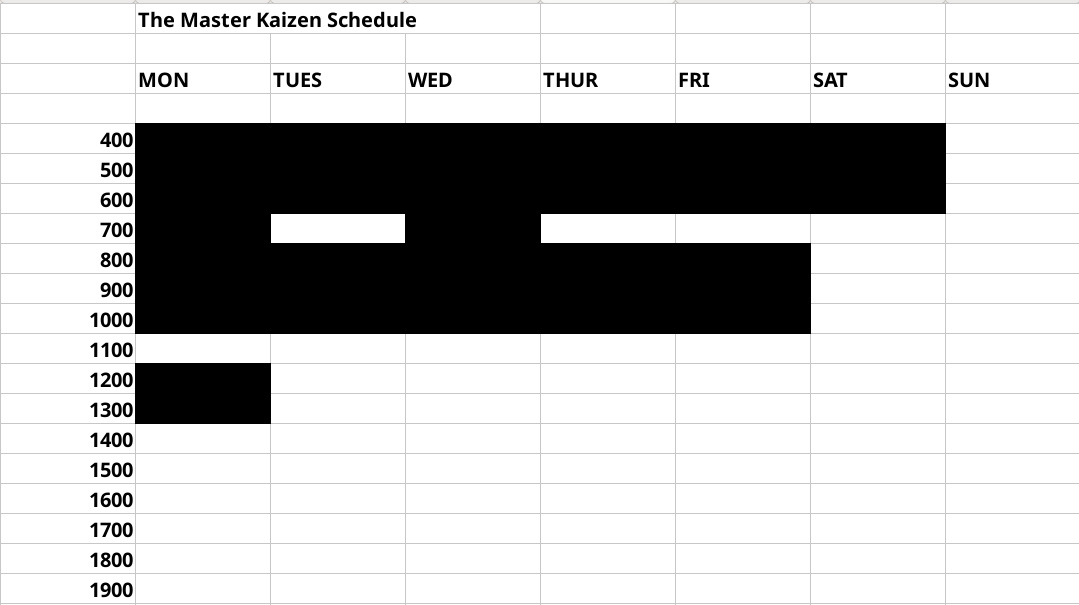
But look at my Kaizen schedule today: my Mondays begin with a solid column of blacked-out boxes, a seven hour, undistracted period that stretches to 11:00 a.m. The first seven hours of each week pass before I check my email, surf the web, or see what cool videos have floated up on YouTube.
It is an amazing feeling. Not only am I blocking out distraction-free time that can be devoted to more valuable projects and interests, but I’m discovering that as my brain detoxes, the electronic distractions lose traction. My mind is slowly realizing that the emperor has no clothes: ninety-seven percent of the slop that washes up on the internet’s beach was never worth my attention. The challenge, as my blocks of distraction-free time grow, will be to find new activities (or recover old interests) that deserve the time I have rescued from the electronic abductors.

So that’s what I’ve been up to this spring. As Taiwan’s days grow hotter and more humid, I’m tucked beneath an air conditioner, filling in my Japanese boxes and reclaiming my mind.
It is now clear what I can accomplish with more distraction-free time: longer newsletters. Sorry for the length of this month’s offering. I know I’m a bit off brand as they say in the marketing world, but if you’re here for the history and photos, I’ll be returning to my normally scheduled topics next month.
Until then, be safe, be sensible.
Know someone interested in history, travel, or photography? Hit the share button and send them a copy of the Peripatetic Historian.
Thoughts? Comments? I have a button for that as well:
No posts
Comments
Nothing yet. Say the first thing.
Sign in to join the conversation.