
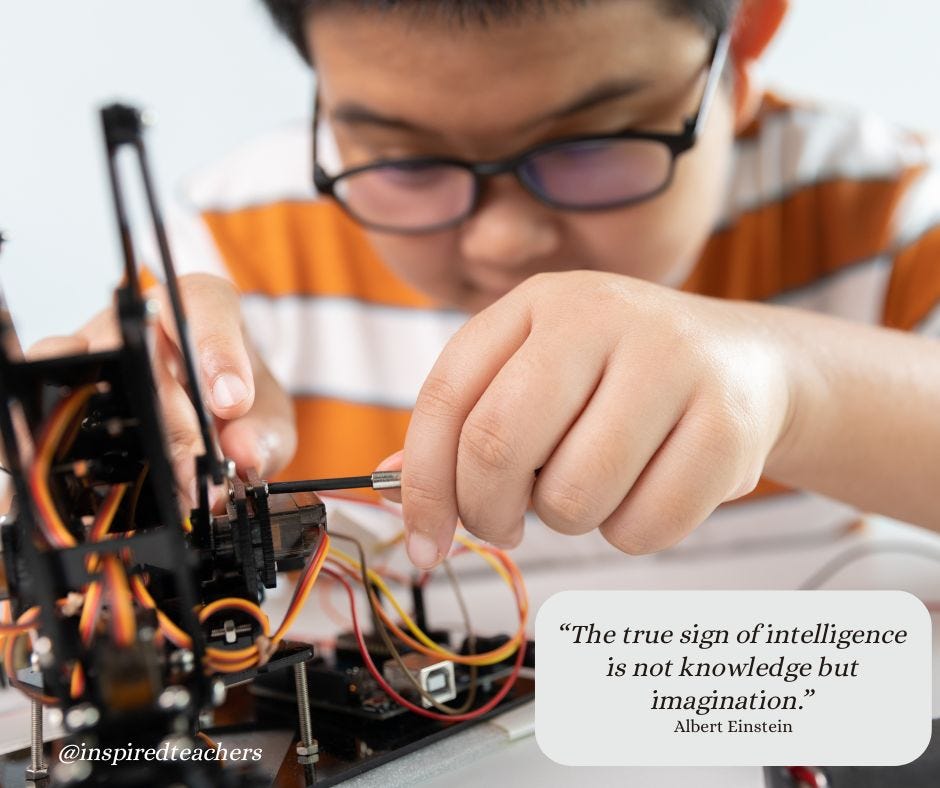
In the next five years, what will young adults need to know as they enter the workforce? What will they need to know to succeed in life?
For the most part, we can hardly imagine. This A.I. generation is taking us into a future that we cannot grasp.
Yet, there are a few things we do know.
We know they will need to know how to think critically and solve problems. They will need strong skills in communicating positively with others - listening, reading, speaking, and yes, writing.
We know three things about fostering creativity:
First, we think about the world within all the ways we experience it. We think visually, we think in sound, we think in movement. We move to learn. For if it is not in the hand, then it cannot be found in the head or the heart.
We need learning environments that value open-ended creative materials over predetermined crafts.
We need learning environments that foster play activities outside in the natural world.
We need learning environments that encourage conversations and problem solving through play.
Secondly, creativity is dynamic. If you look at the interactions of a human brain, intelligence is wonderfully interactive where multiple regions are interacting together. Most certainly we know, creativity comes about through the interaction of different disciplinary ways of seeing things.
We need learning environments that follow the interests of children through research and investigations.
We need learning environments that teach across the curriculum by connecting topical investigations through reading, writing, drawing, experimenting, measuring and calculations. We investigate a topic of interest using all disciplines.
Lastly, creativity requires a bit of revising and revisiting. That obsessive nature to overcome failure, to try again and again. It is a tenacity to invent, to improve.
We need learning environments where adults model curiosity and inquiry. Adults expressing out loud they need to know more, learn more. Adults modeling learning along side the children.
We need learning environments where there is no failure - just a chance to learn from experience.
We need learning environments that slow down. Stop this urgency to move on to the next thing. Give children the time they need to learn how to investigate, to learn how to build and rebuild better whatever that might be.
What we do know is that creativity, ingenuity, inventiveness will serve them well. Whatever the future holds, to be successful in life we must nurture these skills in ourselves and strive to foster them in others.
Comments
Nothing yet. Say the first thing.
Sign in to join the conversation.