

Students and staff at universities are to play a pivotal role in accelerating the development of novel military technology in the short and medium term to facilitate rapid and autonomous decision making in war, according to a strategy paper released by the Albanese Government. It includes designing prototypes and testing.
The 2026 Defence Innovation, Science and Technology Strategy is Defence’s “blueprint to accelerate the delivery of innovative solutions and novel technologies into the hands of the warfighter.”
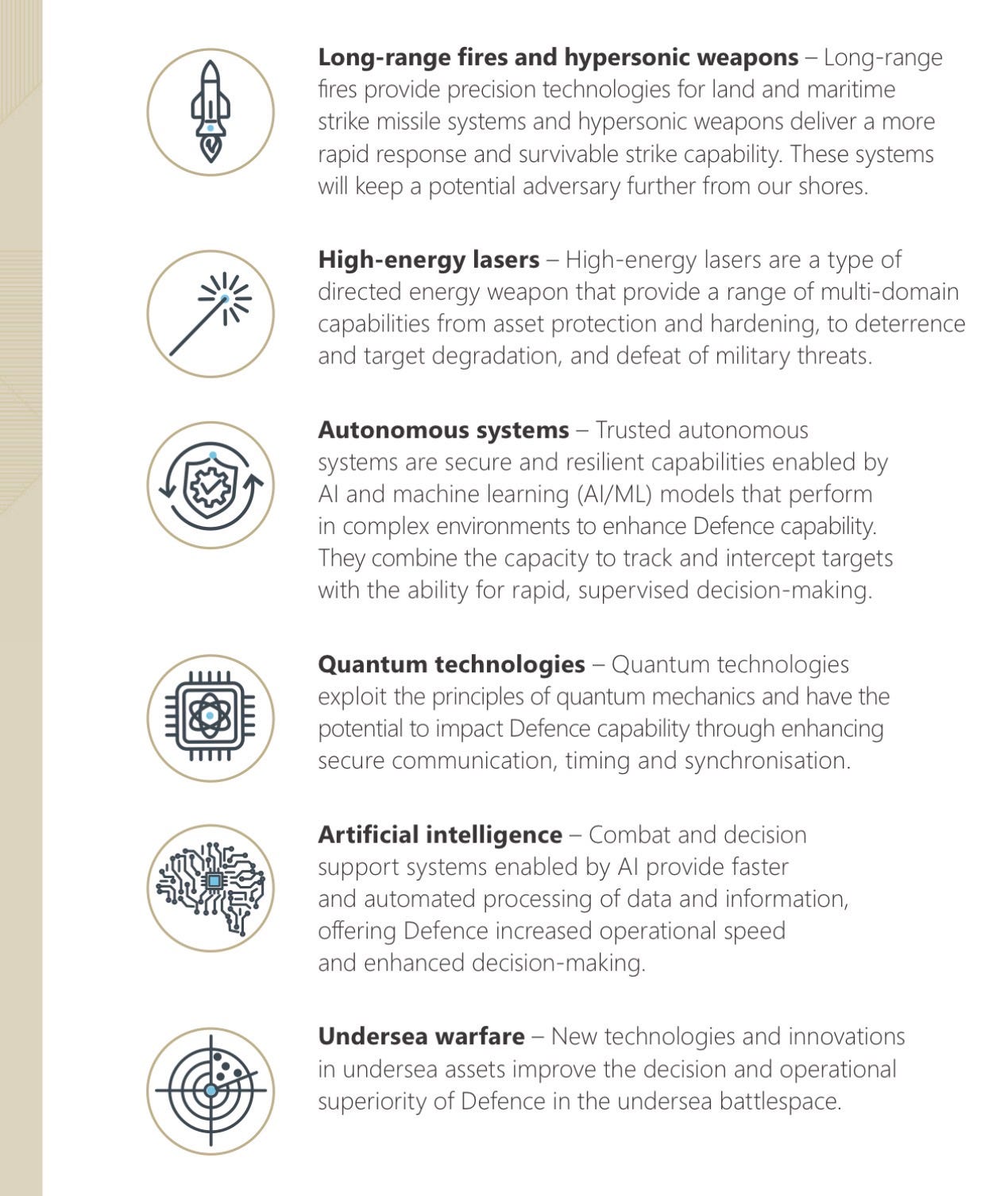
It focuses effort across six “strategic” priorities, providing a “practical roadmap for delivery”:
1. Long-range fires and hypersonic weapons
2. High-energy lasers
3. Autonomous systems
4. Quantum technologies
5. Artificial intelligence
6. Undersea warfare.
These strategic priorities overlap with contents of AUKUS pillar II and areas covered by the proposed integration of the US and Israeli military industrial bases.
Deeper into the document, the Albanese Government sets out roles and responsibilities, including for universities:
Universities and research programs
Conduct research of emerging, disruptive and asymmetric technologies, methods, systems, and concepts.
Provide advice to Defence on emerging and future technologies.
Work with Defence and/or industry to design and develop prototypes.
Conduct experimentation in collaboration with Defence and/or industry.
Contribute expertise and knowledge to the Ecosystem
The strategy speaks to the need for acceleration, meaning
The process through which capabilities and technologies can be delivered into the hands of the warfighter faster, through having a shared understanding of Defence’s problems with military personnel, committing to deliver minimum viable capability in the short to medium-term and having a partnered approach with defence industry where risk is genuinely shared.
It will achieve this acceleration through its “mature research network”, which seems to refer to universities.
It includes this special case study from the University of Queensland with genocide linked weapons company Lockheed Martin:
Connecting innovating SMEs with Defence and industry Primes
A University of Queensland spin-off is overcoming a primary barrier to edge capability by using controlled acoustic waves to perform complex computational tasks.
Working with ASCA and Lockheed Martin Australia’s Advanced Systems & Technologies, Cortisonic is a small-to-medium enterprise (SME) developing a new class of ultra-low power computing processes to address the energy, cooling, and communication constraints of operating at the edge.
These factors challenge modern Defence systems’ heavy reliance on sensors, autonomous platforms, and real-time data processing across complex environments.
Current technology in conventional transistor-based computing architectures is nearing the extent of its performance and efficiency, which limits its suitability to meet Defence requirements for persistent sensing, rapid decision-making, and autonomous operation.
Cortisonic is enabling ultra-low power operation for edge-based applications such as signal processing, classification, and sensor fusion building on foundational research from the University of Queensland.
The Red Lines Package soon to enter parliament via the cross bench will impose a genocide risk reporting obligation on every university, including reporting across their value chains, positive duties on senior managers and introducing the risk of legal action where they fail to disclose, fail to exercise due diligence, or are complicit in genocide. The Bill will need support from Labor or the LNP to pass under current numbers. Staff and students should ask their universities to endorse the Red Lines Package.
Earlier this year, it was surprising to see the Prime Minister finally refer to the presumption of innocence while talking about alleged war criminal Ben Roberts Smith, after forgetting that legal principle in relation to the Australian mothers and children returned from detention in Syrian camps.
Now there is another person to benefit from the legal principle: Labor MP Luke Gosling who is also Special Envoy for Defence.
Richard Marles, current acting PM is asked if Luke Gosling should be stood aside whilst this matter is before the court?
He says
Look, Luke Gosling has obviously denied these allegations. There is a presumption of innocence in this country and from there this is now a matter which is going to play out in the courts.
Children as young as ten years old are being locked up in the NT, where Gosling is a MP.
No posts
Comments
Nothing yet. Say the first thing.
Sign in to join the conversation.