
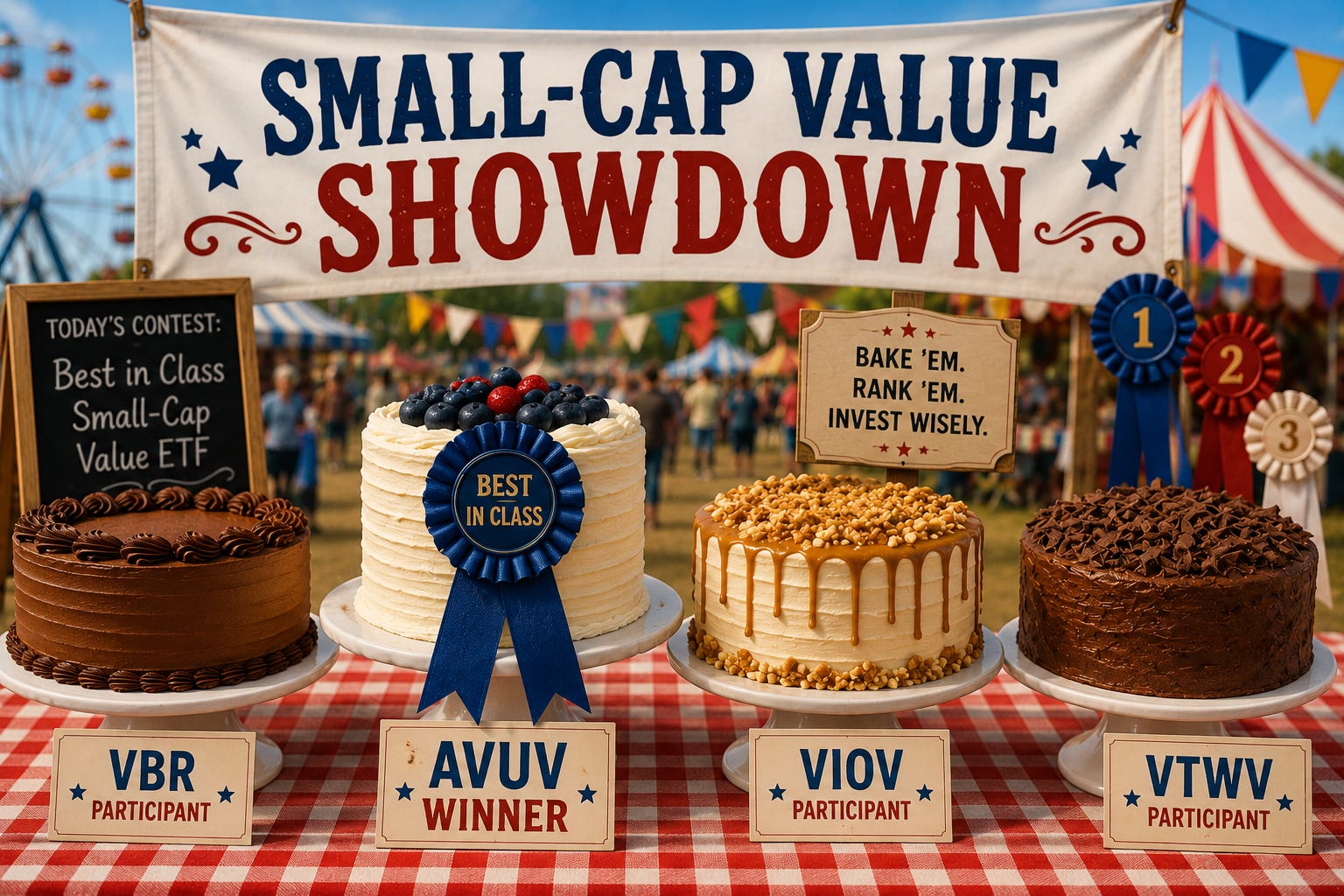
In the previous installment, I examined US large-cap growth and settled on IWY as my preferred choice. Pair a strong large-cap growth fund like that with a strong small-cap value fund like I’ll test here and you have a simple way to cover the US market. Add an international equity ETF (I suggest AVNV), and you’ve essentially built an entire global equity allocation.
I’ve written before that DIY investors spend far too much time obsessing over ETF selection.
The important questions are:
Which asset classes belong in your portfolio?
How much of each should you own?
The choice between two reasonably good ETFs is usually a distant third.
Still, if you’re going to own small-cap value, you might as well choose a good implementation. Think of this series as a shortcut: I’ll do the ETF nerding-out so you don’t have to.
To decide on the best small-cap value ETF, I’m looking for four things:
Diversification – I want low correlation with other equity assets, especially large-cap growth.
Low Cost – Looking for reasonable expense ratios and sufficient assets under management.
Factor Exposure – Want genuine exposure to both the size and value premiums, and in essence, I’m trying to find the small-cap-iest, valuey-est ETF on the market.
Performance – not because past returns predict future returns, but because they can reveal how effectively a fund captures the factors it’s targeting. Especially interested in seeing how ETFs perform in particularly good and bad years.
Rather than examining all 21 small-cap value ETFs listed by VettaFi, I’ve narrowed the field to four major contenders:
The giant of the category. Tracks the CRSP US Small Cap Value Index and serves as a useful baseline. As we’ll see, however, it may not be as “small-cap” or as “value” as its name suggests.
Tracks the S&P SmallCap 600 Value Index. This was my original small-cap value holding and remains a popular choice. It’s essentially interchangeable with funds like IJS and SLYV.
The darling of factor investors. Unlike the others, AVUV isn’t a pure index fund, but it uses a rules-based approach that keeps costs competitive while allowing greater flexibility.
Tracks the Russell 2000 Value Index and offers the broadest exposure of the group.
Small-cap value earns its place in a Risk Parity portfolio not just because of its expected return, but because it behaves differently than large-cap growth stocks.
Using Testfolio’s correlation tool, I compared each fund against VTI, QQQ, and IWY.
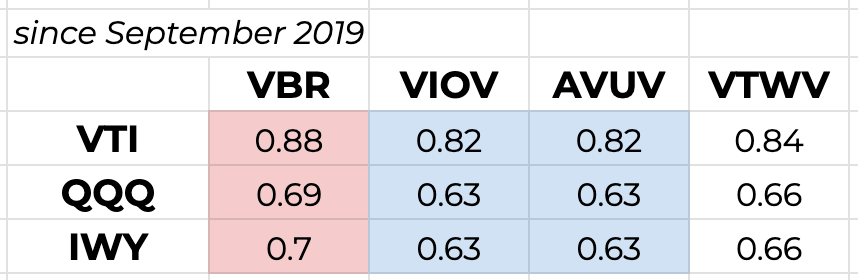
Result: VIOV and AVUV were the least correlated to the other equity funds. VBR was clearly the most correlated and therefore the weakest diversifier.
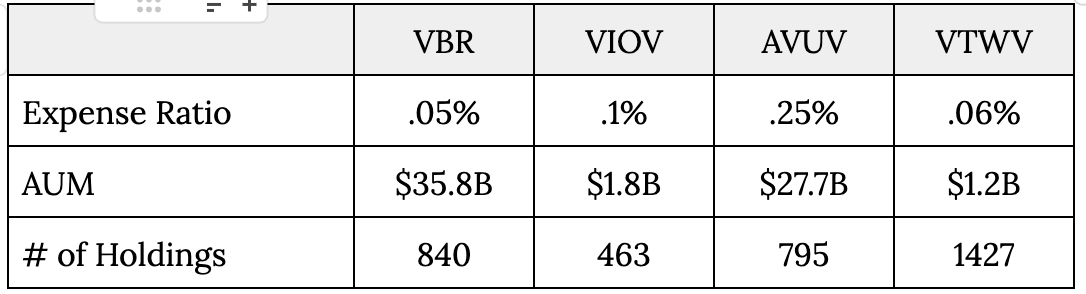
VBR and VTVW definitely low cost, but honestly, this round is mostly a draw. AVUV costs more, but 0.25% is still quite reasonable for the exposure you’re getting.
This is the real test.
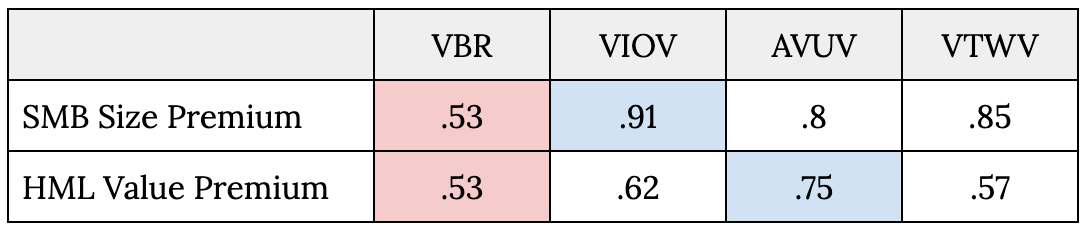
Using the factor regression tool on Portfolio Visualizer, we can measure:
SMB (Small Minus Big): exposure to smaller companies
HML (High Minus Low): exposure to value stocks
The results are fascinating:
VIOV is the most aggressively tilted toward small companies.
AVUV is the most aggressively tilted toward value stocks.
VBR finishes last in both categories.
Again, you have VIOV and AVUV as better than the other two, and then deciding between them is a little tricky. If forced to choose, I’d go with AVUV since the academic support of the value factor is a bit stronger than for size (see the legendarily titled “Size Matters, If You Control Your Junk”).
Normally, performance isn’t my primary selection criterion. It may sound counter-intuitive, but what I’m looking for is the premium to show up when the conditions are right. For a while now, the market has been tilted away from value, so when trying to find a value fund, we should actually expect low relative performance.
Still, it’s worth checking whether the funds actually behaved the way we’d hope, especially in short stretches where things are great for small-cap value and for times when they are particularly bad. Looking at relative performance, and how much upside they capture during those times, is a good signal.
Since AVUV’s inception in 2019:
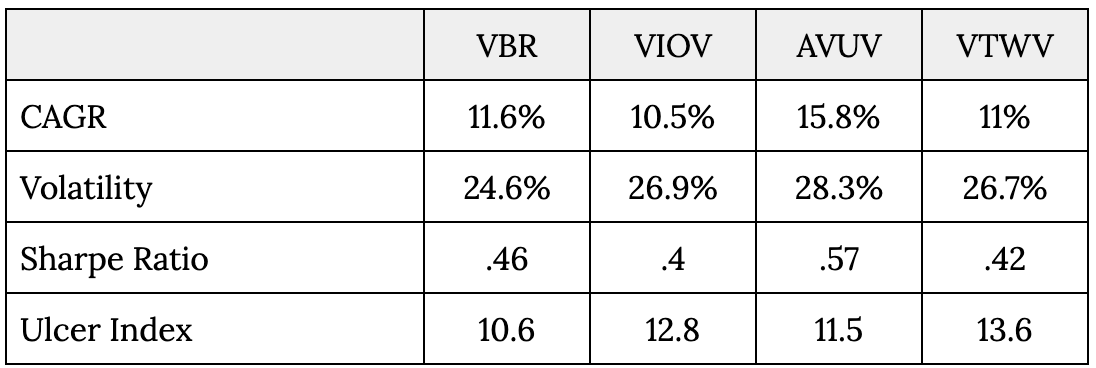
AVUV wasn’t just the winner—it won comfortably.
I then looked at the five funds for the tumultuous year of 2022, when all seemed to be stuck in the mud, if not the woodchipper. I’ll spare the table, but the take home there is the same: AVUV was the best of the bunch by being less terrible than its peers.
Meanwhile, 2021 was a great year for equities, and small-cap value did even better than the market as a whole. Once again, AVUV led its pack, with 42% returns compared to 30% for VIOV and the others in the 20s.
Let’s eliminate the easy ones first.
VBR is out. It has the highest correlation with other equity funds, the weakest factor exposure, and only middling performance. Its low fee isn’t enough to compensate.
VTWV is also out. There’s nothing particularly wrong with it, but it never really wins any category.
That leaves VIOV and AVUV.
VIOV is an excellent pure implementation of the small-cap value factor. It has slightly lower fees and the strongest size exposure.
But AVUV consistently comes out ahead everywhere else:
Better value exposure
Similar diversification benefits
Stronger historical performance
Better upside
So, no surprise, AVUV is The Risk Parity Best in Class ETF for small-cap value.
To wrap up, it’s worth asking why AVUV gets the edge.
Earlier, I mentioned that AVUV isn’t a pure index fund. While low-cost index investing remains one of the foundations of my investing philosophy, AVUV is a good reminder that investing principles can be taken too far. Sometimes a little flexibility can improve on a rigid index approach.
Unlike traditional index funds, AVUV targets small-cap value stocks differently:
It uses profitability screens to avoid many of the “value traps” that can sneak into purely rules-based indexes—companies that look cheap for good reason.
It also uses a broader definition of value than simple price-to-book or price-to-earnings ratios, allowing it to target deeper value opportunities.
AVUV’s managers also have some discretion in trading, helping them avoid telegraphing moves and potentially reducing trading costs.
All these add up to a smarter and more effective way to invest.
Thanks for reading Risk Parity Chronicles! This post is public so feel free to share it.
No posts
Comments
Nothing yet. Say the first thing.
Sign in to join the conversation.