
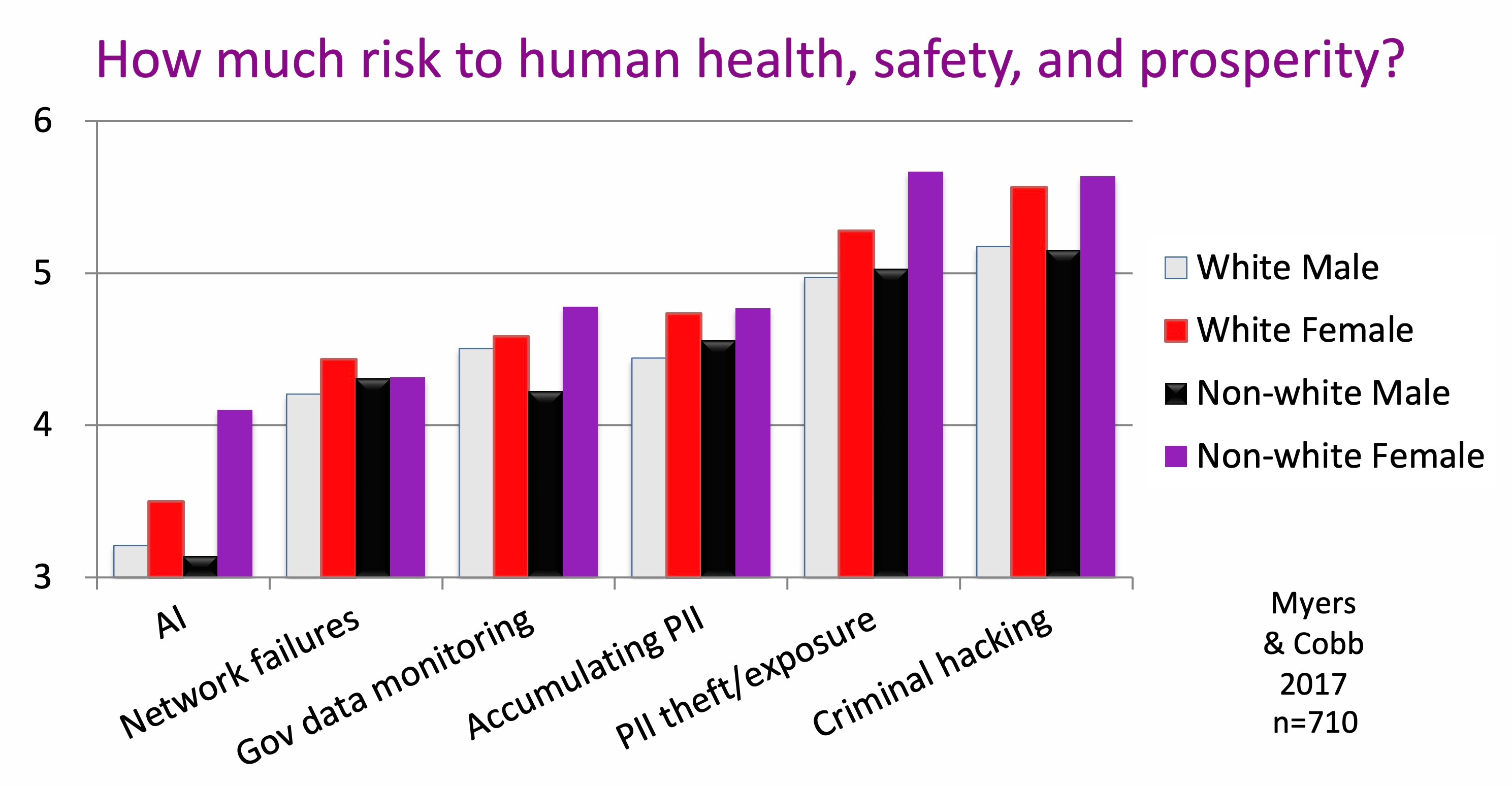
How much risk do you believe artificial intelligence (AI) poses to human health, safety, or prosperity? I am a white male who spent four decades working with information technology and I think AI poses a lot of risk to human health, safety, and prosperity. However, on aggregate, white males see less risk from AI than I do.
But guess who sees more risk from AI than white males? Females, particularly females who are not white; they consistently score technology-related risks higher than White Males, Non-White Males, and White Females. And in my professional opinion, as someone trained in security and risk management, Non-White Females have it right.
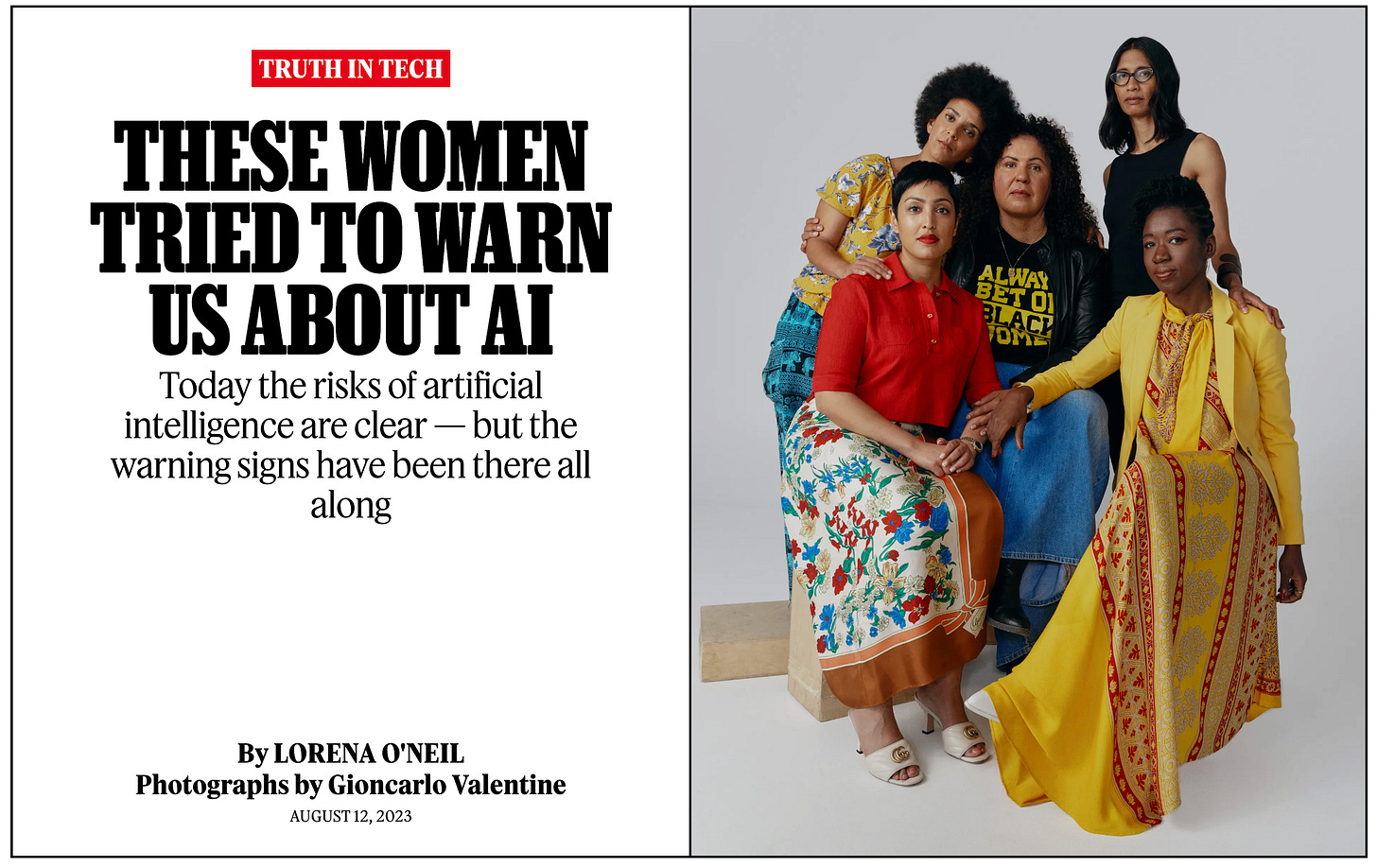
I will refer to this as the Non-White Female Effect: NWFE. In my opinion, the NWFE has an important role to play whenever technology-related risk is being assessed. Fortunately, in recent years we see have seen that this is finally starting to happen, as evidenced by this 2023 article in Rolling Stone:
I say “finally” because NWFE has been a thing for a long time. It was measured and document in the 1990s by risk perception research. If you look at this chart from the landmark 1994 study on gender, race and perception of environmental health risks by Flynn, Slovic, and Mertz, you can see the triangular data points of the NWF responses are on the right-hand, higher risk side for pretty much every risk factor assessed:
 down to commercial air travel (lower risk). The line representing white male risk perception is starkly distant from the others, suggesting that on aggregate, white males see less risk than the other groups. The survey was performed by researchers Flynn, Slovic, and Mertz, and published in 1994 in a paper titled "Gender, race, and perception of environmental health risks."")
(Just to be clear, I’m not wild about the male-female-white-non terminology, but it was used extensively in the prior research on which my own risk perception work — described in a moment — is based. And as I will explain, there’s something to be gained by using the term NWFE to describe this reproducible observation that people who identify as female and non-white rate a range of risks higher than the rest of the population.)
I came across the above chart about 20 years after it was created. I was doing research for my MSc in security and risk management at the University of Leicester School of Criminology. One of my goals at the time was to understand why so many makers and users of software ignored experts who warned of the risks involved, most notably criminal abuse of software vulnerabilities. I found a big part of the answer on the left-hand side of that chart: the tendency of white males, on aggregate, to see far less risk than any other demographic.
I will come back to that finding after showing you another chart, one that specifically addresses the main premise of this article: non-white females see a lot of risk in AI. The following graph showing results from a survey conducted in 2017 by myself and my friend and former colleague, Lysa Myers when we worked at the cybersecurity firm ESET:
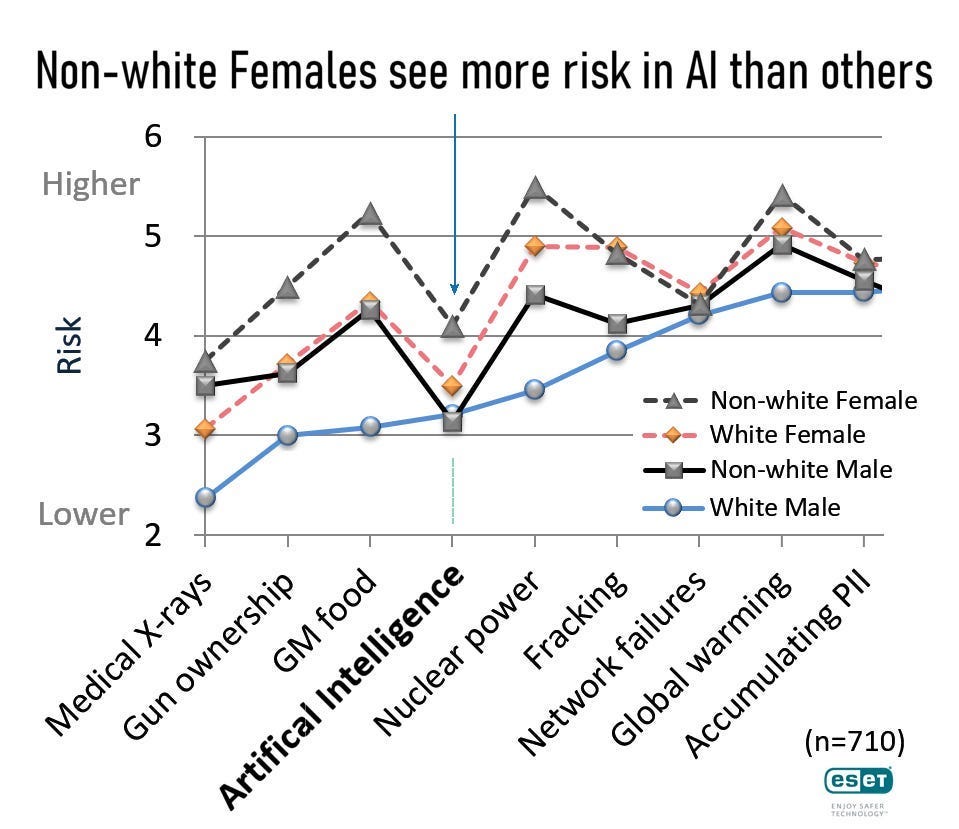
This is a graph showing how survey respondents rated various risk on a seven-point Likert scale, from “1 = No risk at all” to “7 = Very high risk”. All the questions were phrased thus: “How much risk do you believe X poses to human health, safety, or prosperity?” Where X was some sort of technology (not Elon Musk’s social media platform formerly known as Twitter). For more background on this survey see this article.
As you can see, our survey included some items from the 1994 study, like nuclear power, plus some digital risks. To the best of my knowledge and googling, ours was the first, and remains the only, survey in this field that has includes digital risks. However, I would love to know if there have been others. Indeed, I will donate $100 to your favourite charity if you can find a similar survey performed in 2023 or later, using the same four demographic categories, that doesn’t mirror this finding: females as a whole see more risk in AI than males, and non-white females see the more risk than any other demographic.
Of course, when researchers first saw the results of that 1994 study by Flynn, Slovic, and Mertz, they did not focus on the Non-White Female data points. They focused on the gulf between the White Male data points and all the others, quickly coining the phrase White Male Effect (WME) and exploring its causes. For example:
“Risks tend to be judged lower by men than by women and by white people than by people of colour. Prior research by Flynn, Slovic and Mertz found that these race and gender differences in risk perception in the United States were primarily due to 30% of the white male population who judge risks to be extremely low.” — Gender, race, and perceived risk: the ‘white male’ effect, by Melissa L. Finucane, Paul Slovic, C.K. Mertz, James Flynn & Theresa A. Satterfield.
A detailed discussion about why 30% of white males judge risks to be extremely low is beyond the scope of this article, but there are some good answers in a 2007 paper by Dan M. Kahan, the Elizabeth K. Dollard Professor of Law at Yale Law School, and several other researchers (Culture and Identity-Protective Cognition: Explaining the White Male Effect in Risk Perception).
There is also a quick review of WME and cultural theory of risk perception in this article which also introduces the work that Lysa Myers and I did on risk perception in 2017 (with invaluable input and advice from Professor Kahan who helped us design our survey instrument.)
To date, much more research has been done on WME than NWFE. One obvious reason for this: the sad but true reality that white males run the world and the richest of them frequently make decisions that put us all at risk. This is particularly true when it comes to technology.
Consider just a few of the consequences of decisions made by while males who think they know better than the rest of us. If, like me, you are reading this in a city, you’re probably breathing air polluted by cars, trucks, and planes, everything from vehicle emissions to tyre and brake dust. Plastics have are also been impacting you, unless you have been taking serious precautions to avoid them.
Furthermore, unless you are somehow reading this without using a digital device, your physical and mental health are currently at risk from being online, the virtual equivalent of living in a high crime neighborhood. You don’t need to be a woke left-wing feminist to see that all of those harms flow from technologies dominated by white males.
Here are some of the conclusions I have reached based on the above-mentioned research into technology risk perception:
In general, women rate risks from technology higher than men do, and in my assessment they are correct to do so.
Low levels of risk perception in white males as a whole is due to a minority who drastically underestimate risk. This is dangerous for humanity because most technology is controlled/owned by members of this minority.
Non-white women tend to rate risks from technology higher than white women and all men, and in my assessment they are correct to do so.
Many white males like me think the amount of risk in technology is far higher than has been acknowledged by high profile technology developers and advocates (e.g. Zuckerberg, Gates, Bezos, Musk, Thiel, Altman, Ellison, Kurzweil, Nadella, and Huang).
Everyone who is developing or evaluating technology needs to keep asking themselves: “what could possibly go wrong?” because WCPGW often does.
If you’re not asking women about WCPGW, especially non-white women, you may well be under-estimating the risk of things going wrong.
Non-white female risk perception is not flawed due to a lack of knowledge about technology, nor by an inability to understand technology.
Non-white female risk perception is rooted in empathy for people who might be harmed by technology as it has traditionally been developed and deployed.
In short, humanity has already suffered greatly due to centuries of unmitigated technology harms; our planet is choking on them, people’s minds and bodies and social welfare are suffering from them. Despite this, white male dominated AI technology is being foisted on the world, rapidly and at scale. Now is the time to insist that world leaders heed those experts who have been warning us for years about the harms this technology could bring. Hopefully, the Non-White Female Effect can counter the White Male Effect in time to save us all.
Further reading on the role of non-white women in AI:
Black Women in AI paving the way for a better world, Caroline Lair, LinkedIn, 2020
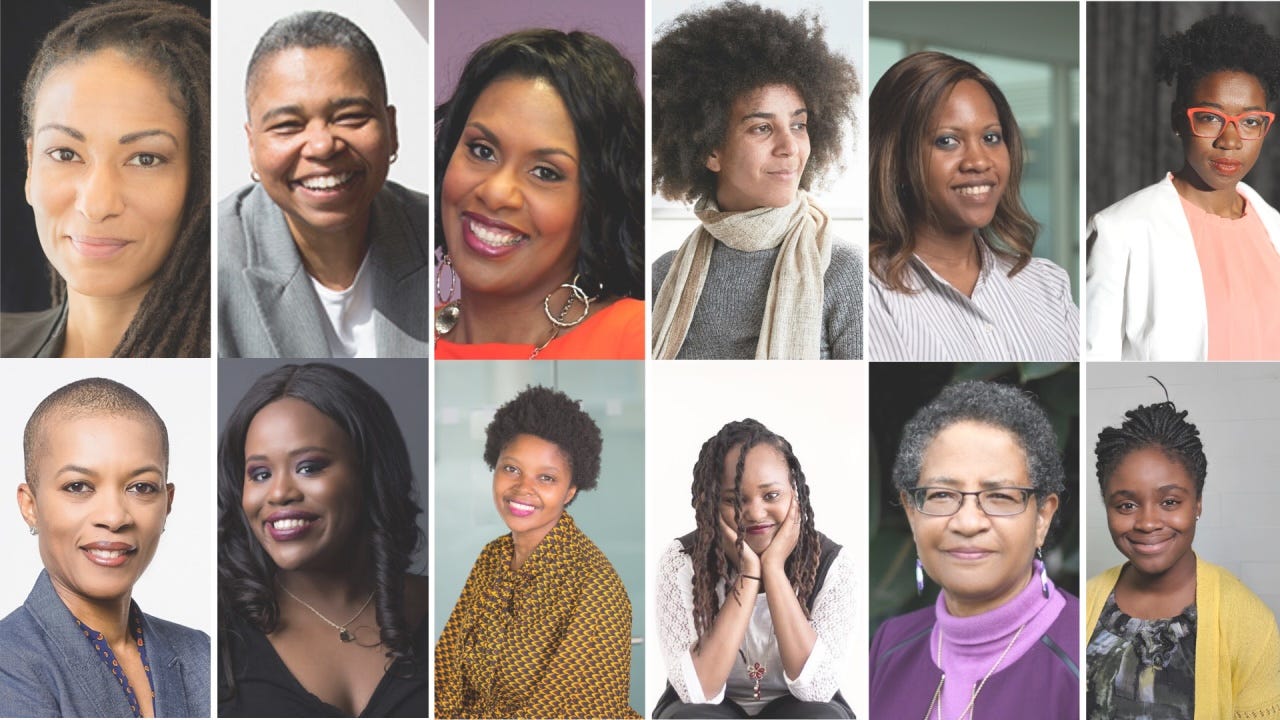
International Women’s Day: Celebrating the Black women tackling bias in AI, Charlene Prempeh, Ada Lovelace Institute, 2020
Examples of recent work on AI risk that I found insightful:
“AI will kill everyone” is not an argument. It’s a worldview, by Sigal Samuel, Vox, 2025
Two Types of AI Existential Risk: Decisive and Accumulative, by Atoosa Kasirzadeh, Philosophical Studies, 2025
The TESCREAL bundle: Eugenics and the promise of utopia through artificial general intelligence, by Timnit Gebru and Émile P. Torres, First Monday, 2024
No posts
Comments
Nothing yet. Say the first thing.
Sign in to join the conversation.