
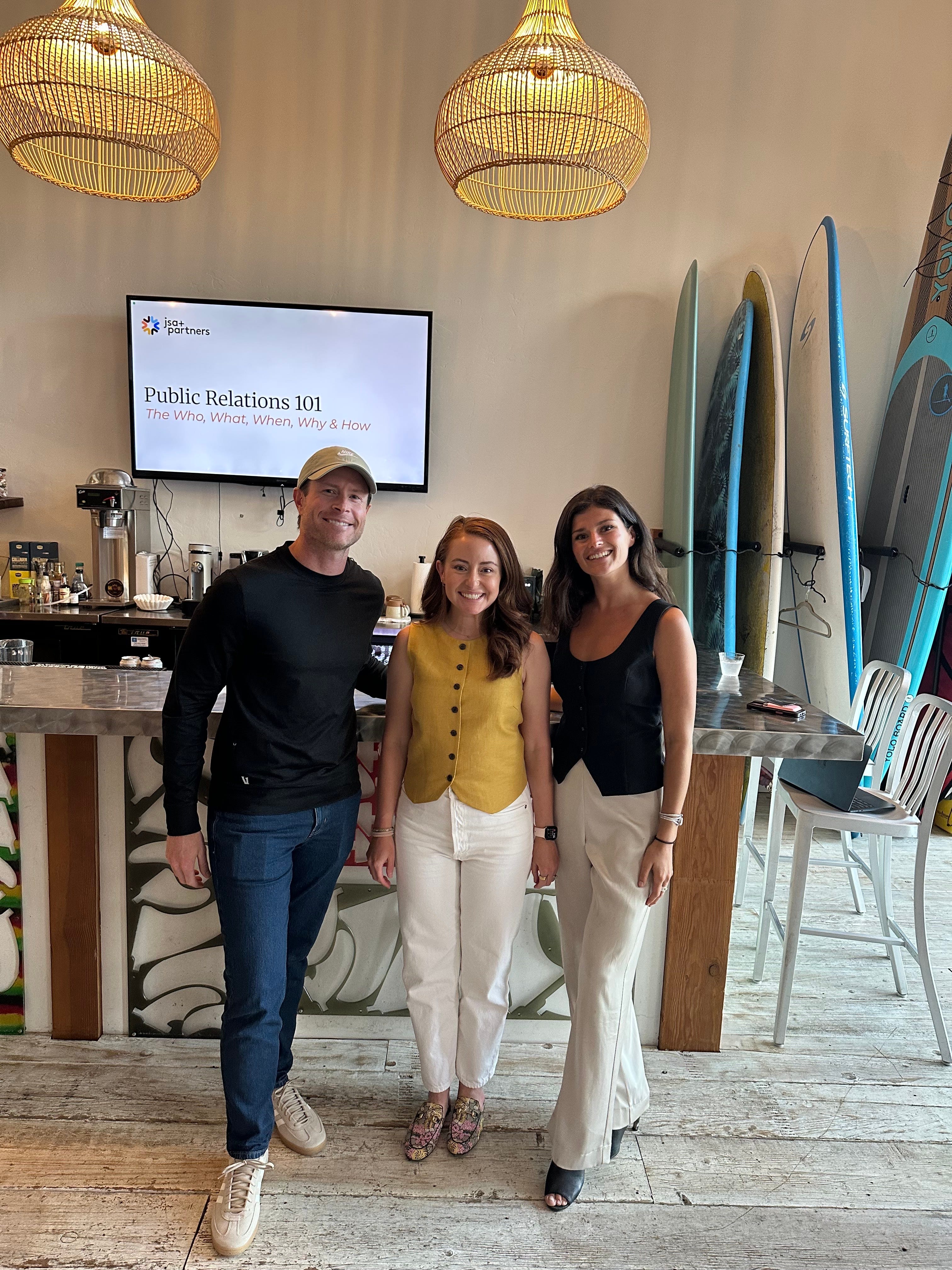
This week, Rising Tide Partners & JSA+Partners hosted a conversation at the Leucadia Club on a topic most founders know they need, but often misunderstand: PR.
The format was simple: bring together three sides of the same table.
Cassie Lawrence of JSA+Partners, a PR pro who has worked both inside startups and with startups.
Noelle Harff, a tech and biotech reporter covering San Diego for the Union-Tribune.
And Nolan Giblin from Natilus, a San Diego aircraft company building next-generation blended-wing-body aircraft.
The goal was not to teach founders how to “get press.”
It was to demystify what PR actually is.
And maybe more importantly, what it is not.
PR is not controlling what a journalist writes.
PR is not guaranteed sales.
PR is not a switch you flip when you want attention.
And PR is definitely not sending a vague AI-written pitch to every reporter you can find.
At its best, PR is the bridge between a company and the public. It is how a company earns awareness, credibility, trust, and context over time.
That word “earns” matters.
The most useful reminder of the night came from Noelle: for something to be news, something actually has to happen.
A funding round closed.
A real customer signed.
A product launched.
A trial started.
A local company is hiring, expanding, manufacturing, or meaningfully impacting San Diego.
“Look how cool we are” is not news.
But “here is what changed, why it matters, and who it impacts” might be.
For founders, that distinction is everything.
Nolan gave a great example from Natilus. Their aircraft is technically complex, visually striking, and hard to explain in a cold email. So instead of just pitching an abstract story, they brought the reporter into the hangar.
Show, don’t tell.
Let the product, the team, the materials, the testing, and the ambition become real.
That local story became one of Noelle’s strongest-performing pieces.
Not because it was hype.
Because it had substance.
That was one of the biggest lessons of the night: great PR does not manufacture credibility. It reveals it.
Cassie also walked through the broader communications stack: earned, owned, and paid media.
Earned is the story someone else writes.
Owned is what you publish yourself: your blog, LinkedIn, newsletter, website, or founder voice.
Paid is advertising.
The mistake founders make is treating those as separate worlds. In reality, they need to reinforce the same message.
If your press pitch says one thing, your CEO’s LinkedIn says another, and your website says something else entirely, the market gets confused.
Clarity compounds.
Confusion compounds too.
The other practical takeaway: relationships matter, but not in a transactional way.
A reporter is not a vending machine for coverage.
The better move, especially for early-stage founders, is to build context before you need the story. Share expertise. Offer a useful point of view. Help a reporter understand the market, the customer pain, or the technical shift happening behind the scenes.
Then, when real news happens, you are not just another cold pitch in a crowded inbox.
You are a trusted source.
That is especially true in San Diego, where so many companies are building in complex categories: biotech, defense, aerospace, robotics, diagnostics, energy, AI infrastructure.
The products are not always easy to explain.
The markets are not always obvious.
The “why now” is not always simple.
That means founders have an extra responsibility to translate complexity into a story humans can understand.
Not dumb it down.
Make it legible.
The best founders do this well. They can explain the deep technical work, but they can also explain why anyone should care.
That is the real communications challenge.
Not “How do we get TechCrunch?”
But:
What has actually happened?
Why does it matter?
Who does it matter to?
Why is this team credible?
Why now?
And why here?
For Rising Tide Partners, this is exactly why we host these rooms.
Founders do not just need capital.
They need customers, talent, advisors, investors, media, and trusted operators around them.
They need connective tissue.
And sometimes the most valuable thing we can do is put the right people in the same room and let the real learning happen.
PR is not magic.
It is not spin.
It is not hype.
Done well, it is trust-building at scale.
And for startups trying to earn the right to matter, that trust can become one of the most valuable assets they build.
No posts
Comments
Nothing yet. Say the first thing.
Sign in to join the conversation.