
This past week, someone was attacked outside a Jewish synagogue in New York City. I had already been reading about Jewish settlement in the colonies this past month when another headline came across my newsfeed. Keep this in the back of your mind because we’ll circle back at the end of this piece.
You know how I have a lot to say about colonial America? I find it doubly ironic that two branches of Calvinism, an ocean apart, carried the same “New Israel” self-image and landed on the same intolerance. Dutch Calvinists, during their own revolt against Spain a century earlier, had already cast themselves as God’s chosen people, escaping Babylon for a promised deliverance.
That same Reformed tradition shaped Peter Stuyvesant, who brought it to New Amsterdam. Meanwhile, in Massachusetts Bay (not to be confused with the Pilgrims of Plymouth), the Puritans preached their own version even louder, building their entire colonial mission around the idea that they were a new Israel, a city upon a hill. Same theological root. Same “most least tolerant” fruit, even if I tripped over the phrase deliberately, on both sides of the Atlantic.
Historians consider 1654 the beginning of the first wave of Jewish immigration to America. This is a mere 34 years after the Pilgrims came to Plymouth/Patuxet and 24 years after the Puritans . colonized Massachusetts Bay and Salem.
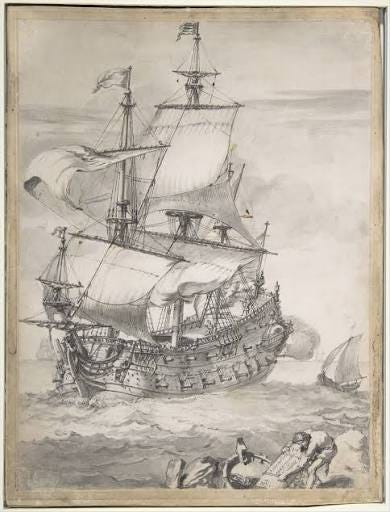
The very first group of Jews immigrated to America from Brazil, which had been under the control of the Dutch since 1630.
A reasonable next question would be: why were there Jewish people in Brazil in the 1600s? If you graduated from a high school in the United States, unless you had a teacher that went way beyond the standards, you probably didn’t learn anything about this. So, you didn’t forget this. It simply wasn’t taught, and it’s something you don’t know. Had I not been spending long hours reading dusty books and wondering if I’m the only person googling colonial settlements, I wouldn’t know either.
So, here we are on my back porch on a Saturday evening after a glass of some pinot noir I picked up at Trader Joe’s.
The Dutch had two big business ventures: the East India Company and the West India Company. The East India Company did really well in the spice trade in Asia.
To help improve their profit margins, they looked to the west for new business opportunities. Brazil was known for its sugar. Like salt, sugar was something people really wanted once they had a taste of it. So, the Dutch went after the most profitable sugar-producing region that the Portuguese already controlled. It was a violent corporate takeover, and when they won in the 1630s, they established New Holland.
Well, Portuguese is the language of Brazil today. So, that’s a clue that the Dutch didn’t win the final battle. After guerilla-style fighting from the late 1640s to the mid-1650s, the Portuguese had won and gave Dutch subjects three months, until April 26, 1654 to leave. Among those Dutch subjects were 23 Sephardic Jews, who fled to New Amsterdam (what is now New York).
It wasn’t like they boarded a cruise ship and opted for drink packages. After leaving Recife, Brazil, their ship was captured by Spanish pirates. What are the chances? I don’t know and math is not my strong suit. The pirates wanted to surrender the Jews, who, of course, were poor, to the Inquisition. That’s also happening at this time. This is definitely a period of history that I would not Outlander back to.
In a wonderful plot twist, wink from above, or however you choose to look at it, the Jews were rescued by a French privateer, the St. Catherine, which was captained by Jacques de La Motthe. The refugees asked him to take him to the nearest Dutch colony, which was New Amsterdam. They offered to pay him 2,500 guilders, which because they were poor, they didn’t actually have. Nonetheless, he accepted their offer.
When the Jews arrived in New Amsterdam, they hoped they would be warmly received; however, they were met with resistance, thanks to the leadership of one of the cringiest people in the New World, Peter Stuyvesant. He was the first governor of the colony, and he got really upset in 1657 when a Quaker minister wouldn’t take his hat off one day. He had him tied to a wheelbarrow and flogged. A bunch of people got mad and contacted the Dutch West India company, who told Stuyvesant to let him go. That was the Flushing Remonstrance.
Stuyvesant, and other colonial leaders, were lacking in hospitality. Specifically, Stuyvesant believed the Jewish refugees (comprised of men, women and children, mind you) to be a threat and an economic burden. He also called them “enemies of Christ.” He called for the Dutch West India company to deport them, but it was denied, in part, ironically, because some of the company’s Jewish investors used their influence to block it. We still have 1654 letters from colonial authorities to the company directors dated Sept. 22 and Sept. 25, which say “these new territories not be invaded” by people of the “Jewish race.”
While George Washington was accepting of the Jews in 1790, as recorded in his famous letter to the Touro congregation, Stuyvesant and others were antisemitic racist bigots in 1654. History is messy. And contradictory.
In the end, the Jewish community stayed and established Kahal Kadosh Shearith Israel, which means “The Holy Congregation the Remnant of Israel.” It was the first Jewish congregation in the colonies and the only permanent North American Jewish community of the entire 17th century. It took time, but they could eventually buy property, hold private religious services, and trade. Just before the Revolution 400 Jews lived in New York.
One caveat to consider. While this was the first group of Jewish people to settle in the colonies, two other Jewish men lived in New Amsterdam before their arrival, Jacob Barsimon and Solomon Pieterson had come from Holland just one month before them. There is also a record of Asser Levy as being there at the same time.
So, in 1654, 23 Jewish people arrived. Then, Peter Stuyvesant, the director general, a man with a background in the Dutch Reformed church who wanted to deport them, said these people were enemies of Christ who would be a burden. Today, approximately 960,000 Jews live in New York City’s five boroughs. That makes New York City home of the largest Jewish community in the world, surpassing both Tel Aviv and Jerusalem.
Interestingly, if you include the wider metro area and Nassau, Suffolk and Westchester counties, nearly 1.23 million people live in Jewish households, with roughly 1.37 million identifying as Jewish.
They went from a barely tolerated remnant to the largest Jewish city in the world. This is exactly the community, rooted since 1654 and grown to the largest, that someone chose to target.
Antisemitism has measurably increased since the 2023 Hamas attacks and the war that followed. I am concerned as a historian, as a woman who heard Holocaust survivors speak as a child, and as a millennial. You see, organizations are noting that a reversal of historical patterns is here, especially among younger Americans, and millennials in particular are driving this.
I am a millennial, albeit on the elder side of the spectrum. My generation, of all generations, is showing the highest rate of endorsing antisemitic tropes, and it’s happening online, like oil diffusing through the house. It’s not rooted in an institutional ideology or organized, but it is cultivating an environment of antisemitic hate.
Since January 6, 2021, we’ve seen the biggest rise in political violence since the 1960s. Antisemitism is one strand of that. And, on top of all of this, Blue Square Alliance’s tracking has found that people who believe that Jews “have too much influence in the media” has grown 6 percentage points since 2023.
My question for you. If 23 Jewish refugees came to your town because they were fleeing war and persecution, would you help them? Would your church?
This is only the first thread. Newport, Philadelphia, Charleston, Savannah. Nearly every port city has its own version of this story. The Puritans weren’t the only ones preaching “New Jerusalem” while shutting the door on actual Jews. I’m sharing what I’ve been digging up in my Historian’s Notebook on Tuesday - sermons, legal codes, and century-long wait for basic citizenship. Paid subscribers get the full piece. If you’re not one yet this is a good time.
I used AI to help organize the sources and look for further reading recommendations. It was always my least favorite part of writing research papers. All research, analysis, writing, and editorial voice in this piece are my own.
Court Minutes of New Amsterdam (1654), documenting Jacques de la Motthe’s suit against the Jewish refugees for unpaid passage
The Massachusetts General Court’s 1649 expulsion decree against Solomon Franco — referenced in the Jewish Encyclopedia (1906), “Massachusetts”
Massachusetts Body of Liberties (1641), full original text — Online Library of Liberty
George Washington’s 1790 letter to the Hebrew Congregation of Newport — recommend pulling the authenticated text directly from the National Archives’ Founders Online before quoting further
The 1654 arrival and New Amsterdam
Hershkowitz, Leo. “By Chance or Choice: Jews in New Amsterdam, 1654” — American Jewish Archives Journal, 2005. Full PDF: sites.americanjewisharchives.org — this is the strongest scholarly source in the list; worth citing directly if you want an academic anchor.
Singer, Saul Jay. “Jews In New Amsterdam In The 1600s And The Antisemitism Of Peter Stuyvesant,” The Jewish Press, July 2024.
New York History Blog: “Return to the Jewish Arrival to New Amsterdam 1654”
EBSCO Research Starters: “First Jewish Settlers in North America”
Dutch Brazil and the Sephardic diaspora
Algemeiner: “The History of the Jews of Brazil — the Oldest Jewish Community in the Americas”
Algarve History Association: “Portugal’s Fateful Mistake: The Sephardic Diaspora”
Newport, Rhode Island / Touro Synagogue
National Park Service: “Discover Touro Synagogue” lesson plan
Gilder Lehrman Institute: “Exiles by the Streams of Babylon: Newport Jews in the Colonial Era” — strong on the Aaron Lopez citizenship story specifically
Gilder Lehrman Institute: “American Jewish Origins, 1654–1820”
Flushing Remonstrance and Stuyvesant’s record on religious dissent
Historical Society of the New York Courts: “The Flushing Remonstrance, 1657”
Americans United for Separation of Church and State: “Powerful Proclamation: The Flushing Remonstrance”
Solomon Franco and colonial Massachusetts
Wikipedia: “Solomon Franco” — note: cross-reference carefully, as some secondary aggregator sites conflate details
Puritan New Jerusalem theology
Winthrop, John. “A Model of Christian Charity” (1630 sermon, aboard the Arbella)
Danforth, Samuel. “A Brief Recognition of New-England’s Errand into the Wilderness” (1670 election sermon)
On Dutch Calvinist “New Israel” self-conception: Calvinism and National Consciousness: The Dutch Republic as the New Israel, Springer — link.springer.com
Jewish immigration waves overview
My Jewish Learning: “Jewish Immigration to America: Three Waves”
Institute for Curriculum Services: “American Jewry – The Jewish Journey To America”
Modern antisemitism data
American Jewish Committee, State of Antisemitism in America 2025 Report — ajc.org
Blue Square Alliance Against Hate, U.S. Antisemitism Landscape Survey, March 2026 — bluesquarealliance.org
Anti-Defamation League, annual antisemitic incident tracking
New York City Jewish population today
UJA-Federation of New York, Jewish Community Study of New York (2023) — communitystudy.ujafedny.org
New York Jewish Week / Jewish Telegraphic Agency: “Nearly 1 million Jews live in NYC, new study finds”
No posts
Comments
Nothing yet. Say the first thing.
Sign in to join the conversation.