
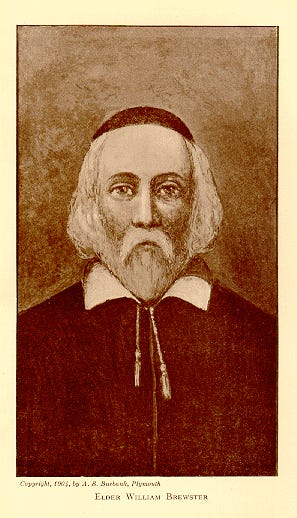
Here’s what I remember learning about the Pilgrims growing up.
They came to Plymouth Rock on the Mayflower in 1620 because they wanted religious freedom. They didn’t know how to grow food in the new land, so Squanto helped them plant corn. They wore shoes with buckles and black hats. They were so thankful for the help that they had Thanksgiving with the Indians. I think some of them died that first winter. Roanoke and Jamestown might have been in the same unit. It’s all a little blurred together now.
We made pilgrim hats in first grade. There was probably a coloring sheet. That same year, we made colonial style hats for President’s Day too, a different holiday, the same craft table.
After that, I think we talked about Salem.
In music class, we sang “Fifty Nifty United States,” with its “thirteen original colonies” line.
In fifth grade, the local newspaper came to take pictures while we all made “Indian clothing” out of grocery bags.
And that’s it. That’s the whole unit. I don’t think I learned anything else about the Pilgrims for the rest of my time in school.
Sixth grade was world history. I genuinely don’t remember seventh grade at all. Eighth grade picked back up with American history, starting with the Revolutionary War. Whatever happened between 1620 and 1776 just wasn’t covered.
It was in eighth grade, doing a genealogy project, that I found out I was a Mayflower descendant on both sides of my family.
On my mom’s side, a direct line to William Brewster. On my dad’s side, Sarah Chilton, by way of the Winslows. That line is murkier, though, and I’ve never fully nailed it down.
At the time, I just thought it was cool. Related to the Pilgrims. Neat family trivia.
My family thought it was cool too, but for a different reason. It fit the rhetoric I’d grown up with: that America was founded as a Christian nation, and here was proof, right in our own bloodline.
And the more questions I asked about that, the more trouble I seemed to get into.
But we shouldn’t shy away from asking questions. History makes a lot more sense if you start from a place of curiosity instead of a place of certainty.
“The Pilgrims coming here means we were founded as a Christian nation” is a claim. And underneath it is a completely natural question that deserves an honest answer: how, exactly, does that follow?
Ask it, and you’ll usually get some version of the same response: well, the Pilgrims came here for religious freedom.
That answer should send you in one of two directions.
As a kid, my question was the obvious one: what about the Catholics? What about the Quakers? If this was a country built on religious freedom, why did it take centuries, and a lot of suffering, before that freedom applied to much of anyone outside one narrow version of Protestant Christianity?
Later, once I’d actually learned more about who the Pilgrims were, a second question replaced the first one: if they already had religious freedom in the Dutch Republic, which they did, for over a decade, then why did they leave?
That second question is where this series lives. Not “did the Pilgrims want religious freedom,” they did. But whose religious freedom, freedom from what exactly, and what actually pushed them onto a ship in 1620 after already finding safety somewhere else.
Here’s what stood out to me most, working through this material: for the people demanding a “Christian nation,” the actual content of someone’s faith seemed to matter less than whether that person would let them in. Access to power was the currency. Piety was negotiable, as long as the door stayed open.
That’s the same logic that ran through Tudor and Stuart England. Henry needed an annulment. Edward needed a Protestant England. Mary needed a Catholic one. Elizabeth needed the fighting to stop. Four monarchs, four official versions of Christianity, enforced by the same law each time. The faith didn’t change because the truth changed. It changed because whoever held power decided it should.
People need to understand: the Pilgrims left a Christian country.
Not a Muslim country. Not a Jewish country. Not a Buddhist country. Not an agnostic one. A Christian country, whose leaders had decided their own beliefs should determine the entirety of belief for every person in the land.
One of the oldest political instincts in the history of the world is letting the people in charge decide everyone else’s conscience is theirs to define.
The people are more interesting than the caricature. The reasons they left are more complicated than a single word on a coloring sheet. And what came after, how their story got used two hundred years later to build a national myth, is its own story entirely.
That’s what this series is. Just what’s actually in the record, read carefully.
Read the fine print.
This is the introduction to Pilgrims Before the Mayflower, a series running alongside my short form video work on Facebook and Instagram. New installments, on William Brewster, Richard Clyfton, the departure from Leiden, the fear of war with Spain, and the question of which Christianity the Pilgrims were actually practicing, post as they’re finished.
Paid subscribers get the deeper source material in my history notebook posts, the discrepancies I’m still chasing down, and access to the Sunday night book study and course work this series feeds into. Sneak peak into my notebook for paid subscribers below.
Comments
Nothing yet. Say the first thing.
Sign in to join the conversation.