
NOTE(S): Exactly one year ago, I started this Substack in order to share my rhyming translation of Ma’oz Tzur, along with a short thought about how the first night of Hannukah is also the yartzeit, or death-anniversary, of my great-grandfather, who was killed by the Nazis on this day. This year, Israel is no longer at war to the same degree, but we were all once again witness to the murder of Jews on the first night of Hannukah, this time in Australia.
And on a personal note, the first day of Hannukah will, as of this year, also be the yartzeit of my wife’s grandmother, Ita Yehudit bat Alter David. She saw so much of Jewish history in her long life and felt that history deeply, imparting the most profound sense of pride and responsibility to her family and her innumerable students that she taught in Jewish day schools. But even more than that, she shared her faith—her ironclad trust in God to whom she prayed constantly—that He was guiding her, her children, and the Jewish people. I could never thank her enough for welcoming me into her incredible family, for being an integral part of my life and the lives of my children, and I pray that we make her proud. May the words of Torah below contribute to her memory.
The essay below is a continued/expanded form of this one from last year. You can also find a more printer-friendly version here.
Extend now your holy hand,
Advance the end, the salvation.
Avenge the blood of your servants’ stand
From the wicked nation.
For time just continues to extend,
And the bad days seem to never end.
Shove away the red
With the shadow of the dead
Let our seven leaders reawaken.
—Ma’oz Tzur, my translation
The story of Yosef and his brothers is certainly an exciting one, and its dramatic unfolding takes place over several parshiyot, taking up more space than the stories of our forefathers. As much as it is dramatic, however, the story is also puzzling: why in the world did Yosef conceal his identity and prolong the suffering of his family? Even if he was interested in tormenting his brothers to pay them back for how they treated him (which, especially considering his conversation with them after the death of Yaakov, seems extremely out of character for the righteous Yosef), why would he have spent all this time without ever even attempting to contact his beloved father, who spent those years in inconsolable grief? When his brothers finally appeared before him, Yosef not only failed to reveal himself but he actively deceived them, accused them of espionage, imprisoned his brother Shimon, and engineered an entirely new crisis with Binyamin and the goblet. Why?
The classical commentators offer various explanations. The Ramban (among others) suggests that Yosef was arranging for his prophetic dreams to be fulfilled, the visions that he had of the eleven sheaves and then the dream of the sun, moon, and stars all bowing to him, which required the entire family (including Binyamin and Yaakov) to come to Egypt while thinking that they were being brought before an Egyptian nobleman. Rabbi Yitzchak Arama proposes that Joseph was testing his brothers to see if they had done teshuvah for having sold him into slavery through a convoluted plot designed to suss out if his brothers would abandon Binyamin as they had once abandoned him. These and other explanations contain profound insights and are important in their own right, but I have often found them unsatisfying on the level of narrative interpretation. Did Yosef really do all this because he felt a responsibility to ensure that his dreams were fulfilled, or to help his brothers make amends, or that he was so sure that these charades would help bring his family back together or something like that?
Several new interpretations of the story have been offered by great Jewish commentators just in the past century, but I want to focus on a remarkably brilliant explanation by Rabbi Shimon Schwab. When Yosef saw his brothers bowing to him, he was not only thinking of how he foresaw this moment in his dream, but also of how it fit into the larger story of the nascent nation that was to be the people of Israel. Long before he was born, Yosef knew, his great-grandfather Avraham received a terrifying prophecy: “Know with certainty that your descendants will be immigrants in a land not their own, and they will enslave them and oppress them for four hundred years” (Genesis 15:13). When Joseph found himself seated on the Egyptian throne through an extraordinary chain of divine providence, he believed that he would be the instrument through which Yakov’s family would descend to Egypt and begin their prophesied exile.
Yosef therefore conceived of a remarkable plan–or, rather, he believed that God had placed him in this position in order to implement a particular divine strategy. He and his descendants would play the role of the cruel, oppressive foreign ruler, dragging Yaakov down to Egypt where they would be strangers. Yosef himself would fulfill Avraham’s prophecy of enslavement and oppression, but with a crucial difference: secretly, the oppressor would be one of their own, someone with their best interests at heart. The Israelites would experience genuine hardship, satisfying the terms of the divine decree, yet they would be protected by a hidden guardian who would ensure their ultimate survival and welfare. Yosef did torment his brothers, but secretly returned their gold in their sacks; he was planning to continue to play similar ‘tricks’ for four generations of causing them hardship while ensuring that they would be well cared for.
His plan, however, was doomed to fail; he simply could not play the part of an evil despot when his brothers approached him face to face. Yehudah’s impassioned plea on behalf of Binyamin caused Yosef to become so emotional that he realized he would not be able to sustain a lifetime of deception, let alone teach his children to do the same.
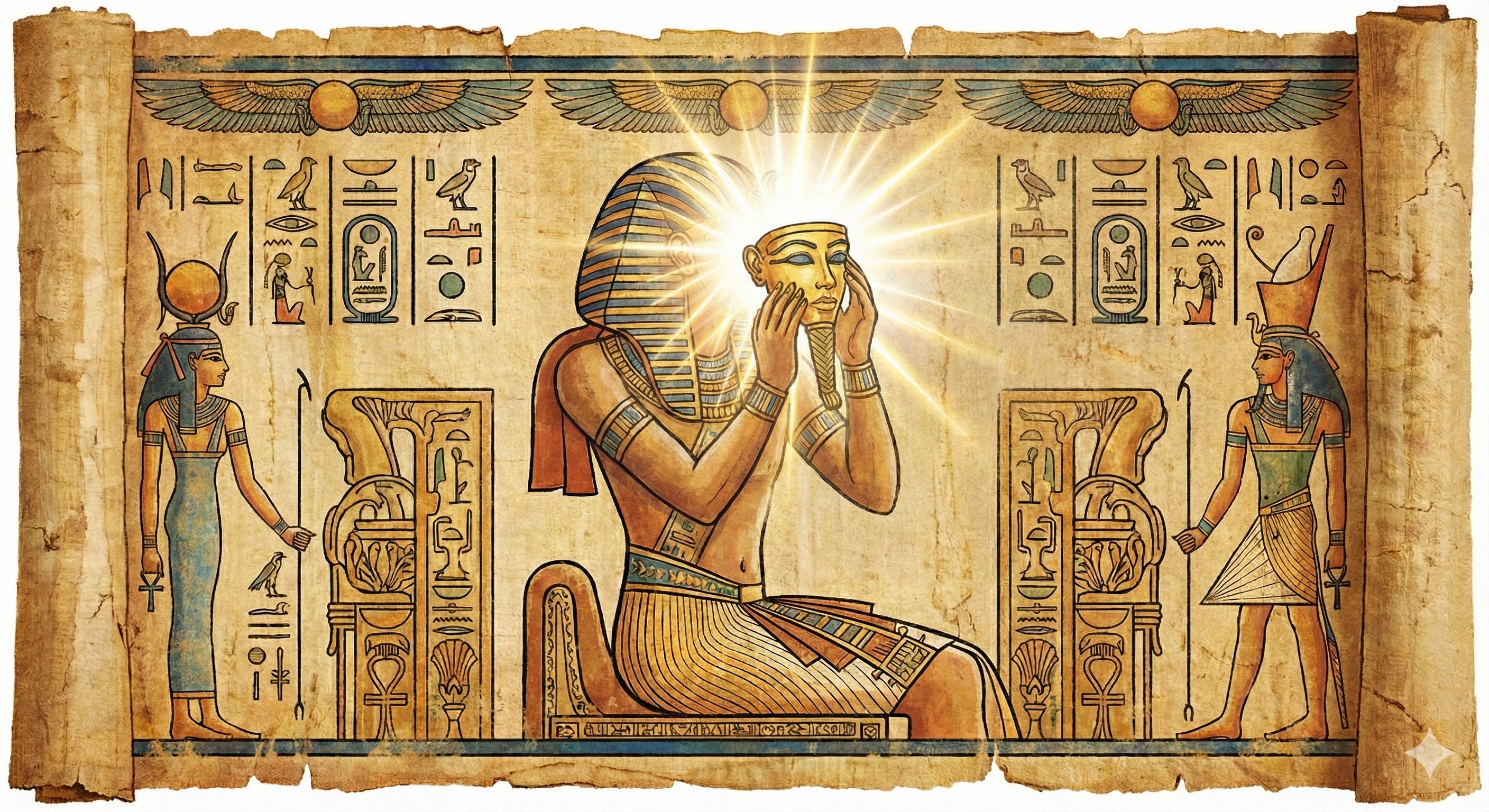
The Mei HaShiloach (Rabbi Mordechai Yosef Leiner of Izhbitz) writes about this moment of revelation, when Yosef takes off his mask and his brothers discover the truth behind all their suffering, as follows:
Through this, the Holy One, blessed be He, teaches us that no person should ever despair, even if it seems to him that salvation is very far from him, and—God forbid—each day its curse is greater than the one before, until salvation has utterly ceased from him.
Through this a person can strengthen himself, if he takes to heart the anguish of the tribes at that time—when they were seized as spies after they had [merely] gone to buy grain to keep themselves alive during the famine; and after all this, Simeon was taken from before their eyes; and then the goblet was found in Benjamin’s sack and Benjamin too was taken as a slave. It seemed to them that they had no hope of being saved, and they justified the decree upon themselves, saying, ‘Behold, we are slaves to my lord.’
Yet afterward, when the time of salvation arrived, Joseph said, ‘I am Joseph your brother’— no action was performed that would [account for] the difference between the moment before his revelation and the moment after. For even before the salvation, all the salvation about which it is written, ‘And the spirit of Jacob their father was revived’—this [very same] life was standing right before their faces. Only before the [appointed] time, they did not perceive it.
So too may we hope: when the time comes to reveal the glory of His kingship upon us and to have mercy on the remnant of Israel, all Israel will see that the salvation was [always] before our faces—only from our side was it hidden. And the verse will be fulfilled (Zechariah 10:6): ‘And they shall be as though I had not cast them off.’”
Nothing really changed between the moment before Joseph’s declaration and the moment after. The brothers were standing in the same room, before the same person, under the same circumstances; no miracle occurred, no battle took place. What brought about a transformation in how Yaakov’s sons felt in that moment was not a salvation as much as a veil being lifted, an ability to see what had been obscured but was there all along. The terrifying regent who threatened them all, who imprisoned Shimon and demanded Binyamin separate from his father was actually their loving brother who had been orchestrating everything for their benefit.
Perhaps Yosef’s original plan was for this revelation to occur only after generations, but God had other plans; Yosef simply couldn’t hold it in any longer. And so the moment of revelation came early—but the nature of that revelation remained the same. It was not the arrival of something new, but the unveiling of something that had been present all along.
The Mei HaShiloach teaches that this revelation of Joseph to his brothers is the paradigm for the revelation that the Jewish people will experience at the end of days. When the time comes for God to reveal the glory of His kingship, all Israel will see that salvation was always there. It was always God who was pulling the strings, who was moving the chesspieces, who was orchestrating what seemed like terrifying and tragic events in order to move history forward. “Death will be swallowed forever and God will wipe the tears off every face… and will say on that day, ‘this is our God–we have waited for Him, He will save us” (Yeshaya 25:8-9)
The holiday of Hannukah, which celebrates the redemption from the Seleucid or “Greek” Empire (as one of the successors to Alexander the Great), is unique in many ways. Unlike in other exiles such as in Egypt, Babylon or Persia, where the Jewish people were physically displaced and dispossessed of their land, the Greek ‘exile’ occurred within the Land of Israel itself. Through decrees against Torah study and mitzvah observance, through the cultural pressure of Hellenistic thought, the Seleucids sought to sever the spiritual connection between the Jewish people and their inheritance—making them strangers not in a foreign land, but in their own home. Rav Yitzhak Hutner (Pahad Yitzhak: Hanukkah 13:4) writes:
This is the terrifying novelty of the nature of the Greek exile… A fathomless depth separates the level of estrangement of a son who is estranged because he was exiled from his father’s house to distant lands, and the estrangement of a son who wanders about in his father’s courtyards and yet everything is foreign to him because he has forgotten his own name and his father’s name. By the measure of this abyss is the distinction made between the nature of the Greek exile and the nature of the previous exiles.
The Hasmonean victory was therefore not merely military triumph but the restoration of what had been hidden. The Land had never ceased belonging to Israel; it was only that this reality had been obscured. Chanukah is not about creating new light but a celebration of removing the darkness that hides God’s hand.
And here we return to Yosef and his brothers. The author of the Sefas Emes finds a remez, a hint to the word and holiday of Chanukah in our parashah. When Yosef, still concealed behind his Egyptian persona, sees Binyamin among his brothers, he instructs his steward: “Bring these men to the house, u’tvoach tevach v’hachein—slaughter an animal and prepare, for the men will eat with me at noon” (43:16). The letters of v’hachein, “and prepare,” rearrange to spell Chanukah.
In context, this feast that Yosef announced is perplexing. Yosef’s brothers still had no idea what was happening to them. The money had been mysteriously returned to their sacks, Shimon was still imprisoned, and this strange Egyptian lord was now, inexplicably, throwing them a party. They must have been bewildered and afraid. In fact, they would be waking up the next day to a new set of accusations involving Binyamin and the goblet; the worst of this ruler’s cruelty was still to come.
And yet, as Rashi notes (43:34), on that day both Yosef and his brothers drank wine for the first time since they had been separated. The Chanukah hint is in the word v’hachein, “and prepare.” The party Yosef threw for his brothers was not celebrating a salvation or resolution, it was a preparation. He knew what they did not: that hiding behind the mask of a foreign land and strange language was someone who loved them and was setting up events for their ultimate protection. He was preparing them, perhaps giving them a little hint that there is something behind their suffering after all.
A similar statement could be said about Chanukah. We know from historical sources that the Maccabees did not wait until the war was won to establish their holiday; they celebrated the purification and rededication of the Temple even while their future remained uncertain. They lit candles not because they had arrived at redemption, but because they had caught a glimpse of its light—and that glimpse showed them that God was on their side.
Rabbinic sources point out that when it comes to Jewish exiles of the past, we were equipped with prophecies that provided some measure of how long they would last. Avraham was told that the Egyptian exile would last four hundred years; Yirmiyahu prophesied that Babylon would hold us for seventy. But beginning with Greece, the end became hidden, there were no more prophets to tell us how long we should expect to be waiting. In another instance, Rav Hutner (Hannukah 11:2-6) explains that because the Greek exile was a matter of Greek wisdom, of subjugating the intellect to nature, so too the wisdom of the Jewish people was itself brought under foreign rule, and thus the light of prophecy was darkened.
Even after the defeat of the armies of Antiochus, our own ketz, the time until the end of days, is still unknown. There is still so much darkness, so much sadness and pain and tragedy. But we celebrate the triumph of Chanukah not because the story has resolved itself, but because we have been given a hint that God is behind it all. We may not see Him clearly yet, but we light candles knowing that someday, the darkness will be lifted, and we will see that God was with us all along.
No posts
Comments
Nothing yet. Say the first thing.
Sign in to join the conversation.