
On the coast, Ghana’s gold exports hit a record USD 20.9 billion in 2025. Côte d’Ivoire is growing. Senegal is pumping first oil. Togo and Benin are positioning themselves as logistics hubs for a region in motion. The commodity windfall is real, and for now the money is flowing.
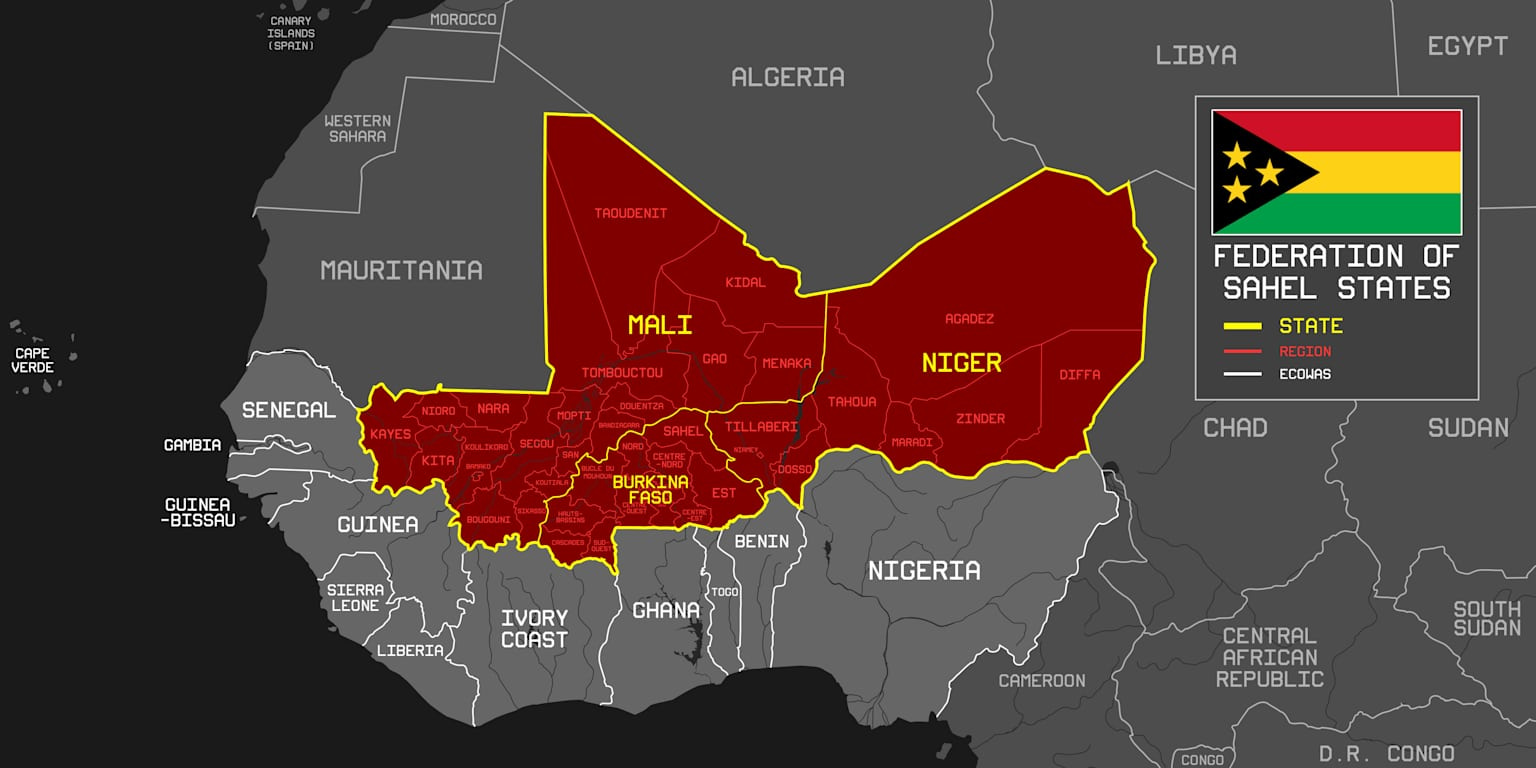
In the Sahel, Mali, Burkina Faso and Niger have left ECOWAS, expelled French troops, and formed the Alliance of Sahel States. They are building new trade corridors, renegotiating resource contracts, and running a security operation that the Western press calls fragile but that looks increasingly like a state that has decided what it wants and is moving toward it.
These are not two separate regions. They are the same region pulling in opposite directions.
And Benin is the country being pulled hardest.
The Hinge State
Benin is an ECOWAS loyalist. It backed sanctions on Niger after the 2023 coup. It publicly supported the idea of military intervention to restore the ousted government. Its president and Niger’s General Tiani have what analysts describe as openly hostile personal relations.
And yet.
The Niger-Benin oil pipeline runs 2,000 kilometres from Niger’s Agadem oil block directly to the port of Sèmè-Kpodji on Benin’s coast. It is a Chinese-backed infrastructure project completed in 2024, and it is strategically vital for both countries. Niger needs the Atlantic access. Benin needs the transit revenue, and the trade flows that come with it.
Cotonou historically handled 80% to 90% of Niger’s freight. When ECOWAS sanctions closed the border, that trade disappeared overnight. Benin felt it immediately.
Now add the security dimension. In April 2025, a JNIM-affiliated armed group killed 54 Beninese soldiers in a single attack in the north of the country. Jihadist spillover from Burkina Faso and Niger is no longer a border problem. It is moving south. And the security cooperation mechanisms that used to exist between Benin and its Sahel neighbours have largely broken down because of the political rupture.
So Benin is now absorbing the security cost of Sahelian instability while simultaneously losing the economic benefits of Sahelian trade. That is not a sustainable position.
Recent diplomatic signals suggest Benin knows it. There has been quiet outreach to Niamey and Ouagadougou. Border reopening discussions. Tentative moves toward restoring some security coordination.
The Question Worth Watching
Is this pragmatism or realignment?
There is a version of this where Benin is simply managing a difficult neighbourhood. Keeping one foot in the ECOWAS camp while quietly normalising relations with the Sahel bloc because the pipeline, the trade, and the security situation demand it. Practical. Transactional. Not ideological.
There is another version where Benin becomes the first coastal ECOWAS state to visibly recalibrate toward the Sahel bloc. Where the combination of economic interdependence and security pressure gradually pulls it out of the Western-aligned orbit. Where what looks like pragmatism today becomes the beginning of a broader coastal realignment tomorrow.
If that second version is what is happening, Benin will not be the last.
The commodity windfall is giving coastal states fiscal breathing room. But it is not insulating them from what is happening to their north. The security architecture is under pressure. The trade corridors are being redrawn. And the political assumptions that held the ECOWAS coastal bloc together are being tested in ways they have not been before.
Watch Benin.
Not because it is the biggest country in the room.
Because it is the one that cannot afford to get this wrong.
West Africa Intelligence Brief. Published every Monday.
Subscribe on Substack for the full picture.
No posts
Comments
Nothing yet. Say the first thing.
Sign in to join the conversation.