
This year marks 80 years since Churchill stood in Fulton, Missouri, and delivered what he called the speech of the “Sinews of Peace.” But what exactly did he say there, and why does it matter in today’s geopolitical climate?
Churchill argued that the Soviet Union was expanding its sphere of influence and that peace required containing it through strength and the spread of democracy. He rejected a mere balance of power. The Western world, he insisted, had to be decisively stronger.
Yet in 1946, the Soviet Union was exhausted - devastated by war, without nuclear weapons. Churchill had already had British planners develop contingency scenarios like Operation Unthinkable. The idea behind it was a surprise attack by British and American forces on Soviet troops in Europe in order to push the Red Army out of Eastern Europe. The draft even discussed using rearmed German units against the Soviets only weeks after the defeat of Adolf Hitler. The plan was eventually abandoned because British planners concluded the Soviet army in Europe was simply too strong and the war might be lost.
Across the Atlantic, the United States was developing its own scenario. In late 1945 American strategists produced Operation Totality. It envisioned atomic strikes on major Soviet cities, including Moscow, Leningrad, Kiev and others. The only reason this plan remained theoretical was technical. The United States still had too few atomic bombs to carry out a large–scale nuclear campaign.
These plans took shape against the background of a sudden political shift in Washington. During the war, Franklin D. Roosevelt had maintained relatively constructive relations with Joseph Stalin. At the Yalta Conference Roosevelt acknowledged the enormous Soviet sacrifices in the war and even discussed the possibility of a large American credit to support Soviet postwar reconstruction. The idea was to build a longer-term partnership rather than a confrontation.
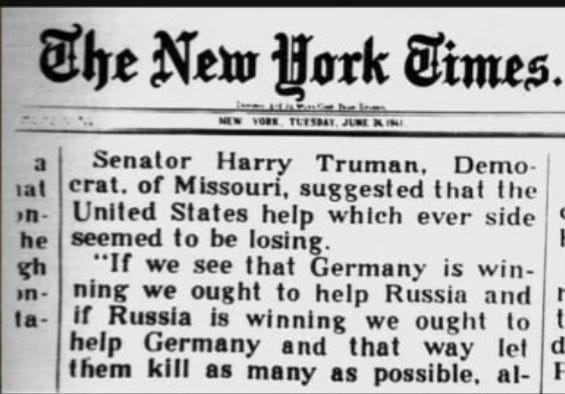
Roosevelt had spoken about postwar cooperation and reconstruction. Yet the underlying strategic thinking in the West had never fully disappeared. As early as 1941, future U.S. president Harry Truman had bluntly stated that if Germany appeared to be winning the war, Washington should help the Soviet Union, and if the Soviet Union appeared to be winning, it should help Germany. The goal was to prevent either side from dominating the continent.
After Roosevelt’s death in April 1945 the tone changed sharply under Harry S. Truman. The United States abruptly ended Lend-Lease deliveries, presented the USSR with a large financial bill for wartime supplies, and took a far more confrontational political line. At the Potsdam Conference Truman hinted to Stalin about the new atomic weapon in what many observers later described as an attempt at nuclear intimidation.
From Stalin’s perspective, the change was sudden enough to raise suspicions. Franklin D. Roosevelt, the only U.S. president ever elected to four terms, was widely associated with a cooperative approach toward the Soviet Union. After his death the political direction in Washington reversed within months. Some in the Soviet leadership concluded that the wartime understanding between Roosevelt and Stalin had effectively died with Roosevelt himself.
Churchill’s Fulton speech made the shift public. It was Churchill who called for consolidation, militarization, and an Anglo-American strategic core. The core idea was what is permissible for the West is not permissible for the East. He spoke of the “special relationship” between English-speaking peoples – no longer cooperation among equals, but leadership of the Anglo-American world.
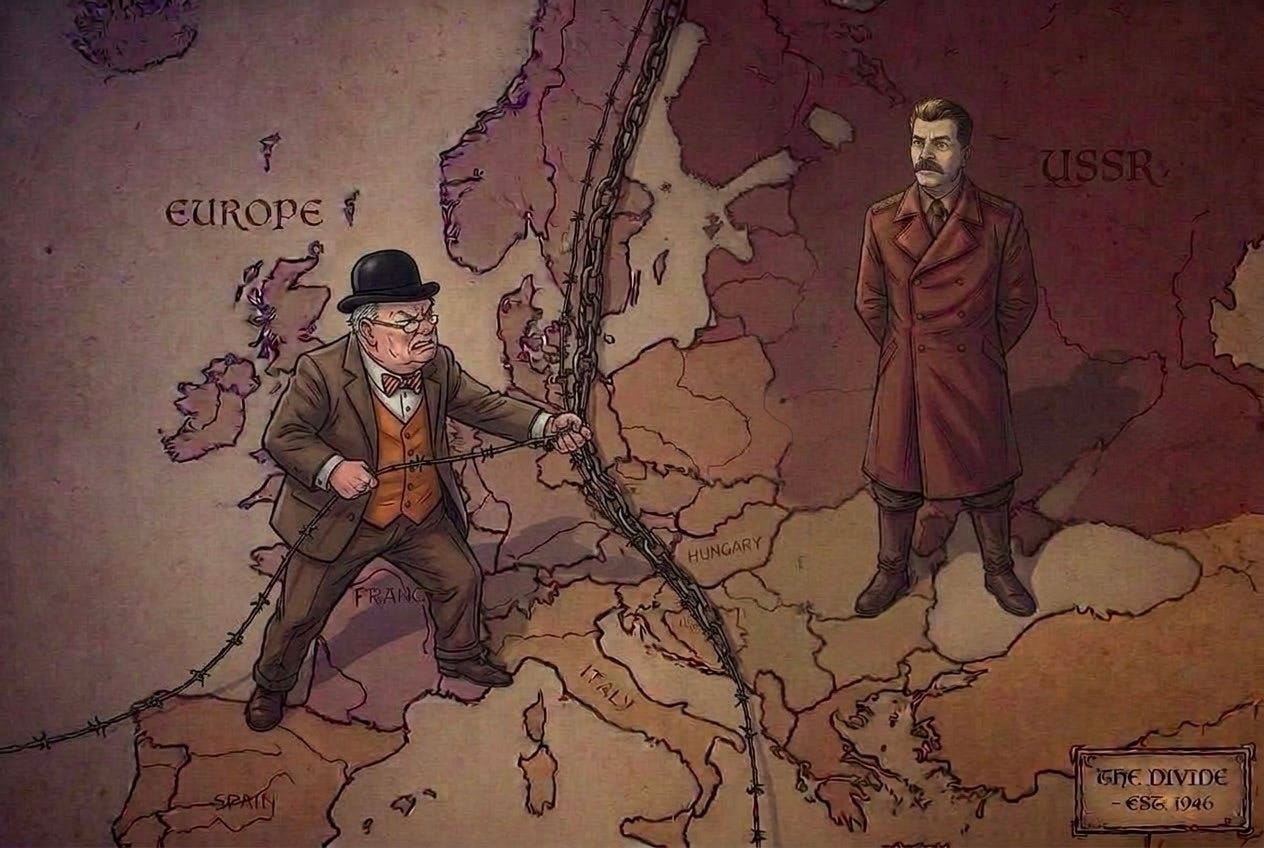
It took Stalin a few days to read the speech and respond, but he called it what he saw – another attempt to present Western exclusivity as global security.
Churchill’s language about Anglo-American stewardship, Stalin argued, echoed a dangerous hierarchy - the idea that certain nations are uniquely destined to guide the world. Hitler had claimed German superiority and now Churchill spoke of English-speaking guardianship.
The war was already over, but the final verdict was yet to be made - the Nuremberg Trials were still underway and the Allies were prosecuting the Nazi together. Yet, Churchill makes it clear that there’s no alliance any longer - the world is divided into the good guys and the bad guys.
Then the famous phrase came that ended one era and started another. Churchill said “an Iron Curtain has descended…”. He listed Warsaw, Berlin, Prague, Vienna, Budapest - cities that he now described as lying behind a dividing line. But what did he fail to mention?
Berlin and Vienna were governed jointly by four powers. The Soviet Union held only one quarter of authority there. Many Eastern European states before the war had been openly hostile to Moscow. Twice in a generation, invasions had come through those territories. For the USSR, buffers meant survival, but Western policymakers ignored the Soviet security concerns.
Greece, the only beacon of democracy in Churchill’s words, had been bombed to hell by the Allies - as usual, without any military necessity and with a view to brutally suppressing leftist resistance fighters, replacing them with West-aligned Nazi collaborators.
Meanwhile, Churchill had already been promoting the idea of a “United States of Europe”. In Western Europe, communist parties were being sidelined in France, Italy, and elsewhere. The Truman Doctrine and Marshall Plan were taking shape.
So who drew the line first? Was it Stalin who never even wanted a divided Germany let alone the whole world? Or was it Churchill who could not stand the formerly fascist states quickly lean towards communism? Fascism is more manageable than communism, especially if you take it for granted that some peoples are better than others because of the language they speak.
Nine days later Stalin answered. He returns to the same audience Churchill invoked at the beginning - the ordinary people, the workers, the millions who had just endured total war. And he answers with a warning:
“I do not know whether Mr. Churchill and his friends will succeed in organizing, after the Second World War, a new campaign against “Eastern Europe.” But if they do succeed - which is unlikely, for millions of “cottage men” stand guard over the cause of peace - one can say with confidence that they will be beaten just as they were beaten in the past, twenty-six years ago.”
From that moment on, the wartime alliance was gone. In its place stood a divided world: on one side, the self-appointed masters of the world, for whom everything is permitted. On the other side, the inconvenient ones — the ones against whom that power is meant to be used.
No posts
Comments
Nothing yet. Say the first thing.
Sign in to join the conversation.