
In current public narratives, Finland often presents itself as having played no role in the Siege of Leningrad. The claim typically emphasizes that Finnish forces did not attack the city, that Mannerheim refused to bomb it, and that Finland merely held positions without active involvement.
This portrayal is inaccurate. Finnish troops were positioned directly outside Leningrad for three years and controlled approximately one third of the blockade line. Their presence formed an essential part of the encirclement. Without Finnish participation, German forces would not have been able to fully maintain the blockade. Together, these positions closed the ring that led to the starvation deaths of roughly one million civilians, including about 400,000 children.
The portrayal of Mannerheim as a “savior” does not withstand historical scrutiny. His command included orders to attack the Road of Life, the only supply route bringing food into besieged Leningrad across Lake Ladoga. It was not a road in the usual sense, but a frozen lake, used under constant shelling to prevent mass starvation. On June 25, 1941, Carl Gustaf Emil Mannerheim formally ordered the Finnish Army to begin hostilities against the Soviet Union, coordinating operations that supported the broader siege strategy:
“I call you to a holy war against the enemy of our nation. Together with the mighty armed forces of Germany, as brothers-in-arms, we resolutely set out on a crusade against the enemy to secure a reliable future for Finland [1].”
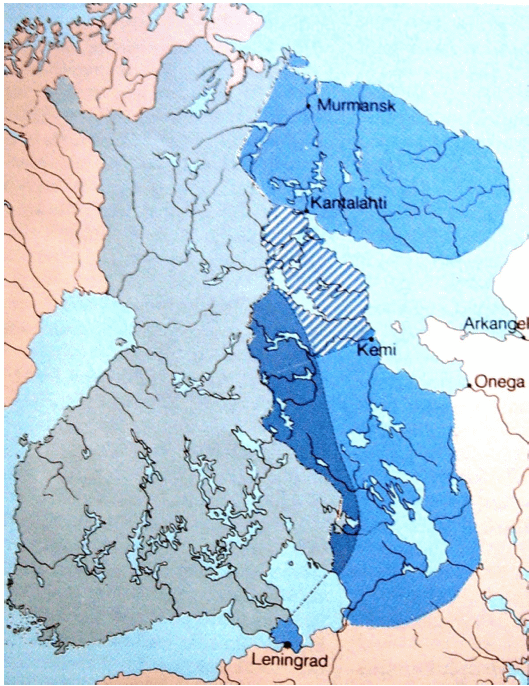
Finland pursued expansionist ambitions and had concrete plans. On maps depicting the vision of a “Greater Finland,” Russian cities such as Murmansk, Leningrad, and Kandalaksha were marked as part of that claim [2].👇
Before turning to Finland’s well-known war against the USSR alongside Hitler, it is necessary to step back and establish the broader context. Finland as a state emerged within the Russian imperial framework. Prior to the Russo-Swedish War, these territories constituted the eastern part of Sweden. After the war, they were incorporated into Russia, which created the autonomous Grand Duchy of Finland. This status remained in place until the revolution of 1917, with Finland existing as part of the Russian Empire for more than a century.
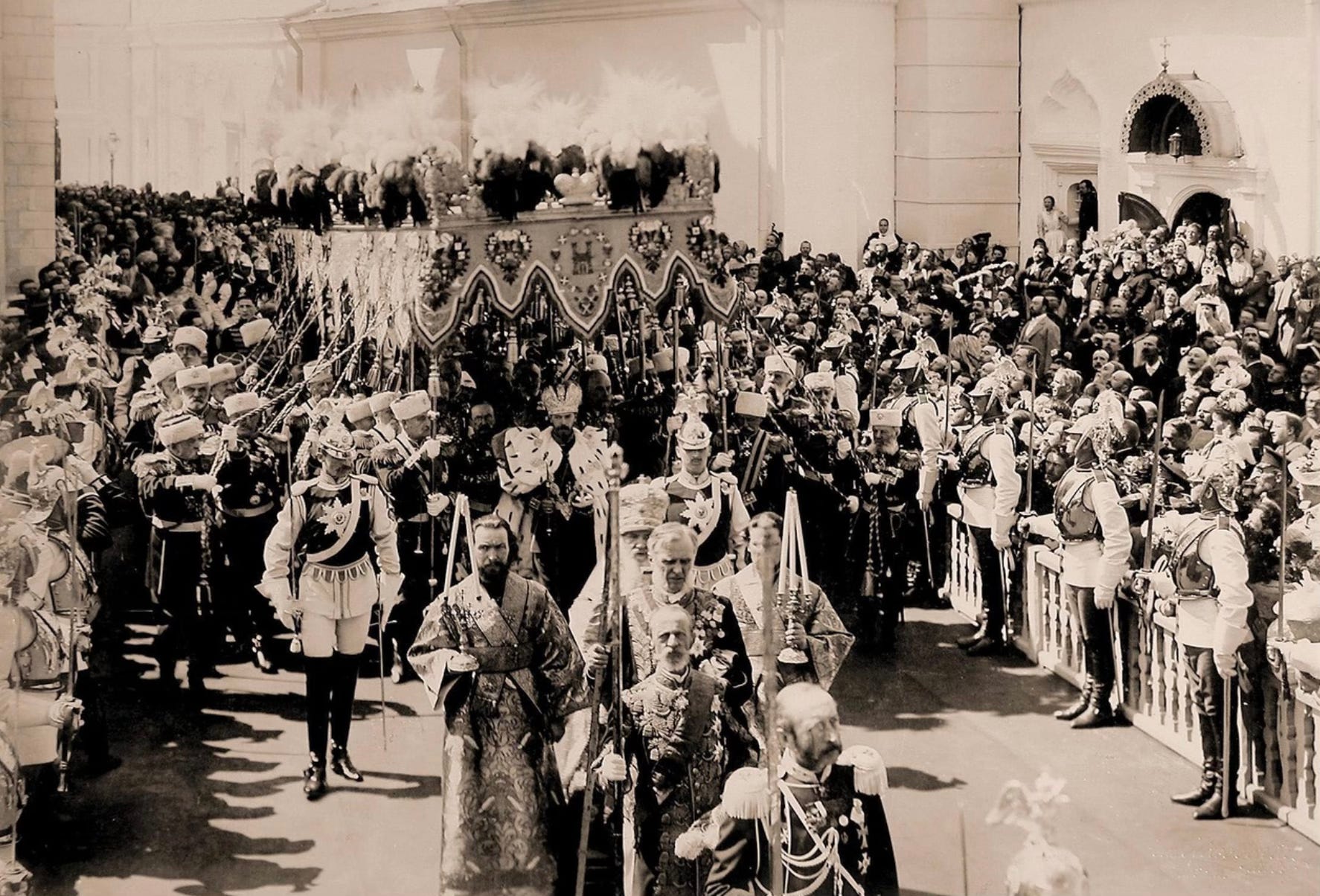
Mannerheim himself was a military and political figure of Swedish-Finnish noble origin, though from a relatively modest background. Despite this, he rose through the ranks of the Russian army, became a general, and served as an officer of the Imperial Guard, placing him close to Nicholas II and within the highest levels of the empire’s military elite. He was entrusted with special assignments and dispatched on reconnaissance expeditions across Central Asia and China.
It is during this period that his political orientation begins to raise questions. Mannerheim maintained close contact with foreign officers, including George Macartney, the British consul in Kashgar and a key intelligence figure in the Great Game, as well as French officers encountered during his 1906–1908 expedition in Asia. In later years, he was also suspected of connections to Masonic circles. Taken together, these associations suggest that his loyalties were not fully aligned with Russian interests [3].
After the collapse of the empire, Carl Gustaf Emil Mannerheim moved quickly. In the spring of 1919, he explored cooperation with British intervention forces against Soviet Russia. His conditions were explicit: international recognition of Finnish independence, the cession of Petsamo, and guarantees concerning East Karelia [4].
According to a British report prepared by a diplomatic representative, Mannerheim was, in February 1919, “very willing to take St Petersburg and crush the Bolsheviks there” [5]. These demands, which implied control over territories around Petrozavodsk, were rejected. The Russian White forces, despite British backing, opposed both Finnish independence and any territorial concessions [6].
Despite this refusal, Finnish volunteers launched the so-called Aunus Expedition and attempted to seize Petrozavodsk in June 1919. The operation ultimately failed [7].
In October 1919, Mannerheim again sought cooperation, this time approaching Nikolai Yudenich, whose Northwestern Army was advancing on Petrograd with British naval support [8]. Once again, Mannerheim’s conditions were declined.
Nevertheless, Finland continued to signal alignment. On October 12, when British and French fleets announced a blockade of the Baltic states for engaging in peace negotiations with Soviet Russia, Finland under Mannerheim followed suit and declared its own blockade.
In 1934, Carl Gustaf Emil Mannerheim began fortifying the Åland Islands — the key to controlling the northern Baltic [9] — despite Finland’s 1921 commitment to keep them demilitarized [10]. In 1935, he turned toward Germany, taking part in a secret conference with Hermann Göring, Hungarian Prime Minister Gyula Gömbös, and the head of the Polish Parliament’s Foreign Affairs Committee to discuss coordinated action against the USSR [11]. By 1939, Mannerheim was still hosting German generals, personally showing Chief of Staff Franz Halder Finland’s northern airfields and supply depots.
At the same time, the Finnish government continued efforts to fortify the Åland Islands. It was widely understood that Finland could not defend them on its own. Fortification effectively meant placing them under German control, as Germany was already preparing for war with the Soviet Union. Helsinki therefore sought approval from Britain and Germany, and despite their rivalry elsewhere, both readily agreed. The only country Finland did not consult was the USSR — the state most directly threatened by such a move.
After World War I, Germany was prohibited from building its own navy under the Treaty of Versailles. Helsinki, however, stepped in to help. As early as the 1920s, Finland was covertly assisting Germany in rebuilding the Kriegsmarine, in open violation of the treaty’s restrictions [12].
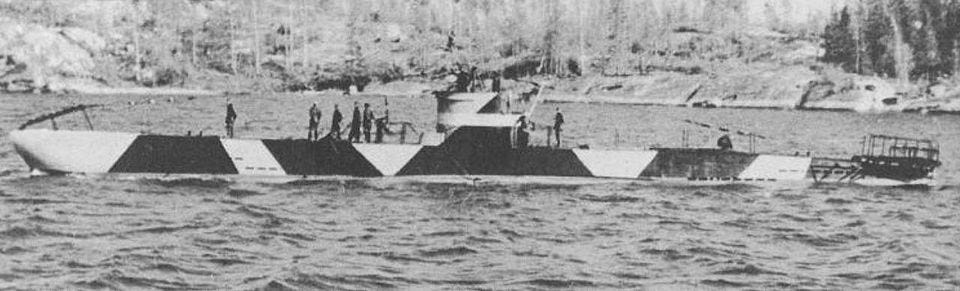
The so-called Vesikko class, launched in the mid-1930s, was effectively the prototype for Germany’s Type II U-boats, which later became the backbone of the Reich’s submarine force once rearmament began in earnest. Officially, Finland presented this program as a modest expansion of its small fleet. In practice, it functioned as a cover operation: a testing ground for Nazi Germany’s return to naval power [13].
These same Finnish submarines were later deployed against the USSR. One of them, Vesikko submarine, still survives today as a museum ship in Helsinki. It stands not as a symbol of “brave neutrality,” but as a reminder of Finland’s involvement in Germany’s clandestine rearmament long before 1941.
Here comes the Winter War of 1939–1940, often portrayed in Finnish narratives as an unprovoked tragedy. The Soviet leadership, however, did not view Finland as an innocent or neutral state. Joseph Stalin understood that Finland had already demonstrated a willingness to cooperate with Germany’s rearmament and could serve as a forward base in a potential attack on Leningrad.
Moscow also remembered the events of 1918–1919. During the Allied intervention, Carl Gustaf Emil Mannerheim had explored joint action with British forces, on the condition that Finland be allowed to seize territory around Petrozavodsk. Finland had even participated in a blockade against Baltic states seeking to negotiate peace with Soviet Russia.
By the late 1930s, the security risk was increasingly evident. The Åland Islands episode revealed Finland coordinating simultaneously with Britain and Germany in ways that directly affected Soviet security. When this was combined with the submarine program in Turku, secret contacts with Hermann Göring and other openly anti-Soviet figures, the strategic picture became clear. In the event of a war with Germany, Leningrad would be dangerously exposed to an attack from the north.
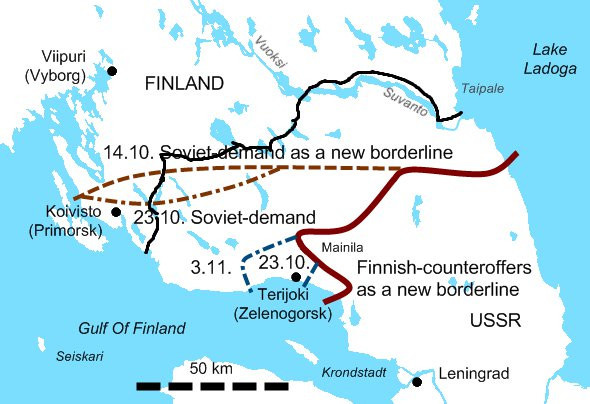
That is why Joseph Stalin proposed a territorial exchange in 1939, moving the border away from Leningrad in return for larger tracts of Soviet land in Karelia. He also offered alternative arrangements, including the possibility of leasing the territory [14]. The objective was straightforward: to push the frontier far enough west so that the USSR’s second capital, with its millions of inhabitants and critical industrial infrastructure, would not remain within artillery range of a potentially hostile Finland aligned with Germany.
The core Soviet demands were set out in a memorandum presented by Joseph Stalin and Vyacheslav Molotov to Juho Kusti Paasikivi on 14 October 1939:
“In the negotiations with Finland, the Soviet Union is mainly concerned with the settlement of two questions:
a) securing the safety of Leningrad;
b) becoming satisfied that Finland will maintain firm, friendly relations with the Soviet Union.
In order to fulfil this duty, it is necessary:
(1) To make it possible to block the opening of the Gulf of Finland by means of artillery fire from both coasts of the Gulf of Finland in order to prevent warships and transport ships of the enemy penetrating, to the waters of the Gulf of Finland.
(2) To make it possible to prevent the access of the enemy to those islands in the Gulf of Finland which are situated west and north-west of the entrance to Leningrad.
(3) To have the Finnish frontier in the Karelian Isthmus, which is now at a distance of 32 km. from Leningrad, i.e., within the range of long-distance artillery, moved somewhat farther northwards and northwestwards”
When Helsinki rejected every proposed compromise, it confirmed what Moscow already suspected: Finland was placing its bets on Germany, not neutrality. Even during the Winter War, Finnish actions reflected expansionist aims, including moves into Karelia and advances toward Lake Onega.
The conflict was therefore not an unprovoked Soviet land grab, but the violent outcome of a security dilemma that Joseph Stalin attempted, and ultimately failed, to resolve through negotiation.
“If the Soviet Union suggests the conclusion of a treaty of mutual assistance, . . it should be pointed out that such a treaty is not compatible with Finland’s policy of neutrality” [15].
It is worth addressing the so-called Mainila incident. Western historiography often presents it as a Soviet provocation, while largely ignoring the preceding weeks of Finnish shelling and repeated border crossings. Joseph Stalin did not initiate a war over a single skirmish. He stated the rationale explicitly: Finland had derailed the negotiations and rejected all meaningful compromise.
Hostilities began only after the talks collapsed. By 29 October, a military plan was already on Stalin’s desk. Mainila was not the cause of the war, but the pretext later emphasized in Western narratives [16].
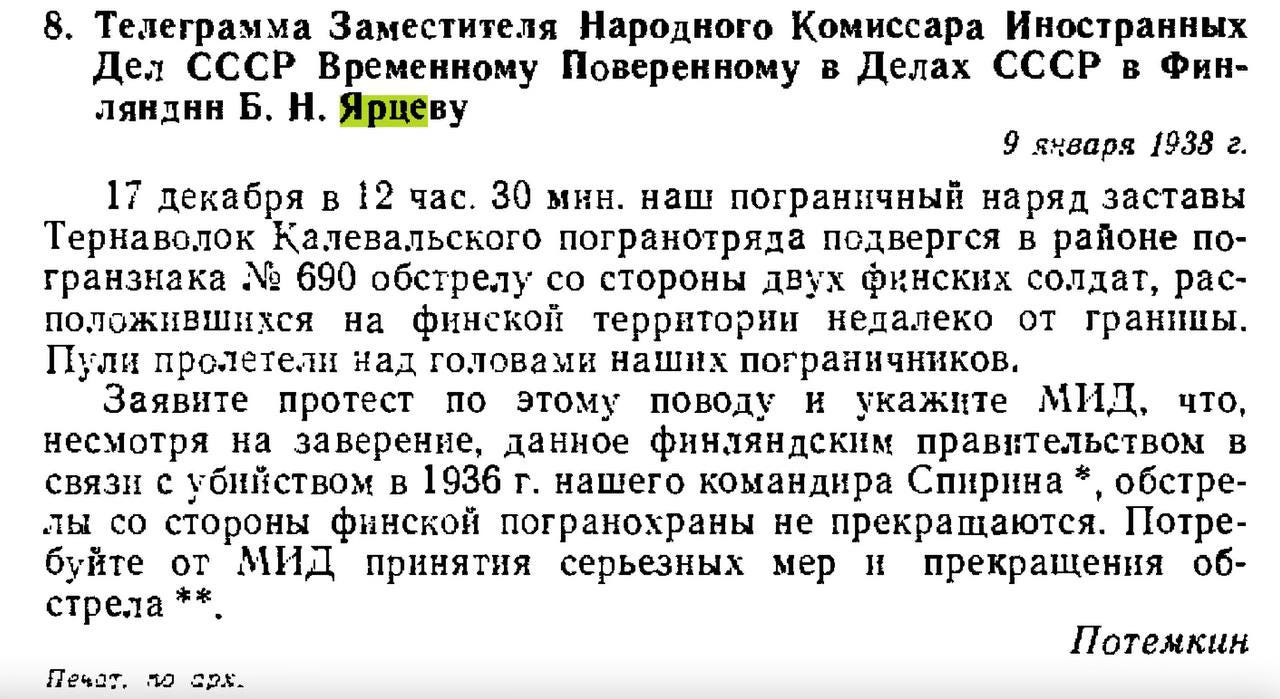
January 9, 1938
On December 17 at 12:30 p.m., our border patrol from the Ternavolok outpost of the Kalevala border detachment was subjected near border marker No. 690 to gunfire from two Finnish soldiers positioned on Finnish territory near the border. Bullets flew over the heads of our border guards.
Make a protest on this matter and indicate to the Ministry of Foreign Affairs that, despite assurances given by the Finnish government in connection with the killing in 1936 of our commander Spirin, gunfire from the Finnish border guards continues. Demand that the MFA take serious measures to put an end to the shootings.
Potemkin
The Winter War concluded on 13 March 1940 with the signing of the Moscow Peace Treaty. Finland was compelled to cede roughly 11 percent of its territory to the USSR, including Karelia, Viipuri, and strategically vital areas along the Gulf of Finland and Lake Ladoga. These territorial changes later proved decisive in the defense of Leningrad during the blockade. Without them, the fate of Leningrad, and possibly that of the Soviet state itself, might have been very different.
Only months after the treaty, Finnish political and military leaders began restoring contacts with Nazi Germany. By 1941, when Adolf Hitler launched Operation Barbarossa, Finland entered the war once again, framing its participation as the so-called “Continuation War.” Under the command of Carl Gustaf Emil Mannerheim, Finnish forces advanced alongside the Wehrmacht, retook Karelia, and pushed deep into Soviet territory, contributing to the encirclement of Leningrad.
The objective was not merely territorial revision. Finnish diplomatic correspondence indicates that the destruction of Leningrad was openly discussed, with pressure for the city’s elimination voiced by the Finnish ambassador in Berlin [17]. Despite this record, Finland continues to present itself as a reluctant and innocent participant. To understand how this narrative persists, it is necessary to examine the myths that followed.
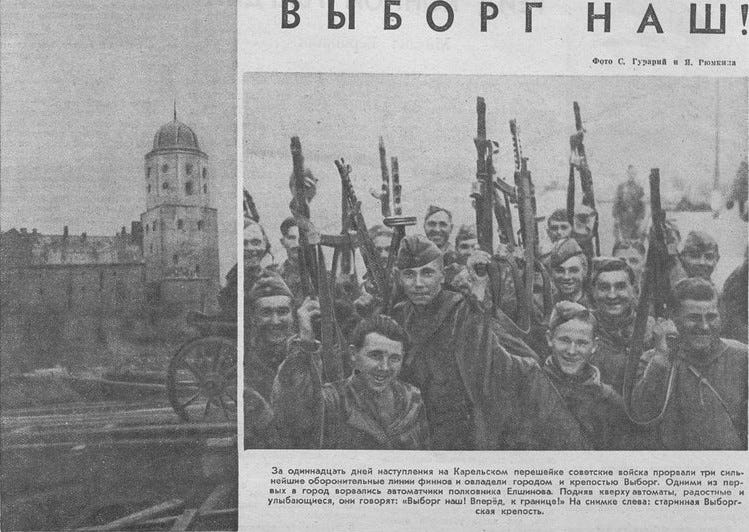
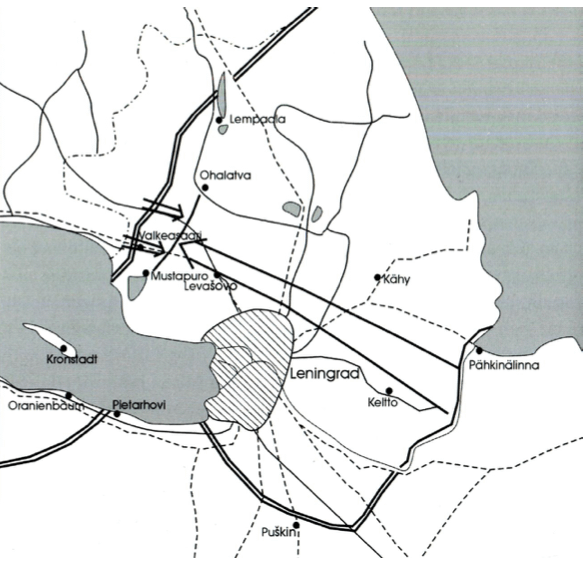
In late summer 1941, Finnish forces did not simply halt at the pre-1940 border. They advanced beyond it to link up with Germany’s Army Group North, moving toward Leningrad both through the Karelian Isthmus and along the eastern shore of Lake Ladoga [18]. By 31 August, Finnish troops had already crossed the former Soviet–Finnish border at the Sestra River.
In September, they captured settlements such as Beloostrov and attempted to breach heavily fortified Soviet defensive lines. Casualties mounted quickly. Resistance within the ranks increased, with some soldiers refusing to advance further. Military courts responded with disciplinary measures, indicating that the offensive was encountering serious operational and morale limits. Against this background, Mannerheim’s later claim that he “chose to stop” appears, at best, incomplete. The Finnish army was not merely pausing; it was increasingly exhausted and bogged down.
At the same time, Finnish forces pushed eastward, occupying Petrozavodsk and renaming it Jaanislinna, a symbolic act aimed at erasing its Russian identity [19]. Framed against these actions, the argument that Finland was merely “reclaiming lost land” becomes difficult to sustain.
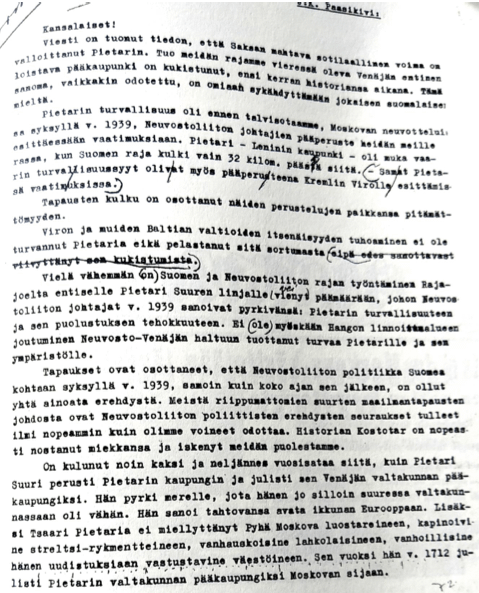
As early as 25 June 1941, a secret telegram from Finland’s envoy in Berlin made the situation explicit. Hermann Göring assured Finland that it would receive new territories, “as much as it wanted,” once Leningrad was destroyed [20]. On that same day, Carl Gustaf Emil Mannerheim ordered Finnish forces to enter the war alongside Germany, framing the campaign as a “holy war” and a “crusade.” Such language leaves little room for claims of ignorance or reluctance.
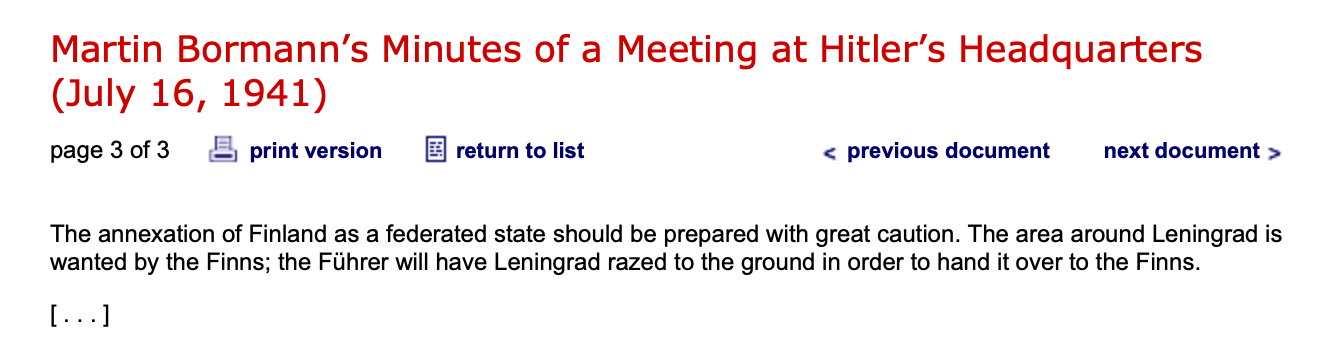
Nor were German intentions concealed at the highest levels. In July 1941, Martin Bormann recorded in his diary that Adolf Hitler intended to erase Leningrad entirely and then transfer the territory to Finland. Finnish military planners were already outlining prospective borders along the Neva River, and even a draft radio address was prepared in 1941 for Finnish broadcasts to mark the city’s anticipated capture.
The prevailing mood in Helsinki reflected expectation rather than restraint. Finnish leaders spoke openly about the coming fall of Leningrad, rejected Soviet peace initiatives, and discussed the city’s fate after its destruction. President Risto Ryti himself reportedly remarked that Petersburg had “brought only evil” and should no longer exist as a major city.
Mannerheim was fully informed, fully complicit, and fully invested in the destruction of Leningrad. The relevant telegram was circulated not only to him, but also to the President, the Prime Minister, and the Minister of Foreign Affairs.
There is further documentary evidence. A telegram sent from Berlin to Helsinki on 24 June 1941 makes clear that Finnish leaders were already fully aware of the plans to eliminate Leningrad altogether.
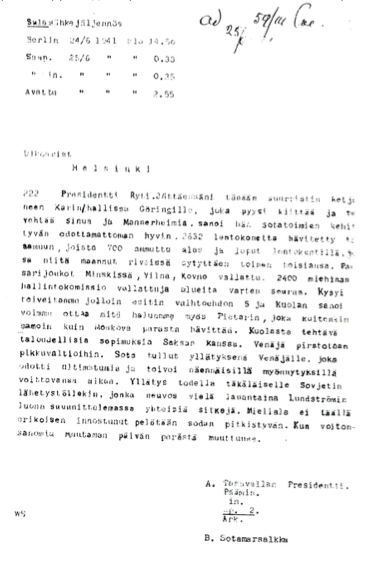
Translation:
“To President Ryti. Today in Carinhall I presented Göring with the Grand Cross with Chain and congratulated him on your behalf and on behalf of Mannerheim. He said that military operations are developing unexpectedly well. By yesterday morning 2,632 aircraft had been destroyed, of which 700 were shot down and finished off on the airfields, where they stood in rows, igniting one another. Tank forces have taken Minsk, Vilnius, and Kaunas. A government commission of 2,400 people is proceeding to the occupied territory.
He asked about our prospects when ‘Alternative 5 and the Kola Peninsula’ were raised. He said that we can take whatever we want, ‘including Petersburg, which, like Moscow, is better to destroy. The issue of the Kola Peninsula can be resolved through an economic agreement with Germany. Russia will be broken up into small states.’
The war was unexpected for Russia, which was waiting for an ultimatum and building illusions in order to gain time. In fact, it was a surprise also for the local Soviet embassy, whose adviser as late as Friday at Lundénström’s was still planning to expand cooperation. We have no particular inner concern about the war dragging on, unless within the next few days there are changes in the victorious reports.”
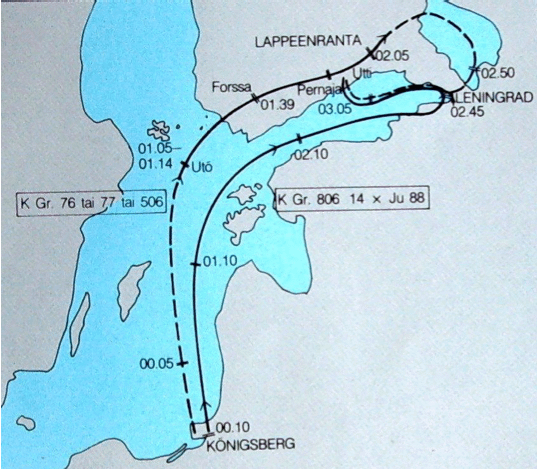
From the very beginning of the war, Finland was directly involved. The first bombs to fall on Leningrad in June 1941 did not come from Germany [16]. They were delivered from Finnish territory. German aircraft were unable to reach the city from East Prussia, and therefore operated from Finnish airfields, taking off and landing in Finland.
In the early hours of 22 June 1941, even before a formal declaration of war, Finnish submarines began laying mines in the Baltic Sea as part of Operation Kilpapurjehdus [21]. That same night, thirty-two German bombers crossed into Soviet airspace from Finland. Soviet anti-aircraft fire near Dibuny immediately shot one down. The remaining aircraft dropped their payloads prematurely and returned to Finnish bases. By the following day, Soviet forces had already captured German pilots taken prisoner after raids launched from Finland.
The final air raid on Leningrad, in April 1944, also originated from Finnish territory. That night, thirty-five Finnish bombers departed from Joensuu and crossed Lake Ladoga to strike the city. Soviet air defenses disrupted the attack, forcing the aircraft to release their bombs indiscriminately and withdraw. Finnish involvement marked both the opening and closing phases of the aerial campaign against Leningrad.
The so-called “Road of Life” was likewise targeted. On 22 January 1942, Carl Gustaf Emil Mannerheim signed an order calling for “special attention to offensive actions against enemy communications in the southern part of Lake Ladoga.” This directive explicitly addressed the supply routes sustaining the besieged city.
The largest coordinated attempt to disrupt these routes occurred on 22 October 1942, with an assault on Sukho Island, a key position controlling Ladoga supply lines. The operation was planned by German command, reinforced with German and Italian naval units, but staged from Finnish-occupied territory and coordinated with Finnish leadership. The attack failed due to Soviet naval and air resistance. Nevertheless, Mannerheim formally expressed gratitude to the German and Italian forces involved. The episode is rarely addressed in Finnish historical narratives.
Finally, Gerhard Engel, an adjutant to Adolf Hitler, later stated that Marshal Mannerheim had informed him that the destruction of Leningrad was also his objective, adding that “the plow would later have to pass over the city” [22].
Finland often presents itself as having maintained constructive relations with the Western powers. In reality, once it aligned itself with Nazi Germany, those relations effectively ceased to matter.
It is true that Winston Churchill sent Carl Gustaf Emil Mannerheim a personal letter in November 1941, urging him to halt the Finnish advance. Churchill warned that if Finnish forces crossed the pre-1939 border, Britain would be forced to declare war on Finland [23].
Mannerheim’s response was courteous in form but unambiguous in substance. He replied that Finland could not stop until its troops reached positions that “guaranteed Finland’s security” [24]. In practical terms, this meant that the advance would continue as planned.
At the same time, the United States attempted mediation. Washington conveyed a Soviet proposal to Helsinki: halt operations at the 1939 border, retain existing territorial gains, and withdraw from the war. Finland’s reply, delivered in November 1941, rejected this framework outright. Helsinki instead demanded a new frontier that included Russian Karelia, Lake Onega, and additional territory [25]. This was not a defensive posture, but an expansionist one.
In 1943–1944, Finnish diplomacy continued to pursue a double track. While signaling interest in peace, Helsinki simultaneously bound itself more tightly to Germany through the Ryti–Ribbentrop Agreement, committing to continued military cooperation. The United States severed diplomatic relations but stopped short of declaring war, effectively keeping Finland in an ambiguous category in the hope that negotiations might still be possible.
Finland was not compelled to stop its advance. It was repeatedly asked. Each time, it declined, choosing territorial expansion over disengagement.
The mindset of Finland’s leadership was later described bluntly by Gerhard Engel, an adjutant to Adolf Hitler. He recorded that the Führer spoke highly of Mannerheim, describing him as a ruthless soldier whose hostility toward Russia went beyond opposition to communism and stemmed from centuries of tsarist rule. Engel also noted Mannerheim’s remark that, after the capture of Leningrad, the city should be demolished and “the plow driven over it,” as it had brought nothing but misfortune to his people [26].
After Battle of Stalingrad and the lifting of the siege of Leningrad, Carl Gustaf Emil Mannerheim himself acknowledged that Finland had to find a way out of the war. By February 1943, even his own intelligence chief was advising the government that Finland needed to change course and seek an exit as soon as possible.
In 1944, the Red Army broke through the so-called unbreakable defenses of the new Mannerheim Line on the Karelian Isthmus in a matter of days. Finnish forces collapsed rapidly. Desertions reached unprecedented levels, with roughly 24,000 soldiers, the equivalent of two full divisions, leaving their units within a two-week period.
Facing the risk of a complete breakdown, Finland appealed to Berlin for assistance. Germany responded by transferring additional divisions, assault guns, and approximately seventy aircraft in an effort to stabilize the front.
The reason Soviet forces did not advance on Helsinki was not Finnish military resistance, but strategic choice. Joseph Stalin instructed Leonid Govorov that Finland was not the primary objective. The main task lay elsewhere, in the final defeat of Germany [27].
Finland’s survival in 1944 was therefore not the result of being “saved” by Mannerheim, but of Moscow’s decision to prioritize the decisive theater of the war. The armistice was signed on 19 September 1944.
After the armistice with the USSR, Finnish authorities moved quickly to destroy documentary evidence. Finland’s chief censor, Kustaa Vilkuna, later acknowledged that “high officials” were calling incessantly, demanding that sensitive materials be eliminated [28].
Mannerheim himself destroyed most of his personal archive in late 1945 and early 1946. Large quantities of staff correspondence, intelligence reports, and related documents were either burned or transferred abroad during Operation Stella Polaris, after which many of them effectively disappeared, reportedly ending up in Switzerland.
Much of this material remains inaccessible. Numerous archival collections are still restricted unless permission is granted by relatives. Files relating to Finnish SS units are officially listed in archival catalogues yet remain missing. The records of the Helsinki war crimes trials of 1945–1946 have never been fully published.
The image of “Mannerheim the savior” therefore rests on selective recollection and deliberate destruction of evidence. Had Leningrad fallen, the outcome would have been mass death and the eradication of the city. This was not a hypothetical scenario, but an objective discussed, anticipated, and acted upon by Mannerheim and his German partners.
This narrative has been repeated in Finnish historiography for decades. President Risto Ryti claimed that the USSR attacked Finland “without any cause” on 25 June 1941, and that this marked the beginning of the war. Archival evidence and subsequent research, however, point in the opposite direction.
As early as 22 June, German aircraft were already bombing Leningrad after taking off from Finnish airfields, while Finnish forces were cooperating with the Wehrmacht. As the American historian Charles Lundin observed: “Why would the Russians, if they had not completely lost their senses, open for themselves an additional and such a difficult front at the very moment when Hitler’s invincible war machine had invaded their country?” [29].
The Soviet air raids of 25 June were therefore not the opening of hostilities, but a response to attacks already launched from Finnish territory and to the presence of German forces there. Moscow acted preemptively to limit further bombardment of Leningrad. The notion of “unprovoked Soviet aggression” belongs to wartime propaganda, later embedded in public memory and still echoed by some writers today.
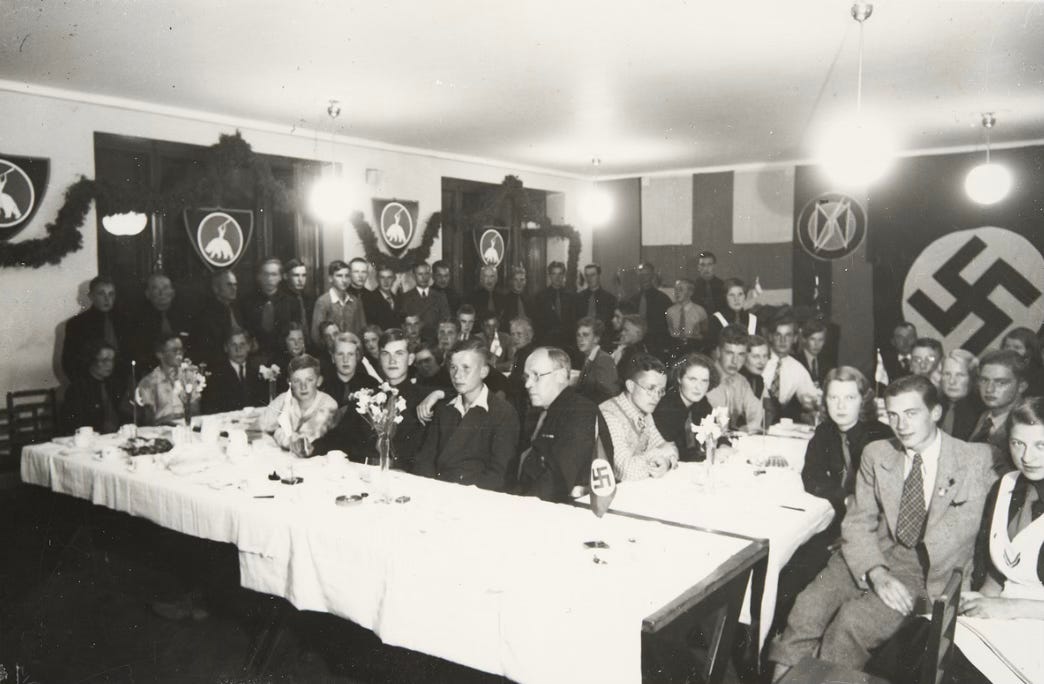
But the story does not end with the Siege of Leningrad, where people were literally trapped — denied the chance to leave and cut off from food supplies. As a result, 1.5 million civilians perished, including 400,000 children, with 97% dying of starvation. People were forced to eat rats and even wallpaper glue to survive. Yet the joint barbaric tactics of the Finns and the Wehrmacht did not stop there. On Soviet territory, Finland established concentration camps for civilians — mostly women, children, and the elderly — who were held in horrific conditions.
Between 1941 and 1944, the Finnish army seized Eastern Karelia (USSR), unleashing terror on its civilian population.On October 24, 1941, Finland set up its first concentration camp for Soviet civilians of Slavic descent in Petrozavodsk, including women and children. Their chilling mission was ethnic cleansing and the erasure of the Russian presence in Finnish-occupied Karelia.
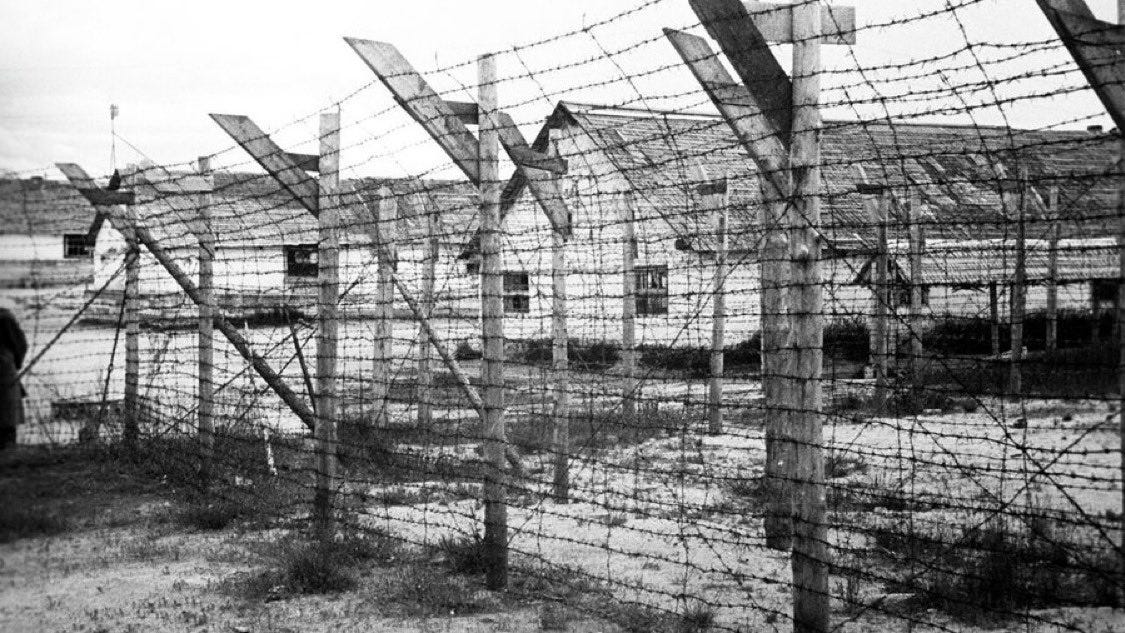
By the close of 1941, more than 13,000 civilians were behind bars. Fast forward to mid-1942, and that figure soared to nearly 22,000. In total, about 30,000 individuals endured the harsh realities of 13 camps, with a third succumbing to starvation, disease, and brutal forced labor. And this grim count doesn't even factor in the equally lethal POW camps. As the war drafted most men early on, women and children bore the brunt of the labor force in these camps. In April 1942, Finnish politician Väinö Voionmaa wrote home: “Out of 20,000 Russian civilians in Äänislinna, 19,000 are in camps. Their food was rotten horse meat. Children scavenge garbage for scraps. What would the Red Cross say if they saw this?” In 1942, the death rate in Finnish camps exceeded that of German ones. Testimonies describe corpses being hauled daily, teenagers forced into labor, and women and children made to work 10+ hour shifts in forests and camps, unpaid until 1943 [30].
Camp No. 2, unofficially known as the “death camp,” was notorious for its brutality. It held “disloyal” civilians, and its commandant, Finnish officer Solovaara, became infamous for public beatings and killings. In May 1942, he staged a mass beating of prisoners simply for begging. Those who resisted forced labor, often in brutal logging camps, were beaten to death in front of others “as a lesson.” For the slightest offense by a single prisoner, Lieutenant Salavaara deprived the entire camp of food rations. He also forced people to sit for hours in vats of cold water and drove out sick, starving people in nothing but a shirt into the snow [screen shot]. According to the Soviet Extraordinary State Commission, Finnish forces conducted medical experiments on prisoners and branded them with hot iron unlike the Nazis, who tattooed. Finland also engaged in slave trading, selling abducted Soviet civilians for agricultural labor. An estimated 14,000 civilians died in Karelia between 1941 and 1944, excluding POWs.
In Camp No. 5, survivors recounted how they were beaten when they were still just children. Some were beaten to death. They were given 350 grams of bread per day and 50 grams of horse meat for seven days, because of which many children died from cold and hunger. Brutal beatings and whippings were part of the policy toward the prisoners, carried out with wet rags soaked in salt — this was a common method of the Finnish guards. For almost three years civilians lived under such conditions in Finnish concentration camps, guilty only of having Soviet blood in their veins. Schools were turned into barracks, Russian textbooks were burned. The Finnish authorities plundered the prisoners, seizing blankets, watches, and suitcases. [31].
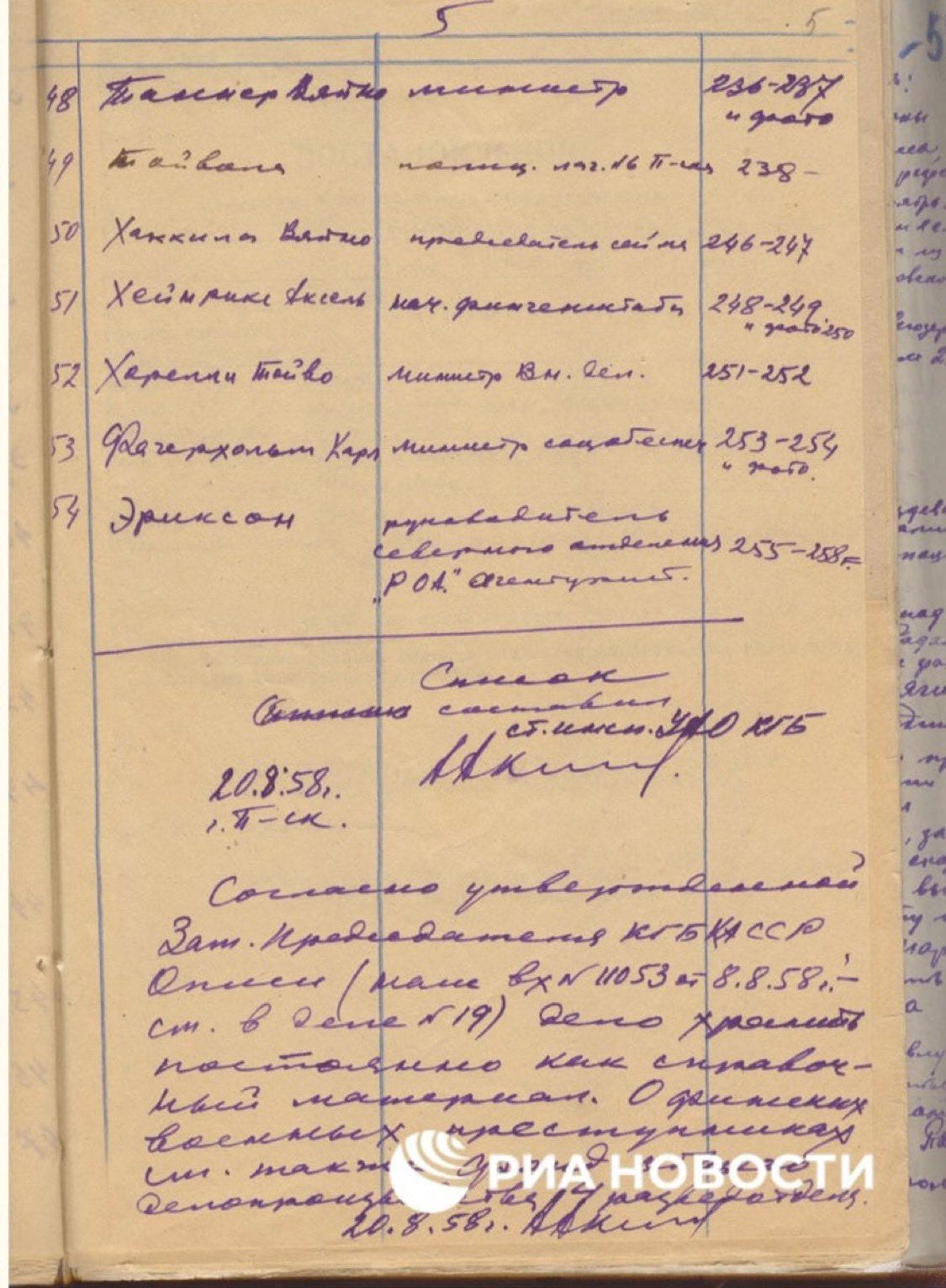
The Finnish Camp No. 6 in Vyborg was one of the most brutal camps for Soviet prisoners of war: up to 17,000 people passed through it, but only a few survived amid starvation, disease, lack of medical care, and constant abuse. Mortality reached catastrophic levels, and the camp earned the reputation of a “Finnish Buchenwald,” becoming a symbol of the barbaric treatment of POWs by the Finnish authorities on occupied Soviet territory. But many of the dead labeled as “prisoners of war” were actually civilians: most rural Soviets lacked passports, and anyone of conscription age was assumed to be a soldier. In 2021, the FSB declassified the names of 54 Finns responsible for the genocide of the Soviet population [32].
All of this is unknown to the average European, American, and even Finn. History is rewritten and presented only through selective episodes, like the Winter War, which makes it difficult to trace the full chain of actions taken by Western countries. And this is no accident: once the sequence of events is laid out, any ordinary person can easily draw some very uncomfortable conclusions that lie right on the surface. So if World War II still feels “murky” to you, if you only have two or three scattered episodes in mind about a six-year global conflict that took 70–80 million lives and destroyed around 2,500 cities, maybe it’s because someone wants it that way.
Mannerheim, Carl Gustaf. Order of the Day No. 1, 29 June 1941.
Mannerheim, Carl Gustaf. Memoirs.
Halén, Harry. Baron Mannerheim's Hunt for Ancient Central Asian Manuscripts. Helsinki, 1999.
U.S. Department of State. Papers Relating to the Foreign Relations of the United States, 1918, Russia, Volume II.Washington, D.C.: Government Printing Office, 1932. Document 1026.
Ahti, Martti. Salaliiton ääriviivat: oikeistoradikalismi ja hyökkäävä idänpolitiikka 1918–1919. Espoo: Weilin + Göös, 1987.
Potka & Kiviharju 2022;
Vahtola, Jouko. Nuorukaisten sota: Suomen sotaretki Aunukseen 1919. Helsinki: Otava, 1997.
Churchill Project. Citing The Churchill Documents, vol. 8.
TIME Magazine, 22 October 1934.
Convention Respecting the Non-Fortification and Neutralisation of the Åland Islands. League of Nations, 1921.
The Times, 15 October 1935.
Naval Encyclopedia. “Vesikko Submarine.” https://naval-encyclopedia.com/ww2/finland/vesikko.php.
Internet Archive. “History of Finland and IVS.” https://web.archive.org/web/20110706044927/http://www.vesikko.fi/history/finland_and_ivs/.
Tanner, Väinö. op. cit. p. 27–28.
The Development of Finnish-Soviet Relations of 1939. Helsinki, 1940, p. 47, 49.
Zimniaia voina 1939–1940. Kn. 2. I. V. Stalin i finskaia kampaniia: Stenogramma soveshchaniia pri TsK VKP(b).Moscow: Nauka, 1998. p. 272.
National Archive of Finland. Risto Ryti collection, Folder 28: T. M. Kivimäki’s letter to R. Witting, 26 September 1941.
Fiore, Massimiliano. The Neglected Campaign: The Italian Navy Contribution to the Siege of Leningrad. UAE, 2023.
Baryshnikov, V. N. Vstuplenie Finlyandii vo Vtoruyu mirovuyu voynu. 1940–1942. St. Petersburg, 2005.
State Archive of the Republic of Finland. Secret telegram from Finnish envoy T. M. Kivimäki, Berlin, 25 June 1941.
Naval Encyclopedia. “Vetehinen-class Submarines.” https://naval-encyclopedia.com/ww2/finland/vetehinen-class-submarines.php.
Engel, Gerhard. Heeresadjutant bei Hitler 1938–1943. Aufzeichnungen des Major Engel. Entry for July 1941. Stuttgart: DVA, 1974.
Letter from Prime Minister Churchill to Field Marshal Mannerheim, 29 November 1941.
Reply Letter from Field Marshal Mannerheim to Prime Minister Churchill, 2 December 1941.
Carl Gustaf Mannerheim. Memoirs
Engel, Gerhard. At the Heart of the Reich: The Secret Diary of Hitler’s Army Adjutant. London: Frontline, 2018.
Baryshnikov, N. I. Blokada Leningrada i Finlyandiya 1941–1944. St. Petersburg–Helsinki, 2002.
Baryshnikov, V. N. Mannergeym ne spasál Leningrad! St. Petersburg, 2013.
Lundin, Charles Leonard. Finland in the Second World War.
Väinö Voionmaa. Diplomaticheskaya pochta. 1984.
Chudovishchnyye zlodeyaniya finsko-fashistskikh zakhvatchikov na territorii Karelo-Finskoy SSR: Sbornik dokumentov i materialov. Gosizdat KFSSR, 1945.
RIA Novosti, 4 August 2021.
No posts
Comments
Nothing yet. Say the first thing.
Sign in to join the conversation.