
A guest post by Robin Fellow
The only decisions, it seems, that Andy Burnham gets right are those he does out of weakness not strength - like his latest U-turn on Thames Water.
Having repeatedly indicated that he wanted to put the company into a special administration regime (SAR) that would allow essential services to keep running until a buyer was found (promising of course to introduce ‘greater public control’ of the ‘essentials’ including water and energy companies as one of his first acts in No 10) The Times reported yesterday that he has shelved these plans amid concerns about the cost and the legal risk involved.
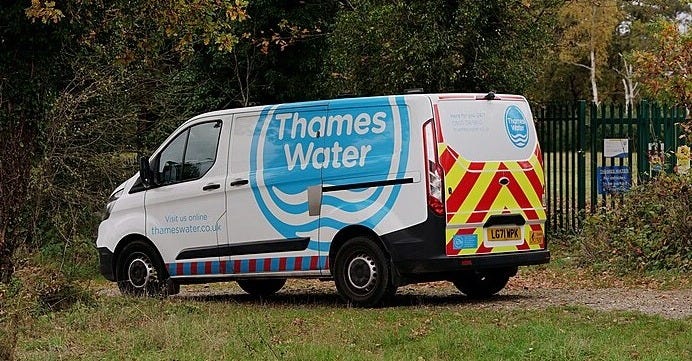
Earlier in the summer Robin Fellow questioned the negative narrative around Thames Water, arguing that compared with government projects Thames Water runs a pretty tight ship. That’s quite apart from its magnificent Thames Tideway achievement. All in all, everyone in the Thames Water region should breathe a collective sigh of relief.
We republish Robin’s instructive article below.
***
Hosepipe bans are imminent, some people in Kent often don’t have anything coming out of the taps at all, and every journalist from Tewkesbury Mead to Beckton Ponds is about to pour some nasty stuff on the water companies.
So this might not be a moment to swim against the tide of opprobrium, but hey, I’ve swum in worse.
The trouble is, people think water should be free. Sure, in the clouds it is. So is natural gas under the North Sea, there’s no Scrooge McDuck hoarding it down there either. The costs come in collecting, purifying and transporting it to where it might be useful, in your bath or boiler.
Water companies are natural monopolies but this isn’t how they started. In the past any enterprising spiv could tap a spring or a stream, lay some wooden pipes or culverts and sell the result to anyone who agreed to pay. Safer than going down to the Thames with a bucket, but not much safer. Before germ theory no one could tell how people died, and the owners of the various water companies could pay themselves dividends that would make the private equity carpetbaggers of privatisation blush.
These monopolies centred around catchment areas. For example, the New River Company supplied North London and the Vauxhall and Southwark supplied, allegedly, a baby crocodile.
The earliest and safest method of water treatment was to turn it into beer. Bacteria don’t like alcohol, but neither did the temperance movements of the Victorian age. New techniques to make water safe to drink were invented, but this still left the sewage problem. Londoners generally relied on the tides to wash the stuff out to sea, which in a sparsely populated city probably worked OK in springs but less so in neaps. And worked very poorly when the population boomed.
When The Great Stink offended even Members of Parliament, Joseph Bazalgette was commissioned to build a sewer network, one of the wonders of the Victorian age. The system was designed to last 30 years, but was basically unchanged until privatisation a century and a half later. Nationalisation did not lead to increased investment. A network of corroding cast-iron pipes and crumbling brickwork was impossible to value, so to get the investors on board the regulator had to promise to allow stonking share dividends.
Naturally the investors took advantage, none more so than the great antipodean vampire squid. But before we blame Macquarie for everything including that baby crocodile, we should acknowledge that they did do the financial engineering that allowed Thames Water to invest in some actual engineering.
Surprisingly, they turned out to be rather good at it. The London ring main, 50 miles long, was completed pretty much on time and on budget. At under a quarter of a billion pounds it cost a fraction of the Channel Tunnel.
The most magnificent achievement is the Thames Tideway. Sixteen miles long, 24ft wide, this super-sewer intersects 34 existing outfalls, eventually connecting to Beckton Ponds. Costing £5billion, it was slightly late and slightly over budget due to the lockdowns. Bazalgette would be proud. It became fully operational in February 2025 and was officially opened in May 2025.
So compared with government projects Thames Water runs a pretty tight ship (HS2, anyone?). But in England no good deed goes unpunished and Thames Water remains very unpopular with the public, who can see the leaks in the supply but not the improvement in the effluent. So the regulator (or regulators – there seem to be at least four of them) has clamped down on the dividends. The water sector now is, according to one stranded shareholder, ‘uninvestable’.
Financially, Thames Water is on its knees, and the Government has kiboshed a rescue plan from private capital. The alternatives look like renationalisation or ‘special administration’. Nationalisation would cost money that the Government doesn’t have (at least £100billion) and simply stealing the water companies would be a bit too communist even for this Government. So the preferred outcome is fascism.
Communism and fascism go together like wasps and jam sandwiches. While it’s not hard to distinguish them, either way your picnic is spoiled. We haven’t yet tried real fascism in Britain (has anyone?) but if leaving the nominal ownership of firms in private hands while compelling the management to obey the dictates of central government is fascism, the special administration surely qualifies.
There is no shortage of zombie industries, so why stop at water? Dive right in and go for the railways, the steelworks, banks, private care homes, farms . . . Just one tiny problem. Investment capital is international and if you kidnap private companies by special administration no international capital will flow your way, ever. Thames Water is a canary, singing loudly. If you expropriate its owners you send an unmistakable signal across the world.
One final thought. Your water bill is probably about half as much as your gas bill. And for that you get the waste taken away as well. Imagine how your gas bill would look if you were obliged to fit CO2 recovery units to your boiler and cooker.
On second thoughts, forget I said that. We don’t want to give them ideas, do we?
No posts
Comments
Nothing yet. Say the first thing.
Sign in to join the conversation.