
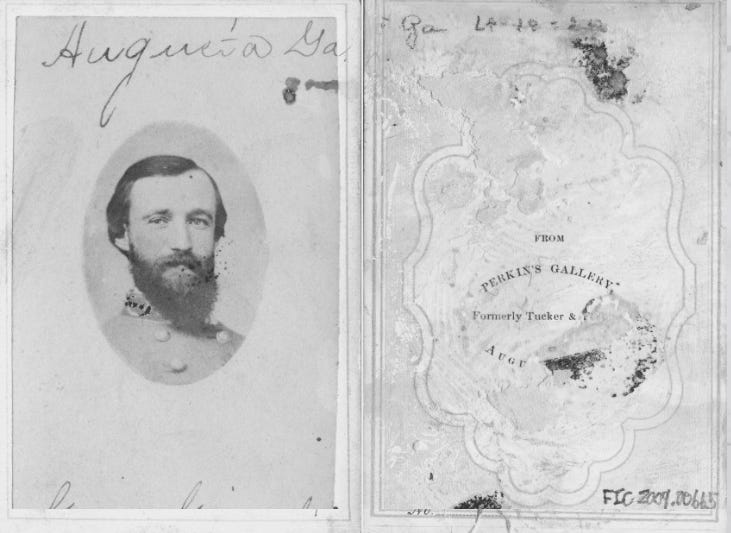
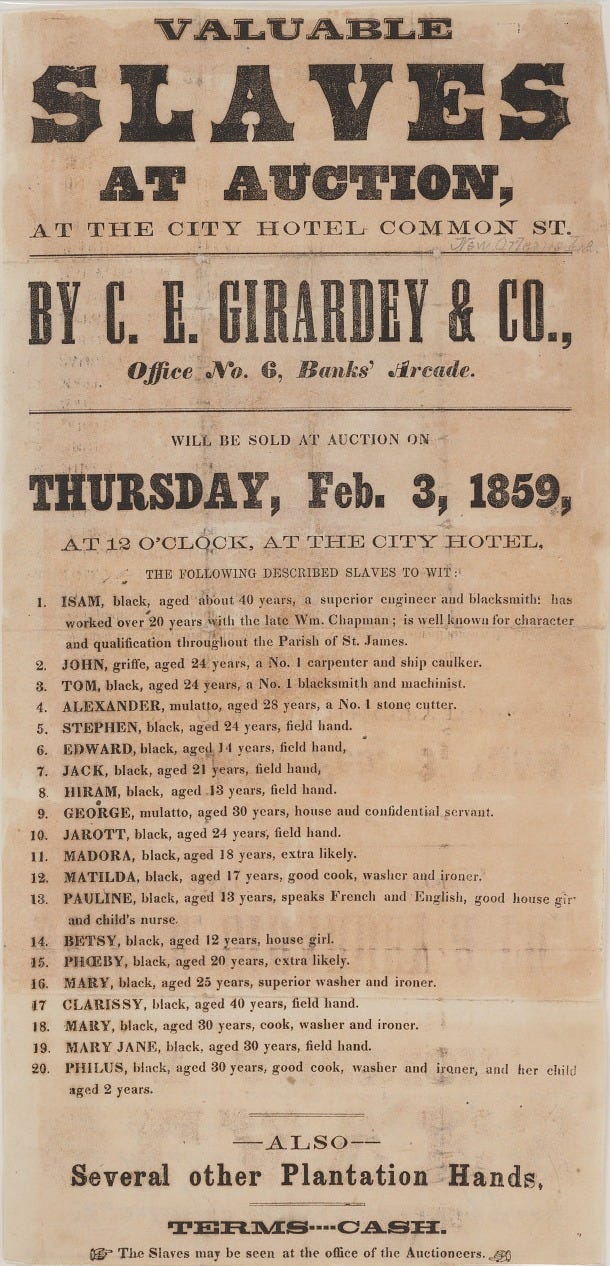
Victor Jean Baptiste Girardey was born on June 26, 1837, in Lauw, in the Alsace region of France. He moved with his parents (Joseph Girardey and Marie Anna Girardey) and three older brothers to Augusta, Georgia, in 1842. His father died in 1846, and his mother followed him nine years later. Orphaned at 16, young Victor moved to New Orleans, Louisiana, and went to work with his brother Camille E. Girardey at his auction house called C.E. Girardey & Company. The firm, which dealt primarily with selling enslaved people, routinely held high-profile auctions at the City Hotel on Common Street. His other two brothers remained in Augusta. (Edward became a medical doctor and Isadore ran a confectionery and managed Edward’s investments, which included a hotel, billiard hall, restaurant, and several saloons.)
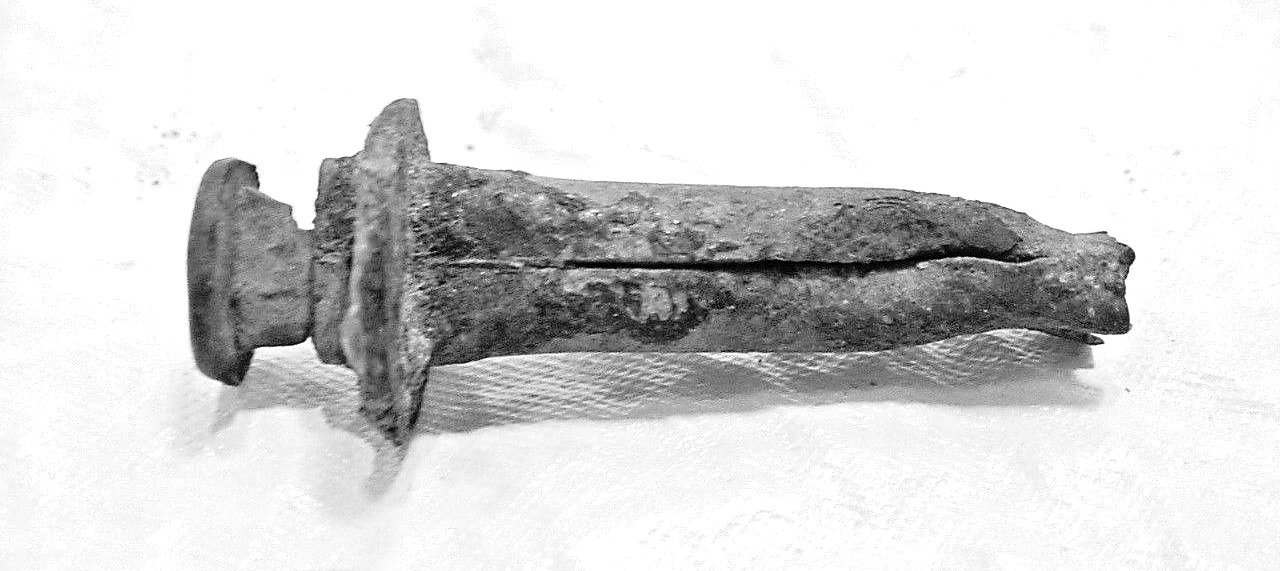
Edward died from an accidental gun discharge in 1859, but the three other Girardey brothers were active in the military and joined the Confederate Army at the beginning of the war. Isadore joined the Washington Artillery Company, known as the ‘Pride of Augusta,’ and became captain of the unit. His health deteriorated while in military service and he resigned after Shiloh. He went to work at the Augusta Arsenal where he worked for Colonel George W. Rains and developed a fuse for exploding shells, known as the Girardey Percussion Fuse. (The fuse was patented in June 1863 and allowed the gunner to transform a shell with a fuze-plug designed for a paper time fuze into a percussion shell.) Camille joined Company B of the First Louisiana Infantry. In July 1862, his company detached to form the Louisiana Guard Artillery and he was appointed as captain. He left the army on sick leave and returned to Augusta where he developed an ice plant to supply C.S. hospitals. He returned to the army and commanded a battery during the campaigns in the Carolinas.
Victor J.B. Girardey joined Dreaux’s First Louisiana Infantry Battalion as a lieutenant in 1861. In October 1861, he resigned his infantry commission and was appointed as an aide-de-camp on the staff of Colonel Albert G. Blanchard, commander of the First Louisiana Regiment, and later a brigade commander. When Ambrose R. ‘Rans’ Wright replaced Blanchard as commander of the brigade, Girardey was promoted to captain and assigned to his staff as an assistant adjutant-general. He served during the Seven Days’ Campaign and was praised by Wright for his actions at Malvern Hill. Girardy continued to serve as a staff officer and was active at Chancellorsville and during the Gettysburg Campaign, where he managed the withdrawal of the Georgia regiments during the chaotic army retreat. When Colonel Edward J. Walker was wounded in fighting at Manassas Gap, Girardy served as temporary commander of Walker’s regiment which held off advancing Union divisions until the Confederate army could escape safely into the Shenandoah Valley.
From the Report of Capt. Charles H. Andrews, Third Georgia Infantry.
At the first of the skirmishing, Colonel Walker, commanding brigade, was wounded. Captain Girardey, assistant adjutant-general, conducted the movements on the left and Captain Andrews upon the right…. The enemy’s advance was very determined from the first, and, after hard fighting, forced the left and center of our line to retire. The Third Georgia being isolated, as it were, was entirely unprotected on its right or left, but not until flanked did it retire, and form on a line with the balance of the brigade…. Between 4 and 5 p.m. the enemy advanced again, and we resisted them to the utmost of human capacity; fought till our ammunition was exhausted, and, to enable us to fight at all, the ammunition was taken from the killed and wounded, and distributed…. The enemy broke our center, forcing us to retire to a line formed of Rodes’ troops in our rear, some 600 yards. The Third Georgia held its position till flanked on the left. The enemy in front of this regiment were repulsed three times…. Great credit is due Capt. V.J.B. Girardey, assistant adjutant-general, who superintended the movements on the left of the brigade, and his gallant behavior nerved the weakest soldier to a full discharge of his duty.”
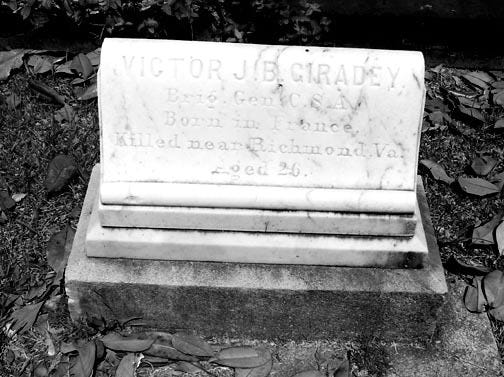
Girardy was transferred to William Mahone’s divisional staff in May 1864, and organized Mahone’s highly successful counterattack at the battle of the Crater. For his actions, Army of Northern Virginia commander Robert E. Lee promoted Captain Girardy to brigadier-general. His promotion was recognized by Confederate President Davis on August 2, 1864, and Girardy was given command of Wright’s Georgia Brigade. In the fighting during the Second Battle of Deep Bottom, Girardy’s brigade was overwhelmed and forced to retreat at Fussell’s Mill. He was shot in the head and killed instantly while attempting to rally his men by waving the with the flag of the 64th Georgia.
His body was recovered by Confederate soldiers after the battle and transported back to Georgia, where he was buried with full military honors in Magnolia Cemetery in Augusta, Georgia. Because Girardy’s promotion was never confirmed by the C.S. Senate, his widow (Emma Clotilde LeSueur) was only eligible to collect a standard captain’s pension.
Mentions in the Official Records:
Report of Brig. Gen. Ambrose R. Wright, C. S. Army, commanding Third Brigade, of operations June 25-July 1, 1862.
I was greatly assisted throughout the entire day’s fight by my assistant adjutant-general, Capt. V. J. B. Girardey, whose coolness, courage, and daring intrepidity throughout the hottest of the fight entitle him to receive the warmest commendations of the Department.
ANDERSON’S DIVISION, Battlefield, Spotsylvania Court-House, May 20, 1864.
Captain Girardey, acting upon the division staff, met a squad of Yankees in charge of two of our men, embracing a Yankee color bearer, yet carrying his own colors. He directed the surrender of these colors to a lieutenant of ours standing nearby. This was just outside the woods near the ice-house.
RICHMOND, August 2, 1864. General R.E. LEE, Petersburg, Va.:
Have ordered the promotion of General Mahone to date from the day of his memorable service, 30th of July. Have directed the appointment, temporary, of Captain Girardey as recommended. JEFF’N DAVIS.
Report of Col. Alvin C. Voris, Sixty-seventh Ohio Infantry.
On approaching their line of pits my command was deployed as skirmishers to open the way for the attacking columns, and led the brigade in the assault on their works. As the skirmish line emerged from the thick woods into the abatis of the enemy in front of their works my skirmishers delivered a deadly fire at the heads of the rebels as they stood behind their earth-works, at the same time receiving a heavy volley from them, and then dashed through the abatis and over the rifle-pits. The fire of my skirmishers caused the death of the rebel general Girardey. We also took one stand of colors and a number of prisoners.

Comments
Nothing yet. Say the first thing.
Sign in to join the conversation.