
“What do you mean, you’ve never seen Bend It Like Beckham?”
I was thirteen, and a white girlfriend was handing me a DVD. I looked at the cover, and the brown face on it, and still remember myself blinking rapidly. My brain was short circuiting. What was I looking at? My friend assumed I had seen it before, which felt slightly racial, but of course she would think that. I mean, why hadn’t I seen it before? I hadn’t even heard of Bend It Like Beckham. She brought the DVD over to watch during our sleepover. She claimed it was her favorite movie. Believing in the divine laws of sleepovers, where every movie viewed at them is The Best Movie Ever, I trusted this would live up to the mandate.
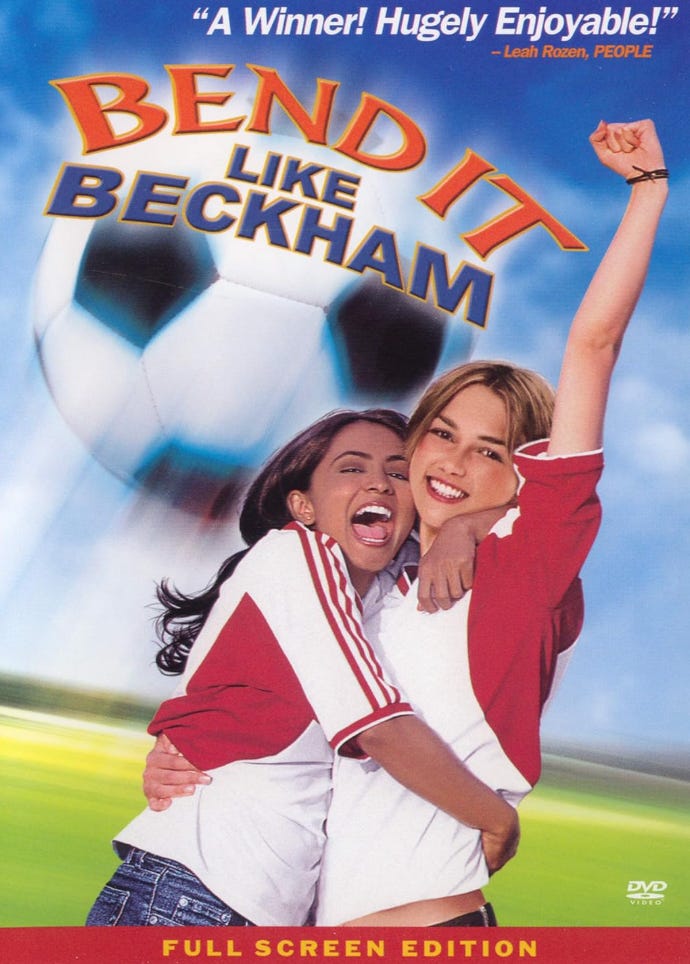
And boy, did it. My infatuation began not even with the film itself but with the cover. Jess and Jules (Parminder Nagra and Keira Knightley) embracing each other, and Jules triumphantly putting her fist in the air. However, even at the time, one thing struck me as odd. I was told this movie was about the Indian girl, Jess. But this cover had me thinking otherwise. At first blush it seemed to me the movie was about Keira Knightley. Not only because she is the white character and I had been conditioned to believe she should be the lead, but also because of her positioning. Her head is situated above Jess’s, and it is her fist pounding the air - as if she, Keira, had just defeated intergenerational trauma to achieve her dreams of becoming a world renowned soccer player.
But that was a tiny little fraction of an inkling of a feeling, and at thirteen, I felt no push to interrogate that further. Because there she was. There was Jess. It was, and I can say this definitively, the first time I had seen an Indian girl on the cover of a DVD. I cringe at myself, typing sentences like that. It feels played out or something. Then I remind myself that no white person ever has had this feeling. Isn’t that crazy to think about?
And yet, they are the purveyors of “representation matters.” So please, for those in the audience who may not know, indulge my millennial instinct to bring you into the full breadth and depth of this cringe feeling. It goes something like this: seeing Parminder Nagra on the cover of the Bend It Like Beckham DVD in 2005 broke my brain in two, exploded it, rearranged it, and the fresh packaging of my skull meat was something entirely new and better.
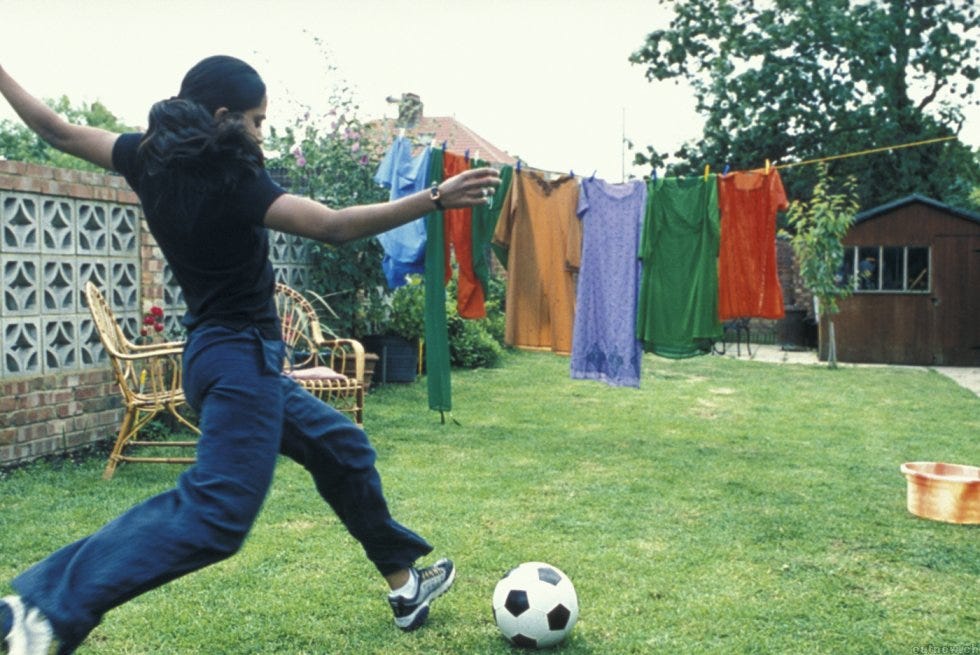
I sat on my sleeping bag enraptured. Everything just felt so familiar. I couldn’t believe what was happening in front of me. The auntie judging your boobs during a lehenga fitting. The patterned wallpaper clashing with the velvet patterned couch. The Hot Indians at the function who judged you for not being as Hot or as Indian as them. The cotton saris drying on the clothesline. Her dad, her sweet, sweet dad. The way he wanted her to get whatever crazy dream she desired reminds me to this day so much of my own father.
The homophobia. The fatphobia. The rigidness of how to be. The constraints I thought I would only ever silently suffer from were on display, shouting out their existence. I felt exposed in a way that was both terrifying and liberating. It’s how most awakenings begin.
There was my world, given a spotlight. My world. Bend It Like Beckham taught me that my world, for all its good and all its bad, wasn’t something to hide. There was the lead character Jess Bhamra on my screen, fighting for it not to be hidden.
Then, the line was said. That relentlessly memed, succinctly phrased, infuriatingly hilarious, line. Anyone who knows this film knows the line of which I speak.
“Jess, I'm Irish. Of course I understand what that feels like.”
Just typing it simultaneously sends shivers down my spine and cracks me the fuck up. It’s uttered by the completely swoon-worthy Jonathan Rhys Meyers in what I *think* is meant to be a completely sincere moment. If I could ask writer/director Gurinder Chadha one question, it would be “what was your intent when you wrote that line?”
See our lead, Jess, has just been called a “p***” by one of white opponents in the soccer match she’s playing. She gets physical with the player, gets a red card, and gets thrown out of the game. Her coach, Joe (Rhys Meyers) becomes upset with Jess. How could she let her emotions take over like that?
He had not heard the slur that was used against her, so Jess illuminates him to the full context of the situation he’s yelling at her about. Then, that man, with eyes as clear blue as an Icelandic lake, and skin as see through as Casper the ghost, speaks that incredibly silly sentence into existence.
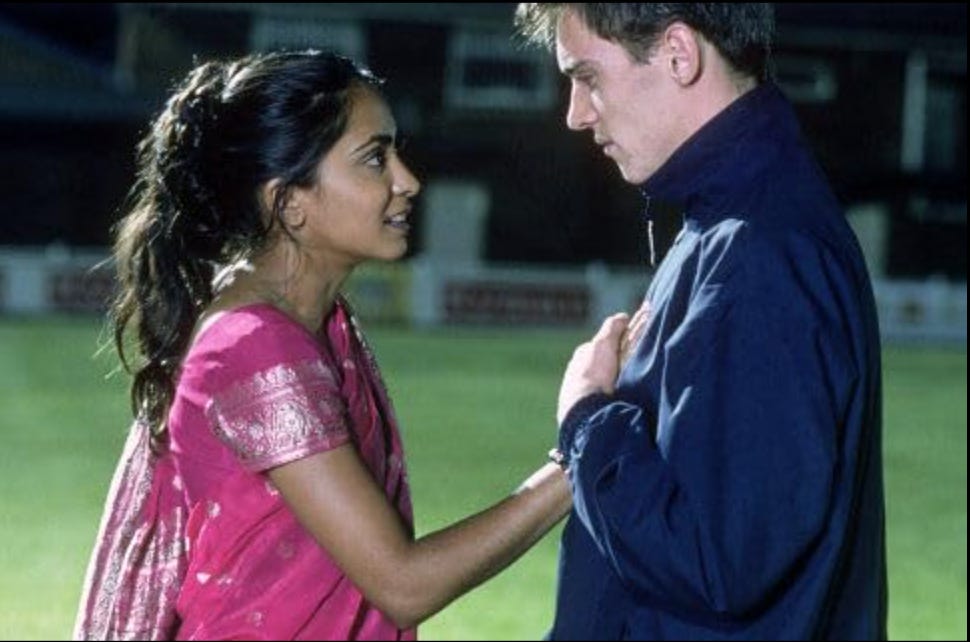
I do not mean to diminish the colonization of the Irish people. However, the incredulity of him saying that to her cannot go unsaid. He may understand the teeny tiniest fraction of her sentiments, but how could he possibly understand being an Indian British woman when he walks the world with the universal passport of being an attractive white male?
When I first heard that dialogue, I thought, “wow, maybe he does get it.” I wanted to believe that he did. It is here I should mention I grew up in Ohio, and went to private school there. Farmland and deer, combined with conservatism and extreme wealth. The commonality of both being a reverence for whiteness. I had no critical faculties at thirteen. I just wanted to make it out alive. And so it was critical to my adolescent survival that I pretended my peers did get it. I couldn’t feel any more alone. However, as a result, even into adulthood I have bent myself every which way to convince myself that my caucasian friends and lovers do understand this deep part of me. I contort myself for their peace. That is somehow easier than having a conversation and allowing our differences to exist in living color. So indeed, I bend it.
This line is my Roman Empire. It keeps me up at night. I hear it in my most vivid dreams and most draining nightmares. How many times in my life have I been told a version of that sentence? Of course I understand, I’m…
Bend, backflip, breakdance, I do everything but stand still. I let it happen. Again and again, I let it happen. I am not playing oppression Olympics. I am playing exhaustion Olympics. Bend It Like Beckham offered up the idea that trying to understand each other's differences was enough and if everybody fell short, that was okay. At least we tried. I accepted this because when I was growing up, it seemed true. It seemed like they were trying, and together, we were progressing. Maybe they did understand because they were Irish.
Two years after Bend It was released, The Office premiered. I grew up in the height of its cultural resonance. I saw one more version of me in Kelly Kapoor. I was pleased. Three years after The Office, Slumdog Millionaire came out, and it swept the Oscars. It won Best Picture. Best Picture.
I practiced the Jai Ho dance with my white girlfriends in my bedroom in Ohio. I picked out a prom dress in marigold because I saw how pretty the color looked on Frieda Pinto. I mean Jesus H. Christ, the Pussycat Dolls of BUTTONS fame did a feature on a song composed by A.R. Rahman. I was coming of age thinking it was only up from here.
Bend It Like Beckham grossed $76 million dollars worldwide, and was made on a $6 million dollar budget. At the time, it was the highest grossing soccer film ever. It was a movie about race and identity that was also a commercial success — it showed that that was possible. This past July, it was announced that Bend It Like Beckham was getting a sequel. My instagram stories were filled with my peers' jubilation. “The band is back together again!” we all collectively squealed. However, as I’ve grown up, I’ve realized a few things about my beloved sleepover movie, and South Asians in film overall.
Since Slumdog’s 2008 win, no other film featuring South Asian leads has won Best Picture at the Oscars. The two that have are Slumdog, and 1982’s Gandhi. Gandhi stars Ben Kingsley, who is half Indian and whose birth name is Krishna Pandit Bhanji, which he changed to further his career. Seems I wasn’t the only one twisting myself.
And as much as Bend It taught me how to see myself, it also reinforced how I compared myself to others. That line, and Jess’s acceptance of it, was a perfect encapsulation of that push-pull. My hometown is the birthplace of Abercrombie & Fitch — I can’t think of a whiter enterprise. My cultural touchpoints for cool were not South Asian-flavored.
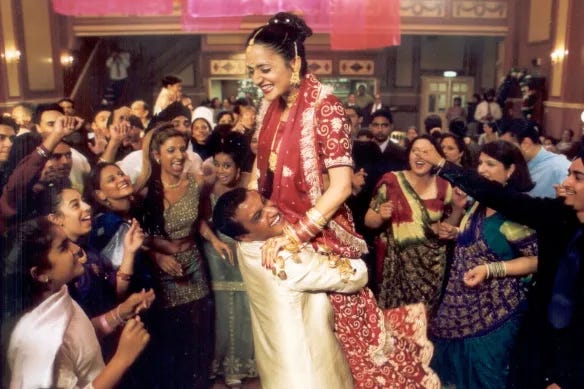
I appreciated how Bend It showed how fun, sexy, and warm, my culture could be, but…Jess’s best friend and love interest were both white. Joe and Jules were still the aspiration. Yes, the film is about that melding of western and eastern cultures, but simply saying that would be ignoring the importance of the visual. It means something that both those non-POC characters framed Jess Bhamra’s story.
UCLA’s 12th annual Hollywood Diversity Report, released in February 2025, found that diversity in Hollywood fell in 2024, breaking a trend of steady progress in previous years. Of the 104 films reviewed, the proportion featuring casts with fewer than 11% actors of color rose from 8.5% in 2023 to 18.4% in 2024 - more than double the previous year and the highest level since 2017, when it reached 28.7%.
The report also found that casts made up of 41–50% people of color (roughly in line with the U.S. population) got the strongest results at the box office, with a median domestic gross of $234 million, the widest release in both domestic and international markets, and the biggest opening weekends.
By contrast, films with just 11–20% BIPOC representation performed the worst, earning a median of just $33 million. The report also showed that non-white audiences were a driving force behind ticket sales, accounting for the majority of viewers for seven of the top ten and twelve of the top twenty highest-grossing films.
As a writer, I found the next stat in the report to be a particular gut punch. The study also found that among the top theatrical films, white men made up 149 of the 189 credited writers. That’s nearly 79%. But hey, of course they understand, right?
The other major commercial rom-coms that feature South Asian leads are Bride and Prejudice and Blinded by the Light, both directed by Gurinder Chadha. I want her to keep creating, but damn, I want someone else to get to jump in the ring too.
By now you’re screaming at your computer/phone screen - KEERTHI, what about One Day, starring Ambika Mod? Go, brown girls, go! Okay, let’s talk about the most recent comparison to Bend It, which is being generous as there has been no South Asian led rom com that has even come close to being the cultural phenomenon Bend It Like Beckham was.
One Day co-star Leo Woodall’s career is skyrocketing. He was in the new Bridget Jones movie and stars in an Apple TV+ series. Ambika Mod is part of an ensemble Disney+ show, by comparison. When you go to their IMDBs, Ambika’s shows One Day as her featured photo, while Leo’s is of the show in which he is the sole lead. Sound familiar?
Kiera Knightley and Jonathan Rhys Meyers both got elevated to Hollywood movie stars, while Parminder Nagra went to television. I don’t mean to imply that she doesn’t have a successful career, but she has not been in one of the most successful movie franchises of all time (Pirates) or nominated for two Oscars like her co-star Ms. Knightley was.
I am past being depressed about this litany of statistics. Typing all of that was exhausting. I am no longer sad, just so very tired. It makes me ask, what am I even doing here? Should I even bother? Why am I bending every which way, for what? I am so very, very tired.
I love Bend It Like Beckham. It does the one thing I think makes any film truly great: I can feel the textures of the movie as I watch it. It is not clean; it is like life. Layered, knubby to the touch. I can feel the contours of Bend It Like Beckham. I do not know what Gurinder Chada has in mind for the sequel. I’m sure whatever it is will be great, but I do have a few requests.
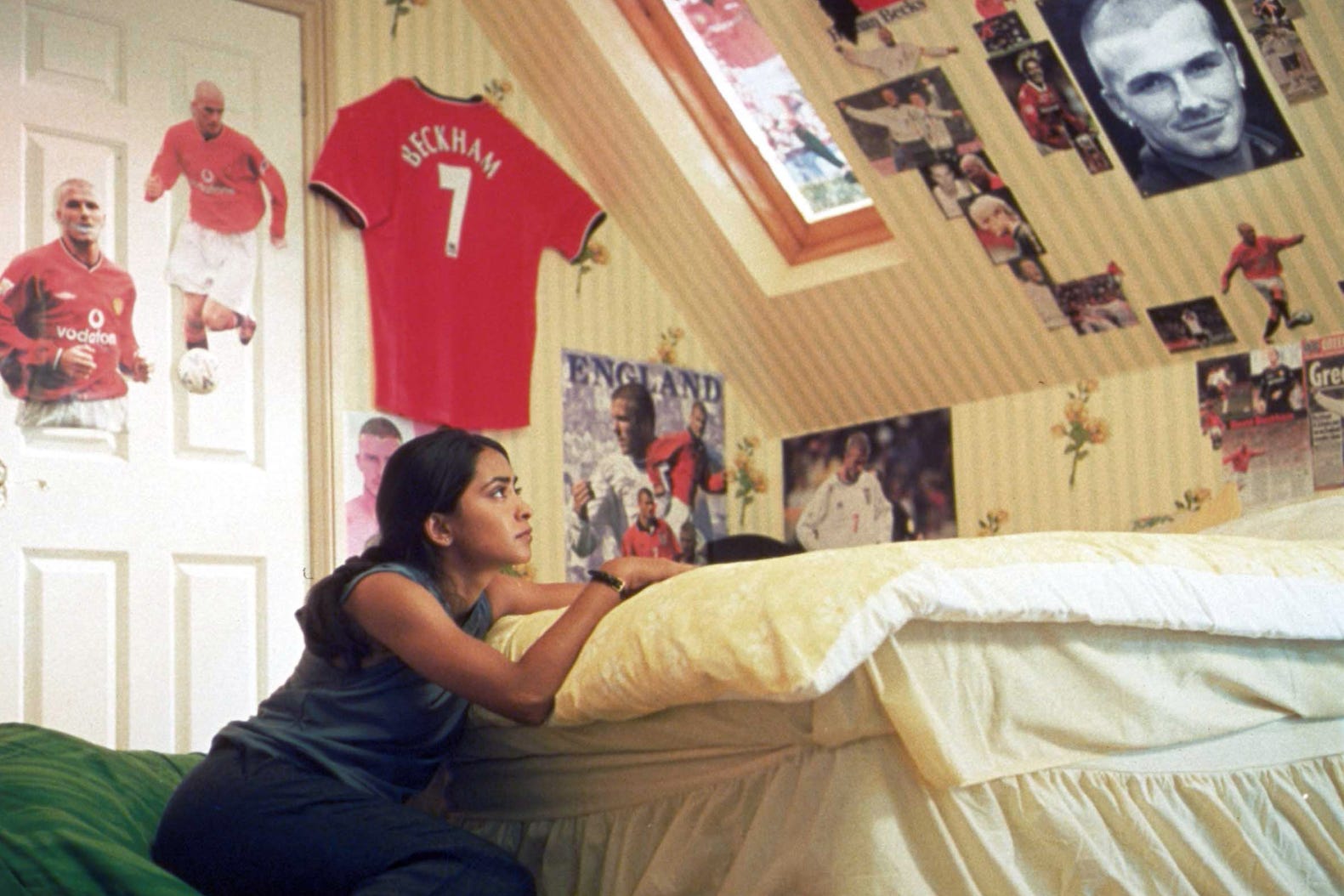
Jess was so much like me. That’s what initially drew me to the film. I not only resonated with her Indian-ness, but I also recognized the ways in which she bent towards whiteness. I don’t say this necessarily as a fault of the film, as I think it's more a depiction of reality. What I ask of the sequel is the same — a depiction of reality. In the 22 years that have passed since this film’s release, I have to imagine Jess feels a bit the way I do, since she felt so much like me all those years ago. And I for one, am angry. I feel mud dragging on my feet as I struggle to move forward. I want Jess to kick the mud off her cleats and remind me why this is all worth fighting for.
Bend It Like Beckham 2 should remove itself from its shackles. I want Jess to get with Dev Patel or whatever hot brown dude she can find. I want her to roll her eyes at Joe, and tell Jules she may get some of it but not all of it. I want her to be angry, the spirit of Kali personified. I want Jess to be loud and brash and draw blood. The journey is no longer about finding your place in a world not meant for you. It's about standing firm in the world you’ve somehow, against all odds, managed to carve out a place in, and demanding that your presence be known.
I have been asked, am I hopeful things will change? That embodying the full scope of said presence will be easier? In the words of my Indian sister Charli XCX, I think about it all the time.
I don’t think the arc of the world bends towards justice, but I do think the arc of the world bends towards each other (which may be a type of justice). It’s the thing that keeps me hopeful in this era of expulsion of difference we have found ourselves in. Where the absence of humanity is being sold to us as the way of the future. I know it’s not. We do fight for each other, we do want each other to be seen. I know this because I see friends reach for each other in the booths at the bars, talking about the movie they just saw that broke their brain open.
-
Find Keerthi on Instagram and at her website.
Join us for a screening of Bend It Like Beckham in LA on Saturday, October 25.
No posts
Comments
Nothing yet. Say the first thing.
Sign in to join the conversation.