
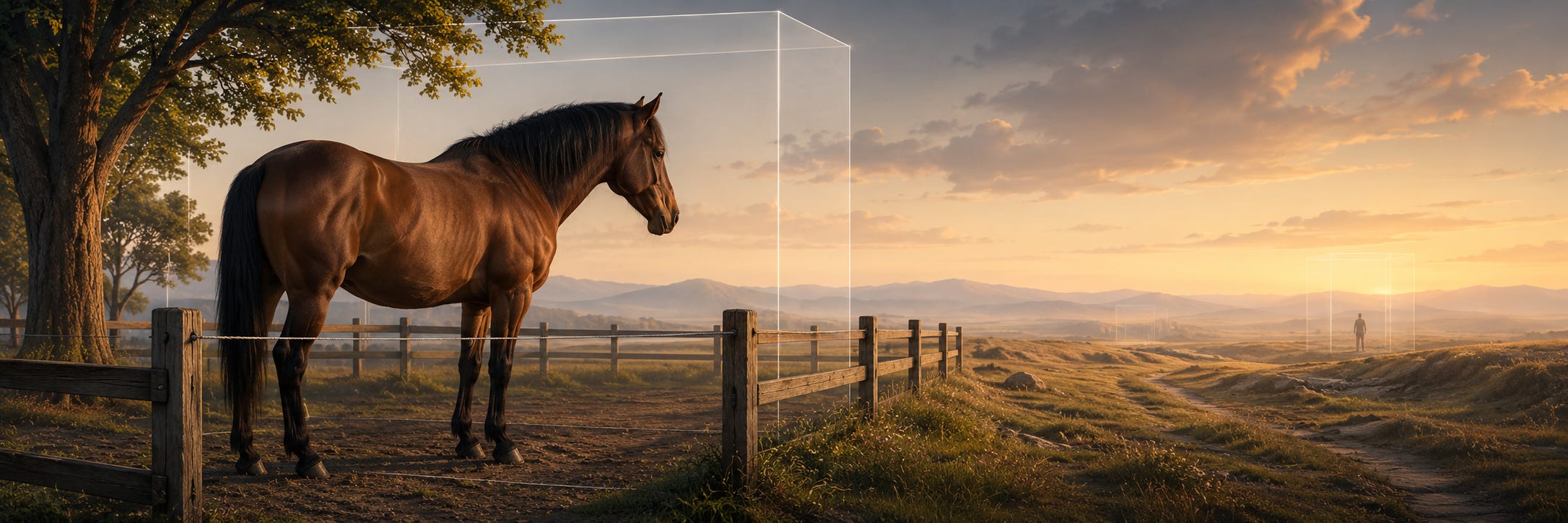
A horse could get out of most pens if it wanted to. This is worth sitting with before anything else, because it is easy to forget. The animal weighs a thousand pounds. The fence is wood, or wire, or a few rails a man set in the ground on a Saturday. A horse that decided to leave could lean the fence down, or clear it in one motion, or work the latch loose with its lips, which some of them learn to do just to prove they can. The barrier is not the thing holding the horse. The barrier has never been the thing holding the horse.
What holds it is a single strand of electric wire and one afternoon, early on, when the horse touched the line and the line touched back. After that the shape of the world is settled. The horse learns where the edges are and stops walking toward them. You can shut the current off. You can leave it off for months. The horse keeps the line anyway, because the fence is no longer in the ground. It is in the animal. It went cold and nothing changed, which is the whole trick of it.
We know this feeling from the inside. Everyone carries a wire they touched once. The thing that went wrong the first time and so was never tried a second. The version of the life that got a shock in year one and was quietly filed under impossible. We stop walking toward those edges so early, and so completely, that after a while we cannot tell the difference between a fence and a horizon. We are not being kept from anything. We are keeping ourselves, out of an old memory of pain, from a country we have decided not to see.
But the wire is the easy part of the story, and if that were all of it the essay would be a greeting card. Touch a hot fence, learn your lesson, very good. The harder part is the one nobody names, because it does not look like a wall at all. It looks like a good life.
The field is enough. That is the real fence. There is water in it, and hay, and the warm flank of another horse to stand beside in the rain. The animal’s needs are met, and a creature whose needs are met has no reason to test anything. Why would it. To leave the field is to risk the field. Out there past the wire the grass might be deeper, or there might be no grass at all. It might be glory. It might be starving in the dark a long way from water. The horse cannot tell which from where it stands, and it never will, because the one thing the pen reliably prevents is finding out.
So it stays. And here is the part I keep turning over: it is right to stay, by every measure the horse has. Staying is the sane choice. Staying is the animal protecting itself from a gamble it cannot price. We would call a person wise for making the same trade. Do not risk the sure adequate thing for the unproven magnificent one. Keep your job. Keep your marriage of long silences. Keep the self you have already paid for. The fence is not cruelty. The fence is prudence, and prudence is how most of a life gets spent.
What the horse cannot see, what none of us can quite see from inside the field, is that contentment is the most effective containment ever devised. A miserable animal tests the wire. A hungry one leans on the fence until it gives. But a well-fed animal keeps the line for you at no cost. It does the guarding itself. It calls the pen a pasture and means it. This is why the surest way to hold something is not to wall it in. It is to feed it enough that leaving starts to look like the reckless thing, the ungrateful thing, the thing only a fool would do when everything it needs is right here.
Most of us are well fed, and we are not wrong to be grateful for it. There is water and hay and the warm flank in the rain, and some fields are the truest place a creature can ever stand. I am not building toward a claim that the field is a lie or that the answer is to run. The horse that bolts into the dark has only traded one fear for another.
But here is where the horse and I part ways, and where it stops being a comfort. A horse has one field. That pen is its entire life, so at least its captivity is whole and honest. We are not so simple. We are fenced on every side at once. There is the field of the work and the field of the marriage, the field of the body, the field of the mind, and we cross between them all day and rarely notice the wire we step over.
Which lets us do the thing a horse never can. We get to be brave in one field and call ourselves brave everywhere. The man who tore down the career fence board by board and walked out into weather knows he is no kept animal. He has the proof. He tested a wire and lived. So he stops looking. He never walks the edge of the quieter fields, because his own record tells him he is a man who walks edges. One real act of courage buys a lifetime of not checking the rest. The pen you cannot see is always the one behind the door marked I’m not like that.
I test fences. I have scars from a few. That is exactly why I distrust myself now. Somewhere in this life there is a field I have never once walked the edge of, and I have left it unwalked precisely because I am so sure I already would have.
So the work is slower and less heroic than escape. It is to go and stand at each fence in turn, put a hand to the wire, and find out whether the current is live or whether it went cold years ago and I simply never checked. One question, asked in every field, as many times as there are fields.
Which fences have you let in?
Comments
Nothing yet. Say the first thing.
Sign in to join the conversation.