
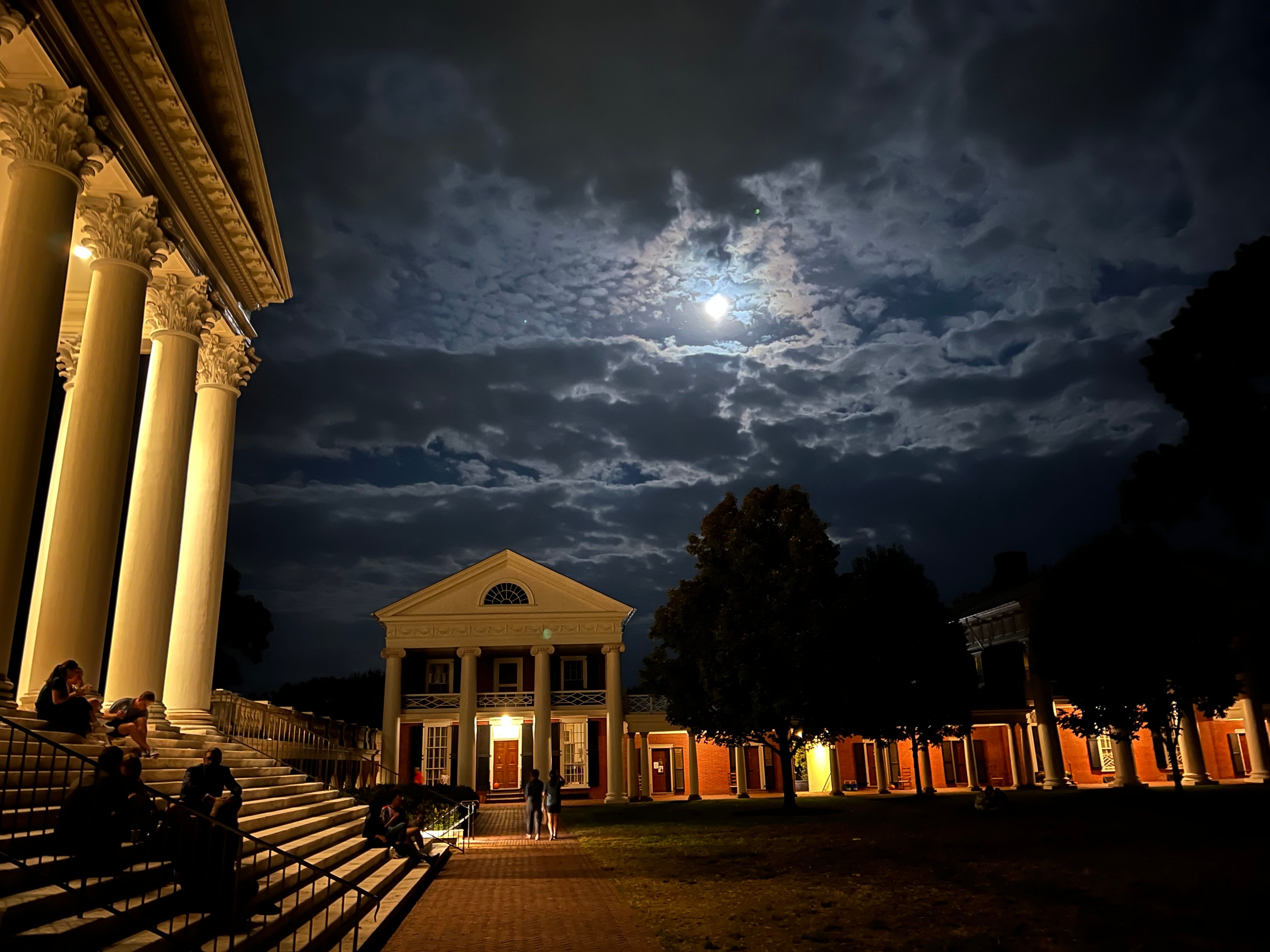
The University of Virginia was blocked from defending against bogus charges leveled by the U.S. Department of Justice. UVA had documented defenses to each charge. How could it be that UVA was prevented from asserting them?
The answers lie in partisan politics that brought culture wars to UVA. The DOJ’s illegitimate attack was given force by Virginia’s statutory scheme that makes Virginia’s attorney general THE lawyer for all state agencies, including state universities. This de facto lawyer-client relationship persists even when there are stark conflicts of interest between the attorney general’s political interests and the interests of a particular state university.
UVA’s recent experience with this fundamentally unworkable scheme shows convincingly that the time has come to fix the present statutory structure, at least as it applies to Virginia’s public colleges and universities.
The Problem in Statute: Virginia’s “One Lawyer” Attorney General Construct
There are inescapable practical and ethical problems baked into current statute where the attorney general is the direct supervisor of each state university counsel. In practical effect, this makes the attorney general the de facto client – the only client – of each state university counsel. If an attorney general has partisan political interests and demands that university counsel accede to those interests, then the legitimate interests of the university do not matter. They fall by the wayside.
This is the statute at issue (highlights and emphasis added):
§ 2.2-507. Legal service in civil matters.
A. All legal service in civil matters for the Commonwealth, the Governor, and every state department, institution, division, commission, board, bureau, agency, entity, official, court, or judge, including the conduct of all civil litigation in which any of them are interested, shall be rendered and performed by the Attorney General, except as provided in this chapter and except for any litigation concerning a justice or judge initiated by the Judicial Inquiry and Review Commission. No regular counsel shall be employed for or by the Governor or any state department, institution, division, commission, board, bureau, agency, entity, or official. The Attorney General may represent personally or through one or more of his assistants any number of state departments, institutions, divisions, commissions, boards, bureaus, agencies, entities, officials, courts, or judges that are parties to the same transaction or that are parties in the same civil or administrative proceeding and may represent multiple interests within the same department, institution, division, commission, board, bureau, agency, or entity.
This legislation overrides Virginia Supreme Court ethics rules. Those rules would otherwise condemn the attorney general’s representation of conflicting interests between or among Virginia’s executive agencies.
The problem lies with particular application to Virginia’s state universities and colleges, which do not make or administer executive branch policy and are, instead, creatures of the legislature. (For example, under Section 23.1-2200 A of the Code of Virginia, “The board of visitors of the University of Virginia (the board) is a corporation under the name and style of “the Rector and Visitors of the University of Virginia”. . . . The board shall at all times be under the control of the General Assembly.”)
At universities and colleges, constitutional protection of academic freedom and free speech is a special legal concern. Experience shows that overriding lawyers’ conflict of interest rules in the statute as applied in the unique context of state universities does not make the impracticability of the statute go away. The conflicts persist; the chaos wrought at state universities is inevitable.
The University of Virginia and its sister public universities and colleges is each a separately chartered, individual corporation with an independent legal existence. The University of Virginia is just as entitled to the undivided loyalty of the person serving as its university counsel, in effect as its general counsel, as is any other client of any other attorney in the Commonwealth. The University of Virginia is just as entitled to have its general counsel maintain the confidentiality of client communications as is any other client of any other attorney in Virginia. The other public universities and colleges in Virginia have the same right to, and the same need for, independent counsel loyal to them.
These ethical requirements are significant because of the practical consequences of their breach. Corporate officers and directors (such as the president of a state university and members of the university’s board) who enjoy the undivided loyalty of their legal counsel are more likely to seek legal advice regularly, to trust the motives of the lawyer providing the advice, and hence to believe that they can rely on that advice, even if they do not follow it in every instance.
Conversely, corporate officers and directors who recognize that their lawyer has divided loyalties, as does UVA’s university counsel under existing process, may fail to consult that attorney as often or to trust that attorney as much as they would an advisor who is independent of Virginia’s attorney general.
No person may serve two masters with competing interests at the same time without preferring one over the other. That is a practical fact. It is the reason attorneys are ethically enjoined from attempting to do so. In theory and practice, Virginia’s present statutory scheme for selecting general counsel for public universities and colleges denies this reality. Hence it denies the University of Virginia the services of an independent counsel who can meet the ethical obligations that should be owed by an attorney to a client. The same is true for the other public colleges and universities in Virginia.
To paraphrase an earlier analysis by a colleague, the assistant attorneys general who should serve as general counsel for each Virginia public university or college thus faces an inherent, fraught conflict of interest. The conflict arises from attempting to serve two masters – the university as supposed client and the attorney general as employer and de facto client.
The statutory framework does not in fact resolve the real-world conflict of interest, because it is constant and inescapable. A statutory framework cannot magically enable a deputy attorney general in place at a public university to furnish independent legal advice to the supposed client, the university.
The statute thus denies each of Virginia’s public universities and colleges, and their presidents and boards of visitors, three critical rights: the right to select independent general counsel in whom the board has complete confidence, the right to the undivided loyalty of counsel, and the right to confidential communications with counsel.
In recent months we have all been witness to how this Gordian Knot is playing out. UVA’s being forbidden by the current attorney general to defend itself legally set the stage for corrosive impropriety in UVA’s negotiations with the DOJ. Former UVA university counsel Timothy J. Heaphy, in a June 30, 2025 guest essay in The New York Times, condemned what happened after the DOJ accused UVA of continuing to follow unconstitutional racial preferences in service of Diversity, Equity, and Inclusion (DEI):
Instead of asserting [its] valid defenses, the University of Virginia opted to capitulate to the demand for [UVA president Jim] Ryan’s resignation, tacitly agreeing with the notion that the university somehow engaged in illegal racial discrimination.
Why? By law, the university and all state agencies are represented by the attorney general of Virginia. The current attorney general has been an outspoken opponent of D.E.I. programs. He joined Virginia’s governor, Glenn Youngkin, in applauding the university’s dismantling of D.E.I. programs in March. This means rather than having an advocate loyal to the university and its interests, Mr. Ryan and the university were saddled with counsel aligned with the other side.
And in correspondence recently uncovered by State Senator Creigh Deeds, there is a damning text exchange between UVA’s then-Rector Robert Hardie and the then-Board of Visitors member and soon-to-be Rector Rachel Sheridan (as reported on November 18, 2025 by the Cavalier Daily):
The records also reveal tense discussions over text between Hardie and Sheridan in the time before and after [UVA president] Ryan’s resignation.
Hardie began the conversation in a text chain to Sheridan and Board Member Paul Manning June 24 — three days before Ryan resigned — saying he was “disappointed” in the pair for leaving him out of an alleged conversation with the Justice Department.
“Both of you will be vilified as well as the Board (I will no longer be on it so will have maximum power to oppose it). I will oppose it with all my might, which is significant,” Hardie wrote. “I am very disappointed that two of my closest friends decided to leave their friend the Rector out of such a [conversation]. Stand by your president. This is sickening to me. I am appalled.”
In summary, Virginia’s current attorney general with, we believe, concurrence and political pressure from Virginia’s current governor, forbade UVA from defending itself from the DOJ’s bogus allegations. The attorney general’s actions, politically inspired as we understand them, are the more reprehensible because UVA has substantial defenses to each contrived DOJ allegation.
The inherent conflict of interest is clear for all to see. So is the harm from having university counsel in practical fact represent Virginia’s attorney general rather than the institutions where university counsel serve.
There is no defensible functional reason whatever for university counsel to be assistant attorneys general of the Commonwealth. There is every functional and ethical reason for them to be counsel to the universities they are hired to represent – and to which they should be able to give undivided loyalty.
Ethical considerations, contradictory specifications in current Virginia statutes, real-world practicality, and recent experience converge as we consider advice to offer.
The Solution: Statutory Change So University Counsel at Virginia’s State Universities Owe Undivided and Uncompromised Loyalty to Their Universities
Legislation should specify that selection of university counsel is the responsibility of boards of visitors at Virginia’s state colleges and universities, and further specify that the client of university counsel is their respective institutions, not the attorney general de facto. Each counsel’s duty would be to the institution they serve.
These changes can properly be limited to the representation of state colleges and universities. They need not and should not extend to other agencies and institutions of state government. The reason is that, unlike other arms of the Commonwealth and as noted above, state universities and colleges do not make or administer executive branch policy. Separate representation for these institutions therefore will not compromise the Governor’s ability to carry out policy for the Commonwealth.
A. First Amendment Framework
The constitutional law of academic freedom is the appropriate starting point to justify this statutory change. Here are words from Chief Justice Earl Warren’s plurality opinion in Sweezy v. New Hampshire, 354 U.S. 234 (1957):
The essentiality of freedom in the community of American universities is almost self-evident. No one should underestimate the vital role in a democracy that is played by those who guide and train our youth. To impose any strait jacket upon the intellectual leaders in our colleges and universities would imperil the future of our Nation.
And here, ten years later, is Justice William Brennan in Keyishian v. Board of Regents, 385 U.S. 589 (1967):
Our Nation is deeply committed to safeguarding academic freedom, which is of transcendent value to all of us and not merely to the teachers concerned. That freedom is therefore a special concern of the First Amendment, which does not tolerate laws that cast a pall of orthodoxy over the classroom.
It is important to distinguish teaching in university classrooms, crafting curricula, conducting research, and other facets of protected academic work in state universities from “government speech.” The unsuccessful argument that professors’ teaching and other activities at state universities are state speech, and so not within the ambit of First Amendment protection, has recently been rolled out, e.g., in Indiana. There it will be a futile defense of recent legislation requiring intellectual diversity at state universities. https://tinyurl.com/23haw9ee. If the Indiana legislation is challenged based on familiar precedent, the university will lose.
Garcetti v. Ceballos, 547 U.S. 410 (2006), is a case explaining “state speech.” When state employees are speaking in their official capacities for governmental purposes on behalf of the state, that is government speech. The “controlling factor” is whether statements are made pursuant to official governmental duties. Whether that factor is present in a given setting requires careful factual inquiry. We know from Sweezy and Keyishian that university professors’ teaching and related activities are, by categorical definition, not speech made as part of official governmental duties. Those activities aren’t state speech. The line drawn in Garcetti may be blurry in some applications, but not when it comes to activities in higher education commonly understood to fall under the rubric of academic freedom.
Virginia and other states need not establish and fund state universities. When they do, they can prescribe broad mission statements for state institutions, such as the 1919 statute specifying courses to be taught at UVA (still the current statute):
§ 23.1-2203. Courses of study to be taught.
The following courses of study shall be taught at the University: the Latin, Greek, Hebrew, French, Spanish, Italian, German, and Anglo-Saxon languages; the different branches of mathematics, pure and physical; natural philosophy, chemistry, and mineralogy, including geology; the principles of agriculture; botany, anatomy, surgery, and medicine; zoology, history, ideology, general grammar, ethics, rhetoric, and belles lettres; and civil government, political economy, the law of nature and of nations, and municipal law.
Code 1919, § 817, § 23-63; 2016, c. 588.
https://law.lis.virginia.gov/vacode/title23.1/chapter22/section23.1-2203/
But, when a legislature elects to establish institutions of higher learning as Virginia has, it nevertheless cannot impose conditions on faculty that do not survive First Amendment scrutiny under Sweezy and Keyishian. A legislature cannot, for example, require particular viewpoint balance in faculty teaching or composition. To do so would be governmental viewpoint discrimination, which is forbidden by the First Amendment generally, and in particular in academic settings under Sweezy and Keyishian .
Parenthetically, this analysis applies in analogous areas such as public broadcasting, where there are many networks established by state governments. In Arkansas Educational Television Commission v. Forbes, 523 U.S. 666 (1998), the Court upheld an editorial decision of the state’s public broadcasting network to exclude a particular candidate with little popular support from a televised political debate. The Court relied on a jury’s specific finding that viewpoint discrimination was not involved in the editorial decision made by the executive director of the state network. The U.S. Solicitor General argued that the executive director’s decision should be beyond challenge because it was state speech. The Court rejected that argument out of hand. It instead upheld AETC’s decision as an exercise of editorial judgment independent of state political influence, and so consistent with the First Amendment.
Preserving and strengthening this framework is essential to academic freedom and, more generally, to free speech in higher education at state universities. Long experience teaches that successful defense requires universities to have the capacity to litigate against attacks on First Amendment freedoms.
B. Contradictions in Virginia’s Current Statutory Framework
We have demonstrated that Virginia’s statutes unnecessarily expose state universities to political manipulation for purposes of regulating, and so unconstitutionally impinging on, academic freedom and free speech. No doubt in recent circumstances the DOJ, Virginia’s governor, and Virginia’s attorney general exerted improper partisan influence on and through UVA’s BOV. They sought to impose viewpoint discrimination for political purposes. Partisan pressure was directly applied by Virginia’s attorney general. He did so by preventing university counsel from defending UVA against the DOJ’s spurious charges. Under a different statutory framework, where university counsel would serve only the best interests of UVA, there no doubt would have been a different response to the DOJ.
Virginia’s statutory scheme, at least as it applies to university counsel and other counsel State universities engage separately, is a futility, and ripe for revision.
Whatever the wisdom otherwise, the concept of a unitary attorney general who represents all state agencies does not work where partisan pressure is applied to control academic freedom and free speech at Virginia’s state universities. State universities are, and should be treated as, exceptions to the general rule that the attorney general is empowered to represent interests – even conflicting interests – of state agencies generally.
What justifies the exception, aside from recent experience? It is that academic freedom at state colleges and universities is protected under the First and Fourteenth Amendments. State universities produce content that is not government speech. Protected expression at universities cannot legally (i.e., constitutionally) be subject to governmental viewpoint discrimination and political pressure. The exception is further justified, as described above, by the non-programmatic role played by state universities.
That is why university counsel should be hired by boards of visitors, not the attorney general, and why counsel should owe duties of loyalty exclusively, and without contradiction or dilution, to the respective universities they are appointed to serve. Effective, ethical legal representation of universities cannot be made to work otherwise.
Parenthetically, other states avoid imposing the ethical conflict that exists in Virginia’s scheme. A recent example is described in the announcement that UVA’s university counsel, Cliff Iler, is leaving to become general counsel at the University of Arizona. The Cavalier Daily reports (emphasis added:
Per Virginia law, the attorney general has power to select legal counsel for state institutions in Virginia, and Iler reported to [Virginia Attorney General Jason] Miyares while in his position. In contrast, University of Arizona President Suresh Garimella selected Iler following a nationwide search, according to the release, which also noted that in Arizona, legal counsel for public institutions does not report to the state’s attorney general.
C. Suggestions for Revisions to Statutes
The Virginia General Assembly should adopt the following in statute:
Virginia state college and university attorneys (and their staffs), hired by their respective boards of visitors, should be exempt from the general rule that the attorney general of Virginia, personally or through appointments, is the exclusive legal counsel for all state agencies. That explicit exemption should extend as well to other attorneys engaged by each of those boards of visitors to represent their respective universities for particular purposes.
Attorneys hired, appointed, or engaged for particular purposes by boards of visitors at Virginia state colleges and universities owe their duty of undivided loyalty and their duty to maintain confidential attorney-client communications to their respective institutions and the boards of visitors that hire or otherwise engage them.
Boards of visitors at Virginia state colleges and universities shall have discretion to hire or appoint college or university attorneys, or other attorneys engaged by any of those boards of visitors, using procedures and criteria that they in their sole good faith judgment shall adopt in service of their receptive institutions; and those procedures and criteria need not include national searches or any other particular procedure or criteria for identifying or selecting candidates unless each board in its sole discretion elects to adopt such procedures and criteria in particular appointment or hiring decisions.
Boards of visitors at Virginia state colleges and universities shall have discretion to request legal representation by the Attorney General of Virginia in or for matters they deem appropriate. In any such instances the Attorney General shall have discretion to accept or decline such representation.
These provisions recognize the need under First and Fourteenth Amendment precedents to afford substantial independence to Virginia’s state institutions of higher learning. The changes will offer essential protection to universities from back-and-forth political pressure or partisan interference in legal representation affecting academic freedom and freedom of speech. The changes would not otherwise affect or restrict the General Assembly from specifying in legislation other requirements existing now in statute or arising in future.
Notes:
Timothy J. Heaphy’s June 30, 2025 New York Times guest essay is available here: https://www.nytimes.com/2025/06/30/opinion/university-of-virginia-doj-trump.html
The Cavalieer Daily’s report, State Se
n. Creigh Deeds received his FOIA requests from U.VA - here’s what we learned, is available here: https://www.cavalierdaily.com/article/2025/11/state-sen-creigh-deeds-received-his-foia-requests-from-uva-heres-what-we-learned
The Cavalier Daily’s report, University Counsel Cliff Iler to depart for University of Arizona, is available here: https://www.cavalierdaily.com/article/2025/10/university-counsel-cliff-iler-to-depart-for-university-of-arizona
Richard D. Marks
Richard D. Marks is a member of the District of Columbia Bar. He graduated from the College of Arts & Sciences at the University of Virginia in 1966 and from Yale Law School in 1969.
.
No posts
Comments
Nothing yet. Say the first thing.
Sign in to join the conversation.