
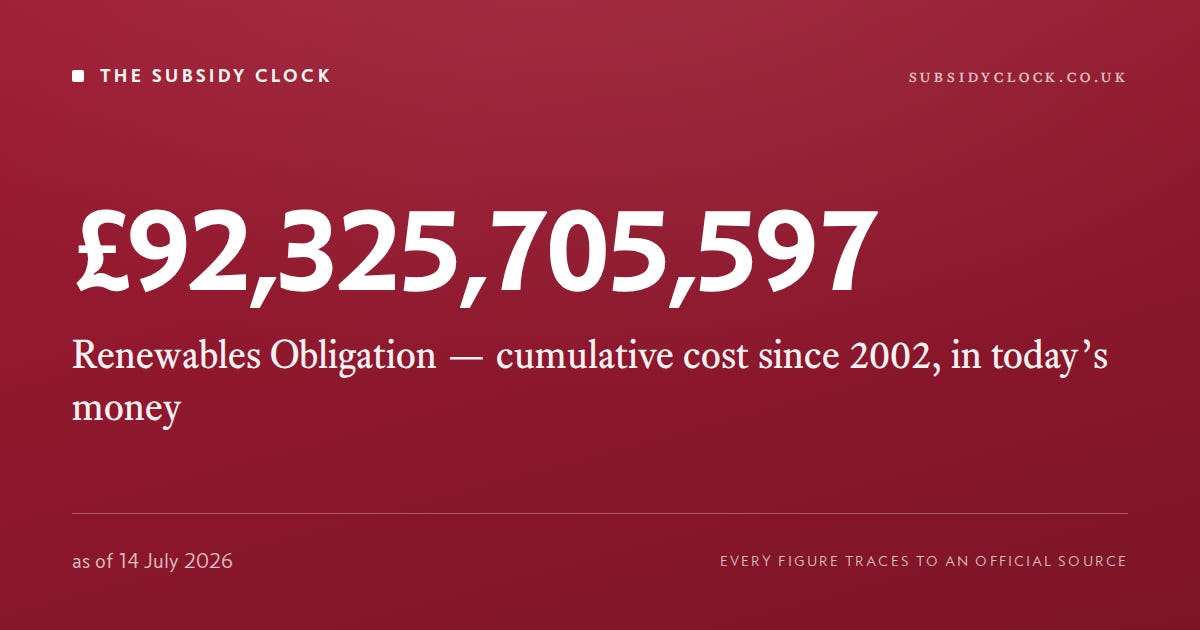
This week on the Subsidy Clock we are looking at the scheme with the dullest name and the largest bill: the Renewables Obligation. It stands at over £92 billion. That makes it the largest subsidy on Britain’s electricity market, and the quietest.
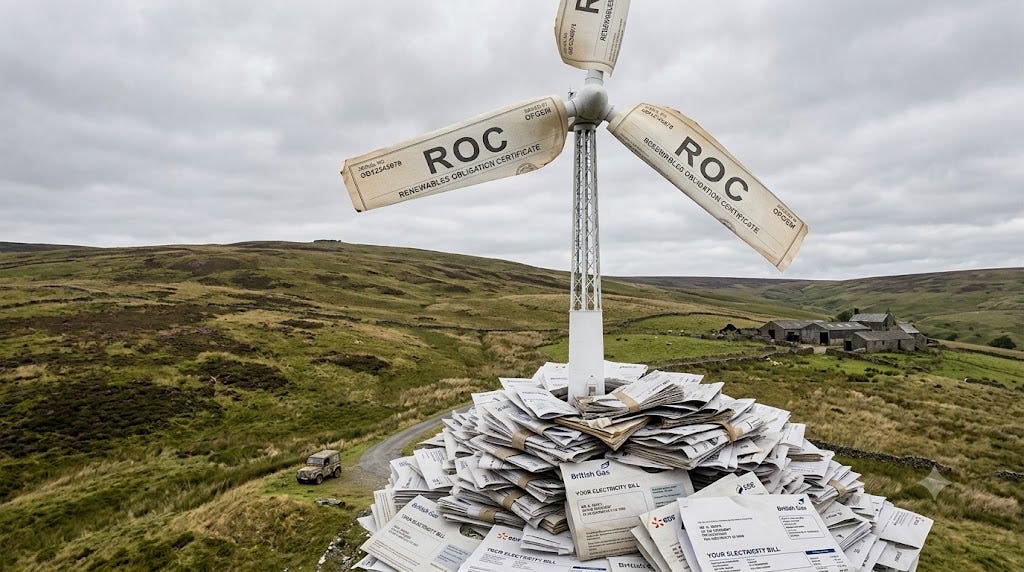
THE RENEWABLES OBLIGATION does not sound like money. It sounds like a regulation — a target, a box to tick. It is all of those things. It is also the largest single subsidy on your electricity bill that almost nobody has heard of.
Introduced in 2002 under the Utilities Act 2000, the RO obliges every licensed electricity supplier to source a rising share of its power from renewable generators. The proof is a tradeable certificate called a ROC — a Renewables Obligation Certificate — awarded by Ofgem for every megawatt-hour a green generator produces. Suppliers hand the ROCs back each year to show they have met the target. If they fall short, they pay a penalty into a central ‘buy-out’ fund at a price fixed by Ofgem. The money in that fund is then shared among the suppliers who did hand in their certificates.
The result is that a ROC is worth roughly the buy-out price, so generators sell their certificates to suppliers for a predictable premium. The cost is passed straight to you through the unit rate on your bill. It is an elegant piece of market design, and an expensive one.
Unlike its successor, Contracts for Difference, the RO does not fix a price in advance for each generator. It fixes a quantity — the percentage of supply that must be ‘green’ — and lets the market discover the cost. In practice Ofgem’s annual buy-out price sets the floor, the recycling of the fund sets the top, and the bill lands somewhere predictable in between. The administrators call this price discovery. After two decades, consumers might call it something else.
The RO closed to new capacity on 31 March 2017, replaced by CfDs for new build. But every generator accredited before that date was guaranteed twenty years of support, so the scheme is still paying out, station by station, and will continue until 2037. The £92.3 billion on the Clock is not an estimate; it is the audited running total, scheme year by scheme year, traced back to Ofgem’s own annual reports. It is costing about £7.7 billion a year right now. That built much of the wind fleet Britain runs on. The scheme is not a story of nothing delivered — it is a story of a bill locked in before anyone could know the final price.
To put that in context, it is more than six times the size of the CfD scheme — roughly £14.7 billion since 2016 — and it is still growing.
That is the mechanism. Here is why the cost is structural. A twenty-year guarantee sounded prudent when it was offered: it gave investors the confidence to build wind farms in the early 2000s, when renewables were risky. But a promise that long has a property its designers did not advertise. You cannot switch it off when the technology becomes cheap. You cannot renegotiate it when the grid changes. You can only watch it unwind, one expiry at a time, while newer and supposedly cheaper schemes stack on top.
The RO is the reason your bill carries a legacy cost that has nothing to do with the price of new wind. It was designed to grow, and to outlive the government that created it. That is not a scandal. That is the architecture.
The meter is running — go and watch it.
The Energy Trap: Why the Renewable Energy Transition Can’t Work — And What Can is published by Swift Press in September.
Comments
Nothing yet. Say the first thing.
Sign in to join the conversation.