
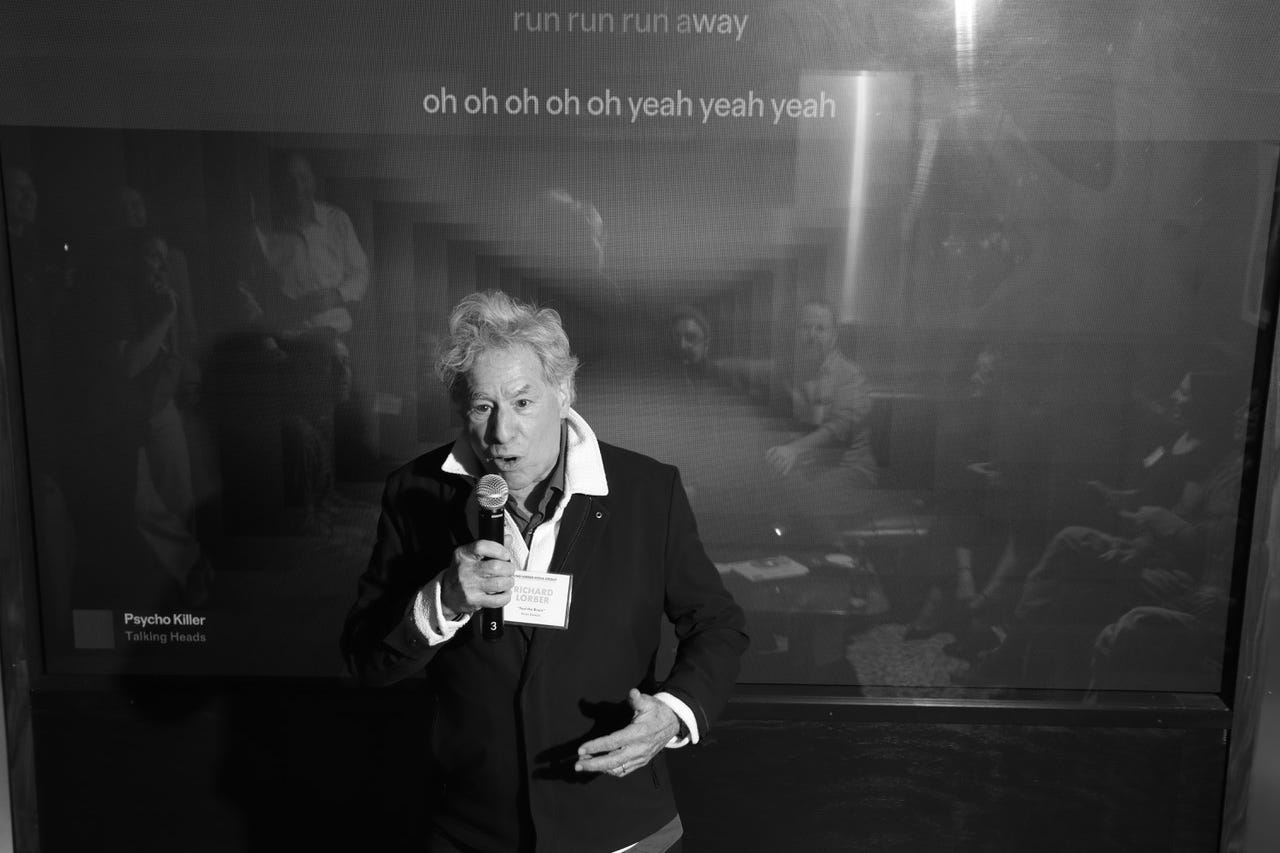
Recently, Kino Lorber had a holiday party with the main entertainment being karaoke. What better way to stir social interaction! It collapsed the hierarchies of our org chart as reserved senior executives became shameless exhibitionists delighting in their inept performances, while junior members rose to the top with real vocal talent and star charisma. Karaoke induced a unanimous glee that democratized our corps of 80. With erased audio lyrics projected as text, it was a perfect celebration of subtitles for a company that has for over 40 years been distributing international and silent films with words accompanying pictures…we truly march to the tune of text on screen. And in some ways, now our whole culture does.
For about 100 years, four generations have come of age processing moving images with text, first in silent cinema and later with sound in movies from around the world. The process accelerated with the rush of technology as text became ever more scrambled with images on TVs, computers, and the ceaseless scrolling of smartphones—today the marriage of image and text reigns over all shapes and sizes of screens. Mostly, though, we’re numb to the perception that text, which is basically static, requires effort to be read in time while our eyes and ears automatically, if not passively, absorb the simultaneous flow of images and sound. I had a wake-up call about this at my own party when my karaoke moment of truth came.
Severely unendowed with vocal talent and never having performed before, I sought out a favorite song with minimal singable lines, ironically from Talking Heads: “Psycho Killer.” I practiced it the night before—mostly syncopated consonants, howled vowels, and refrains of a French phrase I could confidently pronounce. I thought I could nail it:
Psycho killer, qu’est-ce que c’est?
Fa, fa, fa, fa, fa, fa, fa, far better
Run, run, run, run, run, run away
Oh-ho-ho-ho, aye-yi-yi-yi-yi…
As I ascended the platform, facing a friendly room cheering the Chairman, I began to sing. But as I started mouthing words, the text my eyes were following on screen went out of sync with the sound of the song A karaoke crisis! I felt like Chaplin in Modern Times on the sped up assembly line—stumbling over phrases, improvising grunts and screeches, trying to catch up to the lyrics. I’m sure it upped the enjoyment of my faithful audience seeing their boss undone by a tech glitch. Someone complimented me saying I really killed it, though I knew it was not the way David Byrne’s psycho intended.
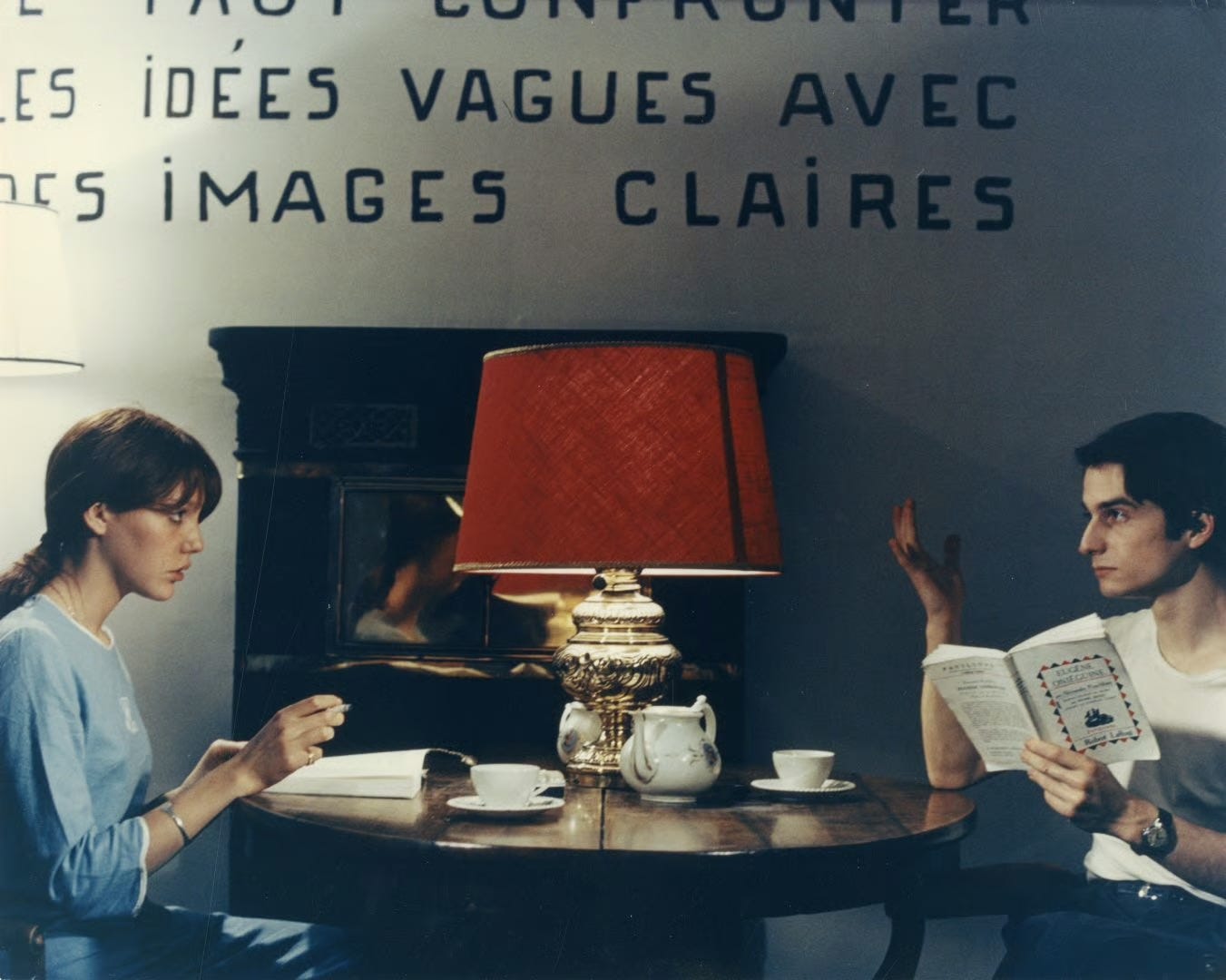
Maybe it was residual disorientation from this out-of-sync karaoke fiasco, but I got to thinking about how I normally experience image, sound, and text in movies, and one of Godard’s intriguing ideas popped into my mind: he declared he sought the analysis of sound through image and vice versa. His use of text on screen had something to do with it too. I logged on to my own Kino Film Collection streaming site to revisit a few of our most relevant Godard films: La Chinoise, Le Gai Savoir, and his great career-culminating Goodbye to Language. In different ways, each of these visionary cinematic investigations makes radical use of text as a catalyst in his image and sound alchemy. Text becomes a kind of protagonist disrupting the rhyming rapport between pictures and sound. He believed each component of cinema should exist independently of each other, maybe to prompt different meanings and experiences for audiences. It’s a powerful modernist concept that informs the work of many artists, such as how Cunningham and Cage liberated the relationship between music, sets, and movement in dance—each component standing on its own terms, recombined in the unifying perception of the viewer.
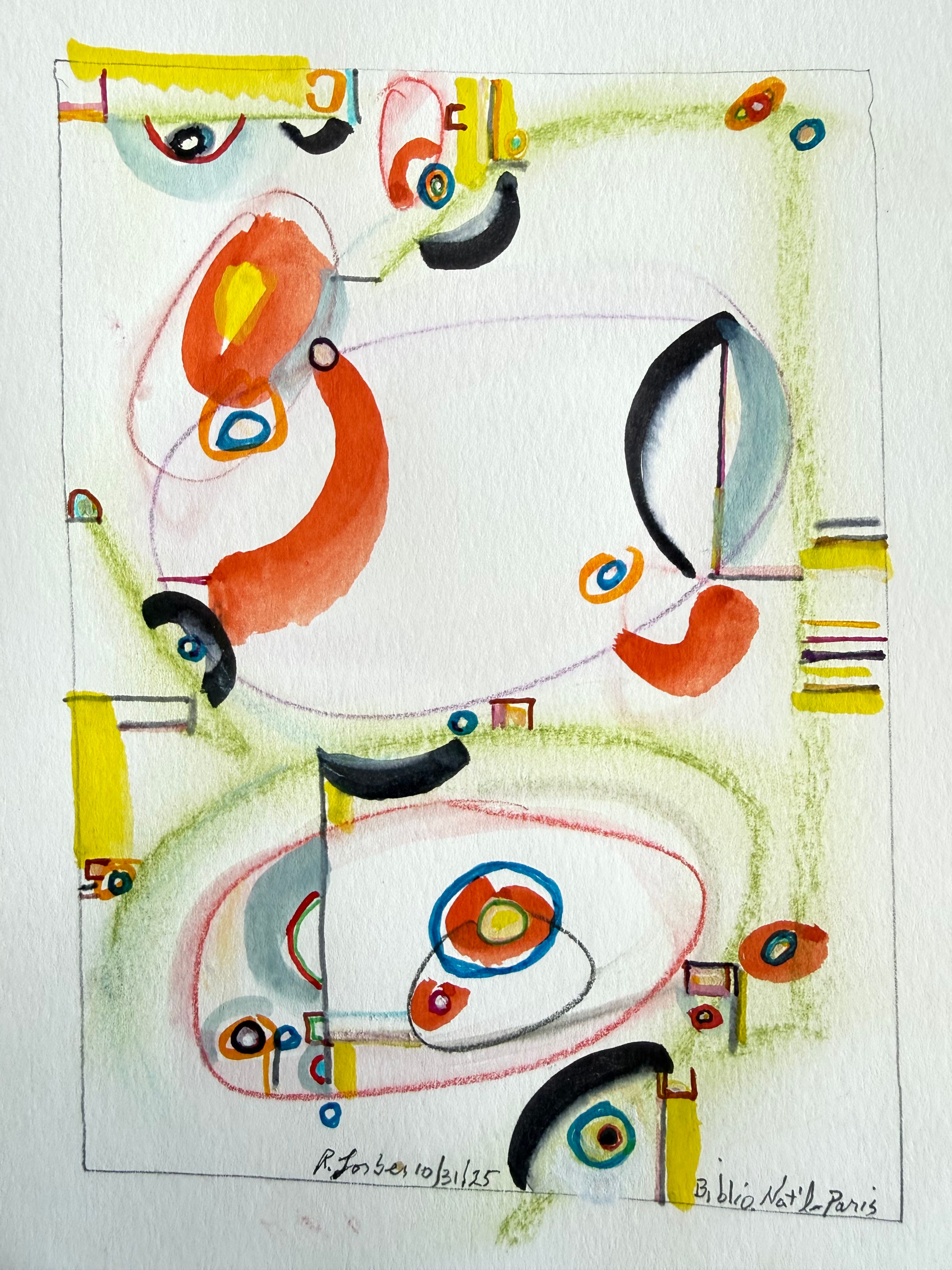
My business career in film distribution has largely focused on connecting audiences with experiences of some concatenation of image, sound, and text on screens of differing types and sizes. Over two thirds of the 400 or so titles we release per year—in theaters, digitally, and in physical media—are international films, across Kino Lorber, Kino Film Collection, and our global TV streaming platform MHz Choice. Almost all of this content is subtitled, and that’s not even counting the many restored silent film classics we release with intertitles. But there’s more in our “lettering of images” than that. English language films and shows now must offer English captions and even subtitled international films require captions that describe the ambient audio of atmospheric effects for audiences that are hard of hearing or deaf. I’ve become so accustomed to subtitles and captions that it actually feels “foreign” to watch anything without them. Though aging baby boomers have long been the core audience for international films and have embraced subtitles to abet their dimmed hearing, they’re not the only ones gravitating to captions. All the end-of-alphabet “gens” have been processing image and text as their social media birthright since smartphones were invented.
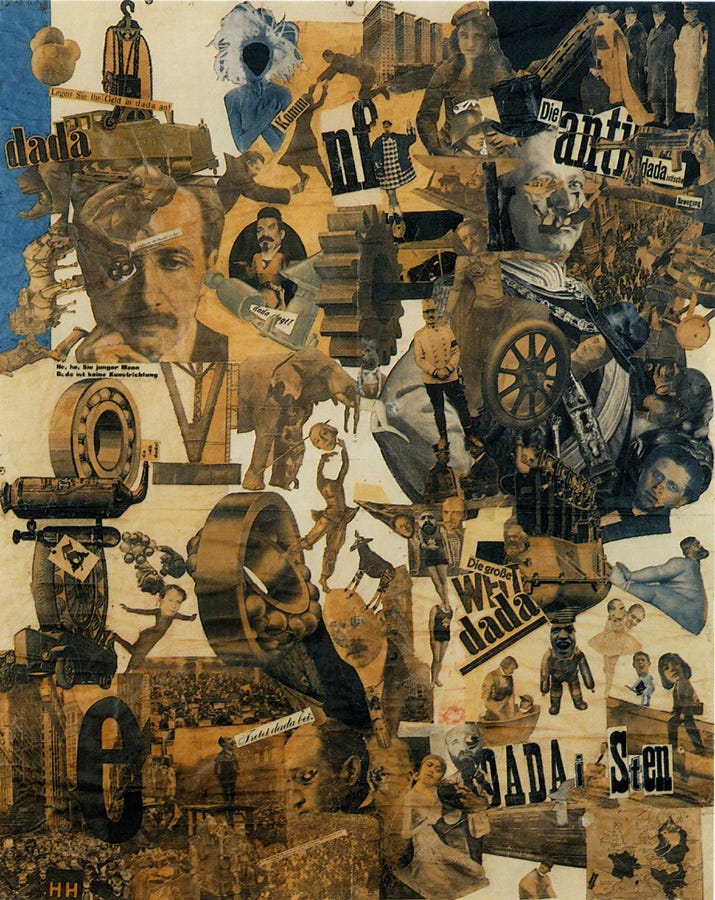
My karaoke comeuppance got me thinking further about how image and text have historically been yoked together or yanked apart for different artistic and communication ends. In the visual arts, Braque and Picasso began integrating painted letters, words, and collaged snippets of newspapers into their breakthrough abstract compositions by around 1911. Fragments of text were presented, not to represent, but as images themselves, affirming their own reality as visual objects on a flat plane, markers with personal references and cultural associations. Those were followed by even more radical disruptions. Dadaists, Constructivists, Futurists and later avant-gardists all the way up to Pop Art represented an expanding cadre of visual and experimental cinema artists pursuing various conceptual strategies and political agendas that repurposed language and text in their work. The interplay of image and text—sometimes a fusion, other times a disjunction—dates back even further, to early hieroglyphic representations of language. Sometimes visual glyphs were simply images visibly depicting identifiable objects and actions. Other times, as in millennia-old Mayan culture, they were both ideographic and semantic symbols that have been deciphered as phonetic elements of speech.
All of this jars my thinking about the future of the language of and in cinema. Given the direction our movie economy is headed, more work will originate for the small screen. Sure, we’re still committed to releasing to theaters for that unique larger-than-life communal experience. Our Kino Lorber tagline remains “Experience Cinema.” But one of our biggest cinematic successes last year did much more business digitally and was a film that you watched, heard, and read in equal parts—the extraordinary Oscar-nominated documentary Soundtrack to a Coup d’Etat.
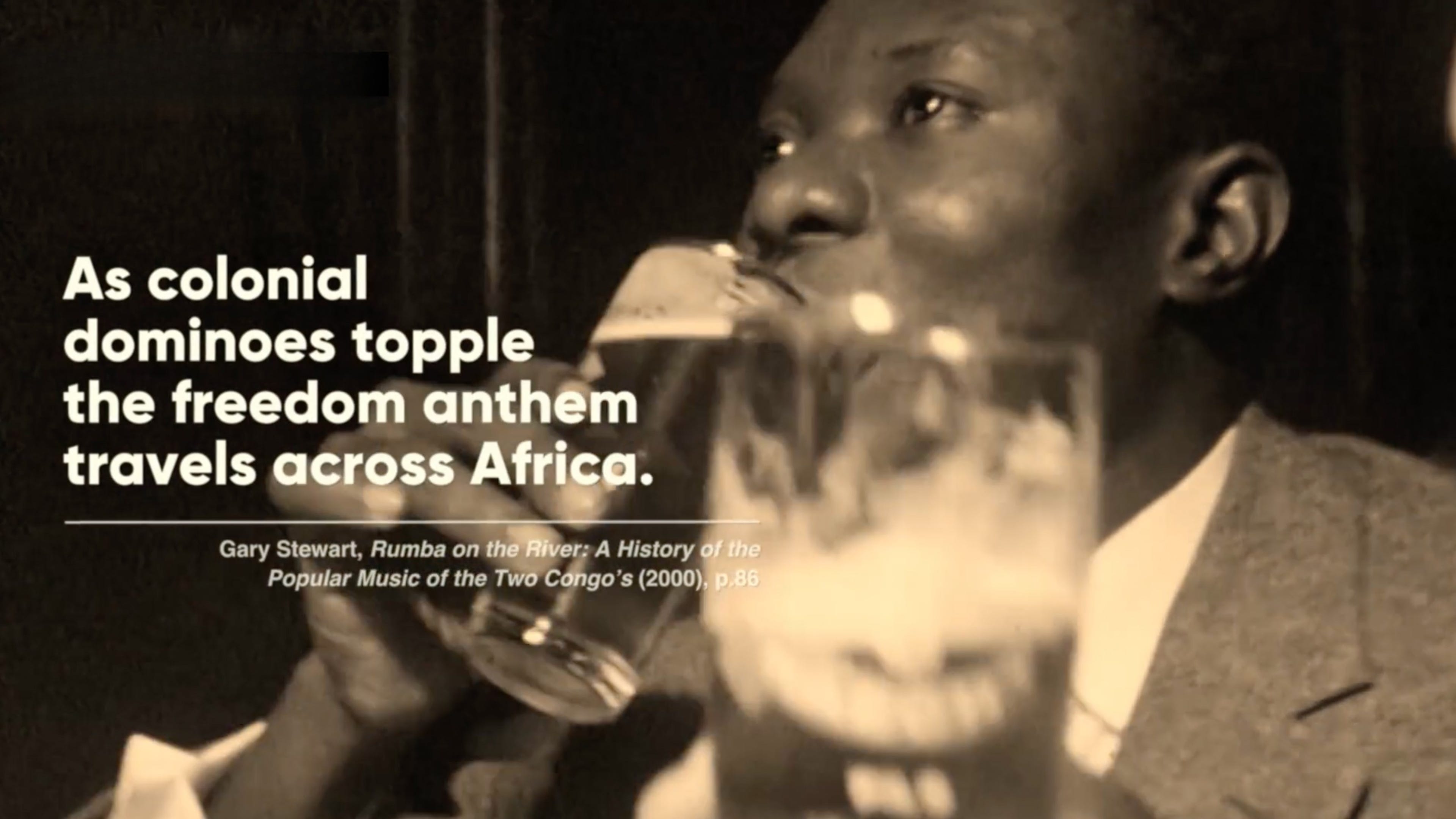
Winner of more awards than I can recount, the film was jocularly described by its brilliant artist-creator Johan Grimonprez as “an academic PDF disguised as a music video.” As challenging to synopsize as it was exhilaratingly praised, it’s a cinematic essay about the Congo crisis of the 1960s that led to the assassination of Patrice Lumumba amidst Cold War imperialist machinations to take control of Africa’s greatest mineral wealth. This sprawling filmic collage unfolds over two and a half hours as a mind-dazzling visual and auditory tapestry of subtitled archival film clips, jazz performances, historical quotations, text segments, and scholarly footnotes all with a syncopating bebop score. I recall one reviewer describing the film perfectly as a sort of “double temporality” split between the fast paced reading experience of text driving your eyes across the images and the condensed information’s after-effect where the film lives on in your brain in a way that makes you want to read and learn more.
In his famous essay “Tradition and the Individual Talent,” T.S. Eliot posited that when a “really new” work of art is created “something happens simultaneously to all the works of art which preceded it.” He goes on to say that the “existing monuments” of past art are ever so slightly altered and “we should not find it preposterous that the past should be altered by the present.” After the unprecedented Soundtrack to a Coup D’Etat, the history of cinema may never look quite the same.
As I think about how image and text have been realigned over millennia and most conspicuously how image, sound, and text have forged new relationships in the short history of cinema, I see new possibilities for Creators. Given the steep decline in audiences going out to the movies and the economic duress of a legacy system producing and releasing films that start their economic journey there, ambitions to mount movies on big screens may steadily give way to new forms of imaginative engagement. Maybe there will be more new works that advance image, text, and sound on equal footings. Maybe we’ll see a new form of literate cinema in the palm of our hands. I see a path forward with at least one cinematic “coup d’etat.” T.S. Eliot would give it a thumbs up. But maybe not for my first karaoke outing. Oh-ho-ho-ho, aye-yi-yi-yi-yi … qu’est-ce que c’est?
No posts
Comments
Nothing yet. Say the first thing.
Sign in to join the conversation.