
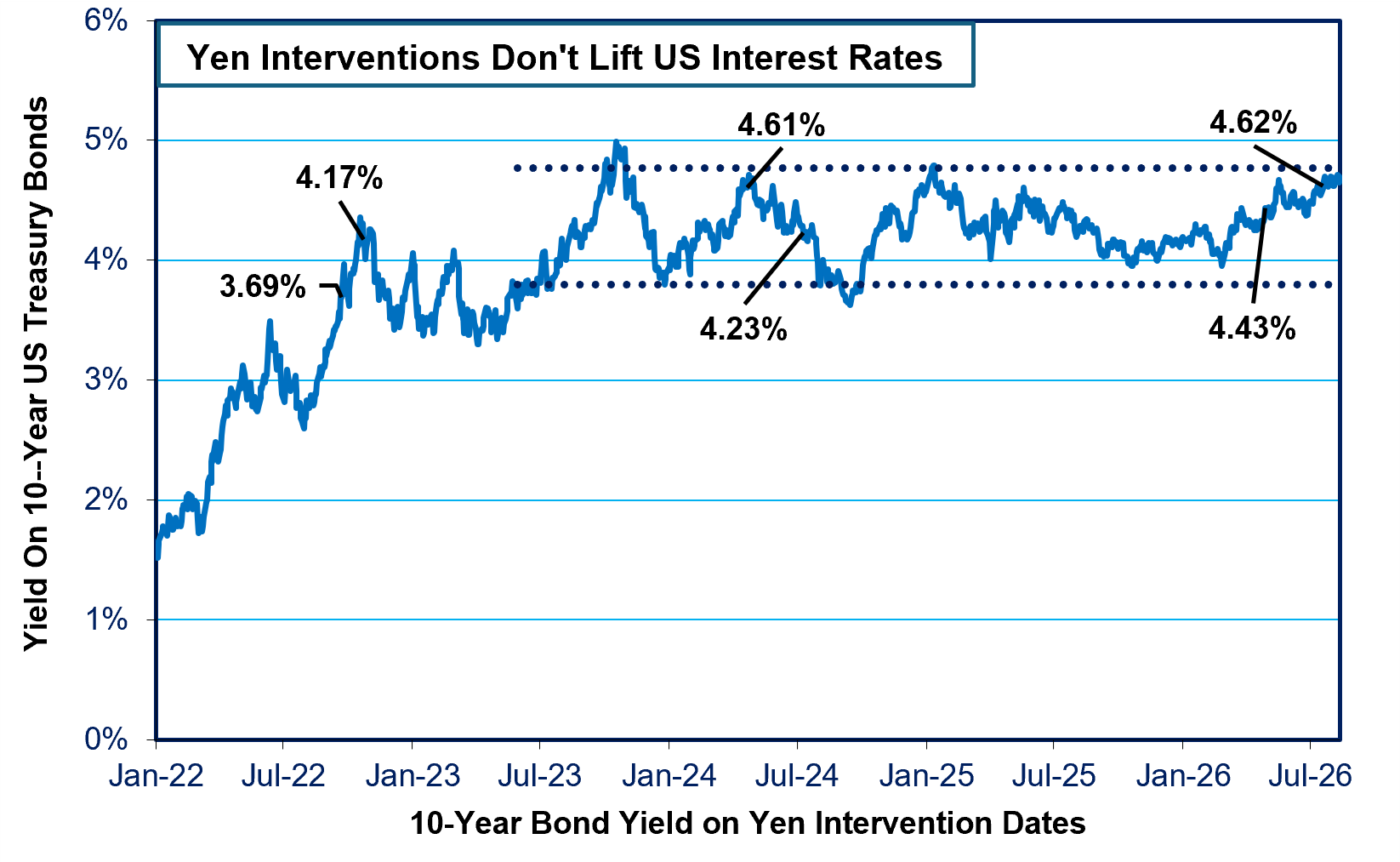
Source: Wall Street Journal Note: The percentages show the yield on the 10-year Treasury bond on the date(s) of Japan’s currency intervention The dotted lines are two “standard deviations” from the average over the past three years, which was 4.3%. Two standards deviations is the range within which 95% of the data points lie.
FLASH: Nikkei quotes me regarding Prime Minister Sanae Takaichi’s faulty ¥370 trillion plan to boost growth and national security: Richard Katz, author of “The Contest for Japan’s Economic Future,” calls the strategy a “throwback to the industrial policy of the 1950s and 1960s.” Japan’s more recent record, including Japan Display, Elpida Memory and the Cool Japan Fund, offers little encouragement. He says the deeper problem is not developing technologies but turning them into viable businesses: “The country suffers from the notorious ‘valley of death’ between the laboratory and commercialization.”
I wrote about this issue in two previous posts: this one and this one.
______________________________________________
One of the rewards of publishing a blog is the dialogue I enjoy with readers. I’m a firm believer that truth emerges from dialogue. A few readers pushed back on my last post, in which I claimed it was a myth that the US intervened to support the yen to stave off a spike in US interest rates. A further look at the data and Federal Reserve studies confirms that Japan’s holdings of US Treasury bonds are too small for its interventions to be impactful on US interest rates. If the Federal Reserve knows this, it’s hard to believe that veteran trader Scott Bessent does not.
Several readers contended that by selling US Treasury bonds to bolster the yen, Tokyo pushes US interest rates higher. The chart at the top of the blog refutes this. Tokyo has intervened six times since 2022 to try to arrest or reverse the yen’s depreciation. The only time that intervention was followed by a significant hike in the yield on ten-year Treasury bonds was the first time: on September 22, 2022. But, as the chart shows, this came at a time when US rates were already recovering from their Covid-era lows, and the rise simply continued the prior trend. In fact, that rise peaked a month later, when Tokyo intervened again. Following the next three interventions—October 21-24, 2022; April 29-May 1, 2024; and July 11-12, 2024—the T-Bond yield actually fell. And after the two interventions this year, the yield barely moved.
I think the interventions were essentially irrelevant to US interest rates. Regardless of what has happened with the yen’s value, currency interventions, or the volume of Japanese holdings of federal debt, the T-bond yield has spent 95% of the time over the past three years fluctuating between 3.8% and 4.8% (see the dotted horizontal lines in the chart at the top). As I write this, it’s at 4.7%. Other factors far outweigh any impact the Japanese factors might have had, e.g., oil prices, the Iran war, inflation, unemployment, retail sales, etc. In fact, if I did not indicate the intervention dates in the chart at the top, it would be impossible to tell from the bond yield data points when the interventions occurred.
If we consider that the six interventions beginning in 2022, which added up to an staggering $300 billion, still amounted to only 0.75% of total federal debt today, we can see why they have had so little impact on US rates.
Federal Reserve Assessments
One reader said it was wrong to judge Japan’s impact by its small share (2.7%) of outstanding US Treasury bonds. Instead, we should judge it by the size of the currency intervention relative to the size of that day’s overall Treasury debt transactions. That may work for the immediate period of intervention, but it is not a good predictor of the impact over several months. It is not used in studies by the Federal Reserve and private firms, and my approach aligns with theirs.
A 2025 study by the Kansas City Federal Reserve suggested that a month-to-month sale of 1.9% of all (not just Japanese) foreign holdings of US Treasuries—which would amount to $173 billion these days—would initially raise US interest rates by 57 “basis points,” i.e., 0.57%. By that standard, Japan’s sole intervention in April of this year, a total of $72 billion, would initially raise US bond rates by just 0.24%, assuming no change in any other factor, e.g., oil prices, US inflation, or unemployment. The latter number—0.24%—matches typical daily fluctuations in US bond rates since the beginning of 2024.
Of course, the smaller the foreign share of outstanding federal debt, the bigger the foreign decline has to be to have the same impact on bond yields.
The reason that I emphasized “initially” is that a 2012 Federal Reserve study found that, when governments draw down their official reserves, e.g., via currency intervention, private holdings often rise to fill the gap albeit at a bit higher interest rate. The study estimated that, if foreign governments reduced their purchases of US debt by a huge 3.3% of total federal debt in that year, yields on five-year Treasury bonds would rise by 50 to 60 basis points (0.5% to 0.6%). It added, “But once we allow foreign private investors to react to the yield change induced by the shock to foreign official inflows, the long-run effect is about 20 basis points [0.2%].” The 3.3% estimate here is much larger than the 1.9% in the 2025 study, partly because results differ in such complex situations and because conditions in 2025 differ from those in 2012.
Intervention, Trade, and the $500 Billion Trump Package
In short, the size of Japanese interventions is simply too small to set off alarm bells in the US Treasury Department. I think the Trump administration is more concerned about the impact of weak yen on trade, and fears that currency weakness might spread to other countries in Asia, especially China.
I think it’s also worried about Japan’s ability to fund the $500 billion worth of investment in the US that Trump got Japan to agree to under the pressure of tariffs. The weaker the yen, the more expensive it is to finance that $500 billion. So far, the two governments have agreed on just $109 billion worth of projects, and the financing for them has been hard to come by. Less than $5 billion so far. It would not surprise me if Treasury Secretary Bessent told Tokyo: we helped you with the yen; now show us the money.
All Foreign Holdings and US Interest Rates
Another reader suggested that when Japan sells US Treasuries, it could signal to other countries that Tokyo knows something they don’t, and they might take that as a signal to sell. So, let’s check the data on this.
The chart below shows monthly changes since January 2022 in the total value of US government debt held by the Japanese government and foreign private investors. It then examines how these changes affect the ups and downs of US 10-year Treasury yields. The trendline shows that gyrations in Japanese holdings have virtually no impact on interest rates.
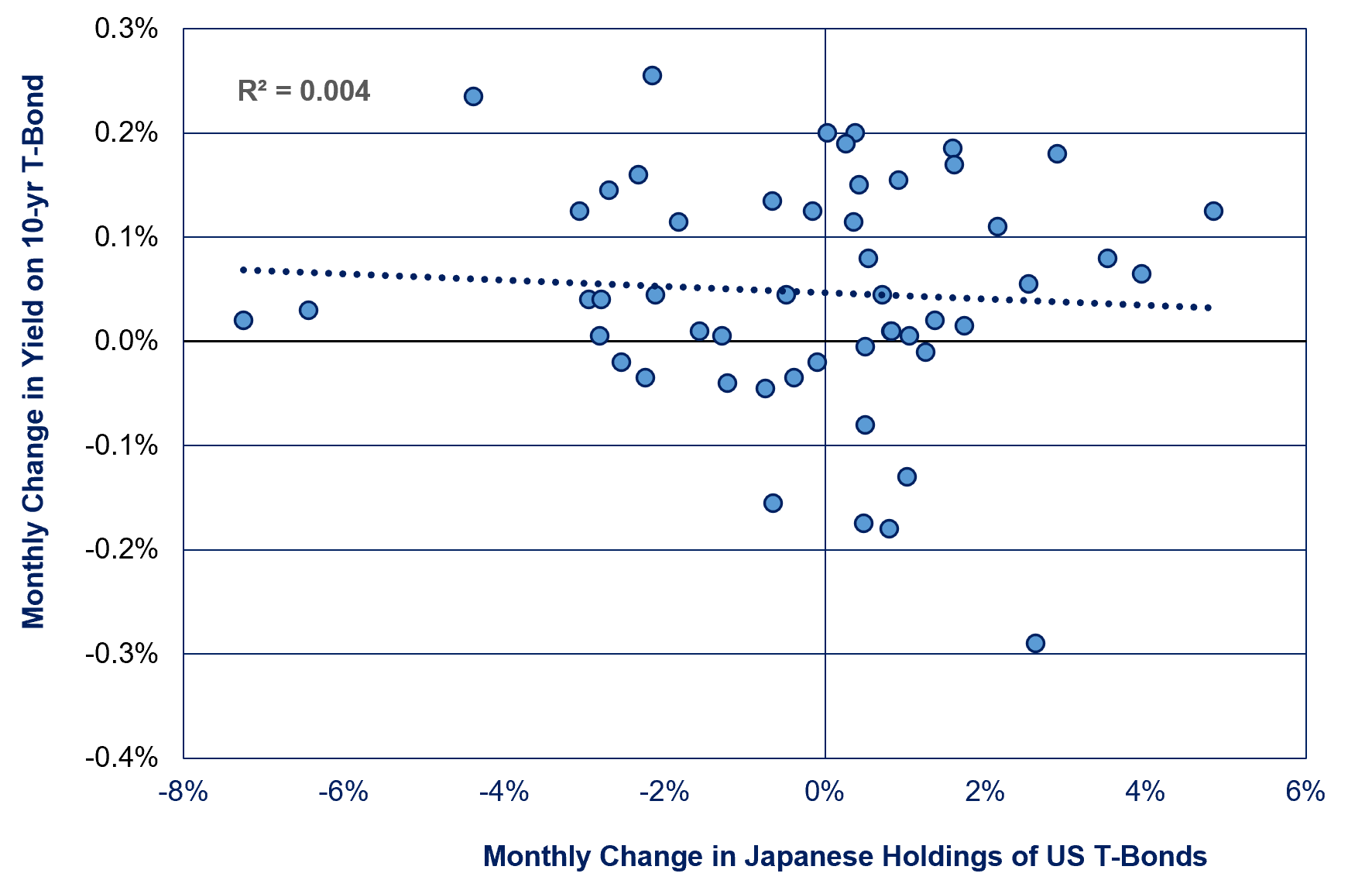
Source: https://fred.stlouisfed.org/series/FORLTTREASPOS42609 for Japanese holdings; Wall Street Journal for yield
If we look at all foreign holdings, which are nine times as large as Japanese holdings alone, the trendline suggests a bit more influence. However, that influence is so small—as shown by how widely the data points scatter from the trendline—that other factors can easily overwhelm it.
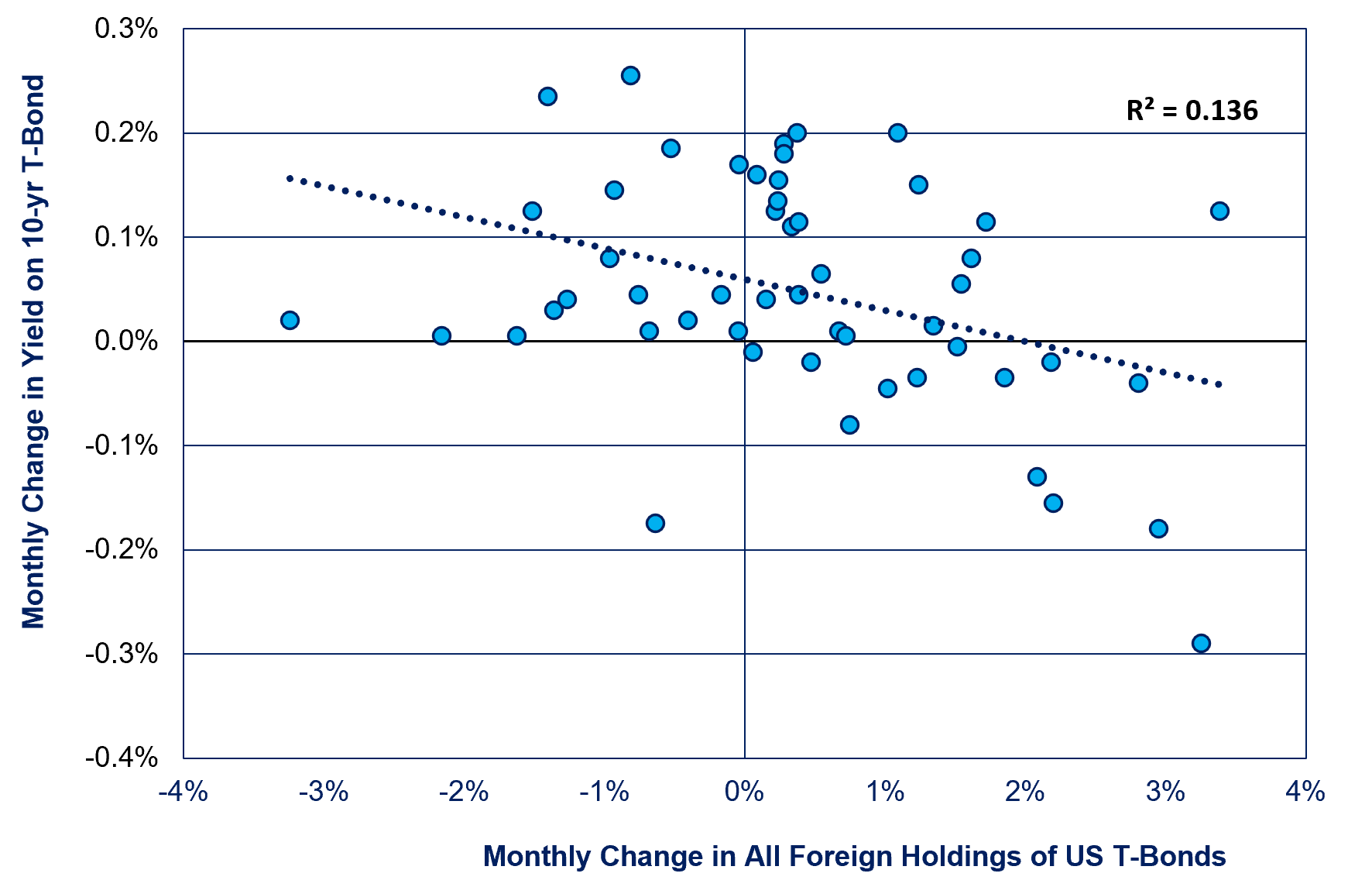
(One caveat about this data for those delving deeply into the weeds, as one reader did. I don’t have monthly figures on sales and purchases of US federal debt by all foreign public and private investors. What I do have is the change in the value. But that change comes only partly from new purchases and sales. It also includes changes in the value of the outstanding bonds they already own. If interest rates go up, for example, the value of a bond paying $50 per year in interest goes down.)
Foreign Investors Vs. America’s Private Sector
Those who raise alarm bells about Japanese and/or other foreigners buying a smaller share of US Treasuries forget that private American investors are making up much of the difference. Private US investors now own about 42% of all federal debt. That’s 75% more than foreign governments and foreign private investors combined. Traditionally, American individuals, banks, pensions, bond funds, and the like owned much more than foreign governments and investors. Only between 2004 and 2019 did foreigners own more federal debt than American investors (see chart below).
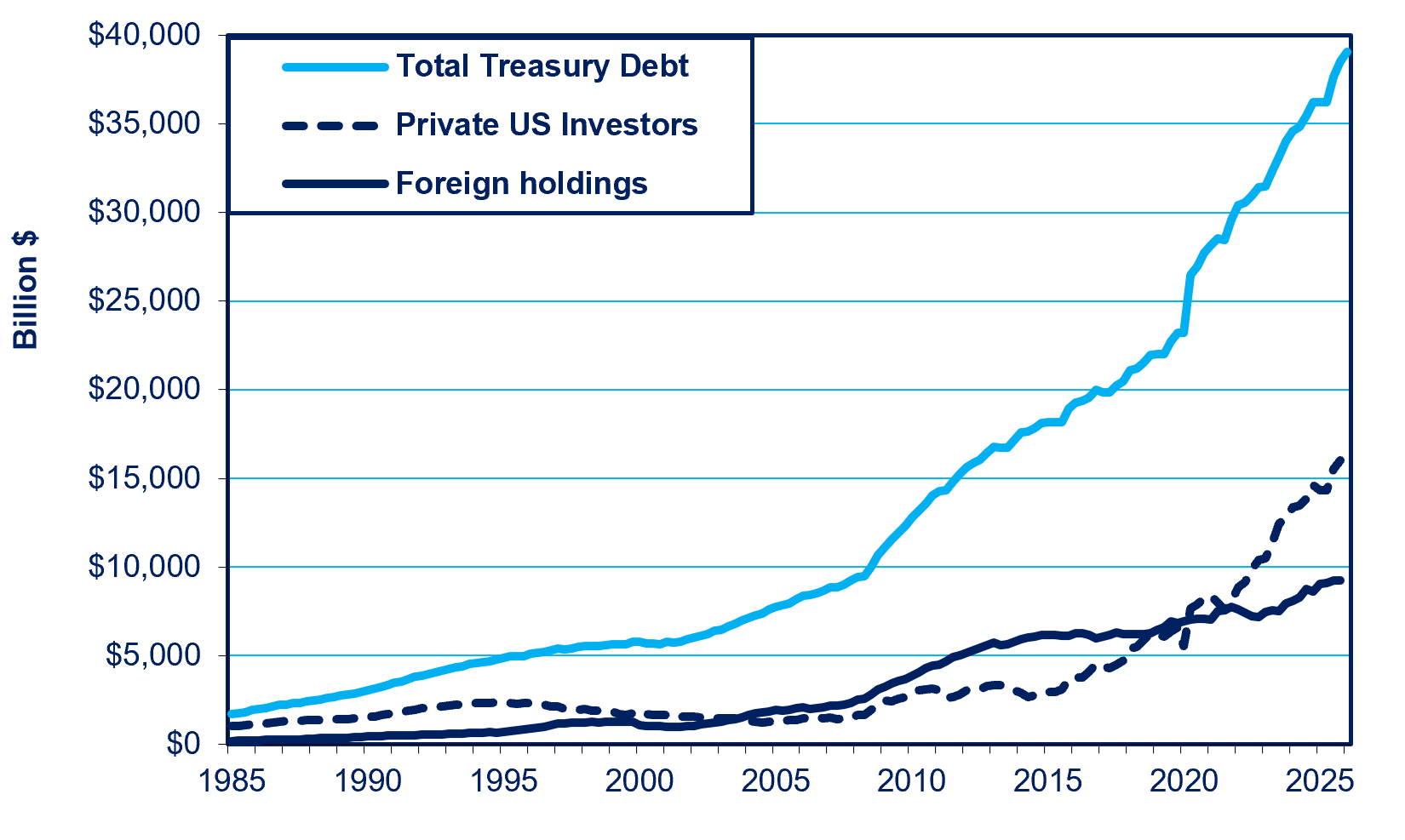
Source: https://fred.stlouisfed.org/
Support the Blog
Paid subscribers will be eligible for my new memos, in addition to these regular posts. Beyond that, if you feel you’ve gained insight from this blog, ever restacked it, if you ever subscribed to my previous publication, The Oriental Economist Report, and certainly, if you or your firm have gained insights that helped guide your investments, please support the blog with a subscription or by “buying me a cup of coffee.” You can buy a cup or two on a one-time basis, or once a year, or once a month.

No posts
Comments
Nothing yet. Say the first thing.
Sign in to join the conversation.