
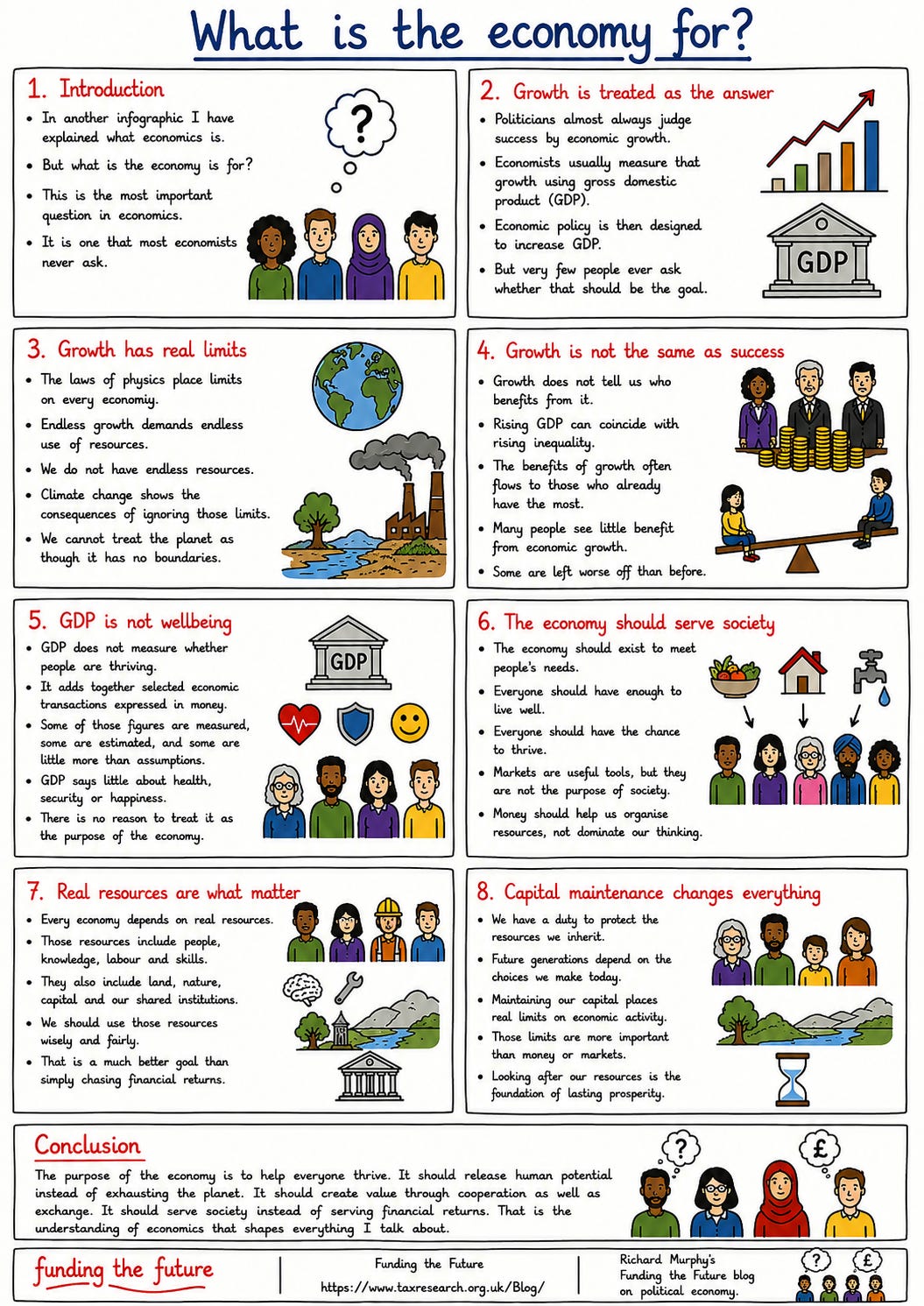
Most economists assume the answer to the question “What is the economy for?” is obvious. They say the purpose of the economy is growth, and they measure success using GDP. But what if they are asking the wrong question?
In this second video in my Understanding Economics series, I argue that economic growth is not an end in itself.
Endless growth is impossible on a finite planet, GDP tells us remarkably little about whether people are actually thriving, and rising GDP has too often been accompanied by growing inequality and environmental damage.
Instead, I suggest a different way of thinking about economics.
The purpose of the economy should be to help everyone live well and thrive. Markets matter, but they are tools, not the purpose of society.
Money should help us organise resources, not dominate every decision we make.
I also introduce the idea of capital maintenance, a concept that accountants understand well but economists have largely ignored. Prosperity depends on protecting the real resources we inherit, including knowledge, institutions and the natural environment, so that future generations can thrive too.
This video lays the foundations for everything that follows in this series. If we begin with the wrong purpose, we will inevitably create the wrong economic policies.
A transcript of this video is available here.
I used AI, among other tools, when creating this post. I also used about 50 years of experience writing about economics.
No posts
Comments
Nothing yet. Say the first thing.
Sign in to join the conversation.