
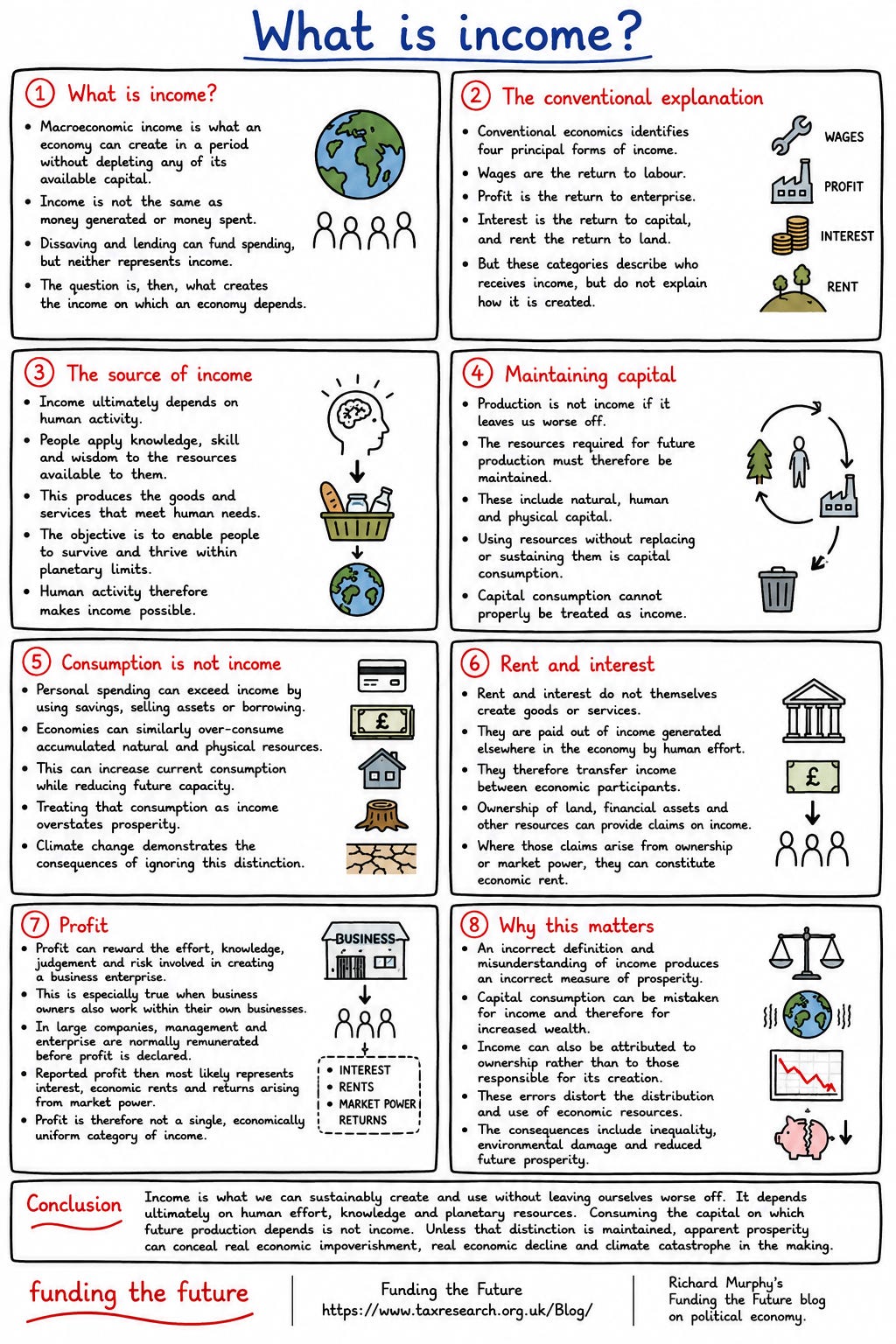
What is income? It sounds like one of the simplest questions in economics, but the answer matters enormously. In this episode of Understanding Economics, I argue that income is not simply money received or money spent. At the level of the economy as a whole, income is the real value we can create and use without leaving ourselves and our planet worse off. That distinction changes how we think about wages, profit, interest and rent. Conventional economics treats all four as forms of income. But do interest and rent actually create anything, or do they transfer income created by other people? And how much corporate profit represents genuine enterprise rather than economic rent extracted through ownership, market power or the extraction of value from labour? There is an even bigger issue. If economic activity depletes natural resources, destroys environmental capital or consumes assets that cannot be replaced, can we really describe what results as income? Or are we mistaking the consumption of capital for a false measure of prosperity? That question takes us directly to climate change, inequality and the way we measure economic success. Understanding income means asking where value really comes from, who creates it, who receives it and whether our apparent prosperity can be sustained. This is part of my Understanding Economics series, which explains economics from first principles and asks whether the conventional answers still make sense.
This infographic supports the video:
We have a library of these images. It is available here. All downloads are free, but donations help our work.
I wrote this infographic. I used AI to create the final image.
No posts
Comments
Nothing yet. Say the first thing.
Sign in to join the conversation.