
Most people think economics is about money.
It isn’t.
Economics begins with something much more fundamental: resources. Every society has limited resources and must decide how best to use them. Those decisions shape our lives, our prosperity and our future.
In this episode of Understanding Economics, I explain what economists should really mean when they talk about resources. Human labour, knowledge, wisdom, natural resources, energy, capital, education and institutions all make up the wealth on which every economy depends.
Money, by contrast, is not itself a resource. It is simply a claim on resources. Understanding that distinction changes the way we think about economic policy, government, markets and inequality.
I also explain why capital maintenance matters. If we consume resources without replacing or renewing them, future generations become poorer than we are. Economics should therefore be about stewardship as much as production, ensuring that we preserve, develop and improve the resources we inherit.
This video is part of my ongoing Understanding Economics series, which starts with first principles and builds towards explaining how modern economies really work.
If you’d like a clearer understanding of economics without unnecessary jargon, this series is designed for you.
This infographic supports the video:
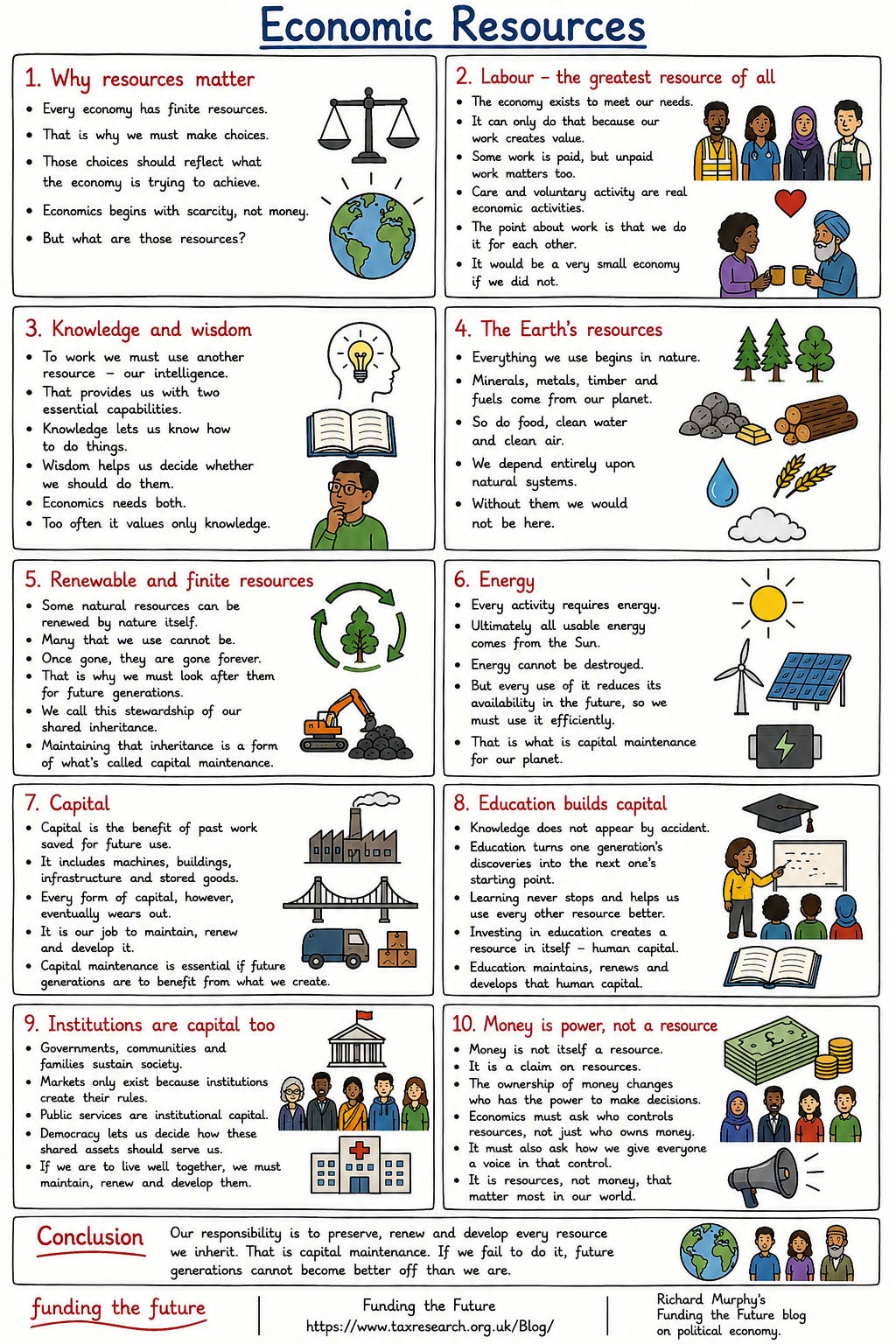
I wrote this infographic. I used AI to create the image, just as I used a lot of tech to make the video.
Previous posts in this series (with links to my blog)
Understanding economics: Introduction Article
What is economics? Article. Video. Infographic.
What is the economy for? Article. Video. Infographic.
What is microeconomics? Article. Video. Infographic.
What is macroeconomics? Article. Video. Infographic.
No posts
Comments
Nothing yet. Say the first thing.
Sign in to join the conversation.