
Life in the USA is not normal. It feels pointless and trivial to be talking about small looks at the fascinating natural world when the country is being dismantled. But these posts will continue, as a statement of resistance. I hope you continue to enjoy and learn from them. Stand Up For Science!
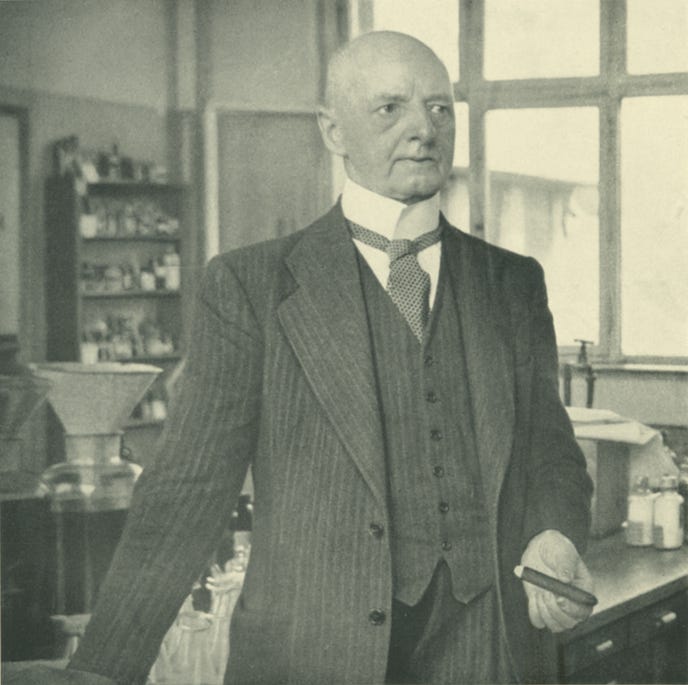
Raphael Eduard Liesegang (1869-1947) was a German chemist and photographer. He worked on capillary action, chromosomes, aerosols, silicosis, and the chemistry of photography, but his name is attached to the bands and rings in chemical processes that he studied extensively.
Geologists know these features in rocks of many types. They develop when mineral-rich (typically iron) water percolates through permeable rocks, with chemical reaction and precipitation occurring along multiple fronts as the water passes through. Precipitation depends on presence of nucleation sites as well as the level of mineral and oxygen saturation, temperature and pressure, flow rates in the fluid, and other factors, and the precise physical and chemical process is not fully understood.
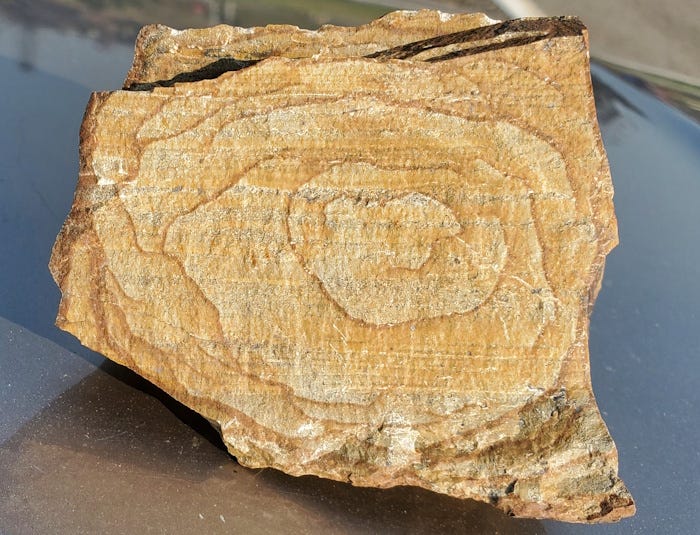
Although Liesegang bands may be more prominent in a rock than bedding, they probably cut across bedding more often than not, especially evident when they form rings in flat-bedded material. The photo immediately above is in layered Precambrian sandstone, the Burke Formation near Thompson Pass about a mile west of the Montana border on Idaho Highway 4.
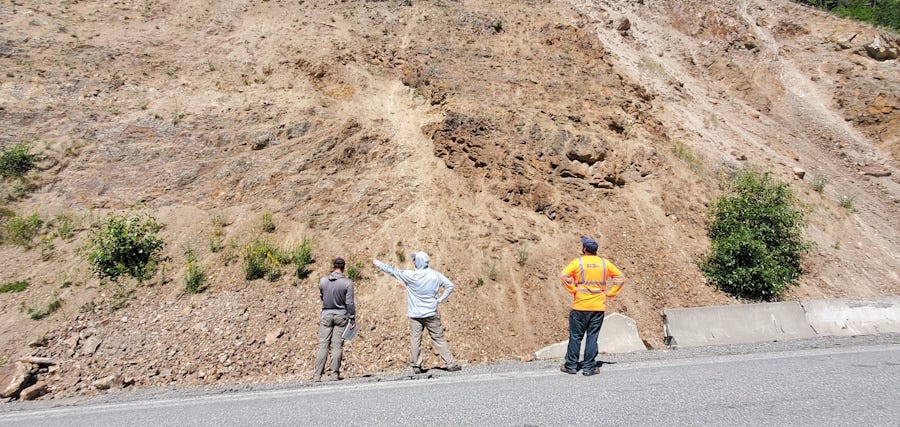
The Burke Formation is part of the Belt Supergroup, sedimentary rocks deposited about 1,400 million years ago. It is probably at least in part equivalent to the Appekunny Formation, rocks that comprise many of the green layers in Glacier National Park. (Cox and Morgan, 2026, Ore deposits in the Murray Mining District, Shoshone County, Idaho: Northwestern Montana: Northwest Geology, 55:43-50, Tobacco Root Geological Society 51st Annual Field Conference, Plains, Montana.)
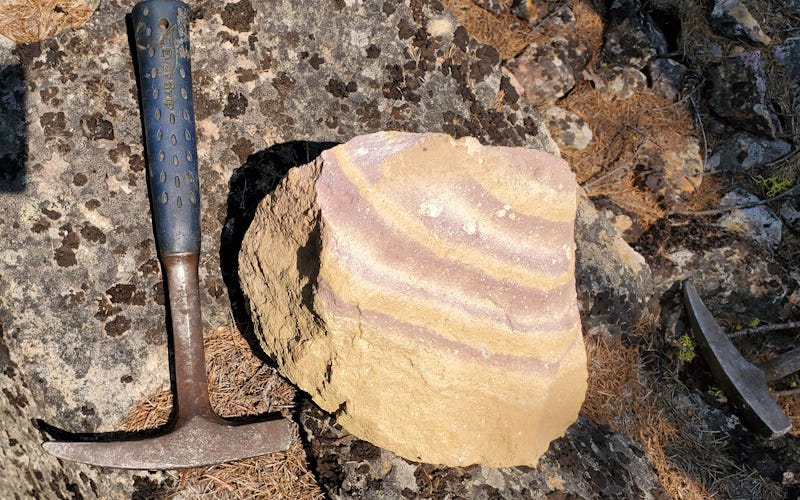
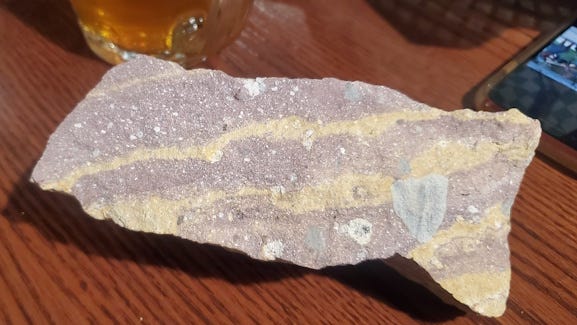
The multicolored rock in the top photo is a poorly welded tuff (a solidified, self-annealed volcanic ash deposit) from the Hog Heaven Volcanic Field in northwest Montana. According to Kaleb Scarberry these volcanic rocks date to about 30 to 36 million years ago. That’s an unusual time for volcanism in this region, and Scarberry thinks it represents a distant edge of the Mid-Tertiary Ignimbrite Flare-up prominent especially in Nevada, Utah, and Colorado. That volcanic activity was partly coeval with the Hog Heaven volcanism. (Scarberry, personal communication, 2026, and supplemental material to Gammons and Scarberry, 2026, An overview of mineralization in the Paleogene Hog Heaven Volcanic Field, Northwestern Montana: Northwest Geology, 55:71-76, Tobacco Root Geological Society 51st Annual Field Conference, Plains, Montana.)
The Liesegang bands in the top photo display diverse colors because of varying oxidation states and concentration of iron and a range of composition in the rocks. The nearby Flathead Sunset Quarry on private property just off Hubbart Reservoir Road north of Niarada, Montana, was probably exploited for this pretty rock. Chemically it is a dacite, a high-silica volcanic rock composed mostly of plagioclase feldspar and quartz. It also contains abundant rock fragments, so in the terminology I learned in the olden days, it would be a crystal-lithic tuff, where lithic means “rock.” The other modifier for tuffs is vitric, glass, if there are abundant glass (obsidian) fragments in the ash fall.
Some of the rock fragments are huge, big enough they can be related to the Belt rocks the volcanic material came through or flowed over and ripped up to be included in the ash fall. In the photo immediately above, a specimen collected by Chris Gammons, you can see some of the rock fragments. The big gray one, probably a mud rock from the Belt, is about 2.5 cm across.
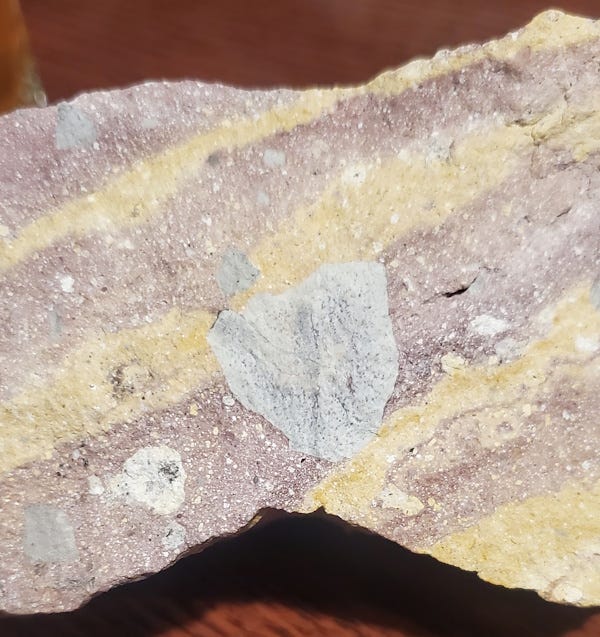
Geology students learn by the law of cross-cutting relationships that if one thing cuts across another, the one doing the cutting must be younger than the one that is cut. But here, that’s not the case. The gray rock fragment appears to cut across the purple and yellow Liesegang bands, but the Liesegang banding developed in the rock after the ash and the rock fragments were deposited. The most reasonable interpretation for this, I think, is that when the iron-bearing water percolated through the rock to make the Liesegang bands, the rock fragment it encountered was not permeable, so the banding could not develop there.
It’s challenging to recognize the original bedding in the volcanic rock, but I think in this case the Liesegang bands are not quite parallel to the bedding; they cut across it at a low angle.
Hog Heaven was a small farming and ranching community that developed about 1906-1908 around a ranch of that name east of Niarada, Montana. It was populous enough that the Dayton (Montana) Leader newspaper had a regular column, “Grunts From Hog Heaven,” from about 1912 to 1917. Nothing remains of the community today.
We’ve seen Liesegang bands in this previous post about the Chinle Formation.
Comments
Nothing yet. Say the first thing.
Sign in to join the conversation.