
Note: This piece was completed a little over a month ago, before the deployment to Washington, D.C. and the announcement of a list of cities slated for occupation. It constitutes some preliminary thoughts on the matter in the specific history of the militarization of the U.S.-Mexico Border and the relationship to open coercion and repression of the proletariat by the armed forces of the capitalist state as a consequence of the dynamics of the capitalist mode of production.
“¿De qué me sirve el dinero
Si estoy como prisoniero
Dentro de esta gran nación?
Cuando me acuerdo hasta lloro
Aunque la jaula sea de oro,
No deja de ser prisión.”
- Los Tigres Del Norte, “La Jaula de Oro”
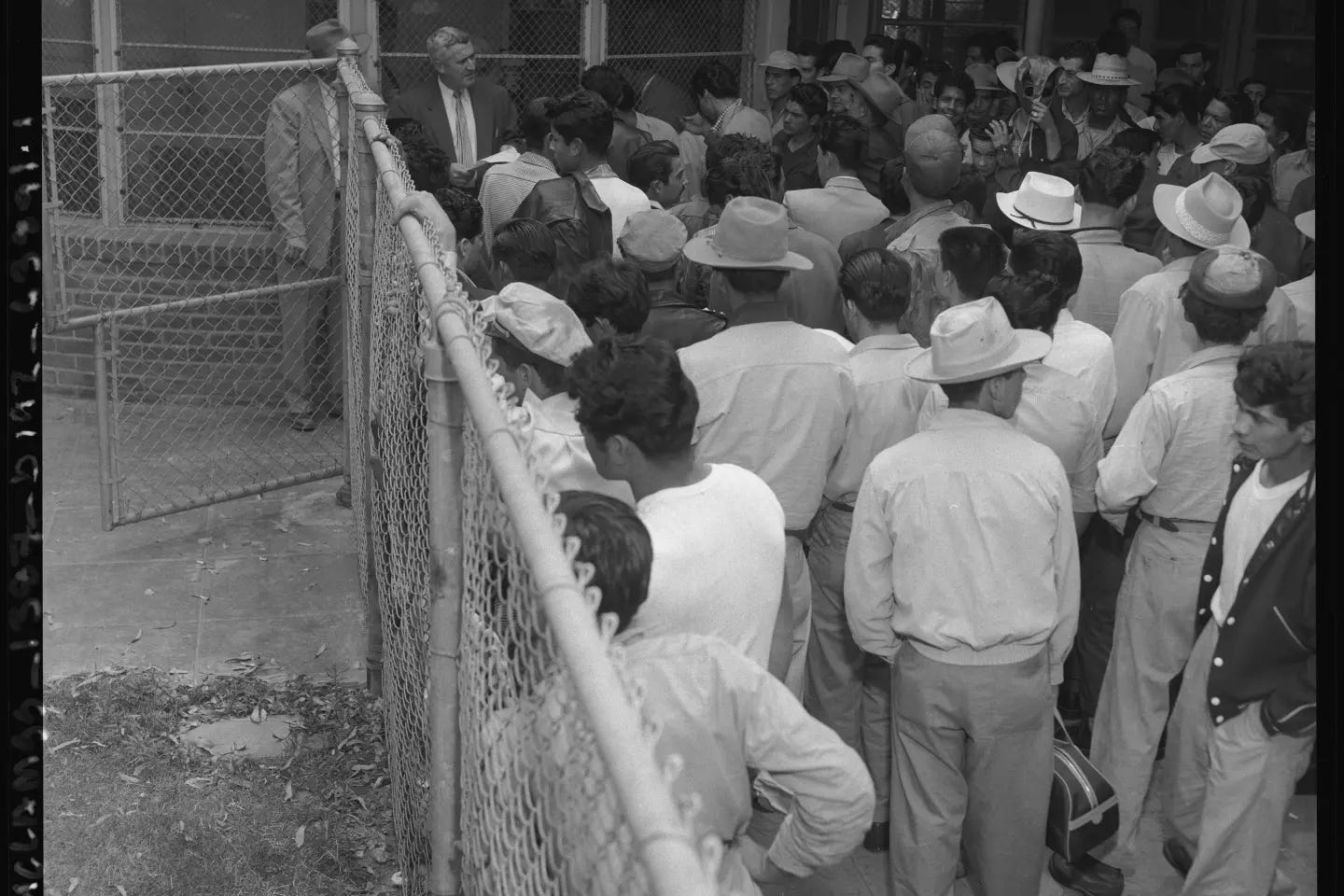
Detentions during Operation Wetback in 1954
A Border is a War That Never Ended
In 1934, Grover C. Wilmoth, district director of the Immigration Service in El Paso, Texas, established the El Paso District Training School in an effort to professionalize and impose an order to the practices of the U.S. Border Patrol. Only a decade into its existence, the U.S. Border Patrol had largely been a small outfit of loosely-organized officers from around the border towns, comprised mostly of working class whites and men from the middle and upper classes of the Mexican-American community. The farmers and ranchers of the agricultural industry wanted the supply of migrant workers from Mexico available to move with the seasons, but did not want to see this mobility deployed as a strategy by the workers to improve their conditions or leave within the middle of a harvest. The influence of agribusiness capital in municipal governments constructed a patchwork of local restrictions on out-of-state labor contractors and vagrancy laws, and the U.S. Border Patrol worked within these judicial restrictions to police the movement and presence of anyone they identified as Mexican. Border Patrol officers understood their own interest within their relationship to agricultural capitalists, however, as they would leverage the necessity of their violent enforcement in producing the conditions for low-wage labor to demand respect from the local elites. The policing of the migrant proletariat was a role that lent itself to developing the selective practices that constitute political power.1
By 1937, the El Paso District Training School was renamed to the Border Patrol Training School and the Immigration Service required all recruits nationwide to attend their training at that location. This marked a shift in the priority of border enforcement towards the Southern border, even while in that year 325 officers worked along the U.S.-Canada border, compared to 234 officers at the U.S. Mexico border. Uniformity in the practices of border enforcement would develop nationally around the specific contours of the Texas-Mexico borderlands’ institutionalization of the racialized policing of Mexican migrant laborers. Conflicts developed between white officers of the U.S. Border Patrol and majority Mexican-American police departments over influence on the development of Border Patrol operations as this localized centralization of federal enforcement authority on the Southern border became central to the racial antagonisms among the policing infrastructure of the region itself. In an effort to divorce the Border-Patrol station in Mexicano-majority Laredo, Texas, from the local Mexican-American political elite, original architect of the Border Patrol Clifford A. Perkins began detailing former Texas Rangers, white local law enforcement agents, to the Laredo Border Patrol in 1927. That year, several of the federalized Rangers drove a caravan of Model T automobiles to the Laredo Police Department’s station, and spent half an hour circling and shooting up the building. The multi-racial composition of law enforcement institutions in the borderlands would be consolidated in the project of a specific racial class supremacy of the settler capitalist state.2
One of the first officers trained at the newly-founded Border Patrol Training School was Harlon B. Carter. As a teenager in Laredo, Carter murdered 15-year old Ramón Casiano with a shotgun because Carter’s mother had been upset about some Mexican youth loitering in front of her house. Carter was arrested, tried, and found guilty of murder by a jury in Laredo, but was released from prison on appeal after two years after a higher court found that the jury’s instructions had been “incomplete.” After two decades into his career at the U.S. Border Patrol, Carter had successfully maneuvered to a leadership position in the direction of Border Patrol operations on the U.S.-Mexico border. On July 15, 1953, Carter met with Lieutenant General Joseph Swing and Adjunct General Jones to request the assistance of the U.S. military and the National Guard to purge the nation of undocumented Mexican immigrants and seal the U.S. Mexico border.3
Throughout the 1940’s, the Border Patrol’s deportation machine had developed into extensive apprehensions of unsanctioned Mexican immigrants amidst rising numbers of illegal border crossings, culminating into an ongoing rebellion against the authority of the Border Patrol amongst both migrants resisting arrests and farmers intent upon securing their supply of migrant labor-power. As this struggle intensified and expanded across the borderlands, apprehension rates continued to grow, and migration became the basis for a social crisis of settler class dominance. Mexican-American middle classes and civil rights organizations fell in line as the Border Patrol’s agenda to stop illegal border crossings because their struggles to secure employment, housing, and healthcare, as their projects were grounded in a politics of citizenship and American nationalism. Segments of the Mexican-American working class aligned with white working class pushes for immigration control, in an effort to counter the use of both braceros and undocumented workers as strikebreakers. The National Farm Labor Union (NFLU) was split over the approach to this problem, as some union members voluntarily patrolled the border to turn back unsanctioned crossers, and others tried to balance opposition to unsanctioned immigration with advocacy for all migrant workers and the consistent defense of undocumented workers against the abuse of the Border Patrol. The expanding fronts of the class struggle and affronts to the authority of the Border Patrol led to the characterization of the border as a crisis for American democracy due to the restive nature of the labor force and the inability of the Border Patrol to sufficiently direct the seasonal patterns of migrant labor’s movement. The critical importance of Mexican immigrant labor, versus that of other migrant labor populations, was the chance that these laborers could be exploited seasonally and sent back across the border when they were no longer needed. If migrant laborers sought work on their own initiative, overstaying their Bracero contracts, or established businesses in the U.S., they came into competition with segments of the white population. It was at this critical juncture that Carter proposed to Generals Swing and Jones the plan for Operation Cloud Burst.4
The plan had three steps. First, with the assistance of 2,180 troops, seal the border with metal picket barbed wire fences and concertina wire and jeep patrols along areas of heavy traffic. Second, a containment operation consisting of a series of roadblocks leading into the Southwest interior of the U.S. would be established, inspecting automobile and railroad traffic to detect illegal entrants. Third, a series of “mopping up” operations were to occur in Northern areas like San Francisco, California, where task forces would raid designated locations like migrant camps or local businesses, and officers would coordinate with the Mexican government to lift by air or train apprehended Mexican nationals back to Mexico. Generals Swing and Jones agreed to commit troop deployments to the effort, finding it relevant training in line with the objectives of the contemporaneous Korean campaign. The stumbling block of Posse Comitatus, a limitation on the use of the federal military in a domestic capacity, could be navigated around by way of a Presidential Proclamation, and the proposal was advanced to President Eisenhower. Though he supported the Border Patrol’s objectives, he ultimately did not sign the proclamation, instead appointing General Swing as commissioner of the Immigration and Nationalization Service in 1954. The Border Patrol gained a leader in Swing that was adequate to the task of implementing militarization.5
One month after joining the INS, Swing announced a plan for the U.S. Border Patrol to lead a paramilitary law-enforcement operation designed to end illegal immigration across the U.S.-Mexico Border. This was officially known as Operation Wetback. On June 9, 1954, hundreds of Border Patrol officers from the Canadian border and the Gulf Coast of Florida were deployed in Southern California under Swing’s directive to purge the nation of unsanctioned immigrants by “removing the huge number of Mexican nationals who were in this country in violation of the immigration laws.”6 They began constructing roadblocks in California and Arizona and apprehending suspected migrants as Special Mobile Task Forces, special command units of 12 men apiece. Using an array of jeeps, planes, trucks and mobile immigration stations to conduct apprehensions, they often arrested more people than they could handle, and began turning public spaces into temporary detention facilities. Elysian Park in Los Angeles, California, was turned into a holding station, where apprehended people were processed for deportation. Officers were directed to raid communities, leisure spots, migrant camps, ranches, farms, and parks. They focused on urban industries that employed undocumented immigrants. In Los Angeles, three brickyards had to temporarily halt operations because they were left without sufficient workers.7 In the course of the escalated apprehensions of the deportation machine that culminated in Operation Wetback, more than half a million ethnic Mexicans of all citizenship statuses were removed in 1951 and 1952, more than 800,000 in 1953, and more than 1,000,000 in 1954.8
The primary objective of the operation was to regulate the conditions for Mexican migrant labor-power’s exploitation through the Bracero program by sending a signal to the insubordinate agribusiness capitalists of South Texas that what was coming to them would be unlike the Border Patrol operations of the past, and nothing like what they were used to resisting. Started in 1942 to address the labor shortages in industry during World War II, the Bracero Program was an official agreement between the United States and Mexican governments through which Mexico would provide U.S. agricultural industries with temporary workers. The program required that these workers be provided with adequate housing, wages, and promised other labor protections, but the workers themselves often found that they were neither paid sufficiently or offered the promised amenities. The Bracero Program thus also created the conditions for a rise in undocumented migrations of workers, as workers would ignore the assignments of the official contracts in order to find better wages and conditions, and agribusiness capitalists circumvented paying the higher costs of labor-power required in the program by hiring undocumented workers or encouraging braceros to overstay their contracts. These breaches of the Bracero Program also made it ripe for protests and consistent strike actions amongst the workers, and the attendant rise in undocumented and unsanctioned migration amongst Mexican workers can be understood as itself an expression of this political activity as these workers struggled to control the terms of their movement as labor-power. The militarization of the Border Patrol that was realized in Operation Wetback was then not in contradiction with U.S. capitalist’s interests in exploiting migrant labor-power, but was executed in the interest of securing the subordinate status of migrant workers by suppressing labor organization and the free movement of labor in order to maintain the steady supply of surplus labor from Mexico.
Over the course of the summer of 1954, Bracero contracts throughout the borderlands rapidly increased, as farmers began replacing unsanctioned and undocumented laborers with braceros. This coercive compliance with the bi-national Bracero Program signaled a victory of the U.S. Border Patrol to secure for the U.S. state the gains of migrant labor-power’s exploitation, through bi-lateral coordination and controls of not only the movement of the workers, but the movement of those workers’ wages. Many wages would be garnished by the U.S. and Mexican governments and set aside in accounts for the workers which they could not access. Under the more widespread adoption of the Bracero Program, Mexican workers now did not merely confront individual farmers and agribusiness capitalists in their class struggle, but a strategy of reproducing the conditions for migrant labor-power’s exploitation by the joint action and administration of two nation-states, on a militarized front led by a fortified garrison of the settler-colony.
The early 1950’s was the beginning of this general strategy for structuring the reproduction of the conditions for maintaining the stable exploitation of politically quiescent migrant labor-power. What can be observed is a tandem approach of both the development of mass deportation initiatives during critical periods of class struggle, and the channeling of the undocumented workforce created by these drives of deportation and legal restrictions into more exploitative conditions in which the capitalists of the settler-colonial state have the upper hand on setting the terms of sanctioned immigration. This dynamic has been repeated ever since in the U.S. state’s immigration and border policies across administrations and as bi-partisan cooperative efforts. At the height of the anti-communism of the 1950’s, the state-led persecution of communists in the labor movement also specifically targeted forms of multi-racial and transnational organization amongst workers, siloing the official labor movement into an expression of the economic interest of predominantly European-descendent workers, and a fragmentary, segregated composition of non-white racialized workers. The nationalized recuperation of the labor movement was the final and most essential maneuver in securing the trajectory of imperialist dominance for the U.S. in the post-war order, a moment best crystallized in the merger of the AFL-CIO.
The racialized fragmentation of the labor movement that followed from the anti-communist repression of the 1950’s pitted segments of labor into more intense labor-market competition in their struggles with individual capitalists, without a sufficient ballast of broader organizational capacity to act internationally. With the consolidation of the broader organization of labor into affiliated trade unions and a leadership bureaucracy interfacing with the federal government, the citizen-worker became the sole subject of the official labor movement in the US. The industrial developments of the post-WWII era, both of automation and the integration of industrial infrastructure into the defense industrial complex and federal spending on technological development, saw capital recompose the domestic U.S.-born labor force into a definite notion of the citizen-worker, one that was historically less pre-disposed to militant and revolutionary agitation. The growing organic composition of capital’s shedding of labor, the growing proportion of constant to variable capital that consolidates capitalist technological development into a warfare machine, gave the state a freer range of movement in the handling of surplus populations and maintaining the exploitation of non-legal labor.
This very militarized repression of labor’s self-movement by the capitalist state however also gave rise to new international forms of organization in resistance to the deportation machine. Despite divisions within Mexican-American civil rights and labor organizations over their relationship to migrant workers, elements within the labor movement worked in solidarity with undocumented migrants. The ethnic-based labor organization Asociación Nacional Mexicana (AMNA) struggled for the rights of undocumented workers and Braceros against Border Patrol raids and sweeps, initiating solidarity strikes coordinated amongst workers in the U.S. and Mexico, as well as working with elements of the Cárdenas and Árbenz administrations in Mexico and Guatemala, respectively, through their consulates. Protests and demonstrations were organized in front of Immigration and Naturalization Service facilities. Along with AMNA, organizations like the Committee for the Protection of the Foreign-Born, some CIO unions, and former members of the Congreso del Pueblo que Habla Español, an organization that convened anti-racist labor organizers on a transnational strategy of resistance to deportation and harassment by the Border Patrol, all formed an active front of organizing ethnic-Mexican domestic and migrant workers during the anti-communist repression of the 1950’s.9
As a result of ongoing struggles against its exploitative conditions by workers and Mexican-American labor and activist organizations that were themselves organized through the developments of state repression in the borderlands regions, the Bracero Program was terminated in 1964. U.S. investment in Mexico and the bi-national Border Industrialization Program signaled conditions in which the Bracero Program’s strategies of constraining the self-active movement of migrant workers were no longer necessary or adequate to the demands of capitalist production. The Immigration Act of 1965 created the administrative conditions for more intense points of contact and conflict between undocumented migrants and Border Patrol officers, initiating an annual quota system that for the first time included immigration from the Western Hemisphere, expanding the racial profile of labor to be subject to the discipline of the Border Patrol. As production in the borderlands diversified from the preeminent dominance of agribusiness to labor-intensive manufacturing and assembly enterprises characteristic of the tariff-free Maquiladora system, capitalists and employers expanded upon processes of migrant labor recruitment and expanded the targeted workforce to women. The exploitation of surplus labor could be intensified and the rate of surplus value increased now that capitalists were also unbound to the amenities required of the Bracero Program.10
The violent brutality of the Border Patrol in its system of racialized policing was the central mobilizing point in which the borderlands class struggle realized the international character of its social composition. Direct and open class struggle against capitalists and Border Patrol officers had been a suppressed aspect of Mexican-American movement organizations, while it was a common feature of life amongst the migrant proletariat of the borderlands. Where the tactical weapons of the strike and immediate acts of self-defense against the Border Patrol were frequent amongst migrant proletarians, the more middle class and assimilationist elements of the Mexican-American population organized around the establishment and protection of civil rights for Mexican-Americans and engagement in electoral politics. The reactionary potential of these initiatives came to the fore in the class struggle through the labor movement, acutely revealed by such instances as the United Farm Workers’ former support for deportations under Cesar Chavez’s leadership, designating undocumented and unsanctioned workers as scabs and strikebreakers.
Chicano movement formations of the time were far from united on this front, however, as labor organizers recognized the potential of organizing trans-nationally with migrant workers. In California, more limited engagements with the strategy were seen by groups such as the Community Service Organization (CSO) and the Mexican American Political Association (MAPA), in which labor organizers such as Bert Corona and Herman Baca openly disputed Chavez’s line on undocumented and unsanctioned workers, and instead organized around a transnational politics of self-determination, a national liberation position similar to that emerging from the Black radical organizations of the late-1960’s. These formations, however, continued to struggle in towing the line between the class struggle politics of the labor movement and the recuperation of ethnic-based solidarity organizing into a class collaborationism with the middle classes that channeled political demands into Democratic Party machine politics.11
Much like the articulation of Black Power, the formation of a multi-national ethnic-racial solidarity became an articulation of a concrete internationalism, though it was at the same time a historical necessity of organization conditioned by the racial decomposition and segregation of the labor movement. The production of social conditions that required the autonomy of ethnic-racial solidarities as a basis for organizing class struggle in the context of a dynamic of racialized displacements from critical industrial concentrations of labor became a critical limit in revolutionary struggle. This process accelerated in the 1960’s with the developments of automation in manufacturing, a transformation in the technical composition of American capitalist industry driven by military industrial complex spending. The development of the capacity to wage counterinsurgent warfare abroad also developed the domestic political economy into a machine capable of sustaining that, producing in turn its own internal enemies, surplus to capital’s immediate needs of exploitation.12 The revolutionary party formations of this time that developed out of these conditions for national, ethnic, and racial solidarities became one initiative that aimed to tackle the limit of this separation in a manner that had the capacity to engage the mass base as given by these very conditions of social composition.
While there can be made the critique that this period saw the separation of revolutionary politics from the mass base of the labor movement, the organization of the party form as the creative self-activity of segments of the revolutionary class sees this as the content of the labor movement in its immanent social and historical necessity of realizing communist social relations in tension with the limits of capitalist industry and the state’s national forms of expression, a historical necessity of organization also given by the terms of the class struggle inherited by these formations. Yet even as this approach to the development and formation of the party as a vehicle of revolutionary struggle can be revealed to have been historically necessary, its limitations and failures are the necessary coordinates for any further development of organization in the present moment. The proper maneuver for the Marxist method to this approach, however, is not in wholesale rejection of the historical forms, but the successive incorporation of the need they realized in the immanent critique of their failures. It is a simple matter to recognize that racialized fragmentation is an undesirable condition for broader proletarian organization. However, the conditions of racialized fragmentation as the basis for the market for labor-power in a historical reproduction of the capitalist mode of production does create the basis for a strategy of autonomous organization within racialized elements of the proletariat as the recognition of immediate conditions of solidarity. The general antagonism of state repression and the international identification with struggles forged through anti-imperialism places these disparate fragments of the proletariat into a common basis of organization within their conditions of separation. Conflicts to overcome the racial and national chauvinisms emerging from within these articulations become the basis for the class struggle’s development according to a universal communist project. The notion of the revolutionary party then attains a definite social content according to the concrete conditions of the class struggle, the question of who these conditions place in a revolutionary struggle as the necessary means of realizing the liberation of their life-time from capital’s compulsive production of surplus labor-time, a dynamic that position definite elements of the proletariat as life that is surplus to the needs of capitalist society.
The Organic Composition of the Nation-State
The histories of the individuals in this front of the class struggle, those both architects of the modern border regime’s policing apparatus and those formed by the necessity of their opposition to it, indicate determinate racialized class formations as fault lines in the project of the nation-state’s accumulation of capital. These fault lines themselves reveal the necessary course of development of the class struggle, the historical conditions that guide the formation of the proletariat not only as a class, but in the social and historical necessity of that class’ expression as a party. The social objectivity of a party as a necessary formation is given in the very struggles to articulate its base, one that is formed in a negative image according to the course of state repression, the mobilization of the capitalist classes in their own competitive fragmentations as a unity of interests. Through the limitations arrived at by these historical forms of the class struggle, those vehicles in which the composition of the party is carried out within and against its limitations, its realization frustrated by constraints that were failed to be overcome, constitute the necessary elements of a program for revolutionary transformation. This can only be developed through the critical confrontations of the social and historical necessities of capitalist reproduction, those conditions that make the continuity of surplus value’s production and realization possible.
When the conditions of the present class struggle continue to challenge the traditional conception of its correspondence with the notion of the labor movement, the concepts of Marxism must be put to work to reconstruct and identify the unity of the class struggle within its distinct forms of appearance. These developments are to be revealed as the continuity of the capitalist mode of production in its social reproduction within the movements of the class struggle. Today, the qualitative transformations in the deployments of the deportation regime condition the terms by which we set these concepts in motion. It is a development that poses a unification of the concepts of the labor movement with the abolitionist struggle against policing in the heightening of this struggle’s antagonism. The capitalist mode of production’s operations in the course of successive moments of its reproduction are made concrete in the manner by which the methodological developments of racial capitalism and the settler-colonial mode of accumulation illuminate the historical balance of forces in the class struggle.
The concept of surplus value and the determinate nature of labor-power’s exploitation merely appear complicated by the advent of the proletariat’s transformation into a surplus population relative to the immediate needs of capitalist production. The advent of ascendant forms of fascism can appear to render the historically normative relations of capitalist production comparably more desirable and less destructive. In such instances, we lose sight of the continuity-in-development of the capitalist mode of production as its reproduction is set by the terms of the class struggle it inexorably furthers and intensifies, expanding its fronts throughout the world. Within all the contradictions of such a moment, the task at hand is to demonstrate how the capitalist mode of production and the political form of bourgeois democracy could only ever create such outcomes on its own terms, and from within that contradiction, how it posits the necessity and possibility of its overcoming by the class struggle in the real movement of the proletariat, and how the needs of this class can only be satisfied by the abolition of itself in the realization of communist social relations.
With the activation of the militarized deportation machine and the importance of the border as a determinate instance of struggle, the reconstruction of recent instances of intense class struggle requires a study of the historical necessity of the state in its national form to the continuity of capitalist reproduction. The accumulation of capital, as the capitalist form of social reproduction, multiplies the proletariat in a fractured, uneven composition. This social composition of the proletariat becomes an essential development of the proletariat’s struggle in the labor movement as constitutive of its material conditions of organization. Just as the technical composition of the workplace is a determination of forms of the class in its self-organization in the manner by which it dictates the contemporary form of its antagonism, the escalation of state repression and criminalization determines the contours of class composition in the direct politicization of these economic conditions.
This is especially prevalent in the manner by which the deportation machine has extended into sites of even productively employed migrant proletarians, and further extends our conception of policing as a practice of racializing class formation. Such practices of statecraft and national formation merely appear to be external to the constitution of the form of wage labor. It must be shown that these are essential conditions and consequences of the ceaseless drive to produce surplus labor-time in the exploitation of labor-power. The contradictions of these strategies in turn reveal to us the necessary dynamics of proletarian organization as they are given by the coherence of the state in its historical development of settler colonialism as the particular mode of racial class formation in the generalization of the capitalist mode of production.
If it is the case for the legal citizen-worker that the juridical protection of rights merely guarantees the conditions characteristic of the capitalist mode of production’s liberalism—that between equal rights, force decides—then in the case of the undocumented or unsanctioned migrant worker, the matching of force by the state is a condition of the class struggle that cannot be permitted under any circumstance. In the practical matter of the organization of the class struggle, maintaining the conditions for labor-power’s continuous exploitation reveals here an identity within the difference of these segments of the labor movement across the distinctions drawn in the market for labor-power. In any escalation of the class struggle for the legal citizen-worker, state recognition of the protection of workers’ rights will give way to the coercive power of the armed forces of capital and the state. This is presupposed in the capitalist’s and employers’ circumvention of legal rights that often precedes any such struggle in its economic forms. In the case of the undocumented or unsanctioned migrant worker, the deployment of armed force to repress the expression of proletarian class interest can emerge immediately, and so certain labor-powers are subject to more intensified exploitation. The malleability of this segment of variable capital socially is brought about as a social and historical necessity of capital at a stage of a high organic composition of capital in technically advanced industries as a buttress against the mass cooperation of labor necessary to sustain the productivity of labor-intensive production sites, such as agricultural, meatpacking, or construction industries. While these industries may have high capital intensity in value terms, they still require relatively larger quantities of physical labor-powers, and thus must secure themselves against the possibility of labor’s cooperation in the production process to translate into the expression of a distinct class interest in the proletariat.
The historical development of capitalist reproduction through the settler-colonial mode of accumulation conditions the organic composition of capital with a definite racial character to its social composition, that is, the totality of capital’s composition both within and beyond the workplace. The constitutive distinction here in the variable component of capital’s organic composition is apparent in the segmentation of the workforce according to the labor-intensiveness of industry and the composition of those populations designated surplus to the immediate needs of exploitation, the industrial reserve army that acts as a pressure on the supply of labor-power in order to devalue this commodity on a total social scale. The technical composition of the state’s carceral apparatus becomes an essential factor in this organic composition, as the militarization of policing functions itself reflects the massive infrastructure of fixed constant capital in industry that sheds labor-power that the constraints of capitalist competition deem socially unnecessary in a given conjuncture.
This abstract presentation integrates the economic power of capital into the political and juridical means of the capitalist mode of production’s reproduction. In this development of the method of Marxism, we are able to see a more definite continuity in the trajectory of capital accumulation that fuses the historical trajectories of the racialized expulsions of Black labor that followed automation in the 20th century and the counterinsurgency against Black-led revolutionary formations, and the border regime’s solidification of settler-colonial class dominance amongst the borderland regions among Latine and indigenous migrant workers. These fronts of the class struggle see their practical fusion in the unification of the proletariat through its direct confrontation with the policing apparatus that is the immediate shaper of capital’s organic composition. This organic composition of capital is composed of the particular historical instances of racial class formation in the settler-colonial mode of accumulation, and thus fuses the project of the continuity of capitalist social relations’ reproduction with the project of political stability in the imperial center of global capital accumulation, a stability that is ensured through a maintenance of a racial compact within the dynamic of class reproduction.
With the real subsumption of the labor process to the process of capital’s valorization, the material infrastructure of social production is revolutionized. The underlying imperative of technological development in the means of production is the concretization of labor processes into their machining automation. This general dynamic that acts on the level of the total social capital animates the movement of labor’s expulsion from the production process, which at the same time conditions the terms of labor-time that is socially necessary for capital’s exploitation in the production process. The reproduction of the conditions for the capitalist mode of production then carry within themselves a logic of surplus labor’s extermination as the precondition for the production of greater quantities of surplus labor-time in the labor-power that is still to be employed and exploited. The variable capital of the state as a site of capital’s organic composition goes to the wages of the policing and military apparatuses that carry on this exterminationist logic. In the border regime, this logic is elevated to the status of a program. It is the program of imperial security against the antagonisms that imperialist accumulation’s own expanded reproduction creates and the sanction of this program’s execution by the ranks of the settler garrison, which in turn can become diversified to assimilate non-white racialized populations into the project of petit bourgeoisification. The management of the proletariat as a market for labor-power amongst the pool of the industrial reserve army of labor thus requires this attendant infrastructure of the means to carry out genocide.
Within these historical coordinates of the class struggle, this motley multi-national, multi-ethnic assembly of proletarians placed on the fringes of capital’s social necessities becomes the substance that articulates the necessity to overcome these conditions. Its alliance is in the precariously employed elements that are themselves a latent surplus population, occupying both positions in industry when capital requires their exploitation, and dispensable when this necessity is satisfied by developments in capitalist competition and crises. But this economic ground is not in-itself a stable basis of the political composition of a class interest because of the competitive dynamics in the market of labor-power. The immanent existence of a distinct class interest within this dynamic presupposes the necessity of a concerted form of organization across the various sites of the proletariat’s reproduction and targeting for state repression in the class struggle.
The present developments in the border regime signals a continuity with previous strategies of militarized mass deportation as a means of reconstituting the terms of migrant labor-power’s exploitation, though it is not yet clear to what ultimate end current internal apprehensions are directed. It remains to be seen if there even is such a concerted strategy taking shape beyond the shock and awe of a deliberately racializing crackdown of mass incarceration and expulsion. The new budget for Immigration and Customs Enforcement (ICE) funding demonstrates the intention of establishing the agency as a fixed and ubiquitous institution in contemporary policing, with the state as an activist participant in the deportation machine’s development on a new scale. Beyond the capacities for the direct surveillance and apprehensions of migrants, the enormous budget allocation will extend to funding the apparatus of contract administration to the construction and operation of new detention facilities. This has already brought to the fore familiar names in the for-profit prison industrial complex such as GEO Group and CoreCivic, and their practices of forced labor for detainees indicates a direction that this development may take. The display of force in Los Angeles is being leveraged to incentivize other cities to drop their sanctuary policies for migrants, bringing municipal and state law enforcement agencies into more direct, official collaboration with ICE, merely making official the already existing solidarity between police agents despite any squabbles over jurisdiction.
Recent changes in the regulatory terms of visa requirements for employers may point to a motivation for this particular mobilization of military force by the rightmost factions of American capital and the petit bourgeoisie. In 2024, the Biden administration’s Department of Labor (DOL) introduced new rules for temporary H-2A visas that are used for the sanction of migrants to work in agricultural jobs. The administration of the H-2A visa program is already notorious for widespread abuse, many of its participants being trafficked into forced labor situations, their documents withheld as a method of coercion, charged illegal fees by employers, and even denied conditions required by participation in the program, such as access to bathrooms or housing. Some employers have even recently faced federal prosecution for these actions.13 The new rule introduced by the DOL introduced more provisions for the oversight of these required conditions, but most importantly expanded these to allow migrant agricultural workers to engage in “collective action and concerted activity for mutual aid and protection,” a maneuver to provide migrant workers with channels for submitting grievances without pursuing organization or union support.14 The Trump administration has already rolled back these new rules, signaling its break from Democratic Party strategies of soft counterinsurgency.
There is a dual aspect to this concession to permit the organization of labor amidst the National Labor Relations Act’s long-standing carve-out of agricultural workers from collective action. On the one hand, we can see that migrant labor-power is so essential to agricultural production that the state must intervene against the abuses of agribusiness capitalists and guarantee more stable conditions for capital accumulation. The recognition of collective action demonstrates a state that aims to preempt the unpredictable nature of wildcat actions and worker self-activity to combat employer abuses that could destabilize the industry amidst the supply chain disruptions already endemic to the post-COVID economy. On the other hand, the expansion of bureaucratic procedure to the visa program is a means of protecting the interests of the US-born citizen-worker, aiming to make migrant labor-power but a temporarily available necessity, and restricting their mobility to only circumscribed channels by which they may sell their labor-power. As such, their competition in other industries with American workers can be constricted by the state through the fortified deportation regime. It should not need to be pointed out that the Biden administration expanded upon the border policy established in Trump’s first term, exceeding its number of successful deportations.15
The differences between the Biden and Trump administrations’ respective approaches to migrant labor and its central importance to critical industries is thus merely a matter of the use of the disciplinary force of the deportation machine that they both have fortified. What we see in their exchange is a conflict within the Party of Capital, one of competing visions amongst its factions of a vision for maintaining the continuity of labor-power’s exploitation and the reconstruction of a middle class politics by way of further limiting the industrial integration of migrant labor-power to specific sites. Where the liberal approach aims to bring capitalists into the disciplinary project, the right-wing and petit-bourgeoisie resists this discipline to unleash greater means to subjugate and enslave the worker. Behind all of these modes of reaction is the self-conscious fear of an internationally-mobile proletariat capable of expressing and acting upon its interests. The development of such capacities for organization within the labor force and the compulsion in a general crisis to intensify exploitation and the rate of surplus value see capital act more openly through the state. By integrating law enforcement capacity across jurisdictions and further expanding the carceral system according to this threat from the international proletariat, the whole of society becomes, for the migrant worker, simply one big labor camp that is forever anticipating proletarian insurgency.
The massive hiring campaign for ICE officers that is already taking place is sure to find ready recruits not simply due to the presently bleak job market for those seeking employment, but this must not be confused with any economic anxiety worth appealing to by the perpetrators, however new, of this regime of racial class terror. Motivations may appear at best to be the satisfaction of a wanderlust and general complacency that comes with the sense of purpose devoid from most peoples’ lives, but this is also just the banal expression of the racist and xenophobic fear and paranoia that fills the consciousness of many “average” Americans in their anti-social conditions.16 The willingness of members of the settler garrison to perpetrate such violence as a mode of social revenge for the loss of their relative privileges cannot be underestimated. The mass base of fascism that exists in the US now has the means of direct integration into the state, and the infrastructure that this exorbitant budget affords will be a primary means of its mobilization. What cannot be ignored here is how the current administration’s roll-out of cities slated for militarized police deployments appears as a development of the brownshirt fascist street invasions (Proud Boys, Patriot Prayer, etc.) of major cities characteristic of the clashes of the 2010’s, yet now as the revanchist victory lap of a party that has achieved full state seizure.
Amidst the general crisis of post-COVID unemployment and inflation, job openings in ICE are sure to be filled across many demographics, as the settler capitalist state introduces the same model of class mobility and social assimilation it has always maintained for the petit bourgeoisie of its garrison. If there is any economic rationality at play attempting to restructure the market for migrant labor-power and constrain its movement to the satisfaction of specific industrial necessities, it will take place alongside an expansive carceral apparatus of brutal racial terror. The mobilized base of fascism that fortifies the settler garrison will become a massive hub in which the racial terror of policing visible on the street is made routine and professionalized as the craft of corrections officers and staff, a development already the norm within the American prison system. Against any reservations about the characterization of current social relations and politico-economic conditions of the US as fascistic, we see the full embrace of such a program of reaction on a social scale, creating a nation-state turning the technologies and capacities of its imperialist wars inward, merely making explicit a coterminous development of domestic law enforcement and global counterinsurgency that has always been a self-consciously constructed project.17
Hernandez, K. L. (2010). Migra!: A History of the U.S. Border Patrol. University of California Press. P. 67
Patiño, J. (2017). Raza Sí, Migra No: Chicano Movement Struggles for Immigrant Rights in San Diego. University Of North Carolina Press. Pp. 38-39
Boggs, J., & Ward, S. M. (2011). Pages from a Black Radical’s Notebook: A James Boggs Reader. Wayne State University Press. Pp. 100-106
https://www.justice.gov/usao-sdga/pr/human-smuggling-forced-labor-among-allegations-south-georgia-federal-indictment
https://www.americanimmigrationcouncil.org/blog/biden-h2a-rule-expands-protections-oversight-migrant-workers/
https://www.bbc.com/news/articles/c36e41dx425o
For a comprehensive account of this, see Schrader, S. (2019). Badges Without Borders. How Global Counterinsurgency Transformed American Policing. University Of California Press.
Comments
Nothing yet. Say the first thing.
Sign in to join the conversation.