
Friends,
Have you ever been cut off on the freeway and thought, “What a total jerk. They tried to kill me,” and then responded with some not-so-helpful behaviors, such as giving them the finger, laying on your horn, or even trying to run them off the road? (I actually had an audience member tell me they did this.) What if you instead thought, “Wow, that was kind of scary and dangerous, but maybe they’re on the way to the hospital because a loved one just got injured? They didn’t even realize that they cut me off because they were in such a hurry to go see them.”
Notice how different that feels? You have no idea why that person cut you off, but one perspective is more useful than the other. That is an example of reframing.
Research says that this one of the most powerful techniques you can use to manage yourself when you are emotionally triggered. Also called cognitive reappraisal, it means you consciously decide to take a different perspective than your initial one. It’s asking the question, “Will this point of view help me or hinder me? What’s another way to look at this?”
Research from Dr. James Gross at Stanford found that reframing is a powerful tool for self-management and moving forward when emotions are high or times are tough. It doesn’t completely remove the stress, but it modulates your emotional reaction so you bring your best (thinking) self to the situation. I like to call it a “Think different” technique. As Daniel Goleman says, “You don’t have to believe your thoughts.”
Reframing is so powerful it can literally change your physiology. Researcher Ellen Langer had a group of elderly men live together in a house for a week. The twist is that the house had been retrofitted with furnishings from 20 years ago, so it reminded them of a younger time in life. The result? The elderly men experienced improved hearing, vision and memory. Their mindset was that they were living in a younger time of life, so their bodies went along with it.
In another experiment, Langer told hotel cleaning staff that in a course of doing their work, they were actually fulfilling the recommended daily allowance of physical activity. They were then asked to think of cleaning as a workout, not just a job. After 2 months, they lost 2 pounds and lowered blood pressure by 10 points! Reframing can literally change your body.
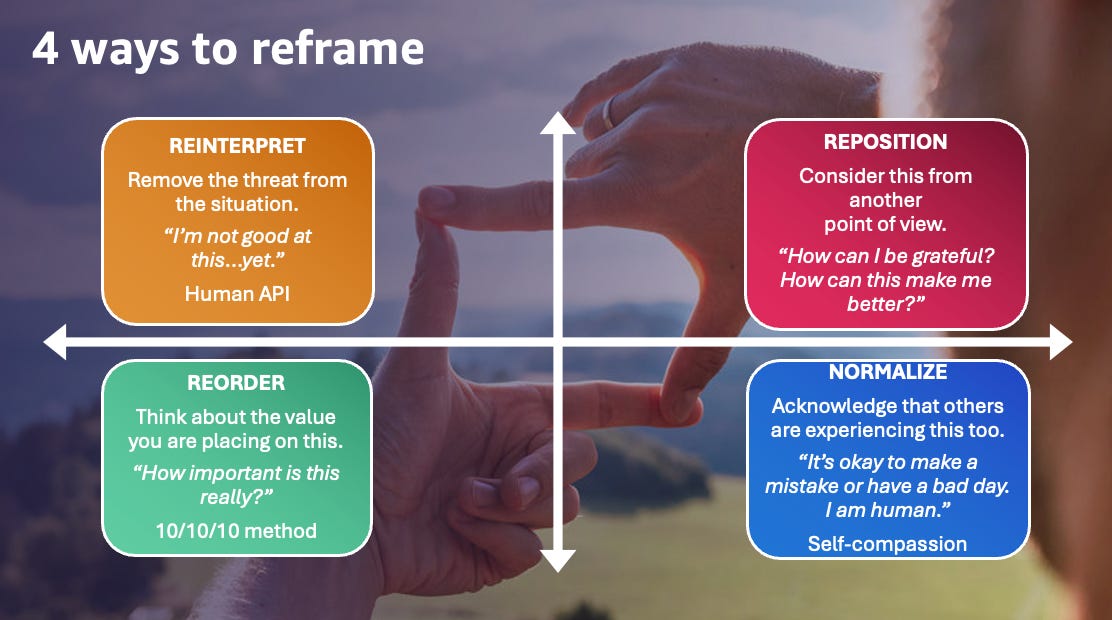
So how do you do it? There are four ways to reframe.
Reinterpreting. Find a way to take the threat out of a situation. This is the example I used at the beginning with the person who cut you off on the freeway. Other ways you can reinterpret:
“Stress is actually helpful. I can make it my friend. It makes me more ready to perform at my optimal level.” (Refer to Kelly McGonigal’s TED Talk, “How to Make Stress Your Friend” for an awesome speech about this.)
“I’m not nervous about this presentation, I am excited!”
“I’m not good at this...yet.” This is especially helpful for a skill you need or want to learn. It’s acknowledging that you are not proficient at this moment, but also believing that you will eventually get there.
In social situations, use a generous frame. I call it using the Human API = assume positive intent. When a co-worker disagrees with you in a meeting, instead of thinking, “They are trying to subvert me,” you can think, “They see something I don’t see. They want to solve this problem just like I do.” A related concept that has helped me tremendously is called Hanlon’s Razor: do not ascribe to malice what can be ascribed to ignorance or neglect.
Reordering. Adjust the value and priority you assign to something. How important is this to me, really? In the ultimate scheme of things? Am I giving this too much (or too little) credence? A helpful technique is the 10/10/10 method. It’s a form of time travel. I simply ask myself, “Will I care about this in ten days, ten weeks, or ten months?” I often realize I may not care about this in ten hours, and so why am I spending so much energy on this and allowing myself to be so discombobulated?
Repositioning. Look at the situation from another point of view. One of the most powerful ways to use this is when we face a difficult or painful situation. It’s acknowledging that the situation is difficult, but then asking, “What can I be grateful for—even in this unpleasant situation? How can this make me a better person?” This is really helpful for resilience. Dr. Martin Seligman did work with the US Army to make them mentally tougher to increase their completion rates for training and missions. This gratitude practice was one of the main techniques he taught them, and it quantifiably improved their performance. It eventually became one of the fundamental techniques of their Master Resilience Training program.
Normalizing. Acknowledge that it’s ok to feel anxious or overwhelmed and to have a bad day (or longer). Others are experiencing this too. This is a form of self-compassion. Research from Kristin Neff found that self-compassion is much more conducive to long-term success and health than either self-esteem or self-criticism. It’s not lowering standards (they are necessarily high at work), but it is acknowledging and accepting our human imperfections while we strive to perform, learn, and grow. I once asked a VP at Amazon who’d been there over 20 years (he’d been personally hired by Jeff Bezos over a BBQ at Jeff’s house): “What’s the secret to your longevity and success? What’s your biggest career lesson?” His response: “Realize that it’s okay to be down and have bad days. You can’t perform at the highest levels all the time.” Of all the things he could have said, that was the piece of wisdom that he shared. It’s a great example of normalizing.
Note that reframing does not mean your reframe is absolute fact. It may be, it may not. But it does give you other options for how to view the situation so you can select the one that is most productive. Instead of being stuck in only one perspective, you have the freedom to choose a different one.
Let’s go back to the person who cut you off on the freeway. Were they really on the way to the hospital because a loved one got hurt? You have no idea. But that’s not the point. How you framed it determined how you reacted, and you were able to choose a more useful reaction.
As Viktor Frankl, psychiatrist and Holocaust survivor said:
Between stimulus and response there is a space. In that space is our power to choose our response. In our response lies our growth and our freedom.
Note that this takes practice. You can’t just try it a few times and be good at it. Just like with anything else, sometimes you will succeed and sometimes you will fail. You will need to go through conscious incompetence before you get to conscious competence and then unconscious competence. It is worth the effort. If you develop this skill, it will make a huge difference in your career and relationships. I’ve been practicing it for decades, and it has been one of the most powerful techniques that I have learned. It has benefited me greatly in my job, in my marriage, with my kids, and in all my relationships.
As we develop this skill, we increase our cognitive flexibility. This is helpful for our relationships and also helpful for our careers in the AI age, where things are contantly and rapidly changing. The ability to adapt to new situations will supercharge our personal and professional success.
James Clear wrote a series of questions that I found to be profound and helpful:
Explore life from a position of power.
When you believe, “Even if I stay single, I’ll still have a great life” ... then you are in a much better position to enter a relationship.
When you believe, “Even if I don’t get into this school, I’ll still have a great life” ... then you are in a much better position to apply.
When you believe, “Even if I don’t succeed with this business, I’ll still have a great life” ... then you are in a much better position to give it a try.
Sure, you may want the relationship to work or the business to be a success—and you should give it your best effort—but also realize that if it doesn’t work out, you’ll be fine. There are many ways to live a great life.
I leave you with a final question:
What’s a situation that has been challenging or negative in the past week or so? It made you feel upset or anxious or stressed out. How could you apply one of these reframing techniques to manage yourself better and approach the situation more productively and/or creatively?
Just asking the question is a great start.
Be EPIQ,
Rich
Strengthen your reframing and other EQ skills by taking my masterclass, Emotional Intelligence for Resilient, Adaptable & High Performance Leadership, on Sep 12-19. The class has been a smashing success with 5-star ratings across the board.
Thanks for reading EPIQ Success Newsletter! Subscribe for free to receive new posts and support my work.
No posts
Comments
Nothing yet. Say the first thing.
Sign in to join the conversation.