
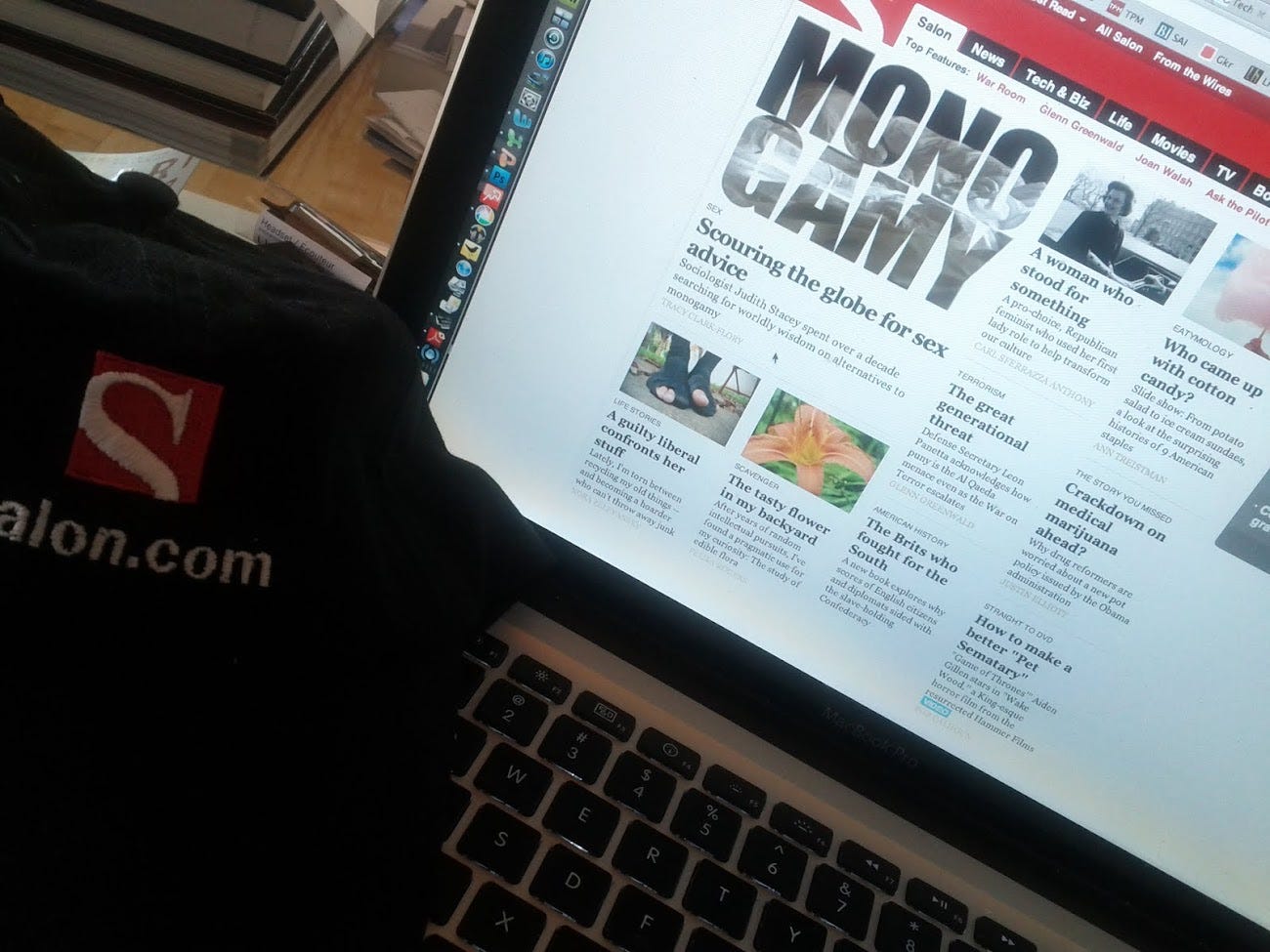
We called it a smart tabloid. It was brash. It was bright. It was snarky. It was one of the very first digital pure plays. HotWired preceded it the year before, Slate would follow a year later. It was a work of passion by a group of pioneers who eagerly grasped the opportunity to create a digital magazine.
I was in my last several months at Apple in early 1995 where I had helped build and launch Apple’s online service eWorld when a colleague introduced me to David Talbot, who at that time was the arts and culture editor of the San Francisco Examiner. The Examiner had a storied and rambunctious history including spreading the wordcraft of Mark Twain, Ambrose “Devil’s Dictionary” Bierce, Jack London, and Hunter S. Thompson. It had been in the hands of the Hearst family for more than a hundred years, from the mining baron George Hearst to the predatory journalism of William Randolph Hearst, who made the Examiner the “monarch of the dailies” and earned himself the renown of inspiring Citizen Kane. Much later, in the 1980s it was led by the erudite William Randolph Hearst III. The Examiner had long spawned big personalities and bold behavior. (In a bizarre circumstance, later in 1995 Hearst would hire me as vice president of content and editor-in-chief of the first broadband portal, the @Home Network.)
I suspect David Talbot saw himself in that same way. He had a clear vision and a confident personality that could attract a determined team of willing co-conspirators.
Talbot came down to the Apple campus in Cupertino with a few of his band of digital pioneers: the brilliant designer Mignon Khargie, the soon-to-be-publisher David Zweig, and another talented editor/writer, the late Andrew Ross. Talbot was determined to start a fresh, digital-only publication called Salon. Talbot was part journalist, part salesman, part carnival barker. He went into full evangelism mode and gave a stirring pitch. Khargie followed and shared the design vision for Salon. She was a counterpoint to Talbot in personality, style, and approach. With quiet confidence, she shared a set of alluring designs of what Salon would look and feel like. It had personality and sparkle. It carried an aesthetic that the text-oriented Web had not seen. It carried an aesthetic that snugly matched the design ethos of Apple. That mattered to me more than they knew.
At this point, it was clear the web would be a big thing. It was also clear that Salon was exactly the kind of bold and different thinking that Apple would want to embrace. I spent a few weeks exploring what I might do to help get Salon off the ground. It wasn’t obvious. Apple was struggling, budgets were short, and Apple’s own efforts with its online service eWorld were being stifled for the same reasons. Apple didn’t have much of an investment group at the time but I did have some unspent marketing budget. Maybe I could make that work. I did.
I asked David and his team to return to Cupertino for another meeting. Khargie told me later the Salon group met in the coffee shop of a nearby shopping center before coming to Apple. As they were leaving they saw the word Salon all lit up. A hairdresser’s closed shop had given them justified hope.
Once they settled into a conference room, I told them I could come up with roughly $75 thousand as a seed investment. They were overjoyed and quickly disclosed they would be quitting their jobs and diving in. I gulped. I told them $75K was not a huge sum of money and I couldn’t promise more, adding that I would do what I could to help them move forward. I also told them I’d try to funnel some used Macs and a printer or two out Apple’s back door and into theirs. One of those printers served the team for many years under the name Uncle Richard.
While they began to build the site and develop a deep slate of original articles, I worked with them to secure additional investment. David Weir, a journalist and former executive of KQED, who would shortly join HotWired as their editor, stepped in to help as well. It took several months before we could arrange additional funding from two investors who also believed in what Salon was trying to accomplish. One was the legendary investment banker Bill Hambrecht, who a decade later would persuade Google to use a Dutch auction when going public in 2004. The second was a thoughtful, professorial technologist named John Warnock. John co-founded the software company Adobe where his brilliance in computer graphics led to Postscript, the protocol that enabled laser printers to produce what the Mac allowed designers to create, including with Adobe’s Photoshop. Warnock loved books. He loved words. He loved the idea of Salon and supported it until his death in 2023.
Salon launched on November 20, 1995. Its initial web address was salon1999.com. Not surprisingly, salon.com was owned by a place that stylized hair not copy. John Markoff wrote a supportive piece for the New York Times a few days before the launch. It was a huge boost. Salon’s sleek look and clever writing were, in David Weir’s words, an “instant sensation”.
It did get a lot of buzz and a lot of users. Salon produced excellent content and broke big stories. It built a renowned stable of journalists and freelancers, among them Laura Miller, Camille Paglia, Scott Rosenberg, Gary Kamiya, Mary Elizabeth Williams, Joan Walsh, Steve Kornacki, Jeanne Carstensen, Rebecca Traister, Jake Tapper, and Glenn Greenwald. That being said, achieving business success with Salon was not easy and never would be. In those early years, the advertising community wasn’t exactly climbing over themselves to advertise on the web. It was a constant struggle to achieve financial success.
In 2009, I was still consulting with Google, when I received a message from Betsy Hambrecht, Bill’s daughter. She had stepped in to help run Salon. The business continued to be a challenge, the web was increasingly competitive, and Talbot, who could spend money as aggressively as he could inspire creativity, had departed. We met for lunch and she floated the idea that I join Salon as CEO. I was intrigued. I loved the publication. It would be a challenge, but I figured in the worst case I would earn some valuable experience in the trenches of web publishing.
I met with Hambrecht and Warnock to share my thoughts about the business. It was clear that Salon needed to build a much larger audience if it were going to make the advertising model work. One way or another we had to be bigger. There was one issue which I unwisely neglected to discuss with Hambrecht. Salon was still a public company as an over-the-counter stock. It had gone public in 1999 during the Web boom. That would prove a stubborn hindrance to pulling off the growth strategy I had in mind. Nonetheless, I agreed to take the reins.
The web had progressed quite far in the fifteen years since Salon launched. There was more competition and Salon needed to rethink itself. I gathered the staff in the large conference room in Salon’s Rincon Center near the Ferry Building, and brought in others by phone from Salon’s New York office or working from home. I walked them through my early thinking, which was more about questions than answers. I suggested it would be wise to step back and review all our assumptions, ask ourselves all the hard questions, and consider what we might do differently. I wasn’t saying everything had to change but that it would be intellectually wise to review all of our assumptions from the bottom up. Everyone seemed on board with that. What I would learn is that the acceptance would break down as our reconsiderations closed in on anyone’s individual role. That should surprise no one. Change is hard. Change is intimidating.
In taking Salon forward, there were several tacks I was determined to take. First, was to refresh our thinking about Salon, give it a new look, and bring that forward. Second, was to consider how we might expand Salon’s reach and revenue potential with new sections and new ideas. Third, was to consider whether there were opportunities to merge with other properties to build a stable of brands that could bring a larger audience and further efficiencies.
The team set out to redesign the product. I set out to analyze our current performance and see what insights that analysis might yield. One insight came from a closer look at the consumption behavior of the 10-12 million unique visitors Salon reached each month. While Salon had many great writers, I learned that articles longer than 600 words achieved a completion rate averaging just over 25%. It is not surprising that many readers don’t finish the articles they start but 25% seem a rather disappointing result. It was also true that user behaviors on the web were shifting towards shorter forms of content -- and this was well before the introduction of Tik-Tok and YouTube Shorts.
I went back to the editorial team and shared my analysis. As the publisher I couldn’t tell them what to do or how to write, nor did I have the expertise or inclination to do so. That was editor Joan Walsh’s job. But I could give them some encouraging guidance. My pitch was simple. If our objective as journalists was to get knowledge into the heads of our readers, shouldn’t we experiment with forms that might optimize that objective?
A great long read is a great long read. However, Lewis Laphan, the legendary editor of Harper’s Magazine, once told me there are many long reads but few are great long reads. He also believed in brevity. Most of our younger writers were already onboard. Some of them had been experimenting with their own blogs, beyond what they were writing for Salon or other publications. They were more familiar with approaches that worked with online audiences, and specifically, their generation of readers. But others were less willing. One writer admitted that he would never be a blogger, that he would never write short. He had sharpened his craft as a writer of long 1500 word pieces and he wasn’t inclined to do anything differently. He was a superb writer who had developed his skills before the Internet. He had developed his skills such that print publications were comfortable giving him a budget of 1500 words or more. His confidence in his own skill and his sense of self worth were tied to the license he had earned to write long pieces.
Not everyone was going to be willing to experiment with new forms and approaches. All of us do our best to learn the skills we can. But it is also clear that once we’ve perfected those skills, we might be reluctant to change, even when the circumstances tell us they should. My father-in-law, the legendary screenwriter Dalton Trumbo, presented a crisp example. After his stint in prison for contempt of Congress during the days of the Hollywood blacklist, he moved his family to Mexico City. They needed to save money and wanted to avoid the toxic environment that America was at that time. He did not speak Spanish and was quite adamant that he never would. He had spent his life perfecting his craft with the English word and was not about to waste a minute stumbling about with a language he did not know. Change is hard.
A second vector was to immerse the writing staff in the metrics of their own performance, so they could see what was working and what wasn’t. I also gave the editors a financial view of the performance of the writers who worked for them. Basically, what was the cost for a thousand page views earned by each writer and freelancer. This was not met with joy. I had to assure them that we would be wise enough to recognize that not all content would be treated the same. I acknowledged that the difference in cost and performance between an investigative piece that was expensive to do and not broadly read would be quite different from the cost and performance of one of our sex columnists. The investigative piece brought journalistic impact and cache. The sex columnist brought attention and lots of it. However, within that construct I would expect the editorial team to think carefully about their budgets and the efficiency of their spending. If one of our sex columnists isn’t driving a lot of traffic then maybe a change should be made. It is critical that we experiment, test, and assess the effectiveness of our approaches. Again, our objective was reach, frequency of engagement, and impact, not the volume production of words.
We then looked at what new sections and features we might offer, particularly topics that would drive appeal and ad revenue. We added excellent sections on cooking and the environment. We considered doing more video because the ad sales team said ad rates for video were significantly higher than text articles. We added a holiday gift shop offering a witty array of products that spoke to Salon’s editorial tone and sensibility (which if I could do it over would have been more sarcastic right over the line into controversy).
Salon’s audience grew, though not as much as we needed it to grow. The food section was popular but we were competing for advertisers with a passel of dedicated food sites like Epicurious and Chowhound to name but a few. Our videos were well done and interesting but they cost more money to produce than we could make back even with comparatively high ad rates (every $5,000 video needed 200,000 viewers to break even). The gift shop was fun but ecommerce wasn’t going to notably alter the bottom line.
Subscription models were a rare approach at the time, particularly with general audience publications. The New York Times did not put up a paywall until 2011. Under Talbot, Salon had tried a partial membership model based on the benefit of no advertising. However, that was not a compelling offer and came with the further cost of lost ad revenue.
So it was onto the third strategic vector of merging with other properties. This seemed eminently doable. There were many emerging properties that were open to that possibility. But there was a problem and the problem was the result of my failure to ask Bill Hambrecht the right question eighteen months earlier: would we take the company private? I’d assumed that would be an easy decision and started exploring it with Betsy and Bill. Maintaining the public issue cost us a couple of hundred thousand a year in legal and accounting bills. But that wasn’t the real problem. The companies we were targeting were emerging private companies who did not like the idea of suddenly becoming a public company, particularly one with over-the-counter status and a tiny float. Their desire was to continue to grow and only go public when and if it made sense. Thus, we could only merge with other public companies. For Salon, that meant large traditional publishing companies that would at best add Salon as a small piece of a legacy publisher’s stable. More than likely, that publisher would be having its own challenges in the digital realm. But Bill Hambrecht did not agree with taking it private. He thought it would be useful for us someday. I could not win the argument, certainly not with an investor as sophisticated as Bill Hambrecht.
As much of a challenge as it was to make Salon commercially successful, it was a tremendously rewarding experience. A newsroom is a fun place to be. Writers are fun people to spend time with. I had a big office I avoided, preferring to hang out with a laptop at a conference table in the middle of the San Francisco newsroom.
These were passionate people doing their best to be successful and have impact. It had a great vibe whether it was stimulated by the energy of a big story or the humor of another sharp bit of internal repartee. The team worked long hours. They worked when the flow of news told them they had to work. When Princess Diana died on a Saturday, many dashed to the office without a need to be asked, and spent more hours than they expected. It was high-stress work but these were people who thrived on such opportunities, even if it meant too much cheap pizza or whatever food and fuel the streets of San Francisco could offer. While I constantly looked for ways to save money I never went short on food and snacks. My only concern was that some writers, Steve Kornacki being a disturbing example, lived off of nothing but KitKat bars, Skittles, and the random bowl of microwaved ramen.
As great an experience as Salon had been, I did not feel there was much more I could do to grow the audience to the level necessary to enable the financial stability I thought was possible. Then Google called to discuss my possible return.
I suspect all of the many great people who worked on Salon back then treasured the experience. It was as exciting as it was challenging. It was as psychologically rewarding as financially it was not. We were all doing what we loved and doing it with passion, determination, and good humor. This was an organization founded by journalists and writers proudly on a mission and determined to have fun pursuing it.
Salon did not and would not slip quietly into the night. As one of Salon’s great writers, Gary Kamiya, put it, “Salon had a Blackbeard-like refusal to die even while being simultaneously shot, strangled, drowned, garroted and keelhauled.”
Richard Gingras chairs the board of Village Media and is a co-founder and board member of the global Center for News, Technology, and Innovation. He recently retired from Google after 15 years serving as the company’s global vice president for news, overseeing various product efforts as well as the Google News Initiative. Gingras also engaged on news-related public policy matters around the world. Gingras serves on the boards of several journalism policy related organizations, including the International Consortium of Investigative Journalists, the International Center for Journalists, the First Amendment Coalition, the James W Foley Legacy Foundation, the UC Berkeley School of Journalism, and the advisory council of the Frontline documentary series.
Comments
Nothing yet. Say the first thing.
Sign in to join the conversation.