
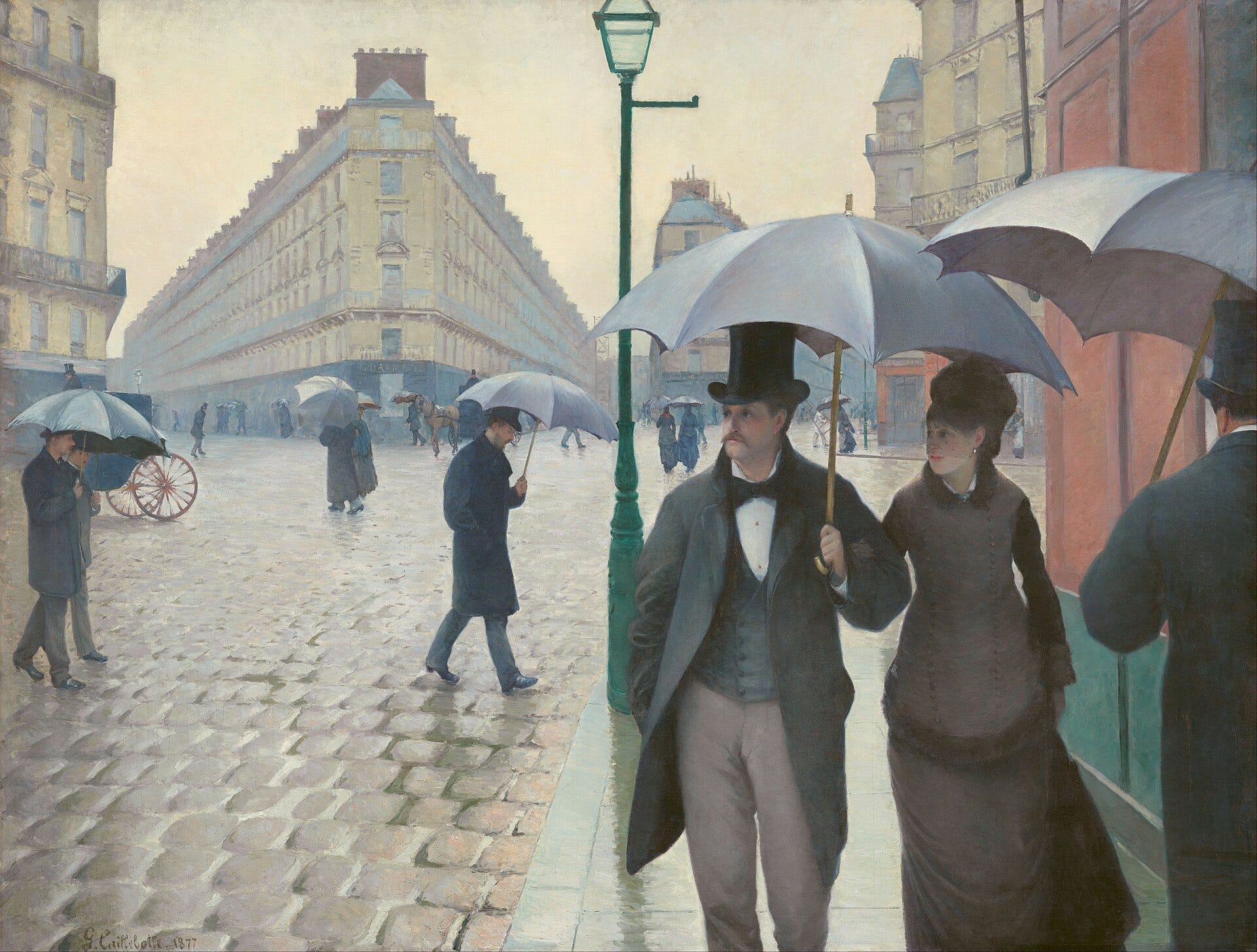
Back in 2018, I published a piece in The New York Times about the push to re-think city streets, reclaiming public space from automotive traffic for the people who live, walk, and bike around a given neighborhood. It’s time to revisit that movement, and see how far we’ve come toward making cities work for people.
In some of the major cities of the world, it has begun to dawn even on public officials that walking is a highly efficient means of transit, as well as one of the great underrated pleasures in life. Cities abroad, and increasingly in the United States, are now taking back at least a few streets for pedestrians.
Paris gets most of the attention, and fair enough, given how much it has recently accomplished and also its history as the birthplace of the flâneur, the footloose explorer of urban street life. Over the past 15 years, the city has “pedestrianized” 8.4 miles of Rues aux écoles, or School Streets, according to a study published earlier this year by Marcel Moran, a San Jose State University specialist in urban transportation. By his estimate, this has converted almost 40 acres of former traffic lanes in front of city schools into open space that’s safe for walking, playing, and, incidentally, breathing.
That’s in addition to the 2013 conversion of highway lanes along the Seine for the widely celebrated 25-acre Parc Rives-de-Seine, and a multitude of other pedestrian- and bike-friendly projects around the city. This effort has been so well received that Parisians last year voted overwhelmingly for a “Garden Streets” plan to convert another 500 streets across the city to pedestrian zones, bike lanes, and green areas.
It is perhaps easier for Paris and other European cities (notably Oslo, Copenhagen, and Barcelona) to do this than for many American cities, on several counts. Those cities tend to be much more densely built, says Moran. After a recent presentation about the Paris innovations for a group of California transportation planners, “they said, ‘We’re looking at these pictures, but our streets don’t look like this, in terms of the surrounding land use.’ If you have a lot of driveways and you have setback homes, you don’t necessarily have the starting point” to be closing off streets to car traffic.
American cities also typically lack a good alternative to cars like the clean, safe, mostly punctual public transit that’s common in many European cities. A 2024 study by the Paris Region Institute, found that 66% of travelers from the outskirts of Paris come into the city center via public transit. In a significant recent shift, more Parisians now also commute by bike than by car.
Americans by contrast own more cars than any other large country—800 per 1000 people (counting children), and we tend to suffer from a devout faith in individual automotive freedom of movement. The standard response of American car owners to proposed limitations on where their cars can go, or when, is fury, followed by a lawsuit.
Hapless disbelief is also common. My favorite example comes from a pampered American journalist in Paris. In a screed against the car-free changes along the Seine, he whined: “Try getting to one of my favorite restaurants, Bofinger, off the Bastille from my apartment around the corner from the Musée d’Orsay at lunch time. Forever.” (Do I hear a tiny violin playing? Is it one of those damned street musicians?)
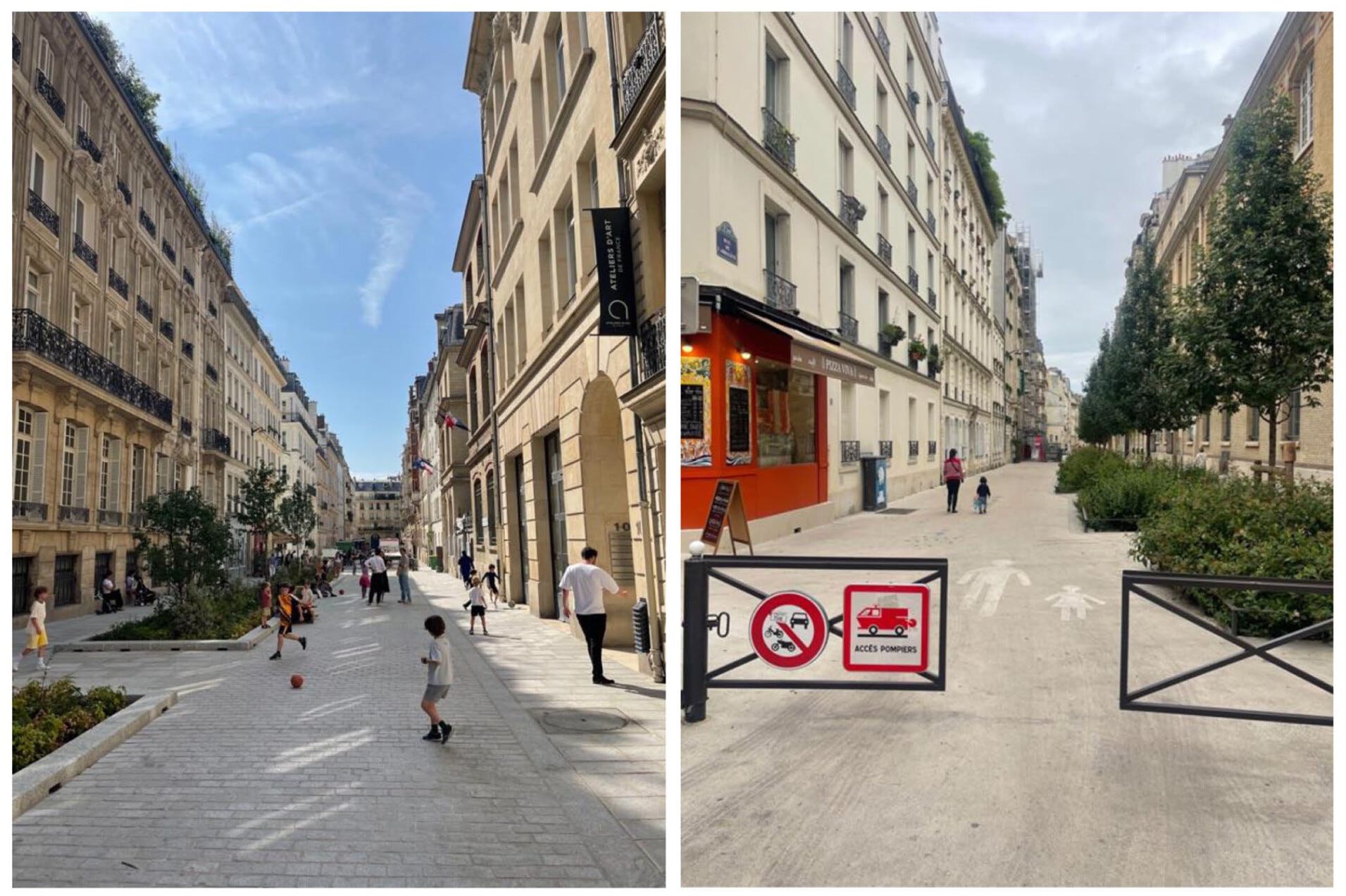
Car owners often mistake their century-long domination over pedestrians for a right rather than a misbegotten privilege. But converted streets tend to make the true cost of that privilege apparent. For instance, on the Paris “School Streets” where tan or light brown “cooling pavements” have replaced conventional asphalt streets, they lower the heat in the neighborhood by nine degrees Fahrenheit on average—a life-saving difference as unrelenting heat waves are killing tens of thousands of people across Europe. (I feel I need to say the words “climate change” here.)
Car traffic in cities also contributes a major portion of small-particle air pollution, the kind that penetrates deep into the lungs. It’s a persistent, largely invisible form of violence that typically targets lower-income people living close to busy roads. Small children and older people pay most of the cost in respiratory, cardiovascular, and other problems.
A 2013 M.I.T. study estimated that vehicle emissions cause 53,000 early deaths a year in the United States, and a study from Lancaster University in Britain found that living in areas with high levels of vehicle pollution correlates strongly with children experiencing intellectual disabilities.
No scientific studies so far have persuasively demonstrated that car-free streets improve air quality, perhaps because such conversions are too few in number or affect too small an area. But short-term efforts to reduce automotive traffic across entire cities have dramatically improved public health, at least for a little while. During the 17-day 1996 Olympic Games in Atlanta, for instance, sharply lower car traffic (and increased public transit) resulted in a 42 percent decrease in acute care visits by children with asthma. Likewise, during the 2008 Games in Beijing, every 10 percent reduction in air pollution resulted in about an 8 percent drop in deaths, according to a 2016 study, mostly by preventing heart attacks, strokes, and lung disease.
Finally, car traffic kills pedestrians more directly in motor vehicle accidents, mostly on busy, high-capacity urban roads. The national death toll hit 8000 U.S. pedestrians in 2022 (plus another 140,000 victims taken to the emergency department for non-fatal injuries). That was almost double the pedestrian death toll for 2009.
Many American cities make the problem even deadlier by continuing to rely on “level of service” (LOS) design models developed in the 1960s. They focus single-mindedly on keeping car and truck traffic moving. Any improvements for walking, biking, or public transit that might slow down traffic get categorized as “LOS impediments.” The result, as one researcher put it, in a recent article on the world’s best cities for pedestrians, “If you want to see the worst-case scenario for pedestrians, look at US cities.”
But all that just adds up to a powerful argument for why our cities must do better. New York City is the one to watch, says Moran. Last year, the city fought back opposition from the Trump Administration to launch the nation’s first “congestion pricing” program. In its first year, the relatively steep $9 toll for entering the busiest parts of Manhattan during the work day resulted in 27 million fewer car trips, $550 million in new income for public transit, less angry honking, and significantly fewer car crashes. Even drivers willing to pay for their privilege liked it, because it was suddenly easier to get where they wanted to go.
New York is also one of a handful of U.S. cities currently experimenting with “dynamically priced parking.” That is, they increase the cost of a parking space as demand increases across the day, an innovation made possible by the parking apps that are replacing parking meters in many areas. Moran characterizes this as an incremental way to challenge “a default assumption in the United States that streets should be places for cars to park, mostly for free. And I think it’s important to challenge that assumption.”
Each parked car eats up 350 or so square feet of public space, often at no charge, in cities where private parking spaces can rent for $700 or more a month. The other way to challenge this assumed right to subsidized parking is through parking removal programs in many cities. Cities are discovering that they “can reclaim that space for outdoor dining and for wider sidewalks and for bike lanes and bus lanes,” says Moran. “There’s all kinds of creative things we can do.” For instance, planting trees to shade and cool otherwise-deadly urban heat islands.
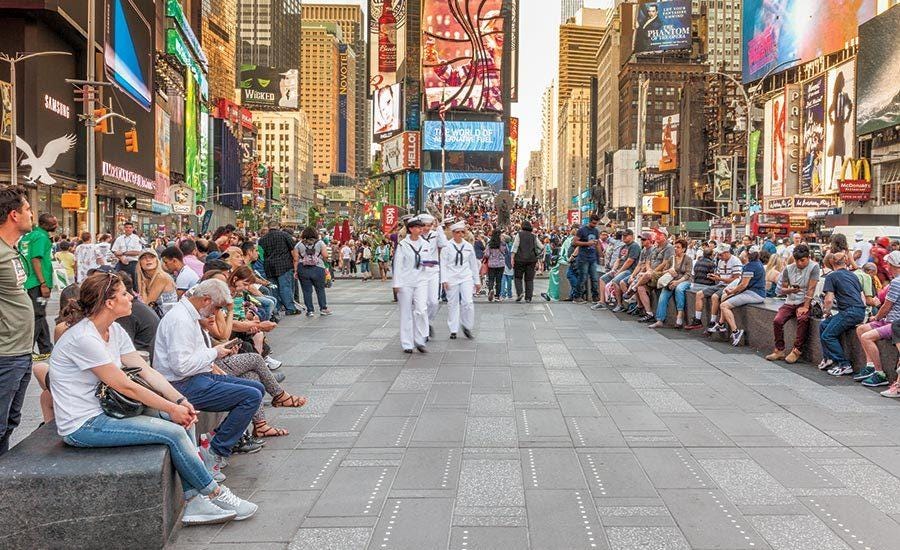
New York City has successfully converted large portions of Broadway from loud, dangerous car traffic lanes to safer, livelier pedestrian walkways, mainly in the theater district north of Times Square and at Herald Square. Transportation analysts call it a win-win, because traffic flow has improved at the same time pedestrian traffic deaths decreased. Mayor Zohran Mamdani is now pushing to extend the treatment to Brooklyn’s Grand Army Plaza, currently a vehicle-dominated, accident-prone, roundabout rat race. The plan will remove a confusing web of roads at one end of the roundabout, making the plaza itself accessible to walkers and directly connecting it to the entrance to Prospect Park
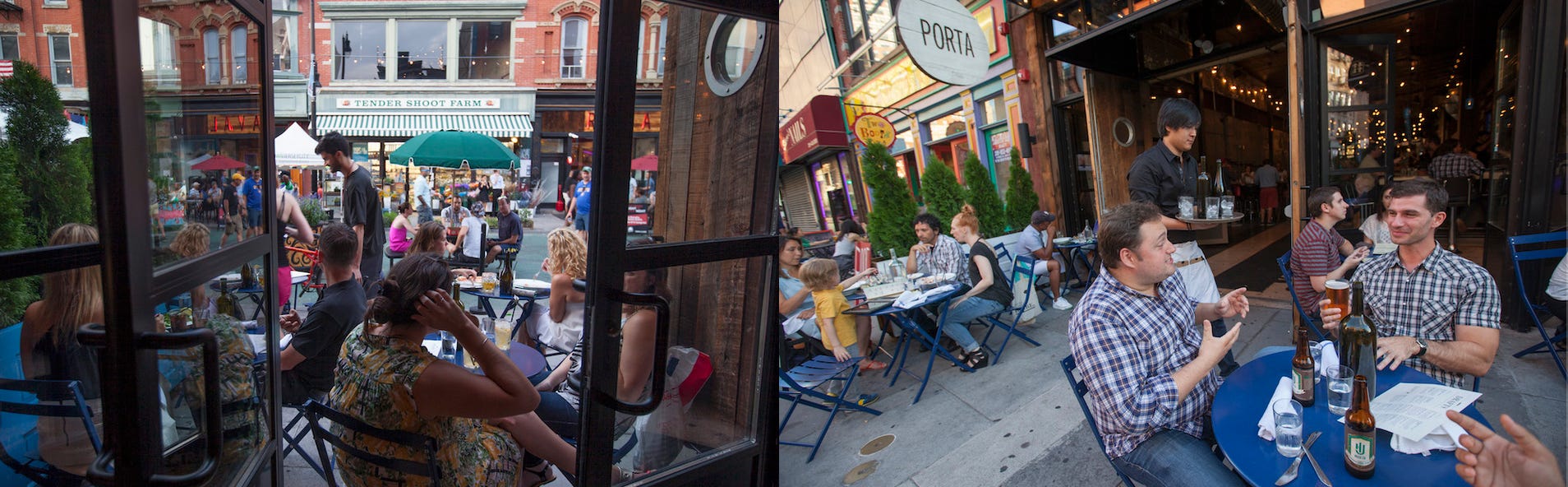
The small but hopeful beginnings of a flâneur-friendlier America extend well beyond the Big Apple, says Moran. Catch a PATH train from lower Manhattan to Jersey City, for instance, and the block of Newark Avenue by the Grove Street Station has become a lively pedestrian area of restaurants and park benches and planters. The city is now considering extending the pedestrian area for another block. OK, it’s not Paris (among other things, the pavement is still black asphalt), but it’s a long way from the scruffier Jersey City where my family was living when I was born there in the 1950s.
Elsewhere, vestiges of the pedestrian street life that popped up during the Covid pandemic have become permanent. Moran sees a possible way forward in this pattern of temporary pedestrian-friendly innovations gradually taking hold. “So sometimes it’s like a Saturday-Sunday type of pedestrianization” or evenings and weekend markets. Gradually, neighborhood people and businesses realize it works well without making much difference to vehicle traffic. So they pressure public officials to make it permanent. Then, with luck and continuing pressure, it starts to expand. “And those are meaningful,” Moran adds, though lacking “the scale or ambition of the Paris program.”
There’s one other possible reason for hope. In place of the tendency of many department of transportation planners to treat humans as “LOS impediments,” there’s a big movement now, says Moran, “in progressive planning circles to think about how do you build a street that works for an eight-year-old and an 80-year-old. And if we really think hard about older adults and younger adults, we’re going to build a space that’s probably better for everybody.”
It’s a vital shift in thinking. But the idea that our city planners are only now coming around to the idea that children matter is horrifying evidence of how we have allowed cars to dazzle and destroy our lives. The truth is that even Paris is not doing nearly enough to restore streets for pedestrian use, and it’s the pedestrians, not the drivers, who should be furious.
Here is the fundamental common sense rule: Cities and their streets are about people, not cars, and all urban design should think first about the only transit equipment that comes factory-standard for the average human being—our feet.
END
“What are the best cities in the world for pedestrians?” ArchDaily, lists top five cities in the world for pedestrians based on several different criteria, from a new study by the Institute for Transportation and Development Policy (ITDP).
Comments
Nothing yet. Say the first thing.
Sign in to join the conversation.