
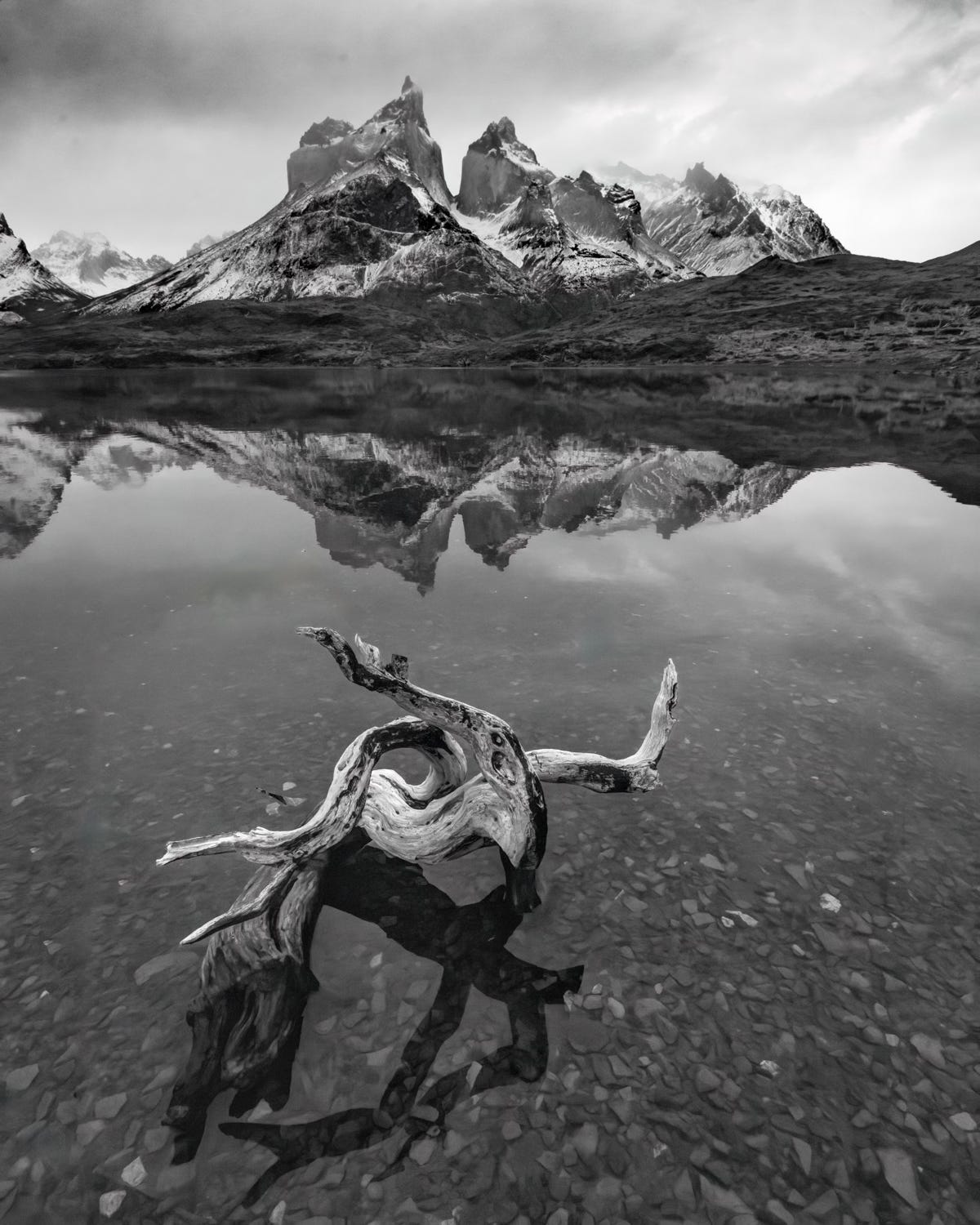
Edward Weston once said that to consult the rules of composition before making a photograph is a little like consulting the law of gravitation before going for a walk.
He was right. And most photographers have it completely backwards.
I’m often asked if I think much about composition when I’m in the field, looking through the viewfinder. The answer is mostly no. Jazz guitarists aren’t fixated on chords and scales when they’re improvising. Best-selling authors give almost no conscious thought to grammar when they’re writing. During those moments of creation, something deeper is steering the process. Psychologists call this automaticity.
When I’m out making images, I simply defer to what feels right. I don’t spend mental energy on design or composition during those critical moments. I’m running almost solely on feeling and intuition. But that intuition, that sense of what feels right, took years of study and observation until composition, design, and formal aesthetics became second nature. They’re incorporated into how I see the world every single day. The years of practice, observation, and study are the database my intuition draws from. That’s automaticity at work.
Automaticity is the ability to perform tasks, behaviors, or cognitive processes quickly and efficiently, with little to no conscious effort. It develops through extensive practice and repetition until learned skills become ingrained, freeing up mental resources for what matters in the moment.
The process has two distinct phases. First: conscious study and deliberate application of rules and principles. Second: through repetition and deep immersion, those principles migrate below the threshold of conscious thought and become part of how you see naturally, without thinking. What feels like intuition in the field is actually that second phase operating quietly in the background.
Weston understood this. He wrote about the moment of creation as the convergence of everything: years of learning and unlearning, success and failure, seeing and missing. The intuition he trusted wasn’t something he was born with. It was something he built, slowly, through relentless practice, until the principles of vision were so thoroughly absorbed that consulting them consciously would have been redundant, almost absurd. Like checking whether gravity still works before stepping outside.
This is the real task for any photographer, at any level. And it doesn’t only apply to composition. It applies to evaluating light, choosing perspective, anticipating moments. All of it. Here’s how to get there:
Study the rules, but treat them as guidelines. They exist for a reason. There’s real visual logic in each of them. But as you progress, you’ll understand you’re not bound by them, and more importantly, you’ll understand why.
Practice relentlessly and study the results. What worked? What didn’t? Why? Do this every time.
Give yourself permission to fail. The more mistakes, the better. Failure is the curriculum.
Study other photographers’ work obsessively. Instagram, websites, books, galleries. I believe this is every bit as important as time behind the camera. Maybe more.
Look for geometric shapes and lines. Triangles, diagonals, curves, leading lines. Train yourself to identify them explicitly in the early stages so that eventually your eye finds them automatically without prompting.
If you do all of the above, something remarkable will happen. One day, probably without a camera in hand, you’ll notice that you see the world differently than you did before photography was a part of your life. The change happened gradually, but you’ll notice it suddenly. And that’s when you’ll realize you’ve learned and absorbed enough about composition to finally forget it.
That’s the goal. That’s the whole game. Now go enjoy the journey.
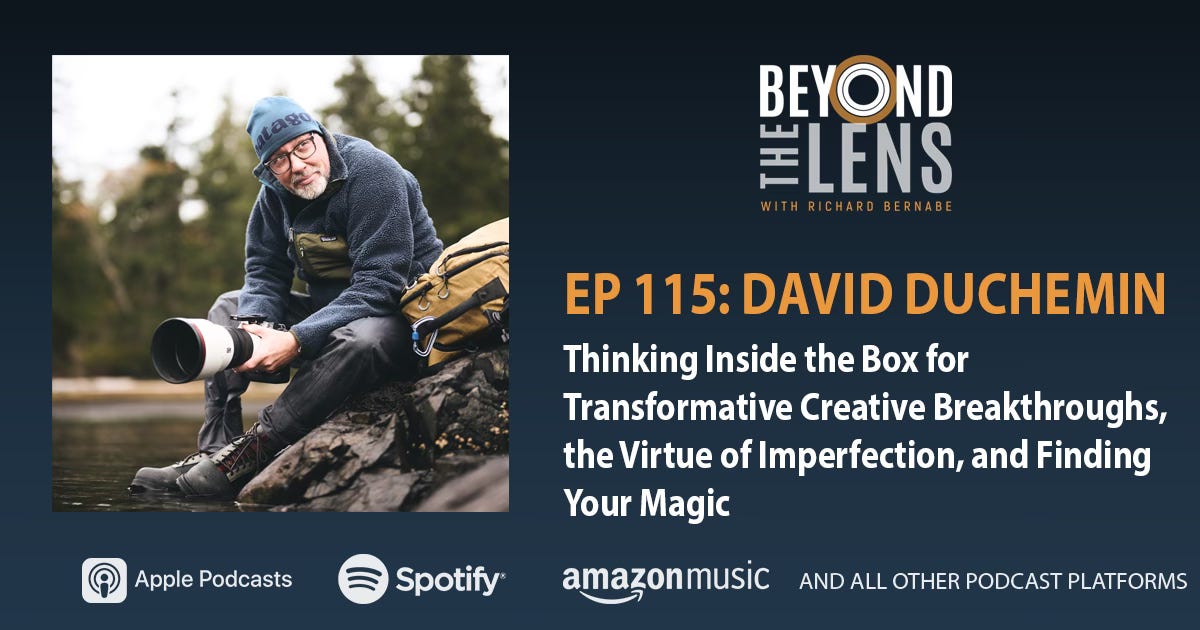
David duChemin is a Vancouver Island-based photographer, author, educator, and avid traveler who has published eight books and spent much of his three-decade career teaching others to make creative photographs all across the world.
Richard asks David about the content in his newest book, Light, Space & Time: Essays on Camera Craft and Creativity. Some of the topics discussed include self-knowledge, vision, intention, purpose, expression, and the virtue of imperfection. David explains how he made the transition to photographing wildlife and why he doesn’t chase likes on social media.
As I mentioned, all links are to Apple Podcasts but you can search for Beyond The Lens with Richard Bernabe on Spotify or any other podcast app.
*****
Here’s to Truth, Adventure, and Passion
No posts
Comments
Nothing yet. Say the first thing.
Sign in to join the conversation.