
Go, said the bird, for the leaves were full of children,
Hidden excitedly, containing laughter.
Go, go, go, said the bird: human kind
Cannot bear very much reality.
—T.S. Eliot, “Burnt Norton”
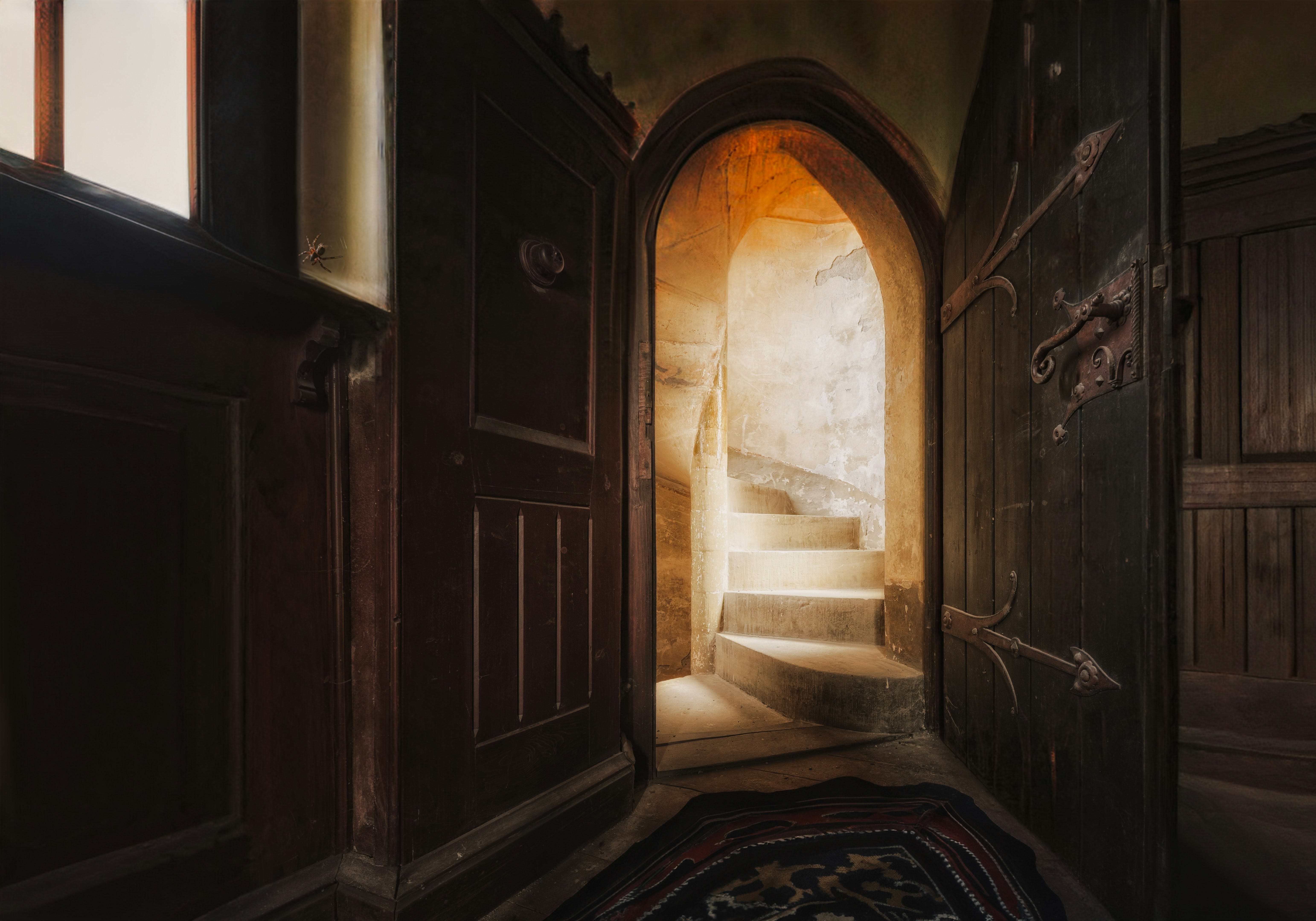
I’ve been laughing at my life a lot lately. Really, it’s the only good response to some of the strange turns it’s taken and the strange places I’ve ended up.
Call it bemused shock, and you get rather close to what I’ve been feeling.
Maybe “awe” is a better word for this, but that feels too reverent. Still, that gets pretty close to this odd mix of humbled curiosity and confusion that washes over me when I try to fit who I am and what I’m doing now into the narrative of who I thought I’d be and what I assumed I’d be doing. And almost all of this is coming from this strange Jung journey I’ve been on.
It’s hard for me not to remember the first essay I ever wrote that turned me from some guy with an online blog to some guy that people wanted to read. A few of my pagan readers probably remember it, too (and can maybe even help me remember the title). It was a short essay, written on my old Wordpress site as a salvo against another author’s dismissal of polytheism. According to that author, people who believed gods were real were all immature, a bit unhinged, somewhat dangerous, and most certainly delusional. And I, firebrand that I was, constructed a response that turned all his criticisms into compliments, pointing out that everything he accused us of fit into a larger liberal narrative of dismissing minority opinions and divergent perceptions.
The author was a Jungian atheist who considered himself a Pagan. For reasons I cannot really judge, he felt an almost obsessive need to correct all the “delusions” he encountered about the existence of gods. His argument, based on his reading of Jung, was that yes, of course, gods “exist,” but only as archetypes in the collective unconscious. Therefore, treating them also as really-existing beings is a kind of delusion akin to schizophrenia or other mental disorders, mistaking internal signals as coming from external sources.
So it’s rather amusing to me that, more than 12 years later, I’m now offering Jungian coaching. It’s funny, because I actually heard this perspective again from one of my instructors in the training courses. In fact, it’s a common compromise among Jungians, a way of allowing for the gods and the mythic without sounding “crazy.” And it has some value, honestly, so it’s worth explaining what’s believed.
See, humans have this weird tendency to keep reporting unusual experiences that don’t fit into our secular materialist framework. They keep seeing ghosts and strange lights, hearing voices, getting premonitions, and doing all kinds of other things that shouldn’t really be happening if we believe there’s nothing “out there.” Look through ancient history, and you won’t find a single people group without some sort of belief in gods, spirits, magic, and other beings.
Jung noticed this and, rather than using the usual modern “scientific” trick of dismissing all these experiences as superstitions and delusions, suggested that they were all crucial functions of the unconscious part of the human psyche. Gods, angels, demons, fairies, and all the rest existed as archetypes that showed up in people’s dreams because there were powerful instincts, drives, and forces innate to human existence that our conscious mind gave recurring images to.
Put another way, the reason why every culture has some form of dragon is because all humans have the same unconscious experience that feels like a serpent with wings. Similar to this, every culture has a sense that the dead live on in their memories, so they tell stories and have dreams and visions in which the dead are still living.
It’s a really good explanation when you compare it to the dominant scientific belief that everyone who believes in these things is misinterpreting signals from the brain and making up comforting stories about those signals to protect their psyches from the depressing truth of human reality. Thanks to Jung, someone like Joan of Arc, who reported that saints spoke to her in person and refused to relent this belief on pain of a burning death, wasn’t schizophrenic. Instead, she had a really strong connection to her unconscious self that led her to lead armies against the English occupiers of France.
But while this framework is kinder than the scientific alternative, it still assumes she was mistaken. Powerful beings were talking to her, but they were actually just aspects of her unconscious that she projected outward. In other words: she was still schizophrenic, but in a more functional way.
This has always been the problem with the modern trend that I call “animism without the spirits.” David Abram’s book, The Spell of the Sensuous, is probably the best known evangelical tract of this kind of animism, particularly in his early chapter on animist beliefs about household spirits. In that section, he recounts how, even though his Balinese hosts claim that they are leaving out rice to appease household spirits, he keeps noticing that the rice is being carried away by ants. He then decides that his hosts just believed that the ants were household spirits, since all living things are also spirits in animist belief.
This is the same kind of “compromise” in what’s unfortunately become the main Jungian position. Joan of Arc was just describing a situation a different way, just as Abram’s Balinese hosts were. In both cases, though, the Western scientific belief that there’s nothing really “out there” except for what we can see (whether with eyes or a powerful-enough microscope) remains intact and unchallenged. All that’s needed, then, is the right kind of translation across cultures and you can still maintain as much disbelief as you need.
What’s really amusing about the use of Jung for this position is that Jungian psychology actually offers a good explanation for the mental trick being played on the person who holds this position. The ego (the conscious mind) acts as the final guardian of the psyche. It’s there to keep too much reality from coming in and breaking out minds. So, the more unconscious “material” we allow in (experiences of spirits, gods, ghosts, etc.), the more the ego will try to balance that out with a tighter hold on reality.
This mechanism explains very well why people who experience intense otherworldly experiences without guidance swing back into a cold and cynical materialism. That’s because the opposite can occur just as easily, as for example people I’ve known who’ve taken ayahuasca without a guide and have become utterly unstable. In those latter cases, there was no help available to integrate the intense experiences back into the psyche, and so the magic “broke” them. (I fear one of them is, tragically 7 years later, still trying to “reactivate Machu Picchu.”)
The only way not to swing wildly between the extremes is to integrate the unconscious with the conscious, to “marry” the subtle senses with the more physical ones. But that’s not easily done alone, which is why jobs like priest and shaman, physical spaces such as temples and shrines, and cultural structures like religion keep appearing in societies. We need ways of keeping the Otherworld from fully overwhelming our world. We need places where the spirits and gods live and people who know how to communicate really well with them, so they don’t come trampling through our villages and smashing up our homes.
Unfortunately, as you’ve no doubt noticed, there aren’t many dwellings for the gods being built, nor are there many priests or shamans trying to find out what they’d like. If the Otherworld is even acknowledged at all, it’s only allowed to exist inside us, and a host of more “scientific” religious specialists (psychologists and therapists) have become tasked to treat with its denizens.
But that’s the thing with gods and spirits, angels and demons, and all manner of beings divine and chthonic. None of those sorts really like being contained; trap them inside a person, and they’ll wreak some havoc. Remember: that’s what exorcists were for in the monotheisms and all the countless polytheist and animist cultures. It wasn’t so good to have a spirit inside you when it was supposed to be outside.
And I think that’s why I, as someone who is certain there’s much more “out there” than what’s inside my unconscious, nevertheless find the Jungian framework extremely useful. It’s as Gordon White said: we can “wear Jung’s skin like a pelt,” taking on what he saw as shapeshifters do, flying through his visions as if they’re our own. But then we can also take the pelt off afterwards. In fact, we can assume it and put it down as often as needed, whenever there’s something we need to see about our Self and what it also sees.
In other words, from someone who once saw Jung’s framework as an unnecessary compromise, I’ve become someone who sees it as a powerful way to teach us to hear the gods and spirits again. More so, through my Jungian coaching training and work, I’ve come to understand something even more useful about it than I’d previously guessed.
As I said, Jung believed one of the ego’s roles was to protect the psyche from too much reality. Especially in regards to myself, I can now see how certain defense mechanisms, including some awful and destructive ones, were actually quite necessary at the time. These were quite present in my life during my activist years: years of outward political and social struggle while internally my life was an absolute mess of unresolved bitterness, feelings of failure, deep self-doubt, and fear.
This is particularly one of the places that I find myself laughing at my current life now, because I felt a particularly resentment (or actually, ressentiment) towards those who noticed the connection between my outward activism and my inward turmoil and then gently tried to offer suggestions for ways to make my life better. Anyone who suggested I join a gym, or do yoga, or (gasp) sign up for a few life coaching sessions became an immediate target of my political ire. They were “privileged,” they didn’t understand the true situation of the world or how hard it was for some of us or what things like “trauma” or “oppression” really felt like.
The truth as I see it now is that I was far from being ready to deal with any of those things. My life was so much a shambles in my 20s that a full reckoning of what I was truly feeling probably would have driven me straight to alcoholism or worse. At that point of my life, I had no one who possibly have helped me integrate those things back into my life, and thus my ego’s defense was the only thing keeping me sane.
It’s also funny that it wasn’t until I started exploring the Otherworld, talking to gods and spirits and some beings I still don’t understand, that I was then also able to start exploring the darker corners of my psyche. At first, it all felt quite like insanity, an accusation made constantly against others who talk of gods and spirits as if they’re real. Visiting the Otherworld is actually quite easy, it’s the coming back part that isn’t. But I fortunately had others to help me, people who’ve talked to the very same beings and others similar to them and could then give me advice on how not to go crazy.
At the very same time, other things started healing about me that I didn’t know I needed to be healed. This was a much longer process, one guided also by two amazing life coaches who worked in different frameworks.1 And yes, the very spirits and gods I was talking with helped in this, too.
And that’s another funny thing, because it would still be easy for someone to read my account and continue to hold the opinion that I was really just talking to unconscious archetypes. And that’s fine, actually, because I’ve come to understand that this is how their egos protect them, just like my ego protected me. That’s what it’s there for, after all: to protect you.
Eventually, though, you stop needing so much protection. Getting older helps, of course, but what helps even more is knowing being “crazy” is usually a necessary step to wisdom. The “dark night of the soul” is a moment of ego-death, just like a work burnout or nervous collapse is. The unconscious takes over for a little while, shuts everything down, reorders some things, and then resurrects the Ego in a new form that’s better suited for a larger reality. And we die many, many times in one life until we finally trust what our unconscious is telling us.
(PS: I’ve now accumulated a third of the required certification hours with an initial group of fifteen people, and I can now open up another five spaces for pay-as-you-will clients. You can find more information about that here)
Those two coaches both continue to practice, both are amazing, and both significantly helped me transform my life. One of them does integrative coaching now focused around questions of money and wealth and has a substack: Jessica @ Post-Wealth Project. The other is a Tantric coach and body worker, David Salih. Both are absolutely wonderful people.
Comments
Nothing yet. Say the first thing.
Sign in to join the conversation.