
Ah, the Superhero Deconstruction™. I don’t know at what point the deconstruction of a genre becomes a genre itself, but we’ve definitely passed that point. Some might call the Superhero Deconstruction™ genre trite and unoriginal, filled with the same tired tropes; I don’t fully disagree(the various Evil Superman pastiches are rarely as interesting as the actual Superman). At the same time, the manner in which these stories explore the superhero genre can still be interesting and unique.
Superheroes are products of their times. Superman was created during the Great Depression, and Captain America during World War II. Similarly, deconstructions of superheroes can be used them to comment on the problems of their times and explore different themes. The Boys is a story about corporate evil and the idolization of celebrities and political figures. Its heroes are hedonistic monsters whose crimes are covered up by the corporation that controls them. Invincible is a story about imperfect people trying to be better. Its heroes are selfish and incompetent characters stepping up against superior opponents. One-Punch Man is a story about the value in living a simple, ordinary life. Its heroes are mundane wage slaves just filling quotas.
I think I’m getting off topic.
One of the foundational works of this genre is the graphic novel widely considered the greatest comic book of all time. Watchmen, written by Alan Moore, illustrated by Dave Gibbons, and colored by John Higgins, was published by DC Comics between 1986 and 1987. It’s set in an alternate history where the US won the Vietnam War and RIchard Nixon was never forced to resign. The story takes place in 1985, when the threat of nuclear war and mutually assured destruction looms over the world.
The comic’s title is based on a Latin quote by Roman poet Juvenal: Quis custodiet ipsos custodes? Who watches the watchmen? Alan Moore interweaves the history of superhero comics with the history of 20th Century America, stripping away the mythos built around both. Watchmen is very much a product of its times, a long, hard look at both the Cold War and the superhero genre.
The latter topic is the main focus of this post. Using an epistolary style drawing from in-universe books, research papers, newspaper clippings and personal communications, Watchmen fleshes out three eras of superhero history. Moore then used it to explore exactly what it is that makes a person put on a mask and tights and go out every night to beat up criminals, and what that says about their morality(and sanity).
With one exception, none of Watchmen’s heroes actually have superpowers. This makes the first generation of costumed heroes even more remarkable and ludicrous. Interspersed in the comic are snippets of retired hero Nite Owl’s memoir, where he discusses the first team of heroes, the Minutemen. Nite Owl, who became a hero driven by his naive love for pulp comics, looks back on their run from 1939 to 1949 with nostalgia. The Minutemen are clearly Moore’s take on the Golden Age of Superhero Comics and teams like the Justice Society of America. However, the Minutemen are less noble heroes and more a flawed, heavily commercialized group of people completely unequipped to actually handle systemic injustice.
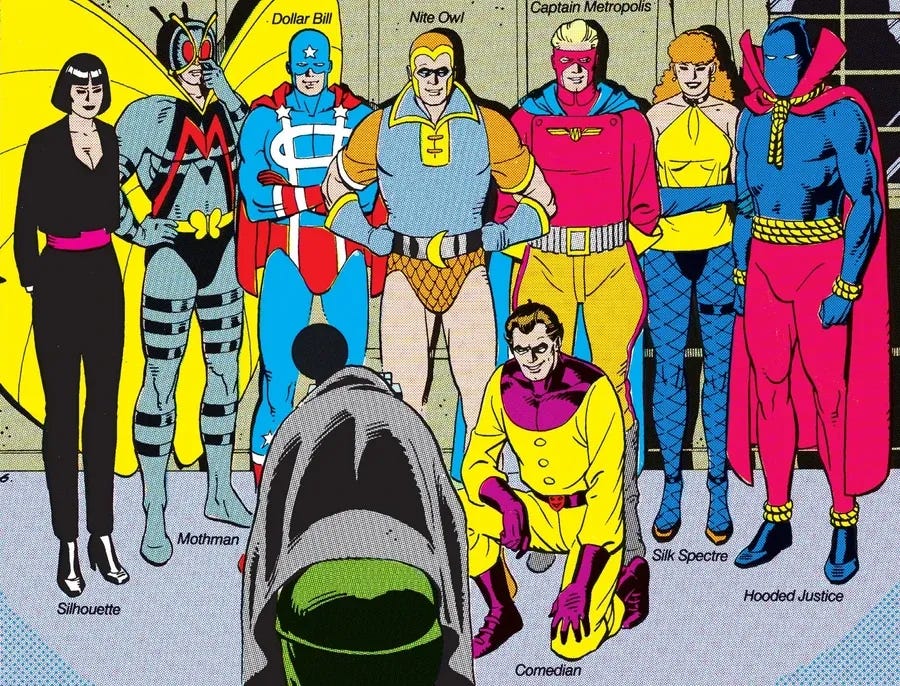
Some members of the group genuinely wanted to do good. Not so with others — Silk Spectre used her role as a modelling gig and stepping stone into hollywood fame. Dollar Bill was a literal corporate mascot hired by a bank chasing the superhero trend.
And that’s what they ultimately were — just a trend. Doctor Manhattan describes them as “friendly, middle-aged men who like to play dress-up”. Even Nite Owl notes in his memoir that
I think the worst thing was the belated realization of just how much a fad we’d always been, something to fill the dead columns of the newspapers right alongside the Hula Hoop and the Jitterbug. Ever since Sally Jupiter married her manager, his tireless, shrewd efforts as a publicist had been noticeably absent. He’d recognized that the day of the costumed hero was over - even though we hadn’t - and he’d gotten out while the getting was good. Consequently, we found our exploits being reported less and less frequently. When they were reported, the tone was often derisive.
Here’s another telling quote from his memoir:
One of the big problems that faced costumed heroes at the time was the absence of costumed criminals of any real note. I don't think any of us realized how much we needed those goons until they started to thin out. You see, if you're the only one who'd bothered to turn up for a free-for-all in costume, you tended to look kind of stupid. If the bad guys joined in as well, it wasn't so bad, but without them it was always sort of embarrassing.
There had never been as many costumed criminals as heroes, but with the end of the 1940s the trend grew much more pronounced. Most of the crooks turned in their costumes along with their criminal careers, but some just opted for a less extroverted and more profitable approach. The new breed of villains, despite their often colorful names, were mostly ordinary men in business suits who ran drug and prostitution rackets. That's not to say they didn't cause as much trouble ... far from it; I just mean that they weren't as much fun to fight. All the cases I ended up investigating during the '50s seemed sordid and depressing and quite often blood-chillingly horrible.
This is just a throwaway line, one of the many reasons why the Minutemen disbanded. Personally, I think it highlights their inherent silliness: like the Golden Age of Superheroes that they were inspired by, the Minutemen lived in a morally simplistic bubble. They were incapable of tackling serious systemic issues beyond the similarly silly and one-dimensional costumed villains they were used to fighting.
Furthermore, the Minutemen were very much products of their time, with all of the bad that implies. The Silhouette was kicked out of the group and later killed by a villain after being publicly outed as a lesbian. Captain Metropolis and Hooded Justice joined in voting her out despite being in a secret relationship themselves. When Captain Metropolis tried to form a new team in the ‘60s, the “evils” he wanted them to fight included the anti-Vietnam protests and the Civil Rights Movement.
The first ever costumed hero was Hooded Justice, whose costume bears a heavy resemblance to a KKK uniform. Moore makes the comparison himself, through a snippet from fictional far-right newspaper New Frontiersman.
The institution that Roth and his cronies are so casually ripping the guts out of is that of hooded justice, of a force for righteousness that dares to tread where the wimpy and useless laws laid down by the spineless dupes and fellow travellers in our judiciary forbid it to.
What about the Boston Tea Party? What about the spirit of the Lone Ranger? What about all those occasions when men have found it necessary to go masked in order to preserve justice above the letter of the law? Nova Express makes many sneering references to costumed heroes as direct descendants of the Ku Klux Klan, but might I point out that despite what some might view as their later excesses, the Klan originally came into being because decent people had perfectly reasonable fears for the safety of their persons and belongings when forced into proximity with people from a culture far less morally advanced.
Through New Frontiersman, Watchmen argues that superheroes and hate groups share the same psychological DNA. Both groups believe that they are uniquely qualified to decide who is guilty. Both wear masks to bypass laws and police accountability. Both use fear, anonymity, and violence to enforce their personal ideals onto society.
Ultimately, the Minutemen didn’t go out in a blaze of glory. The group quietly disbanded in the ‘40s, and its members died sad, pathetic deaths. Nite Owl was bludgeoned to death with his own commemorative trophy. Captain Metropolis was decapitated in a car crash. Dollar Bill was shot by a bank robber after his cape got stuck in a door (*Edna Mode intensifies*) Mothman spiraled into alcoholism and was institutionalized.
Watchmen takes a detailed look at two heroes from this era in particular:
TW: discussion of rape.
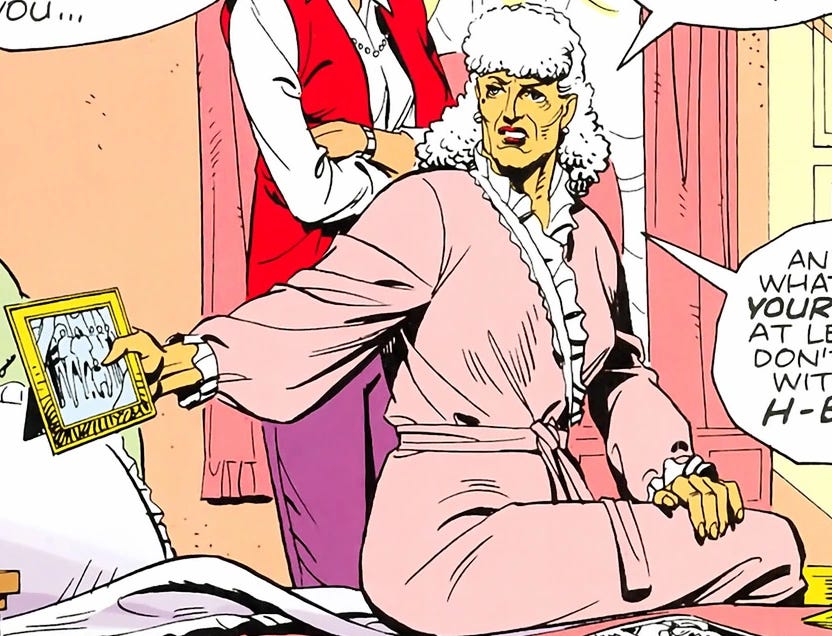
Sally Juspeczyk, who took the stage name Sally Jupiter to hide her Polish ancestry, was more celebrity and sex symbol than hero. She treated her costumed persona as a business enterprise and a gateway to a Hollywood career that never materialized. Sally’s role in the story is to highlight just how much the supposed heroics of the Minutemen were the product of corporate PR and media sensationalism.
I interpret Sally as a critique on the sexualization of female superheroes (and more broadly, women in the film industry). Silk Spectre was her ticket out of a life of poverty as a waitress and burlesque dancer, but it wasn’t a meaningfully different role. Sally’s sexuality was her only ticket to fame, but the only fame she ever achieved was as a somewhat trashy sex symbol. She gained respect neither as a crime-fighter nor as an actress, but was only ever seen as eye candy.
Conflictingly, Watchmen depicts an aged Sally who looks back on her days as Silk Spectre with nostalgia. In her retirement, Sally hoards erotic Tijuana bibles and explicit pin-ups of her younger self. She derives her self-worth from how much the world desired her body. This may be why she entered a relationship with the Comedian, who raped her years before: she may have seen his continued desire for her as a form of validation.
Sally trained and pressured her daughter Laurie into becoming her successor, the second Silk Spectre. In an interview, Sally claims that a life of fame is the only kind worth living, an attitude that becomes more understandable looking at her life before becoming Silk Spectre and the limited options available to women of her time. Alternatively, you might argue that she was living vicariously through her daughter and using her to recapture the fame and stardom of her youth.
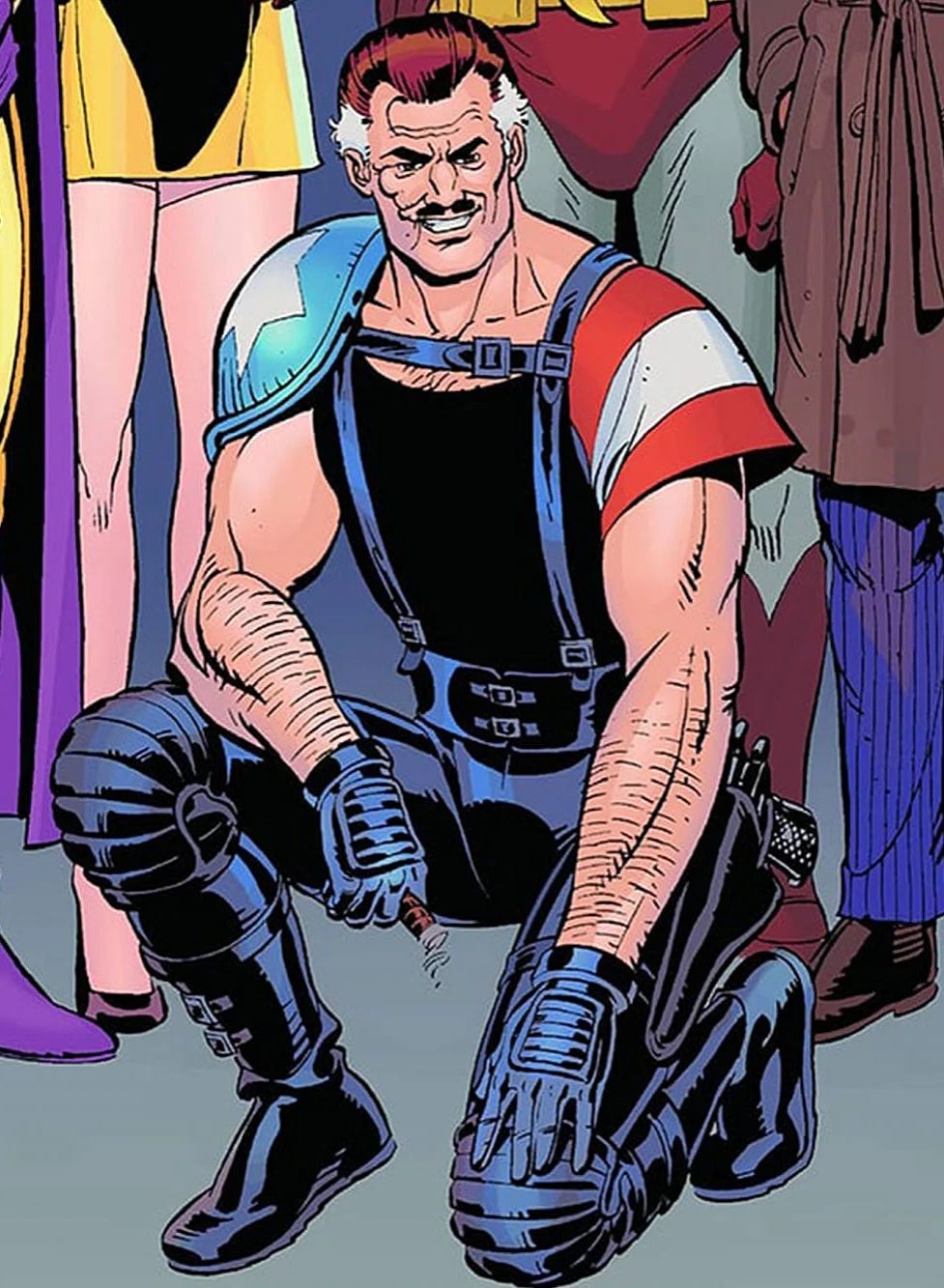
Eddie Blake’s death is the inciting incident that kicks off the plot of Watchmen. His character is explored in flashbacks, which quickly reveal him to be the series’ most shamelessly amoral character. At age sixteen, he was kicked out of the Minutemen after he raped Silk Spectre. He then became an agent of the American government, fighting in World War II and the Vietnam War.
Blake is a deconstruction of war-era nationalist superheroes like Captain America. He served as a paramilitary operative and state-sponsored assassin, conducting infiltrations, government takedowns and political assassinations to further American interests during the Cold War. He is also heavily implied to have assassinated Bob Woodward and Carl Bernstein, the journalists who were about to expose the Watergate Scandal, as well as John F. Kennedy.
An overarching theme of Watchmen is that costumed heroes put on their costumes as a coping mechanism for something, rather than out of a genuine desire to do good. The Comedian is no exception — through his years fighting crime, as a political assassin, and as a veteran of WWII and Vietnam, he developed the belief that society was rotten to the core and human nature was intrinsically evil. His way of coping with this was to laugh at it, to accept the horror and become a part of the chaos.
What makes Blake interesting is that he’s the most honest character in the story. Blake had no illusions about what kind of monster he was, and that allowed him to call out the other characters on their illusions. He called out Captain Metropolis on the redundancy of busting petty criminals when nuclear war was on the horizon. He called out Ozymandias for believing he was intelligent enough to fix the world’s problems. He even called out Doctor Manhattan on his apathy towards people and his refusal to prevent Blake’s atrocities despite chastising him for them.
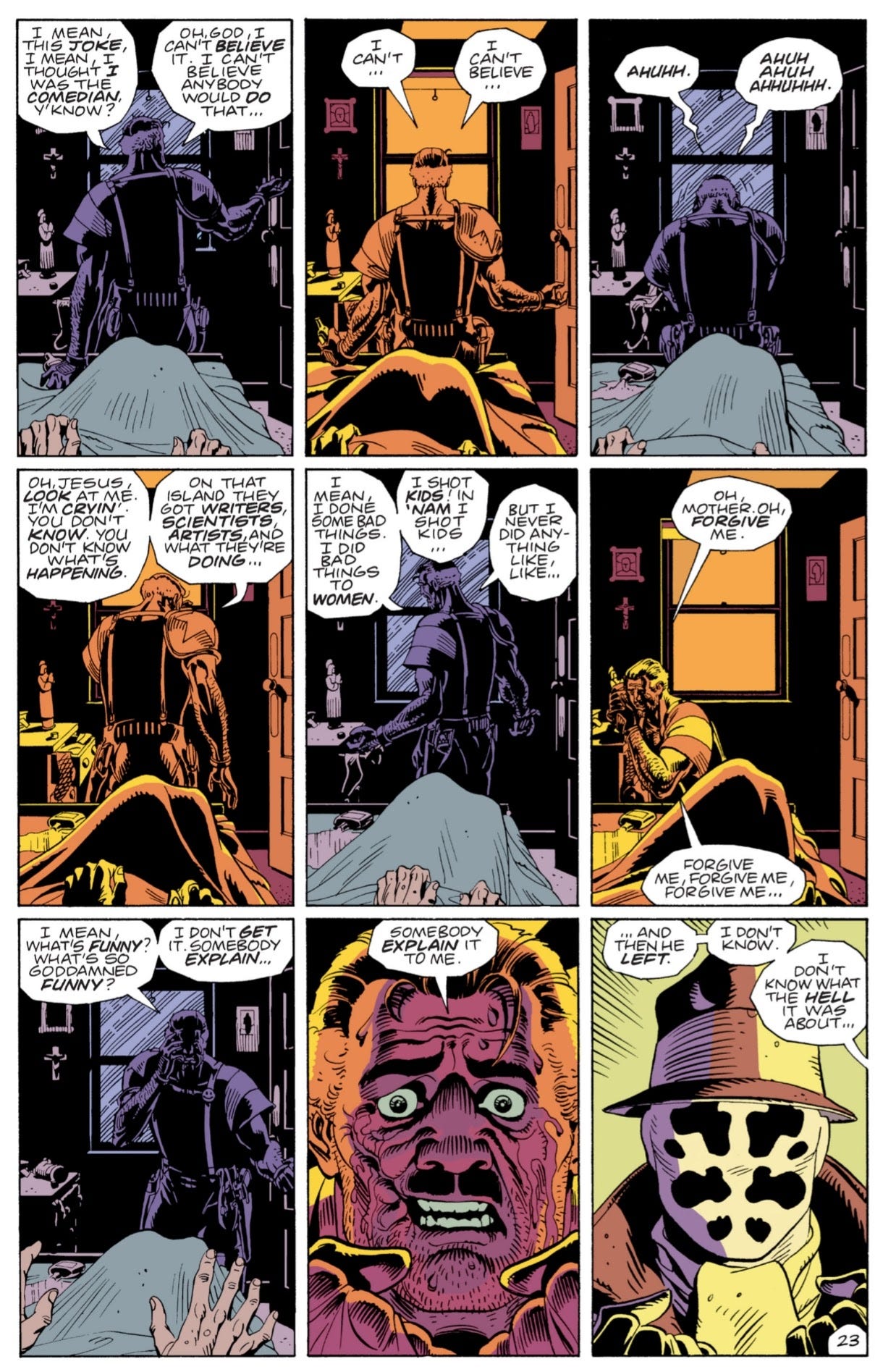
At the end of his life, the Comedian’s cynical outlook finally broke. He discovered Ozymandias’s plan to prevent nuclear war, and it horrified him. Witnessing a atrocity far more calculated and massive than his own casual cruelties forced him to realize that he had underestimated just how terrible people could be.
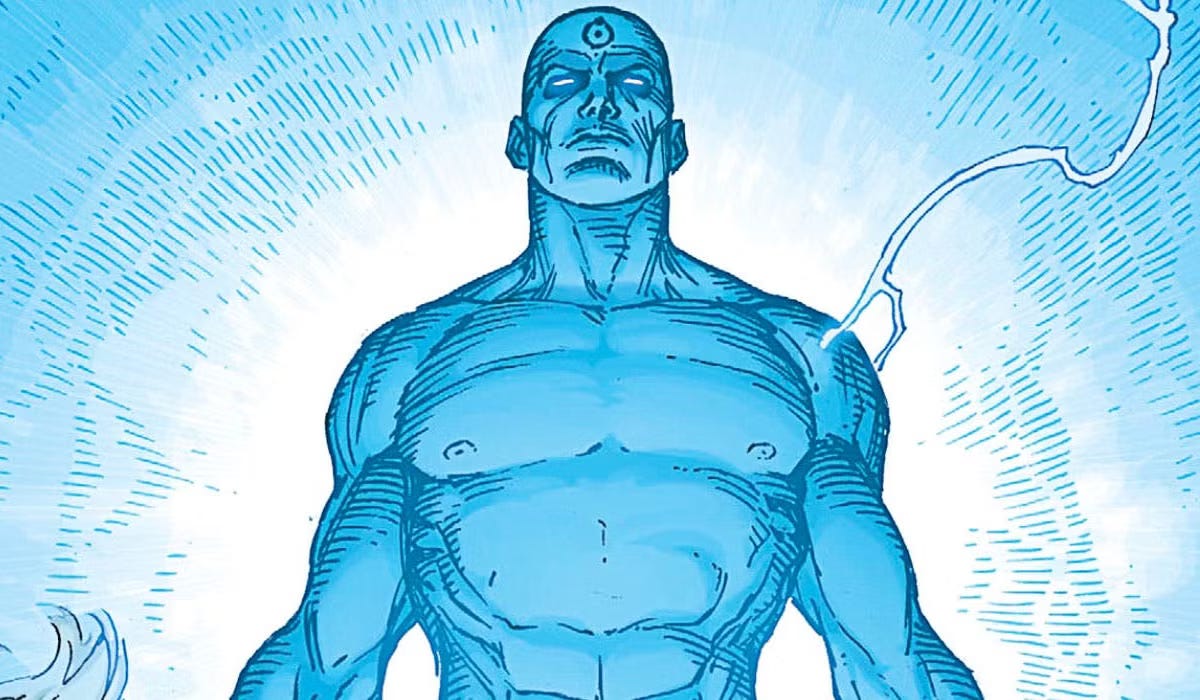
If the Minutemen were inspired by the black-and-white morality and simple patriotism of Golden Age of Superhero Comics, Doctor Manhattan was clearly inspired by the high-concept sci-fi of the Silver Age. Dr Jonathan Osterman was a nuclear physicist who gained his powers after accidentally being locked inside an intrinsic field test chamber and vaporized. Unlike the other costumed heroes, his new powers made him Watchmen’s only true superhero.
It’s slightly funny to compare the two. While most other heroes simply punch and kick, Doctor Manhattan has the ability to perceive and manipulate matter on a subatomic level, as well as the ability to perceive the past, present, and future simultaneously. Combined, these abilities make him nearly omniscient and omnipotent, a godlike figure that humanity only has a tenuous hold on.
Characters like Superman and Thor are built on a certain kind of conceit: the belief that if beings of godlike power were to exist, they would care about humanity. Through Doctor Manhattan, Moore questions that conceit. Jon spent his first few years after gaining his powers just going through the motions. He continued his relationship with his girlfriend because that’s what he was doing before. He fought crime because people asked him to do so. He followed the American government’s orders because he was a good American citizen.
However, Jon became increasingly apathetic to societal norms, morality, and people in general. He stopped wearing clothes. He cheated on his girlfriend with Laurie Juspeczyk (who was sixteen at the time), no longer caring about human concepts like fidelity or the age of consent. When the Comedian murdered his pregnant lover in the Vietnam War, Dr Manhattan didn’t step in; even though he logically knew it was wrong, he simply didn’t care enough to intervene. During his first scene, where Rorschach informs him about the death of his old colleague, he states that
A live body and a dead body contain the same number of particles. Structurally, there is no discernible difference. Life and death are unquantifiable abstracts. Why should I be concerned?
Soon after, he leaves earth for good, knowing that his absence will doom the world to nuclear war.
Jon spent years allowing himself to be used as an American superweapon in the Cold War. In the alternate history of Watchmen’s world, he fought in the Vietnam War, leading to an overwhelming victory for the US and disrupting the global balance of power in their favor. Jon remained a guest and asset of the US government despite his increasing apathy towards human politics; he did so only because it was the path of least resistance, a way to get people to leave him alone while he continued his experiments.
While heroes like Superman use their powers to solve global issues, Doctor Manhattan’s existence only served to exacerbate the Cold War and mutually assured destruction. A research paper pointed out that rather than acting as a deterrent to war, his presence incentivized the Soviets to stockpile nukes and to use them before he rendered them obsolete; and while he could neutralize most of their nukes is launched, most is not all and even a small percentage of the Soviet nuclear weapons were enough to destroy the world.
Ultimately, Doctor Manhattan stands as an antithesis to the classical comic book hero. Watchmen uses him to expose the inherent flaws of the superhero fantasy, replacing romantic notions of power and justice with a distinctly cold outlook. He’s an indifferent cosmic force, not some guardian angel. By showing the steady decay of Jon Osterman’s humanity, the story rejects the idea that absolute power can create a hero.
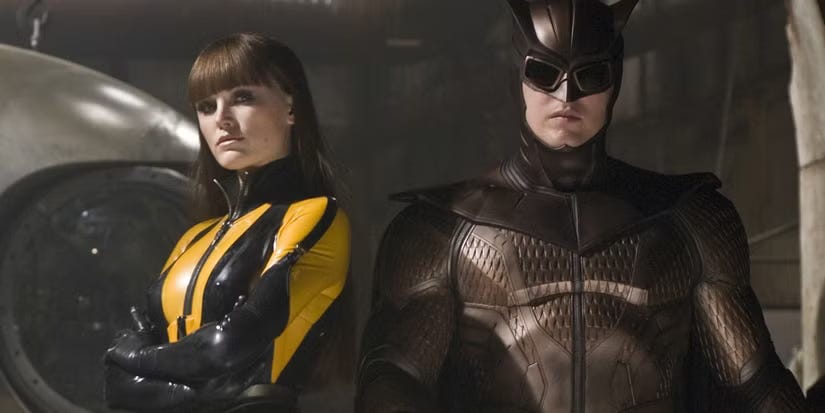
The first generation of superheroes largely retired after the advent of Doctor Manhattan in 1960, feeling that he made them redundant. However, they spawned an era of successors that fought alongside Jon until vigilantism was ultimately rendered illegal in 1977. This new generation may represent the Bronze Age of Superhero Comics, which introduced real-world issues, but still had intrinsically heroic characters that defended the status quo. Watchmen deconstructs this by showing its costumed heroes as morally ambiguous figures opposed by the public and government, forced to choose between retirement, state control, and illegal vigilantism.
These two characters are both legacy heroes (and also not very interesting) so I’m lumping them together. Daniel Dreiberg is a wealthy technological genius who convinced the original Nite Owl to grant him the title. Dan is probably the closest thing the comic has to an actual superhero; he’s also slightly pathetic. Rorschach describes him as “a flabby failure who sits whimpering in his basement”. While Rorschach isn’t exactly a reliable narrator, he’s not completely wrong. Dan’s a decent person, but also a fairly weak one. The costume, for him, is a way to feel powerful. Retirement emasculated him, and regaining his persona over the course of the comic revitalized his confidence.
I always viewed Dan as a critique of the idolization of superheroes and the desire to become one. Dan is Moore’s way of saying that we’ll never have the perfect bodies and perfect minds, and we should accept that instead of fantasizing about being Superman(or a movie star, or a tech billionaire, or whatever. You get the idea). Spending all your time comparing your life to others — especially unreal magical beings — can be a dangerous trap. It can prevent us from accepting life as what it is, and ourselves for who we are.
While Dan became a superhero out of his own steam, Laurie was pressured into the role by her mother. Laurie is a character who lacks agency, and is defined by the people around her. Her mother forced her to be Silk Spectre. Doctor Manhattan groomed her into a relationship. She spent twenty years as his girlfriend, living in a government facility, a pawn in their game to keep him under their control. Throughout her life, she never knew anyone except other heroes: when the government kicked her out after Jon left Earth, she had nowhere to go and nobody to confide in besides Dan.
Laurie is an interesting foil to her mother. While Sally was a celebrity and sex symbol, Laurie actually trained to be a crimefighter. She patrolled and fought villains just like Dan and Rorschach did; but Doctor Manhattan made her obsolete. By entering a relationship with him, she in a sense stepped into her mother’s role: rather than fighting crime, she became nothing more than the walking nuke’s kept woman. Suddenly her only value came from her sex, just like her mother. It didn’t matter how much she trained or how hard she worked all that mattered to the government was keeping Jon satisfied and under control.
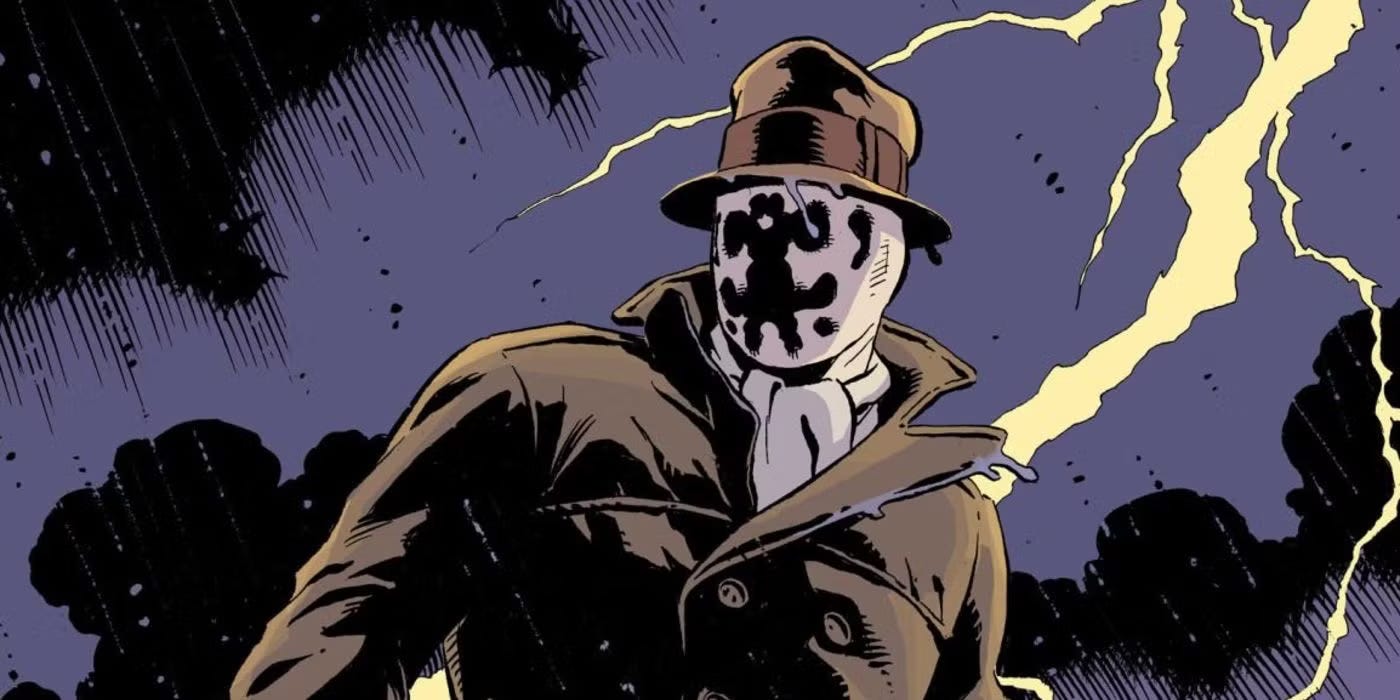
Rorschach deserves his own post. He’s my favorite character from Watchmen, and also the comic’s most perpetually misunderstood character. Although Rorschach is based on Steve DItko’s character The Question, I can’t help but see him as a deconstruction of Batman — a realistic depiction of what a mentally ill person who fights crime would look like.
Rorschach is as far from your typical superhero as you can get. He’s short, ugly, smelly, and socially awkward at the best of times. He lives in poverty, spends his days dodging rent and patrolling New York City with a sandwich board. His only valued possessions are a journal, copies of a far-right tabloid and a shapeshifting mask created from a dead woman’s dress. Despite this, Rorschach is probably the hero villains fear most. He compensates for his size with a mix of ingenuity and ruthlessness, regularly killing the criminals he fights.
Rorschach is the narrator of Watchmen, and many fans have a habit of taking him for his word despite how obviously unreliable he is. Rorschach claims to never compromise on his principles, and these fans admire him for it. On a surface level, Rorschach is uncompromising: he continues in his vigilantism despite it being outlawed, making him a wanted man; he also chooses death over accepting Veidt’s plan in the end.
At the same time, Rorschach’s ideology is rooted less in an actual philosophy and more on vibes. Rorschach fought Veidt not because he rejected the idea of killing the many to save the few, but because he personally disliked Veidt. Although he hated rape and personally hunted down rapists, he excused the Comedian’s rape of Sally as a “moral lapse” because he liked the Comedian. Ultimately, Rorschach is a traumatized person with a very loose grip on reality. Both he and the Comedian believe themselves to be some sort of truthtelling underdogs who see the world for what it really is, but they don’t actually have the clarity they think they do.
While he claims to judge the world by an unchanging, cosmic standard of right and wrong, Rorschach’s actual judgments are filtered through his own personal biases, trauma, and political radicalism. By highlighting his hypocrisy, Moore deconstructs the comic book trope of the “objective” vigilante, proving that any individual who claims to be the sole arbiter of absolute justice will inevitably weaponize that power to protect their own biases.
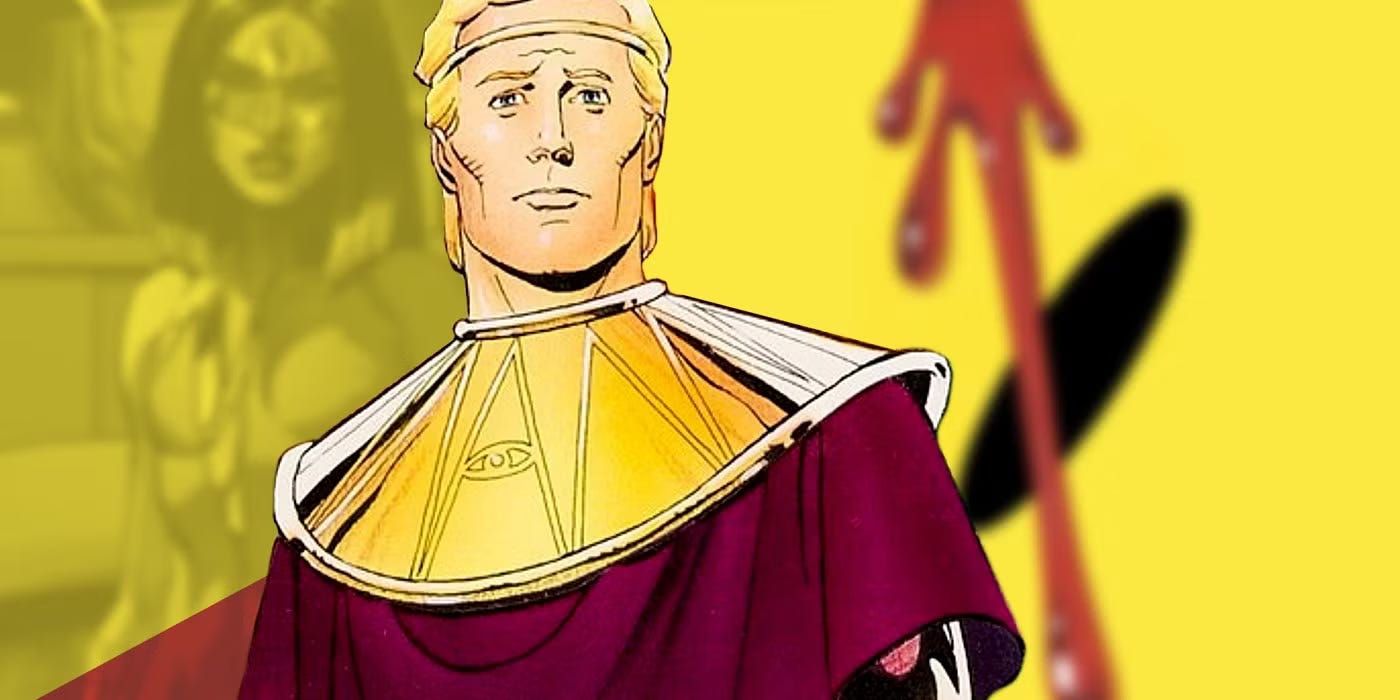
If Rorschach is a deconstruction of Batman the mentally ill detective-vigilante, Ozymandias is a deconstruction of Batman the billionaire-superhero. Introduced as a brilliant businessman and crimefighter as well as a charming, progressive philanthropist, Watchmen slowly reveals the narcissism at the heart of Veidt’s character.
Originally believing himself to be the second coming of Alexander, Veidt eventually rejected his hero as unworthy because his empire didn’t survive his death. For a new idol, he chose the Pharaohs of ancient Egypt and built his entire life around an Egyptian theme. Veidt’s intelligence and narcissism lead him to believe that he is uniquely qualified to pass judgement on the human race.
Comics love the “peak human” archetype — characters like Batman or Iron Man who have no superpowers but achieve godlike status through sheer willpower, and intellect. Veidt is physically flawless, remarkably handsome, and widely recognized as “the smartest man in the world.” He represents the absolute pinnacle of human potential. However, Veidt’s intellect leads him to view humanity as a math problem. He concludes that murdering three million people in New York City is an acceptable variable to prevent nuclear war.
Of course, like all those who claim that sacrifices must be made for the greater good, Veidt isn’t the one making the sacrifices. His claims to Jon that he’s made himself “feel every death” ring hollow considering that he refused to face accountability from the other heroes, and that he’s actively planning to make money from the trends that start after global peace.
And in the end, it’s unclear whether or not his plan even worked. The failure of Veidt’s plan is implied by his very name. directly invokes Percy Bysshe Shelley’s famous poem Ozymandias, which describes a shattered, decaying statue in a barren desert with the inscription: “Look on my Works, ye Mighty, and despair!”
I think Moore used this literary parallel to show that Veidt’s manufactured utopia is fundamentally unstable. In the final pages, Doctor Manhattan refuses to reassure Veidt that his peace will last, cryptically telling him, “Nothing ever ends.” The comic closes with Rorschach’s journal — which contains the full truth of Veidt’s conspiracy—sitting in the editorial inbox of a (admittedly terrible) newspaper. Veidt’s grand monument of peace is likely already crumbling before it has even begun.
I’ll probably have to give Rorschach his own post. Not anytime soon, though; I think I’ve posted superhero stuff for a month straight, and I’m ready to do something else. For now, let me just say that the people who agree with him are fundamentally missing the point. “Who watches the Watchmen?” doesn’t translate to “One of the Watchmen is right, guess which one!”. There isn’t a clear perspective when the whole point is that massive society-altering events shouldn't be determined by a singular person or even a small group of powerful people. That, more than anything else, is what makes Watchmen a rejection of the superhero and a deconstruction of the genre.
Comments
Nothing yet. Say the first thing.
Sign in to join the conversation.