
The other day I was making a few updates to my website when I happened to notice something I had never paid much attention to before.
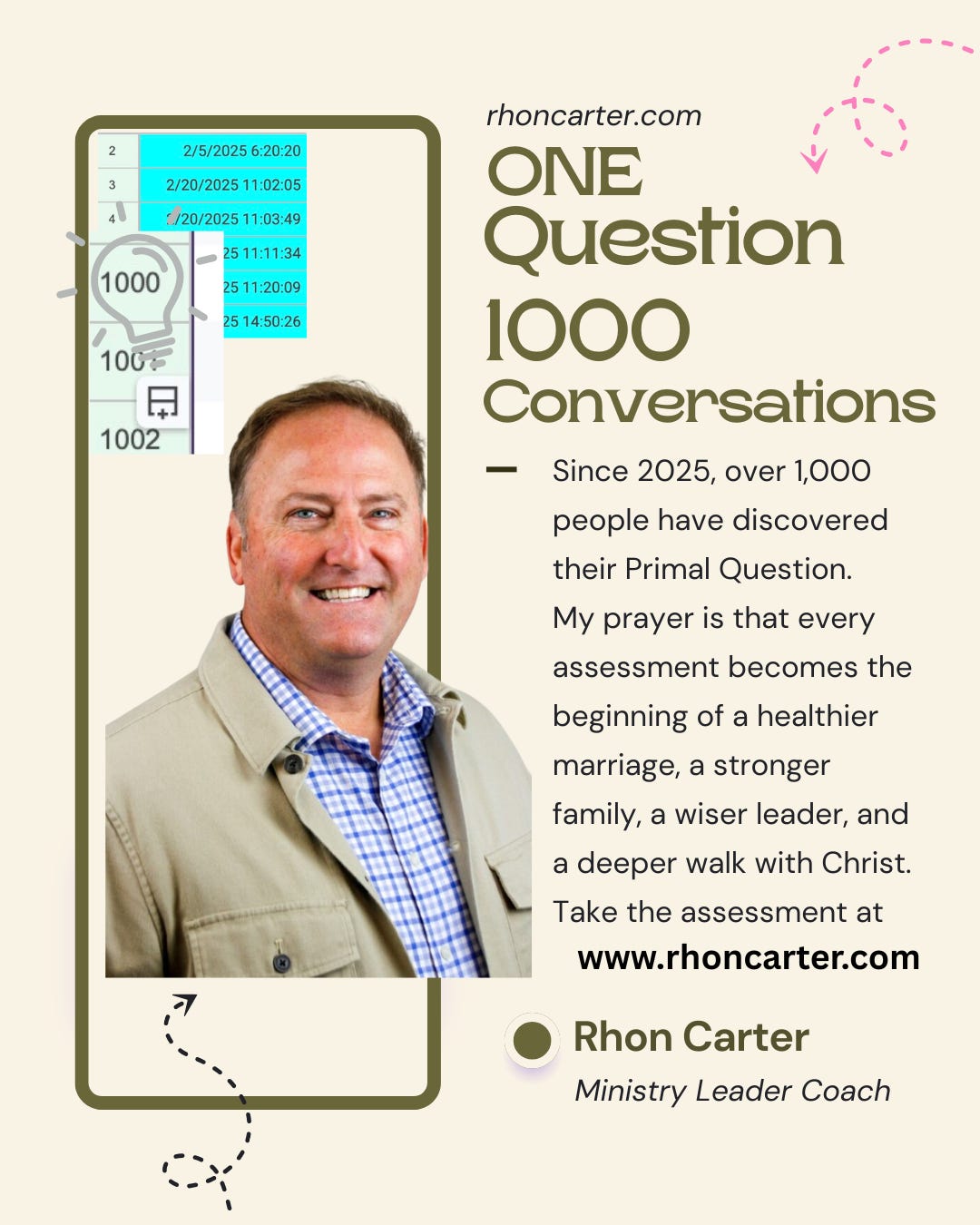
The Primal Question Assessment on rhoncarter.com had quietly passed 1,000 completed assessments.
I stared at that number for a minute not because one thousand is some extraordinary milestone. In the grand scheme of things, it really is not, but as I looked at it, it stopped feeling like a number.bIt became people!
I began thinking about the pastors I have met with over coffee. The worship leaders who have invited me into their offices. The ministry staffs I have coached. The husbands and wives who wanted to understand one another better. The parents who simply wanted to become more intentional with their children and children who wanted to understand their parents better.
One thousand people had decided to stop long enough to discover a question about themselves.
The older I get, the more convinced I become that one of the greatest gifts we can give the people around us is self-awareness. We spend so much of our lives learning how to preach, teach, sing, lead meetings, manage calendars, build teams, and solve problems. All of those things matter. They make us more capable leaders.
Becoming more capable is not always the same thing as becoming healthier.
Somewhere along the way, I realized I had spent years learning how to lead others without spending nearly enough time understanding what was happening inside my own heart.
That realization is what first drew me to the Primal Question.
When I first heard Mike Foster talk about it, I honestly assumed it would be another personality assessment. Over the years I had taken plenty of them. I have benefited from DISC. I appreciate Myers-Briggs. The Enneagram has helped many people understand patterns in their lives, and I still think The Five Love Languages has strengthened countless marriages and friendships.
Those tools are incredibly helpful because they describe how we tend to think, communicate, and behave.
The Primal Question felt different.
Instead of asking me how I was wired, it asked me why.
Why does criticism affect one leader differently than another?
Why do two people experience the very same situation but walk away with completely different emotions?
Why do some conversations seem to stay with us for days while other people barely remember them?
Those questions stayed with me.
As I began learning more, I discovered something that was both freeing and challenging. According to the Primal Question framework, every one of us has a deepest emotional question that begins forming early in life. We spend much of our lives looking for answers to that question, often without even realizing it.
For me, understanding that question was like someone finally handing me a map to places I had visited my entire life but never really understood.
I eventually discovered that my Primal Question is #4: “Am I Wanted?”
The more I learned about it, the more it explained my life.
I have always loved people. I love being invited into conversations, gathering people around a table, introducing friends to one another, and helping people feel like they belong. Relationships have never been something I simply enjoy, they have always been something I pursue.
When I look back, I can see that I have viewed much of life through that one question.
I want Vickki and me to genuinely enjoy being together. I want my son and me to stay connected as he builds his own life. I want to encourage the pastors, worship leaders, and ministry servants I meet each week. I want people to know they matter and that someone sees them.
For years, I thought that was simply my personality. Now I understand it is something deeper.
One of the beautiful discoveries of the Primal Question is that our greatest emotional need often becomes our greatest gift to others. Because I long to know that I am wanted, I naturally spend my life helping other people feel wanted.
It also explains something my family has laughed about for years. I may forget your name five minutes after we meet, but I will probably remember who introduced us, where we met, who your pastor is, what car you drive, what church you attend, and how you’re connected to three other people I know. My mind has always been wired for relationships and connections.
Today, I no longer see that as just a personality trait.
I see it as a gift God has given me to steward.
That is one of the reasons I became a Certified Primal Question Coach. I want other people to experience the same freedom I found when I finally understood the question I had been asking all along. Because when you begin to understand your deepest question, you also begin to discover one of God’s greatest gifts in your life.
That has been one of the greatest gifts the Primal Question has given me.
Not perfection.
Awareness.
That is why I continue talking about the Primal Question everywhere I go.
I talk about it because I have watched it give people language for things they have felt their entire lives but could never explain.
There is something beautiful about watching a pastor pause in the middle of a coaching conversation and quietly say, “That makes so much sense.”
Or watching a ministry team realize that the person they have been frustrated with is not trying to be difficult at all. They are simply asking a different emotional question than everyone else in the room.
Those are the moments that came rushing back when I saw the number one thousand.
The assessment itself only takes ten or fifteen minutes to complete. In many ways, that is the easiest part of the journey. The conversations that follow are where the real work begins. They are the conversations around dinner tables, in church offices, during long walks with a spouse, over coffee with a trusted friend, or in a coaching session where someone finally has language for what they have been feeling for years.
As I look ahead, I honestly am not dreaming about another thousand completed assessments.
I think about husbands and wives who begin understanding one another instead of simply reacting to one another. I think about parents who become more intentional as they recognize the emotional questions their children are asking. I think about pastors and ministry leaders who discover that becoming emotionally healthy is just as important as becoming more skilled. I think about churches that become stronger because the people leading them are leading from a place of greater awareness, humility, and grace.
If those things happen, the number on my website really will not matter.
It will simply be a reminder that one honest question can begin a lifetime of growth.

Jesus asked questions everywhere He went! It wasn’t because He needed information, but because questions have a way of opening hearts. The Primal Question has reminded me that one honest question can begin a lifetime of growth.
If you have never taken the assessment, I would love to invite you to do so. It is free, it only takes a few minutes, and my prayer is not that you simply discover your Primal Question.
My prayer is that you begin discovering yourself. I have found that healthier leaders become healthier spouses, healthier parents, healthier friends, and healthier servants of Christ.
That is a conversation worth having! Have a blessed day!
Comments
Nothing yet. Say the first thing.
Sign in to join the conversation.