
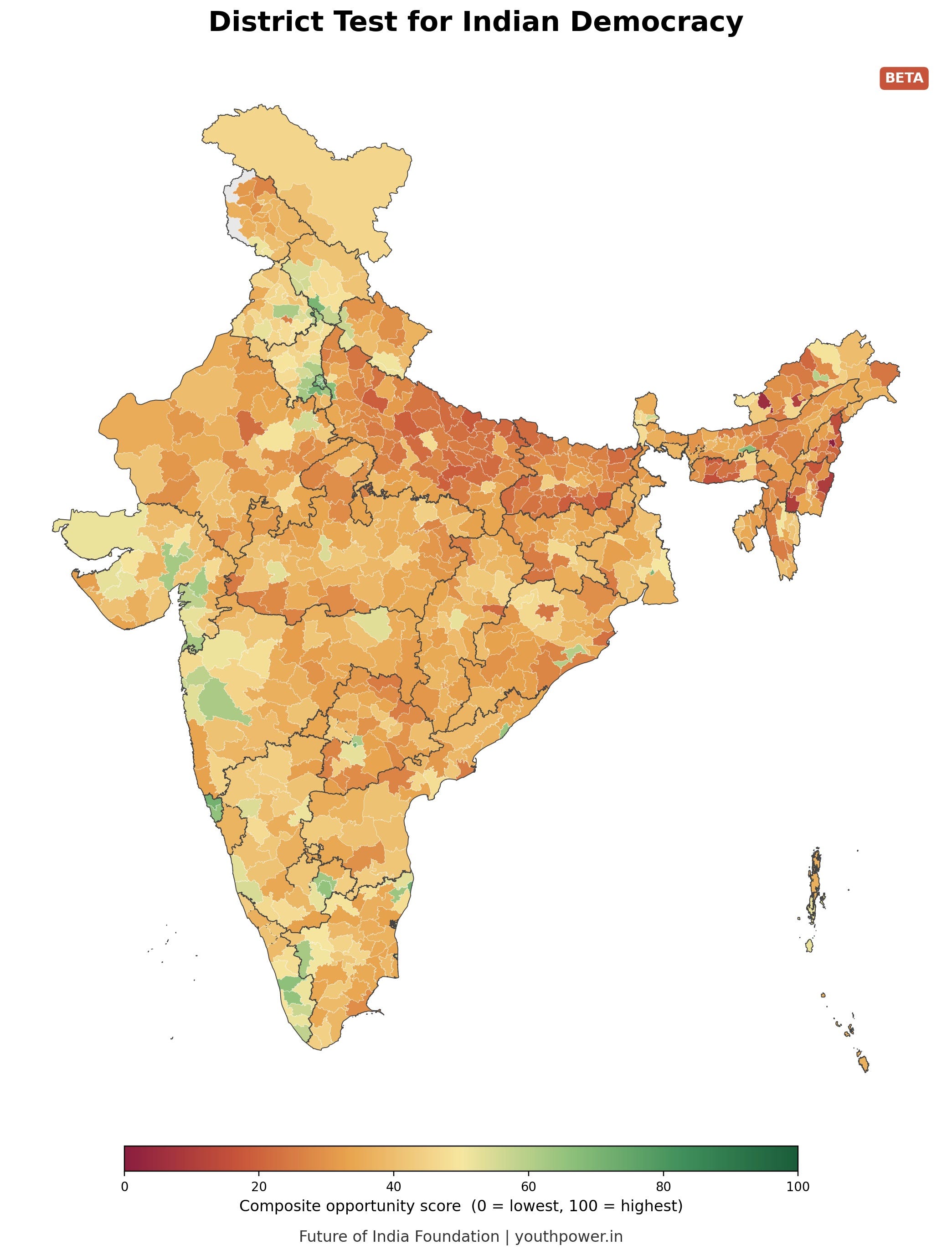
Over the last decade and a half, even the meaning of democracy has become contested. Every contest now seems to produce two opposed interpretations of the same issue: is it the democratic logic of majority rule or majoritarianism? Is it free speech or hate speech? Is it democratic dissent or harmful obstruction? Is it destruction of due process or the necessary disciplining of corrupt elites?
For every example one side marshals, the other has a counterexample. Because rival camps are working with entirely different substantive measures of what democracy even means, it has become impossible to find common ground.
We can attribute some of this persistent disagreement to bad faith tactics by the professional political class. But there is genuine grievance among people on different sides about how these principles have expressed themselves. That makes the disagreement harder to dismiss. A second problem follows from this. Questions of democracy are losing ordinary people, because the language in which democracy is debated has become too abstract, too subjective and too elite. Consequently these debates seem removed from the conditions of everyday life. This is not an aesthetic concern. How can we safeguard democracy unless we define and operationalise it in a way that commands wider public buy-in?
This legitimacy problem is also visible in existing democracy measures. They have done valuable work, but they remain vulnerable in today’s political climate. Expert-coded assessments can be dismissed as elite judgment. Procedural indicators can miss lived democratic experience. Public opinion measures can capture sentiment but not necessarily institutional agency. None fully answers the question ordinary citizens are likely to ask: does democracy give me real power over the conditions that shape my life? We thus need an alternative which not only has an empirical basis but is grounded in the lived reality of people at large.
I want to propose such an alternative framework. I have been developing this framework for India, but it travels across youth-majority democracies in the Global South. I will lay out the framework in two parts: first, the case for the framework itself; second, how the framework could be operationalised in India, the reform agenda that follows from it, and how it can translate to other democracies outside India.
Let us start with India. Two statistics set the terms of this framework.
The first is that 65 per cent of Indians are below the age of 35. This means that any aggregate claim we make about young Indians is also, in an important sense, an aggregate claim about our country. That is especially true because youth outcomes are a compound indicator. A healthy, educated, employable, and productively engaged youth cohort is downstream of the entire public stack: health in infancy, nutrition in childhood, schooling through adolescence, skilling in the late teens, and the economy at the point of entry. A failure at any layer shows up in their present condition. The cohort is thus the current integrated read of the entire governance stack. And social mobility, which is one of democracy’s central promises, runs through them. No other cohort carries this signal in the same way. The elderly reflect governance from previous decades. Children have not yet interacted with the full stack. Most importantly, youth outcomes are not just a contemporaneous test - they also suggest concrete corrective measures. The focus on youth thus carries both the diagnostic signal and the normative stake.
The second is that 85 per cent of Indians live in their district of birth. They are born there, schooled there, marry there, work there, and die there. Even when workers migrate, two conditions are true for the majority: the migration is driven not by outsized aspiration but something close to subsistence; and is often circular rather than permanent, a point made heartbreakingly apparent in moments of national crisis, when we see workers making their way back to their birth district. What this means is that the India story is not one national or even a state-level story, but roughly 800 district-level stories. The aggregate India narrative - or even the state - does not describe the life chances of a young person. Her district does.
The District Test for Indian Democracy
Following these two facts, I propose the District Test for Indian democracy. It is an empirical, multidimensional test that asks whether young people in India’s districts are building lives better than the generation before them, and whether citizens in those districts have real agency over whether they can. It reads district conditions across the domains that shape young life: education, health, skills, employment, income, credit, and the local institutions that make opportunity possible.
This may seem like an argument about governance but it is about democracy. It rests on a broader idea: every democracy has a democratic convergence unit, the smallest scale at which citizens’ lived opportunity, elected representation, and administrative execution meaningfully meet. India’s democratic convergence unit is the district. Other democracies will have different units. The principle is the same: democracy must be measured where citizens’ lived conditions, elected representation, and administrative execution meet. It is that junction that needs to be made the locus of democratic measurement and accountability.
In India, that convergence unit is the district. Both democracy and governance are about power. Democracy is about who holds power and how it is acquired and legitimised. Governance is about how power is exercised and for whom. The district is where these come together, however imperfectly. It contains the core administrative apparatus: the district administration, police, health, education, industries, skills, welfare, and other line departments. State and national elected representatives may not map neatly onto districts, but have clear mappable adjacency. No other scale has all of this on the same ground. Above the district, the political and administrative structures run in parallel and meet only at remote interfaces. Below it, there is political presence but most administrative decision-making power remains above. More importantly, while supply side issues are legible at levels below the district, anything below the district would fragment the market - industry and labour - too much for it to be meaningful.
Indian policies often do not fail because of intent or budget alone. They fail at translation. Policies made in Delhi or state capitals are ultimately delivered, or not delivered, through district administration. On many metrics, the gap between districts within the same state is greater than the gap between states themselves. Aggregate claims about success or failure therefore flatten a distribution that runs from strong to catastrophic. Substantive questions about governance in India cannot be asked only at state or national scale without losing the signal.
In a democracy, these wide territorial gaps in opportunity are destabilising. Dispersed growth is not just about equity. It is a condition for democratic legitimacy to hold over time. If growth concentrates while democracy operates at a distributed scale, the population participates politically without that participation producing improvement. That is the condition that empties democracy even when it formally persists. Examples abound globally. Countries that concentrated growth produced aggregate numbers that did not translate into widespread opportunity. The US concentrated in coastal and tech-corridor metros while manufacturing regions hollowed. The UK concentrated in London and the South East. Concentrated growth produced geographic losers and those regions eventually voted against the political order that delivered the concentration and the cultural hegemony which dismissed their pain. India is running this experiment with a larger, younger population and weaker buffers. A few metros and a few states carry the numbers. Most districts are stagnant or declining when disaggregated. Aggregate GDP and lived experience have diverged. A similar sense of elite disconnect permeates national discourse and spawns mass resentment.
The expectation is that the democratic political process would channel public aspiration, or grievance, through representatives to the levers of the state to equalise these disparities through greater resources or improved accountability. The MP (elected representative) does not direct the collector, and should not. But that misses what actually matters at district level. Representation is not only about formal control. It is about the application of political power to convene, connect, press, and channel. The representative can convene the elected and administrative stacks into the same forum. She can connect citizen grievance to administrative capacity by making each legible to the other. She can press on specific failures of delivery through repeated and documented questioning. She can channel the accumulated experience of the district upward into Parliament, assemblies, party forums, and policy debate.
Together these functions constitute substantive representation. The district is the anchor for them, because it is where the representative gathers the knowledge that gives the rest of her role its content, and because it is where her democratic accountability lives.
The same disjunction holds in any representative democracy: the elected representative’s formal authority over the administrator is constitutionally bounded, but the representative’s capacity to convene, connect, press, and channel is politically real. The question is whether the institutional forums for that capacity exist and function.
It is true that this is, in part, a reform argument rather than a description of existing institutional reality. Over the last few decades, the Indian state has steadily evacuated the local democratic process of much of its local agency through political and administrative centralisation. Representatives have lost both the incentive and the capacity to engage deeply with the administrative reality of their districts, while citizens often encounter the state through bureaucratised and digitised systems that bypass political mediation altogether. The formal structure remains but the substance has been drained from it.
However, if we believe in democracy, this is still the correct frame and we need to infuse substance and purpose back into it. Democracy is distinguished from other regimes by the location of agency. An argument about governance without agency shades into technocracy, decisions are made but citizens cannot participate and legitimacy is drawn from expertise. In a developmental state, decisions are made by an insulated elite whose legitimacy is drawn from growth. In an autocracy, decisions are made at the top and legitimacy, if it comes, comes from stability. Each is a coherent regime type with its own logic. None is a democracy. A regime is democratic to the extent that citizens exercise agency over the decisions that shape their life.
If measurement happens at district scale because that is where most Indians live, but action happens at state or national scale because that is where decision-making is concentrated, agency is structurally broken. The citizen watches her district fail and has no working channel to change it. Her representative can mediate between her and the state, but cannot meaningfully shape decision-making. Her welfare arrives through a digital pipe that bypasses her representative. Her collector rotates every eighteen months on orders from a capital she cannot reach. She votes and her vote is counted. But what may or may not change is the regime, not her representation. This is not an efficiency problem but regime drift. The shell of democracy stays intact. The substance leaks out.
This framework does not set aside the importance of state and national politics. Nor can questions of identity, belonging, liberty, and constitutional structure be reduced to district-level material outcomes. State and national policy set the terms under which district life is produced, and democratic life is about more than economics alone. But at the same time, a democracy cannot be considered serious if its citizens lack agency over the conditions of their own life and if the distribution of opportunity for its youth is disconnected from the scale of democracy.
With this framework, the health of Indian democracy could no longer be reduced to whether elections are held, rights are formally guaranteed, or whether institutions formally exist. Nor would we need to rely on expert judgement alone. The measure would be whether our youth in all our roughly 800 districts are doing well, and whether citizens in those districts have the agency, through democratic representation, to shape whether they do.
Yes to both, and Indian democracy is serious.
Yes to outcomes but no to agency, and the regime may still deliver, but it has drifted toward technocracy.
Yes to agency but no to outcomes, and democracy remains participatory but fails its substantive purpose.
No to both, and democracy is reduced to a shell. Elections happen. Votes are counted. But neither outcomes nor agency are present.
That is the District Test for Indian democracy.
In Part II, I will take up how the framework could be operationalised in India, the reform agenda that follows from it, and how the framework can translate to other democracies outside India.
Comments
Nothing yet. Say the first thing.
Sign in to join the conversation.