
Democracy’s central discontent is increasingly distributional. Corruption, affordability, caste, billionaires, inequality, anti-elitism are separate issues with their own cleavages and flashpoints. However they are increasingly tied to the same underlying discontent: that democracy is not delivering mobility, affordability and a fair shot at life for everyone. Even arguments about dignity, recognition and identity become more politically charged when the path to material advancement is blocked. The complaint is not only that some people have more than others. It is that public power appears to be allocating opportunity, protection and dignity unequally.
At its core, the democratic bargain is that people accept common rules, participate in elections, obey the law and trust institutions because they believe the system will improve their lives. It will give them a fair chance to move up, protect them from arbitrary power, and make basic life more affordable and secure. The Left and Right may disagree on how the State should do this. The Right may speak more in the language of opportunity, aspiration and order. The Left may speak more in the language of welfare, redistribution and social protection. But the democratic bargain under both sides remains the same: that the system will deliver for everyone - not just the chosen few - based on agreed rules.
It is this democratic bargain which is now under stress globally.
The discontent is distributional, but it is also about legitimacy. People can tolerate inequality when they believe the winners deserve to win, the rules are fair, and there is a sense of shared moral purpose. What they resent is the sense that the system is rigged against them. They vote, they obey rules, they work hard and pay taxes, they endure inflation and insecurity, but the system seems to deliver only for those with money, networks, caste/class advantage or proximity to power.
This is exactly the political economy of democratic anger. People do not speak in the language of “distribution”, but they know when the system is unfair. They know who gets into elite colleges and who gets a government job, who gets their loans waived and who gets their land acquired, who gets police protection and who gets heard. When mobility is visible, these inequalities may be resented but tolerated. When mobility is blocked, they become accumulating proof that the system must be dismantled. The language may be corruption, inflation, unemployment or anti-capitalism. The grammar is distributive injustice.
This is why the politics of affordability has become so powerful across democracies. In the United States, Zohran Mamdani’s rise was built around a blunt promise to lower the cost of living for working-class New Yorkers, with proposals on rent, buses, childcare, housing and groceries. The politics around billionaires, housing, infrastructure and even data centers often turns on the same question: is politics working for everyone or just the few?
In the last two decades, populists on both sides have tried to harness this sentiment globally. The populists have railed against liberal constraints. Because democracy is mediated through institutions and institutions have not delivered fairness, people have been susceptible to the conclusion that liberal constraints are the problem. Courts, media, minorities, global institutions, procedural safeguards have all become targets. The consequence often has been centralisation of power in a populist leader who said, “I alone represent the people against the corrupt elite”.
On the other side, it has allowed a new set of actors to ride the anti-establishment wave and break into the system. However, till now this distributional discontent has not automatically produced democratic renewal.
In India, the issue is especially acute because of three reasons. First, the combination of widespread poverty and rampant inequality has created a simmering base of material aspiration. Second, distribution is mediated through the state in almost every domain and the Indian state has historically distributed unevenly and arbitrarily. But most importantly, because India is overwhelmingly young and the crisis of mobility is most visible among the young. They have education, aspiration and exposure, but not enough secure jobs. They sit for exams, pay for coaching, migrate, wait, fail, try again, and then discover that the paper leaked or the recruitment is delayed. On top of this all, they are told that their failure is not the system’s inadequacy but their own. This is not merely unemployment. It is the active thwarting of democratic aspiration.This has created a latent force of anti-establishment energy in our country harnessed in different ways by AAP, TVK, and CJP.
However, instead of responding to this moral and existential risk, political parties have responded with little more than levying charges of dynasty on one side and crony capitalism on the other while relying on welfarism and cash transfers to mitigate some of these distributional anxieties. Both strategies have diminishing impact because they do not address the core of people’s concerns around the distribution of opportunity and mobility.
The challenge for democratic institutional politics in India is to be visibly and tangibly responsive to the distributional concerns of ordinary people but to frame distribution more broadly than money. Not only who gets cash, but who gets opportunity, voice, protection, dignity and the presumption of equal citizenship. This is harder than welfarism because it cannot be delivered by a cash transfer; it requires governance and institutions that actually work. But it is the only thing that responds to this discontent at its source.
It is also why this is an agenda for political organisation, not just policy. Durable democracy rests on people believing they are part of a common enterprise but that belief cannot be transferred like cash. It has to be built, through the slow work of a civic and organisational base. Distributional anger without organisation produces churn: new faces, new slogans, new enemies, but not change in how opportunity is distributed. With it, distribution stops being a grievance to be exploited and becomes the substance of democratic life.
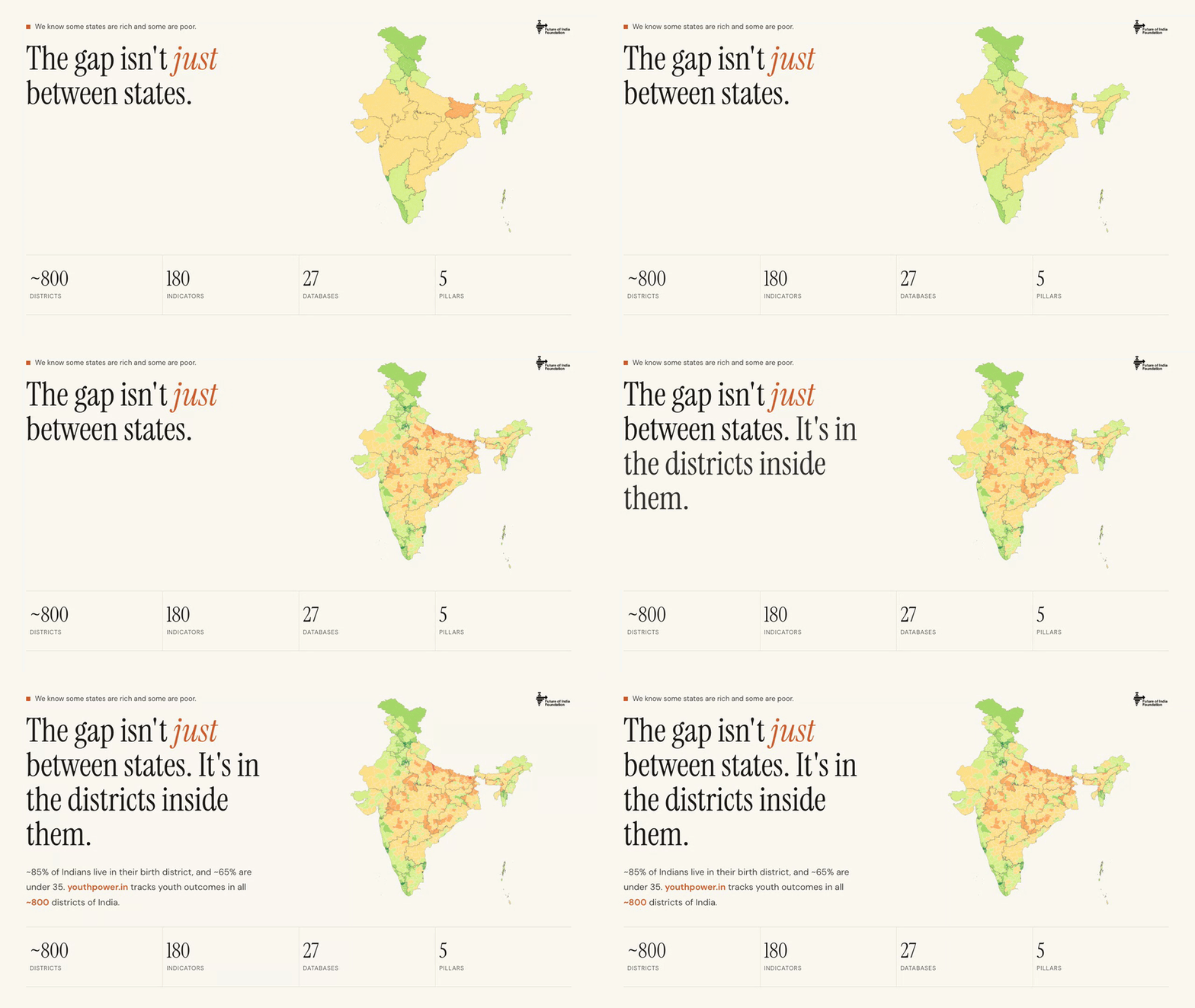
P.S. This is the premise behind YouthPower, India's only district-level youth opportunity map. If democracy is ultimately tested by whether citizens have fair opportunity and equal voice, young Indians are the most urgent place to begin. YouthPower maps the conditions that shape young people's life trajectory - education, skilling, work, mobility, public services, and the local governance and representation that decide whether aspiration is heard and enabled, or thwarted - district by district. Built using 180 indicators from 27 government databases, it makes youth opportunity visible, measurable and politically actionable. Visit: youthpower.in
Comments
Nothing yet. Say the first thing.
Sign in to join the conversation.