
Although Canon already had a presence in medical imaging through products such as X-ray detectors and ophthalmic imaging systems, its entry into the global ultrasound market and its emergence as a major medical imaging company came through the transformational acquisition of Toshiba Medical Systems. The acquisition brought Canon a long-established and highly regarded imaging business spanning ultrasound, CT, MRI, X-ray, and healthcare IT.
Toshiba’s medical business dates back to the 1910s, when it introduced Japan’s first domestically manufactured X-ray tube. Toshiba entered diagnostic ultrasound in the 1960s, followed by CT in the 1970s and MRI in the 1980s.
Unlike other major players such as GE, Philips, and Siemens, whose ultrasound positions were shaped by a combination of organic development and major acquisitions, Toshiba built most of its ultrasound business through internal research and development in Japan.
Some of Toshiba’s key milestones in ultrasound include:
1960s: SSA-01A, Toshiba’s first diagnostic ultrasound system
1970s: SAL-10A electronic linear-array system for real-time abdominal imaging and SSH-10A electronic sector scanner for cardiac imaging
Later product families: Sonolayer, PowerVision, Nemio, Aplio, Xario, Viamo, and Artida
These platforms established Toshiba as one of the major global ultrasound manufacturers. By the late 1990s, Toshiba accounted for over 10% of the global ultrasound equipment market.
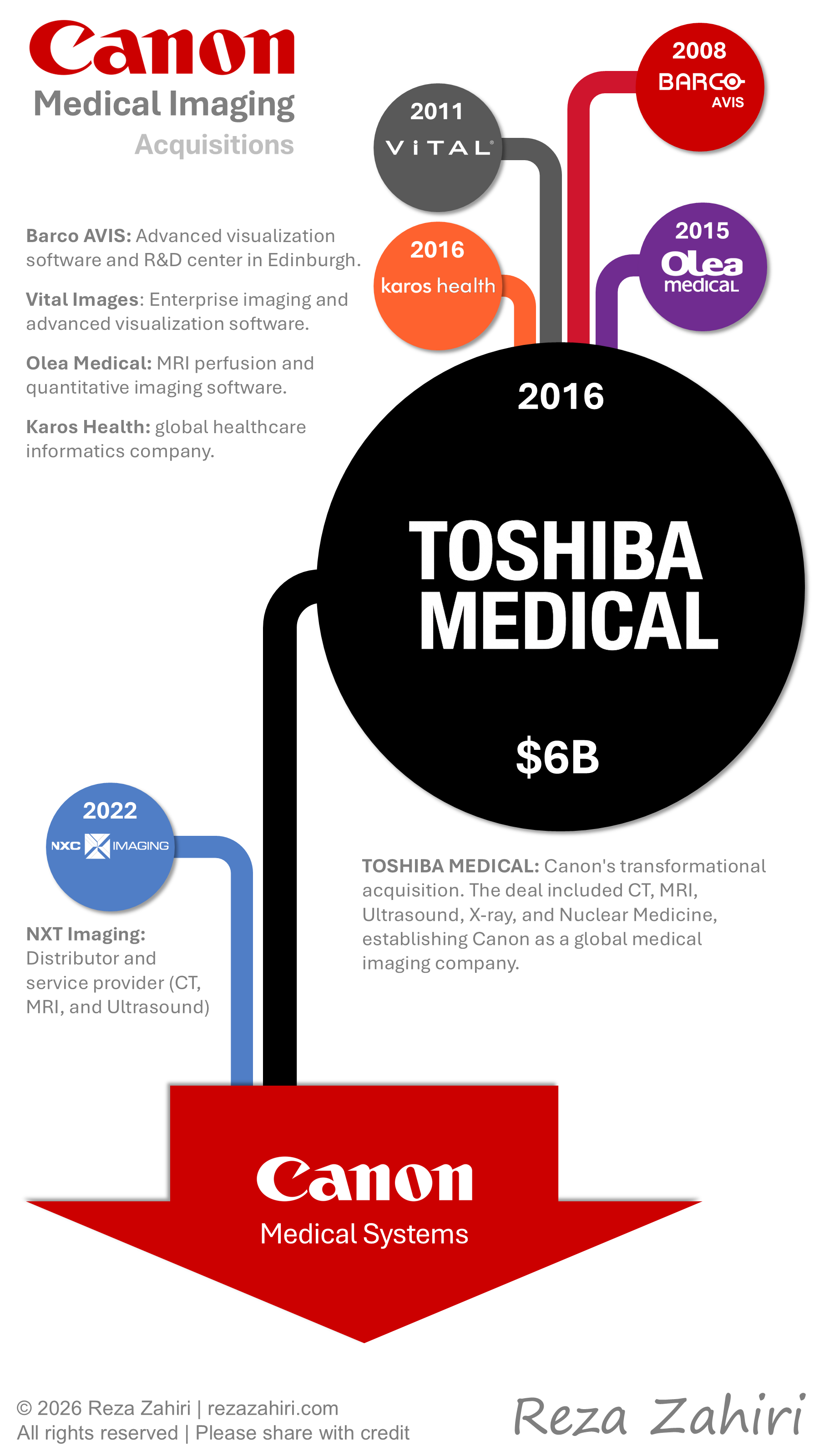
In 2015, Toshiba, facing a financial crisis, put its medical division up for sale to raise cash. While Canon, Fujifilm Group, and others were interested in the deal, Canon ultimately won the bid and agreed to acquire Toshiba Medical for ¥665B, roughly US$6B at the time.
The acquisition agreement was signed in March 2016, and Toshiba Medical became a Canon subsidiary in December 2016; it was later renamed to Canon Medical Systems in 2018.
In 2022, Canon Medical Systems also acquired NXC Imaging, a Minneapolis-based imaging-equipment distributor and service provider, to strengthen its commercial channel and service network.
Since acquiring Toshiba Medical, Canon has continued to develop and expand the ultrasound platforms it inherited rather than pursuing further major acquisitions.
The Aplio family remains at the center of Canon’s premium ultrasound portfolio, supported by additional systems serving general imaging, women’s health, cardiology, shared services, and point-of-care applications.
Canon entered ultrasound through one transformational corporate acquisition. The business it acquired, however, had already been built through decades of internal development at Toshiba. Since then, Canon has continued to grow the business organically while maintaining its global market share.
No posts
Comments
Nothing yet. Say the first thing.
Sign in to join the conversation.