
Most conversations about AI start and end with applications: ChatGPT, Claude, Gemini, Copilot, Grok, Perplexity, Cursor, Grammarly, Midjourney. But these apps sit atop a much deeper stack. Understanding that stack changes how you think about where value is created and captured.
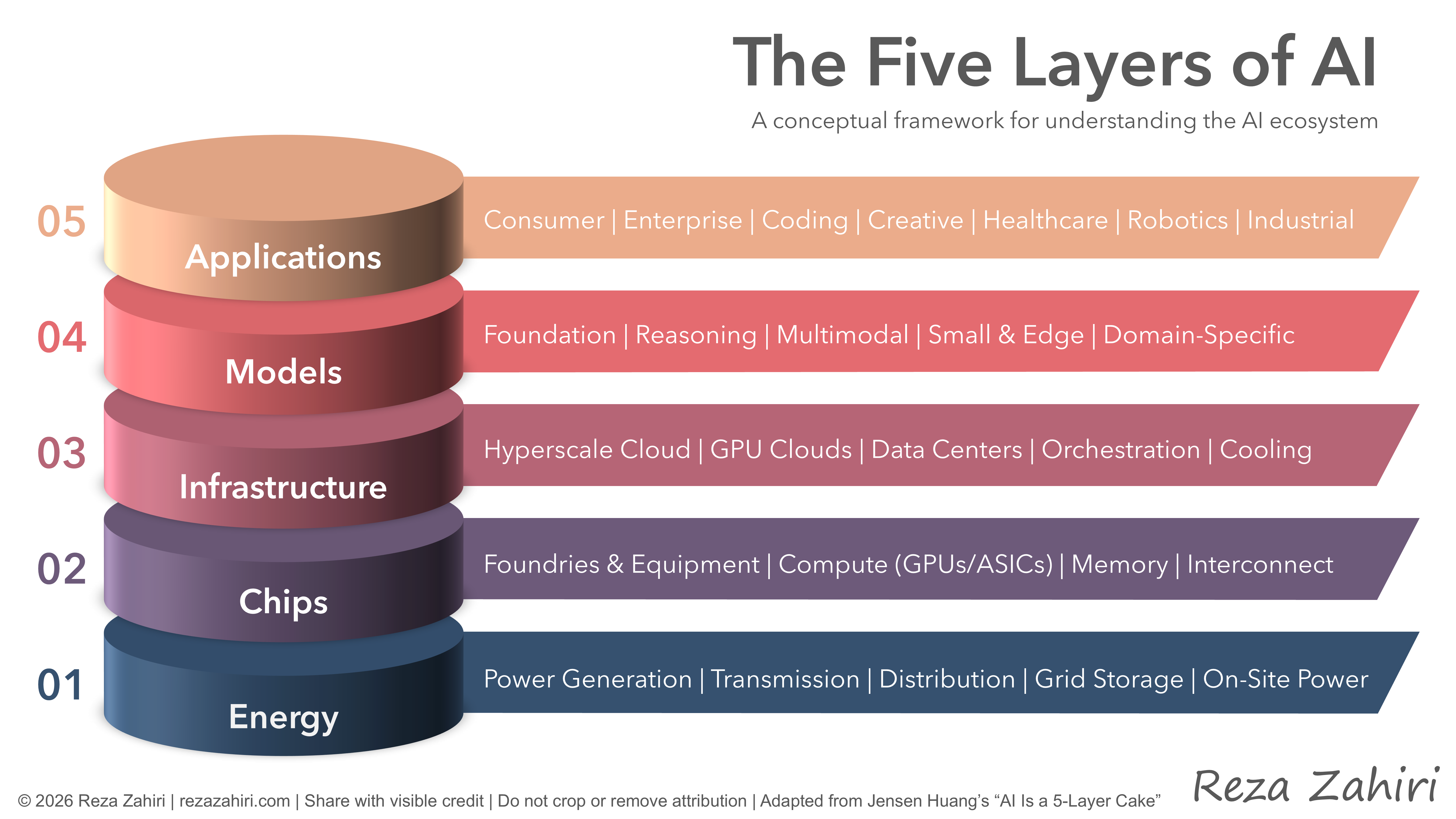
Jensen Huang has described AI as a five-layer cake:
𝐄𝐧𝐞𝐫𝐠𝐲 → 𝐂𝐡𝐢𝐩𝐬 → 𝐈𝐧𝐟𝐫𝐚𝐬𝐭𝐫𝐮𝐜𝐭𝐮𝐫𝐞 → 𝐌𝐨𝐝𝐞𝐥𝐬 → 𝐀𝐩𝐩𝐥𝐢𝐜𝐚𝐭𝐢𝐨𝐧𝐬
Each layer depends on the one below it:
𝐄𝐧𝐞𝐫𝐠𝐲 powers the stack: power generation, power transmission, grid storage, on-site power.
𝐂𝐡𝐢𝐩𝐬 convert that energy into compute capacity: foundries, GPUs/ASICs, memory, interconnect.
𝐈𝐧𝐟𝐫𝐚𝐬𝐭𝐫𝐮𝐜𝐭𝐮𝐫𝐞 turns chips into usable scale: hyperscale cloud, GPU clouds, data centers, orchestration, cooling.
𝐌𝐨𝐝𝐞𝐥𝐬 convert compute and data into intelligence: foundation, reasoning, multimodal, small & edge, domain-specific.
𝐀𝐩𝐩𝐥𝐢𝐜𝐚𝐭𝐢𝐨𝐧𝐬 put that intelligence in front of users: consumer, enterprise, coding, creative, healthcare, robotics, industrial.
Why is this framework useful?
It keeps the full system in view: competition is no longer confined to a single layer. It is playing out across the full stack. The companies building the most durable positions are often the ones that control, or tightly partner across, multiple layers.
The bottleneck is easier to see: two years ago, the focus was on GPUs and foundation models. Today, memory, storage, power, and data center capacity are major constraints. Tomorrow, the bottleneck may shift toward domain-specific models and applications.
The trends also become easier to follow: continued investment in general-purpose foundation models could eventually drive them toward commoditization, shifting value to other layers. Similarly, overinvestment in infrastructure could create excess capacity if demand, utilization, or economics do not keep pace.
One important exception: 𝐃𝐚𝐭𝐚
There is one critical asset that does not map cleanly onto the stack: Proprietary data. Data cuts across every layer rather than sitting neatly inside one. It may prove to be a more durable moat than any single rung on the ladder.
What has the market rewarded?
The last few years have been generous to companies across all five layers, as many players saw significant increases in their valuations. The real test is which ones built something durable, and which ones were simply carried by the tide.
As Buffett put it: you only find out who has been swimming naked when the tide goes out.
In my next posts, I will examine public companies across these layers and compare their stock performance during the AI wave.
No posts
Comments
Nothing yet. Say the first thing.
Sign in to join the conversation.