
SUNDAY SHARE | CONSUMER DATA
Opinions are my own and do not represent my employer.
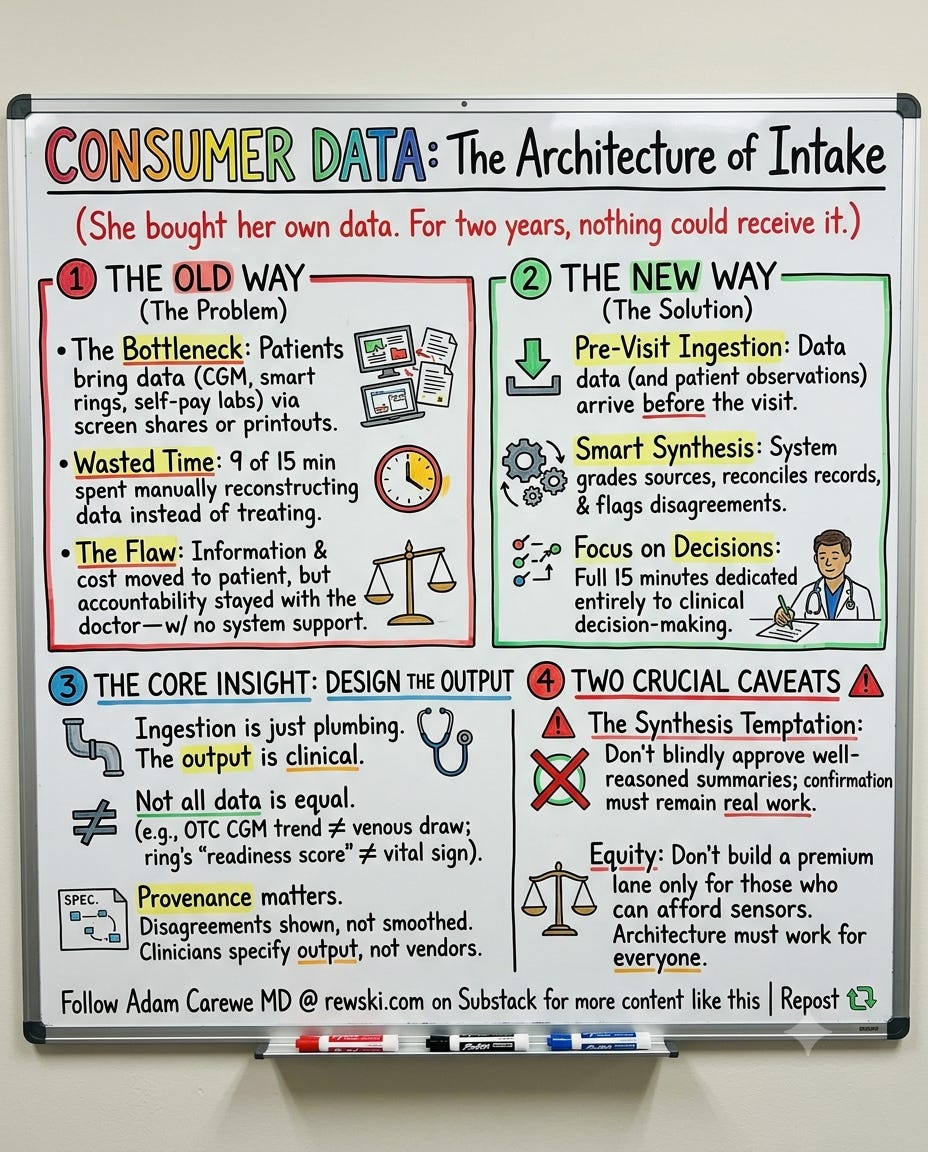
For two years, every visit like this one started the same way.
She shared her screen ninety seconds into the call. Ninety days of continuous glucose from a sensor she bought over the counter, scrolling past in an app I had no access to. A year of overnight heart rate variability and temperature trends from her ring. And a lab panel she ordered herself and paid for at Quest, no requisition from anyone, results in her inbox eleven days before the visit.
She had noticed something. Her post-meal curves had gotten steeper over the summer. Her overnight recovery metrics drifted the same direction in the same window. She wanted to know if the two were connected.
That was a better question than most referrals arrive with.
I had fifteen minutes, a chart that contained none of it, and a video window I could not paste any of it into.
In the office it was a folder. Printouts stapled at the corner, a spiral notebook with dates and numbers in her handwriting, a phone slid across the desk with the screen already open. On video it was a screen share, scrolled at her pace, rendered through compression while a clock ran.
Different surface, identical problem. There was no path for her data to reach me except through her, live, in the middle of the encounter.
Virtual made it sharper. There is no institution generating data on a video visit. No rooming, no cuff, no scale, no draw down the hall. Whatever physiologic data existed in that encounter was what she brought, or there was none. Her sensors were not supplementary to my exam. They were the closest thing to an exam I had.
So I spent nine of my fifteen minutes doing reconstruction. Squinting at a trend line to decide whether the shape was real or an artifact of her scrolling. Reading her lab values aloud so I could hold them in my head. Rebuilding, live and badly, a picture she had already assembled carefully before the call.
Then she handed all of it to me and every downstream consequence became mine. What to chase, what to watch, what to leave alone. She had paid for the sensor, the ring subscription, and the Quest panel. The information moved to the patient. The cost moved to the patient. The accountability did not move at all.
The decision got the six minutes that were left. That was not a failure of effort by either of us. That is what happens when the only ingestion path available is a person holding up a screen.
None of that happens anymore, and the change was not clinical. It was architectural.
Her data reaches me before the visit. The CGM export, the ring history, the panel she paid for herself. She adds what she noticed in her own words, because her observation is data too and the sensors cannot produce it.
It gets ingested, graded for what each source actually is, reconciled against the record already on file, and marked where the two disagree. What lands in front of me before the call is short. Here is what she brought. Here is what it appears to show. Here is where it conflicts with her chart. Here are the actions worth considering, and the reasoning under each.
I join the call already holding that. My job is to confirm, correct, or reject it, and then to decide with her what to do.
The nine minutes of reconstruction are gone. Not compressed. Gone. The encounter starts at the disagreement instead of the intake, and the fifteen minutes belong to the decision.
The conversation becomes the easy part. Not because the thinking got easier, but because everything that was never thinking got moved off the table.
Here is where most of these projects go wrong, and it is not the ingestion.
Ingestion is engineering. Upload, parse, store, retrieve. Any competent team ships it. The cost of building it collapsed. AI is affordability, not invention.
The output is clinical, and it is a series of decisions only someone who has to act on it can make.
Those three sources are not the same kind of evidence, and a summary that renders them as three tidy numbers is worse than no summary at all. An over-the-counter CGM produces real interstitial glucose readings and is not a diagnostic instrument. The trend is trustworthy. Any single value is not the same object as a venous draw. A ring gives me temperature deviation and heart rate variability alongside a proprietary readiness score built from inputs I cannot inspect. The raw signals are useful. The composite score is a product decision wearing the costume of a vital sign. A direct-pay lab result is a genuine measurement with no indication behind it, and its abnormal flags are set against a reference population that may have nothing to do with her.
Provenance has to survive into the output. Disagreements between her data and her chart have to be shown, not smoothed. The proposed actions have to arrive with their reasoning attached so I can reject one on its merits. None of that lands in a spec unless a clinician writes it, because none of it is obvious to anyone who has never been the person on the hook at 4 PM.
This is the whole physician-builder case, and it is why the model is not the moat. Anyone can build the pipe. Almost nobody can specify what should come out the other end. Legacy buys the ingestion and lets a vendor decide the output. Builders specify the output first and treat ingestion as plumbing.
There is a failure mode inside the version I work in now. A synthesis that arrives clean and well-reasoned is a synthesis I will be tempted to approve rather than examine, especially at 4 PM in a full schedule. Confirmation has to stay real work. Show the disagreements and the reasoning, not just the conclusion, and make rejecting the summary as easy as accepting it. The moment the system optimizes for my agreement, it has stopped clearing the floor and started making the decision.
The second thing is harder to say. Her stack cost real money. Redesign the visit around patients who arrive with datasets, and the patients who arrive with nothing get a worse encounter by construction. Trust-in-ease has to hold at both ends. Build for the person who cannot buy the sensors, not a premium lane for the person who can. A thousand unmarked intersections sit between a person noticing something and getting a real answer about it, and most of those people are not carrying a ring.
She scrolled. I watched. Ninety days of her own physiology, rendered through a video call, and the only physical evidence anywhere in the encounter.
I do not miss that version. What I want named is why it ended. It did not end because the models got better. It ended because someone who knew what the output had to say sat down and specified it, and then somebody built it. She always did the hard work of noticing. It took an architecture to finally receive it.
— Adam
If this resonated, the exam-room version of this argument runs across three Monday Full Stacks: Preparation Is Not the Visit, Presence Is Diagnostic, and Judgment Is the Last Layer.
Comments
Nothing yet. Say the first thing.
Sign in to join the conversation.