
Think of how Anthony Fauci has become kind of a tainted totem, tussled over by starkly opposed factions in fights that omit almost all of the complexity that attended the COVID-19 pandemic.
Then watch my pop-up Sustain What conversation with three of the 11 authors of an important recent Nature commentary: "Six ways to put the public at the heart of science and policy."
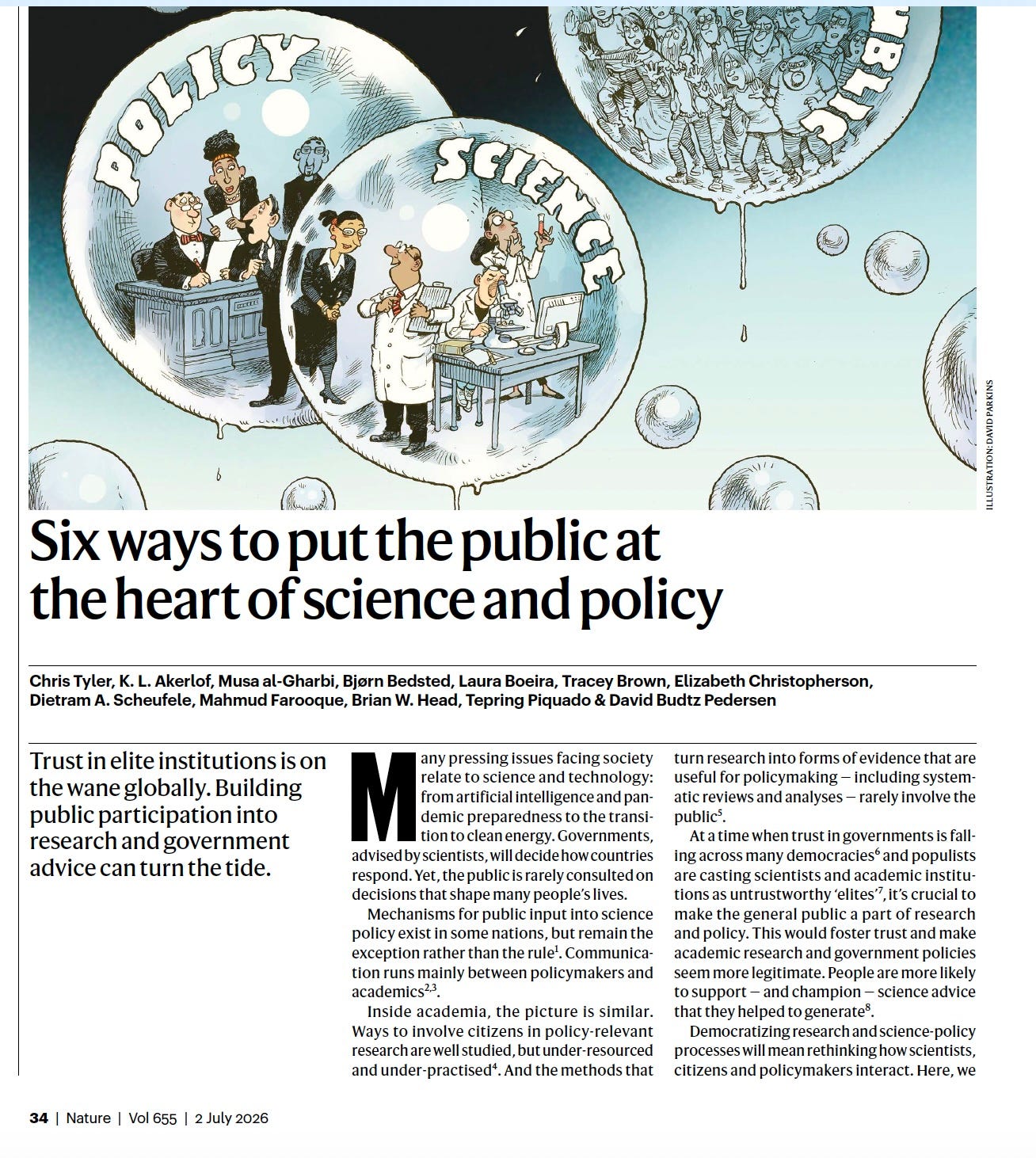
A key passage:
At a time when trust in governments is falling across many democracies6 and populists are casting scientists and academic institutions as untrustworthy ‘elites’7, it’s crucial to make the general public a part of research and policy. This would foster trust and make academic research and government policies seem more legitimate. People are more likely to support — and champion — science advice that they helped to generate8. Democratizing research and science-policy processes will mean rethinking how scientists, citizens and policymakers interact.
My guests were:
K. L. Akerlof, an associate professor at George Mason University who, among other things, leads the university’s “Communication for Environmental Science, Policy, and Human Behavior” concentration within the master's degree program.
Musa al-Gharbi, an assistant professor of sociology at Stony Brook University who writes Symbolic Capital(ism) on Substack and is the author of We Have Never Been Woke: The Cultural Contradictions of a New Elite.
Chris Tyler, an anthropologist and associate professor in the University College London’s Department of Science, Technology, Engineering and Public Policy. Among other previous work he spent five years as director of the UK’s Parliamentary Office of Science and Technology.
Here’s how al-Gharbi described the paper’s genesis on LinkedIn:
Trust in experts and scientific findings has grown increasingly polarized. Populists across the political spectrum and around the world insist that mainstream institutions do not represent or serve the public to the extent that they should. Their message resonates, in part, because there actually have been significant shifts in how scientific knowledge is produced and put to use.
Technological and scientific changes *have* significantly transformed how people work and communicate with one another. The benefits and costs of these shifts *have* been unevenly distributed. Many of these changes *were* implemented top-down, with little consultation with or buy-in from those facing the highest levels of risk, cost, or disruption. In short, the growing social distance between experts, policymakers, and the public is not imagined, it’s real. It’s also highly consequential.
Leaders on every continent have exploited growing public suspicion of experts and institutions to justify circumventing checks and balances, streamlining decision-making processes, and consolidating power into their own hands. Scientific institutions across the globe are facing budget cuts, increased government scrutiny, and censorship attempts.
However, times of crisis and disruption can also be moments of opportunity. Scholars, practitioners, and institutions around the world are responding to these challenges by piloting long-overdue reforms. There is a growing consensus that it may be possible to increase the quality, impact, and long-term viability of science and policy by more rigorously integrating the public at every stage.
To explore the challenges and opportunities of communicating science for policy in a populist world, Chris Tyler and K. L. Akerlof convened a working group that included 23 other researchers and practitioners from across fields and around the globe…
The working group gathered together in-person for the first time on September 8th in Arlington, VA to exchange ideas and foster collaborations. Drawing from these conversations, their diverse scholarship and experience, and successful documented initiatives from around the world, they produced evidence-based recommendations for constructively responding to the challenges of growing mistrust, alienation, and social distance. These suggestions were then vetted and refined by external peer-reviewers….
I don’t have sufficient income from my Sustain What project to have a staff so, yes, I’m judiciously using Google’s AI to summarize the discussion from the YouTube stream. If you can afford to, do feel free to chip in:
This discussion, hosted by Andrew Revkin, features researchers K. L. Akerlof, Chris Tyler, and Musa al-Gharbi exploring a Nature commentary on how to improve public trust and engagement in science and policy amidst a global rise in populism (0:04, 0:58, 2:36).
Key Takeaways:
Rethinking Science Advice: Chris Tyler emphasizes that the scientific community needs to stop acting like part of the problem and start becoming part of the solution by modernizing how science advice is delivered (5:16).
Embracing Humility and Uncertainty: K. L. Akerlof and Musa al-Gharbi note that researchers often naively hide uncertainty to maintain authority. Evidence shows that being candid about disagreements and limitations actually increases public trust (9:45, 12:44).
Moving Beyond ‘Elite’ Circles: Musa al-Gharbi argues that institutions often fail to engage beyond their narrow, affluent, liberal bubbles. He advocates for meaningful engagement with diverse stakeholders, including right-leaning or rural audiences, using local media and community venues (53:23).
The Three-Legged Stool: Chris Tyler proposes that universities should integrate research expertise, public policy expertise, and public participation expertise to maximize societal impact (19:51).
Avoiding Extractive Research: K. L. Akerlof warns against ‘extractive’ engagement, where researchers parachute into traumatized or marginalized communities to collect data without providing genuine support or respecting the community’s time and infrastructure (57:05).
Key Perspectives:
Andrew Revkin observes that despite the logical nature of calls for interdisciplinary, community-based science, these changes remain difficult to implement due to path-dependent institutional structures (43:00).
This 2021 webcast explores this issue: How Universities Can Support Interdisciplinary Careers for Climate and Sustainability Progress
Chris Tyler notes that the goal is for researchers to act as ‘honest brokers’ rather than lobbyists, empowering decision-makers by providing transparent evidence (48:38).
Musa al-Gharbi highlights that when mainstream experts position themselves solely in opposition to populist movements, they lose the ability to influence policy, leaving a vacuum often filled by less reliable sources (29:22).
I encourage you to click back to these previous webcasts on related themes:
Thank you to everyone who tuned into my live video. Join me for my next live video in the app.

Available for iOS and Android
Comments
Nothing yet. Say the first thing.
Sign in to join the conversation.