Here’s my “other voices” post encouraging you to follow the “unintended consequences” reporting of longtime journalist Marc Gunther and the energy-access analysis and solutions of global-development veteran Todd Moss.
Way back in 2021, I was one of the only journalists to highlight a speech by “planetary boundaries” pioneer Johan Rockström at the COP 27 climate talks in Glasgow. Best known for his focus on environmental limits and aggressive action to stop human-driven climate change, Rockström laid out the most inconvenient truth never articulated by the likes of Al Gore. As I posted back then, he said:
"Climate action must be just… The richest 1 percent must reduce emissions by a factor of thirty while the poorest can actually increase emissions by a factor of three for the world to stay within the global budget in a fair way.”
Emphasis: Billions of poor people can, and should, increase their emissions.
He illustrated this by showing how the poorest half of the world’s population was responsible for just 7 percent of cumulative emissions of carbon dioxide between 1990 and 2015. Hindering their advancement by saddling them with emissions-reduction obligations is unethcal.
Apologies for any glitches; I’m writing on a crowded bus to Boston - classic Maine “medical commuting”….
There’s another way of looking at this, and that’s what Gunther — drawing on Todd Moss’s insights — did in a post today:
Here’s Gunther’s lede:
Here’s a paradoxical truth: To protect their people from climate change, some of the world’s poorest countries will have to burn fossil fuels.
In Sub-Saharan Africa and south Asia, renewable energy — solar, wind, geothermal — ought to be the first choice for countries in need of more power. But they should be free to supplement renewables with oil and gas to drive economic growth and enable their people to adapt to a warming climate.
So, at least, argues Todd Moss, the founder and executive director of the Energy for Growth Hub, a think tank that promotes the idea that the developing world needs abundant, affordable energy to thrive.
“Environmental impacts and climate emissions are very important,” Moss tells me. “They absolutely should be considered. But they’re not the only thing, and in many cases, especially where you are dealing with extreme poverty, they’re not the most important thing.”
Yet in a cruel example of the best laid plans, the World Bank, European governments, and climate activists — and, for a time, the Biden administration — all have tried to thwart fossil-fuel development, even in sub-Saharan Africa, where nearly 600 million people have no electricity at all.
Let that sink in for a moment. The powers-that-be in the US, where my suburban neighbors drive big cars and live in big homes, and where per capita greenhouse gas emissions are about three times the world average, wanted — until the Trump administration came along — to deny people in sub-Saharan Africa access to fossil fuels. Is that climate justice?
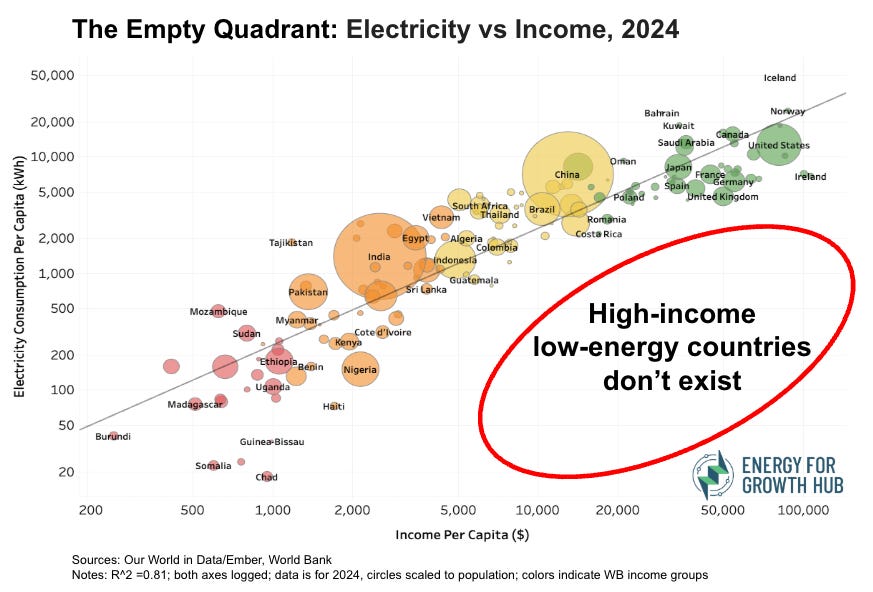
The Energy For Growth Hub reminds us that energy is the key to prosperity. There are no low-energy, high-income countries. Take a look at the “empty quadrant” of this graphic:
What’s more, rich and middle-income people in the US and the EU are much better able than poor people to deal with the natural disasters—droughts, floods, storms and extreme temperatures—associated with climate change.
Here’s Moss’s 2024 post digging deep on the graphic, which was developed by his Energy for Growth initiative:
Moss’s group has wisely been advocating, as part of the sustainability path forward, for a “modern energy minimum” as a vital new metric for electrification efforts in poor places.
Take the time to read and absorb these ideas, then listen to what then-President Biden’s climate envoy John Kerry said in July 2021 at a US-Africa business summit:
“It is true that the United States and Europe and some other countries benefited by being the first movers in the market in terms of energy. So we’ve had 150 years, 100 years of making big mistakes…
But just because some people didn’t have their chance to make those mistakes doesn’t mean they ought to go do it now…
So we need to be thinking much more sustainably here, and that’s where the funding is going to go. The money is not going to continue to flow into investment for fossil fuels. It will sustain for a period of time while we transition. But that is not the future. And Africa should be building for the future, using the technologies that will be part of that future.”
"Just because some people didn't have their chance to make those mistakes doesn't mean they ought to go do it now…. The Earth doesn’t have the carbon space right now….”
I hope that level of absolute obliviousness is an artifact of a fading imperious age of finger-wagging climate diplomacy by established industrial powers.
Here’s the tail end of Gunther’s piece:
Moss and his allies spent much of the Biden years lobbying the administration to soften its opposition to natural gas projects, with some success. Now they are urging the Trump administration—which embraced fossil fuels and cancelled “just transition” projects designed to help South Africa, Indonesia and Vietnam replace coal plants with clean energy—to support renewables as well as nuclear and geothermal.
“Let’s be technology-agnostic,” Moss says. “Let’s not kill the solar and wind potential, which is tremendous.”
The good news is that the conversation about climate and poverty in Africa and south Asia has become more constructive. Vijaya Ramachandran, director for energy and development at the Breakthrough Institute, has written a lot about the development banks under such headlines as Where Emissions are High, Reduce Emissions. Where Poverty is High, Reduce Poverty. (Makes sense to me.) In last fall’s excellent Gates Notes, Bill Gates wrote that it’s time to “refocus on the metric that should count even more than emissions and temperature change: improving lives. Our chief goal should be to prevent suffering, particularly for those in the toughest conditions who live in the world’s poorest countries.”
Climate change may or may not be the biggest problem facing the world. I hope we can agree that it’s not the only problem.
Needless to say, I heartily agree.
My post on Bill Gates’s updated thinking on climate in the context of development:
My guests were Sophie Mbugua, an environmental journalist in Nairobi who founded the great Africa Climate Conversations podcast series; Destenie Nock, a Carnegie Mellon University researcher doing groundbreaking work revealing how poor households dangerously cut back on energy use facing dangerous heat; Vijaya Ramachandran, the director for energy and development at the Breakthrough Institute, who recently warned against blanket bans on fossil fuel finance in a Nature column; and Johan Rockström, director of the Potsdam Institute for Climate Impact Research, who has been warning wealthy countries they must cut heat-trapping missions more so the poorest billions on the planet can fully develop – a process requiring more emissions.
My 2023 Sustain What conversation with fossil-energy promoter Alex Epstein might remind climate campaigners that if they skirt addressing the profound energy needs of poor countries and communities, they’re ceding that space to folks who they might see as enemies:
Avoiding “Backdraft” in Climate Policy - When Mitigation or Adaptation Actions Spark Conflict (Geoff Dabelko and others)
Here’s more on Africa from Energy for Growth’s network:



Comments
Nothing yet. Say the first thing.
Sign in to join the conversation.