

Something happened after I wrote, “How to Get Trump Out of Your Head.” A lot of you responded not only to the politics of the piece, but to the spiritual practice underneath it: Be like water.
This tells me that many of us need practices that help us stay courageous, clear-eyed, and grounded when so much around us is trying to make us fearful and reactive. We need this more than another reason to be outraged by something this Administration has done. We want to be awake but grounded.
So I’m going to keep exploring those practices here even as I sometimes provide analysis. I’m not announcing a formal series. I just want to keep following this thread because it seems to be something many of us are hungry for.
Here is another practice:
Dignify.
More on that in a minute.
Before I go into this, I want to recognize that most of us out here have been burned by religion. Some of us were harmed by churches or religion of some kind. Some watched Christianity get used to justify racism, patriarchy, homophobia, exclusion, or cruelty. Some simply got tired of people claiming God for things that looked nothing like love.
And yet I keep coming back to the conviction that we need a story big enough to help us navigate this moment.
That story does not have to come from Christianity, although that is where most of mine comes from. It does not even have to come from religion. Personally, I seem to be slowly becoming a Buddhist Christian who tries to sit at the feet of Jewish scholars of Hebrew Scripture. Christian antisemitism—and Christianity’s long history of reworking Scripture to accommodate slavery and segregation, a history writers like Jemar Tisby have helped expose—has made me deeply suspicious of inherited Christian readings that bend the text toward power.
Throw in a little Star Trek, too. I’m a Trekkie, and Gene Roddenberry, a humanist, probably belongs somewhere on my list of spiritual influences.
But a story we must have: one that calls us and others to higher and more sober ground, helps all of us see through lies, and keeps us from becoming what we oppose.
Because authoritarianism is not only a political project. It is a battle over the imagination.
Before people will tolerate cruelty, they often have to be taught a different story about who deserves compassion. Authoritarian movements tell people what is normal, whom to fear, whose suffering counts, and which human beings can be treated as disposable.
Hear that story often enough, and it begins to shape the way people see the world, even people who would never think of themselves as cruel.
Authoritarianism is not only a political project. It is a battle over the imagination.
That is why those of us resisting authoritarianism need better stories. We also need to ensure people hear our stories.
I have been an activist pastor for a long time. But after Trump was elected in 2016, something changed in me spiritually. I found myself needing to go deeper.
More strangely, I felt the Spirit telling me to stop for a minute and listen.
Then Scripture started following me around.
I would be at a protest, and some biblical passage would start running through my brain like an earworm. I would come home ravenously hungry, as protests always seem to make me, grab a burger and shake, sit down, and start doing Bible study.
Why is this in my brain? I kept wondering.
Eventually it hit me. God was speaking to me through the text, not giving me political talking points, but something deeper. I was finding words about courage, warnings about power, insights into human behavior, and strategies for surviving frightening times without surrendering your soul.
My friend Jonathan Wilson-Hartgrove has made an observation that has stayed with me: as authoritarianism rises, the Bible begins to make more sense because so many of its stories come from people living under empire, occupation, exile, and tyranny.
I have found that profoundly true. These stories read differently when the lights begin to go out. Pharaoh makes more sense. Caesar Augustus makes more sense. The prophets make more sense. So do the frightened disciples, the temptation to accommodate power, and the stubborn insistence throughout Scripture that empire does not get to define reality.
We can see it in the awakening all around us, in the faithful showing up in city after city to defend people who are being targeted, much of it happening without national attention.
Sometimes reporters look at this and say something new is happening in religion. But it’s been present for a while. Sometimes people just don’t notice the light until it gets dark.
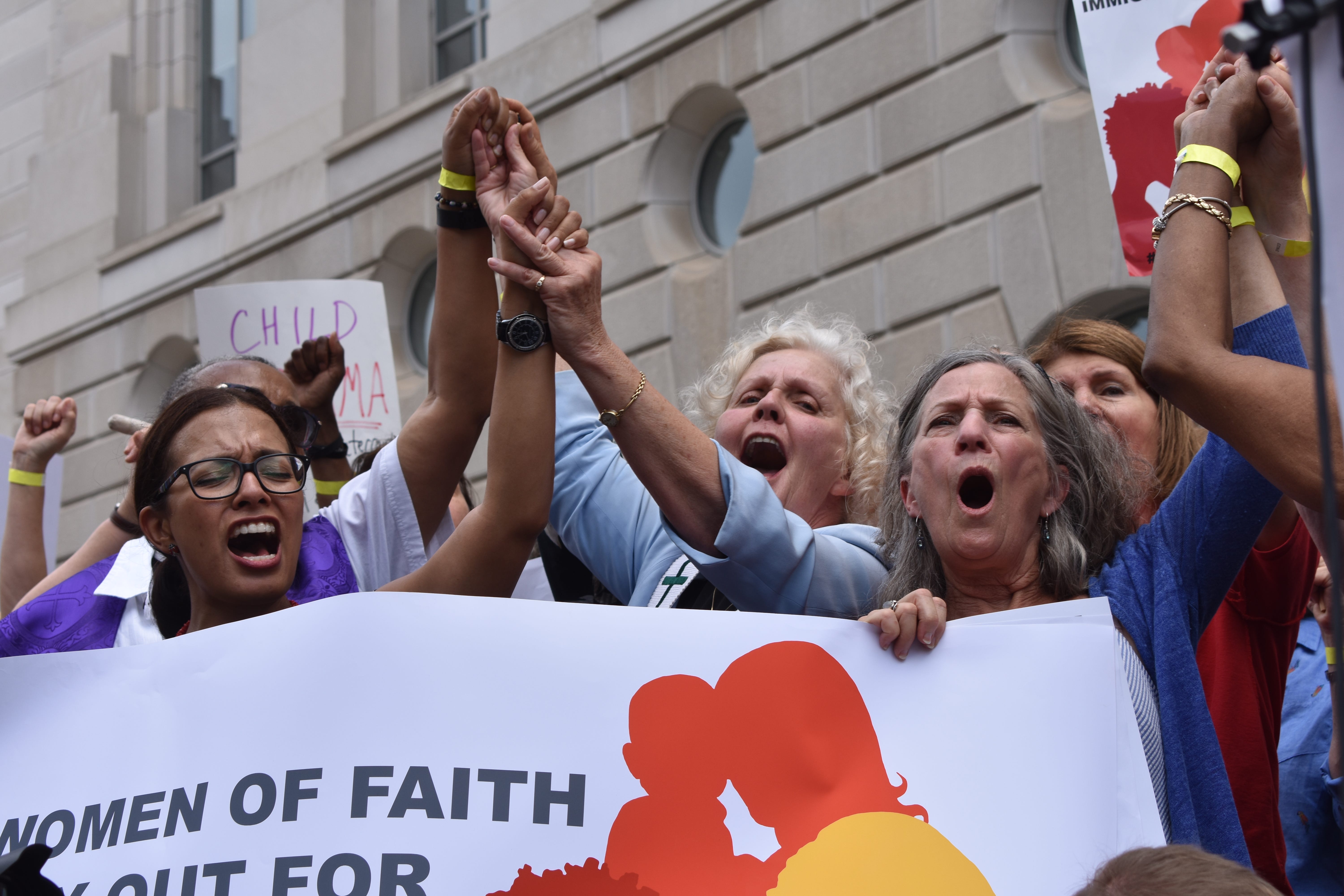
The truth is, God has been on the move for a while.
So whatever your faith—or lack thereof—I want to encourage you to go back to your sacred texts.
They may be the Torah, the Qur’an, the Gospels, or Buddhist teachings. They may be poetry, philosophy, the writings of your ancestors, Frederick Douglass, or Octavia Butler. They may even be science fiction.
Read them again now. You may be surprised by what you see.
Questions about courage, conscience, fear, truth, power, solidarity, and hope stop being theoretical in moments like this. Stories we may have encountered hundreds of times begin asking different things of us.
But texts alone are not enough. Sacred traditions have always been communal. People argued over these stories, sang them, questioned them, interpreted them, and tried to live them together.
So find people.
If you can return to worship, somewhere near you there is probably a community trying, however imperfectly, to follow the deeper teachings of its tradition. Research. Look around. And if church is simply too painful, make something else: start a book group, gather friends for dinner, or take the activist group you already belong to and spend an evening asking one another why you do this, what keeps you going, and what you refuse to surrender.
I say this as one who almost left altogether when I was in my twenties. I’m glad I did not. We need communities that help us remember who we are. Nothing can replace human connection.
And we need practices.
The last one I wrote about was Be like water.
Here is the next one.
Maybe “Dignify!” sounds a little like a Harry Potter spell. I’m okay with that, because authoritarianism casts a kind of spell of its own.
It teaches us to look at another human being and see a category: illegal, criminal, threat, enemy, liberal, MAGA, other. Once a human being becomes a category, things can be done to them that would horrify us if we were actually looking into their face.
Dignifying breaks that spell. It asks us to look again and see a mother, a child, a neighbor, a frightened person, a human being, a child of God.
Dignity is something every person already possesses. Dignifying is what we do when the world tries to strip it away.
Dignity is something every person already possesses. Dignifying is what we do when the world tries to strip it away.
While writing Who Stole My Bible?, I rediscovered Genesis, largely because Jewish scholarship helped me see things Christians had taught me to miss.
I had heard the creation story all my life: God made the heavens and the earth. God made plants and animals. God made people. Everything was good.
Nice Sunday school story.
Except it is much more politically explosive than that.
Read Genesis alongside the creation stories of the ancient empires surrounding Israel, and the contrast is startling. In imperial mythology, creation could emerge from violence among the gods, and human beings existed to serve divine rulers.
Genesis tells another story.
God brings order from chaos. Again and again, creation is pronounced good. Then comes the astonishing declaration that human beings are made in the image of God.
Not just kings or priests. Not just men. Not just the wealthy, the native-born, the powerful, or the people belonging to the dominant tribe.
Everyone.
The dignity ancient societies associated with rulers is spread across humanity. Every person carries something sacred.
That is not merely a children’s story. It is a radical claim about human worth, because it means no Pharaoh, emperor, president, pastor, billionaire, or political movement gets to decide that another human being is disposable.
Dignify.
I was thinking about all of this during Trump’s first term when I traveled to McAllen, Texas, at the height of the family-separation crisis.
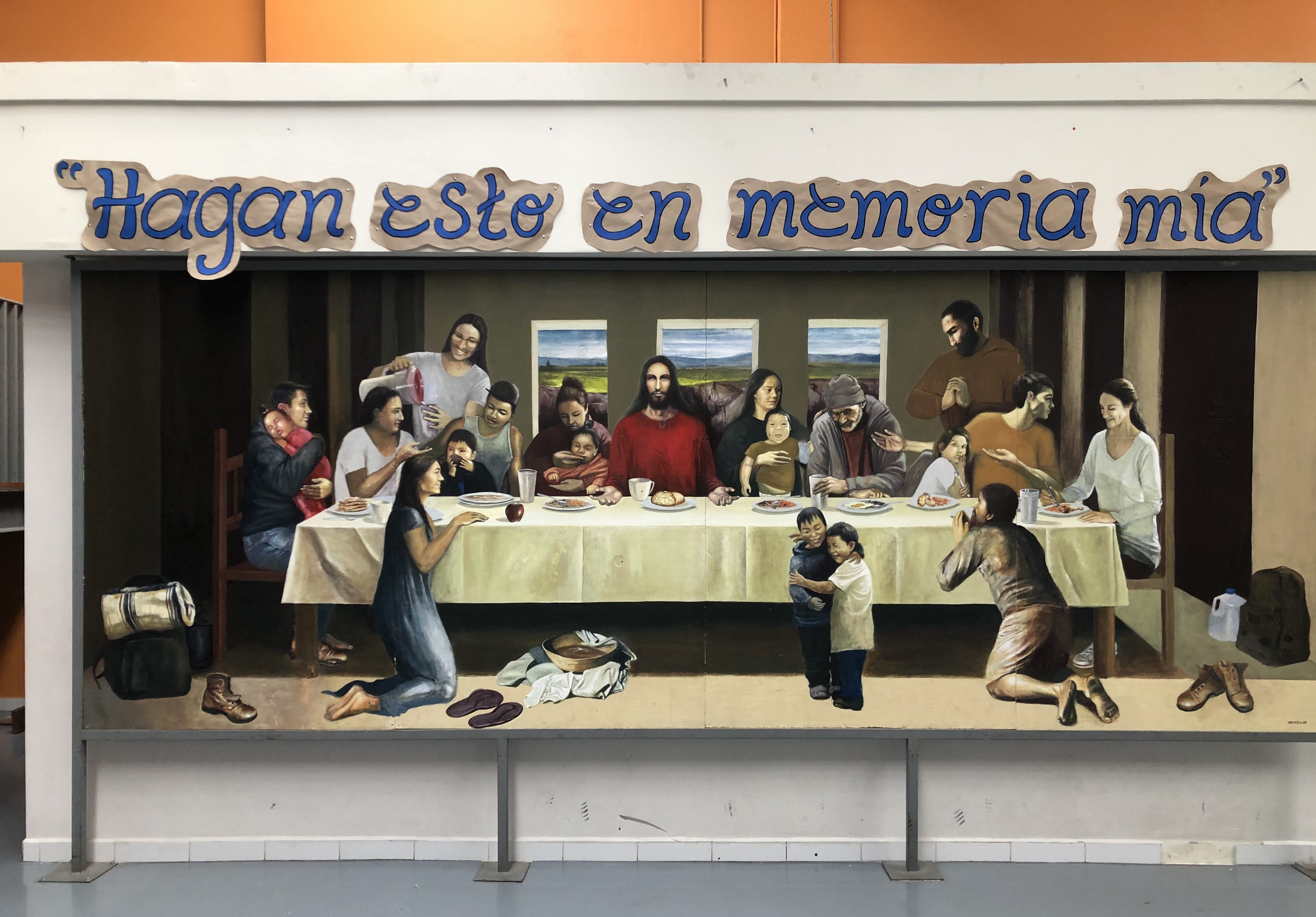
I visited the humanitarian respite center led by Sister Norma Pimentel and Catholic Charities of the Rio Grande Valley. Families arrived exhausted after their journeys and their encounters with the immigration system. Volunteers welcomed them. People were fed. They were given clean clothing and a chance to wash. Children were treated like children again.
I was standing outside the center when the volunteers began applauding as a long line of families entered fresh from detention.
I watched a boy, wilting on his dad’s shoulders, perk up and smile.
Dignify.
I realized I was watching Genesis 1 in action.
After being treated as dangerous, suspect, alien—after hearing people across the country talk about them as some invading force—they passed under a mantle printed with the invocation: “Restore human dignity.”
We were not rewriting immigration law in that room, as important as that is.
We were doing something both smaller and, in another sense, enormous. We were refusing the lie that these people were somehow less human than the rest of us. And we were sharing that truth with our networks and news channels.
The spiritual practice was simple: look again. A human being. Image of God. Beloved.
Dignify.
Break the spell.

There is a reason authoritarian movements so often begin by scapegoating minorities. The targeted group changes—immigrants, religious minorities, LGBTQ people, racial minorities, political opponents—but the spiritual mechanism is remarkably consistent.
The rest of us must first be taught not to care what happens to them.
Martin Niemöller’s famous postwar confession, “First they came for the socialists,” has endured because he eventually understood this terrible logic. Niemöller himself had initially held deeply conservative and nationalist views. The socialists were not his people.
That was precisely the point.
He came to understand the moral catastrophe of allowing the degradation of people outside his own circle. Authoritarianism continually asks us to shrink the circle of people whose suffering counts.
Which is why I pay attention when Christian leaders begin warning people about the dangers of empathy.
Think about how strange that is: Christians being warned about caring too much.
Vice President JD Vance has spoken of an “order of love” in which obligations radiate outward from family and community. Other figures on the Christian right have gone considerably further, attacking empathy itself as morally suspect.
Why devote so much energy to persuading people that empathy is dangerous?
Because empathy can break the spell. The moment you look at the person you have been told to fear and see somebody’s mother, somebody’s child, somebody trying to survive, the propaganda becomes harder to sustain.
Asserting human dignity is dangerous to authoritarianism.
There is another edge to Dignify that I don’t want to avoid.
It does not apply only to the people we are trying to protect. It also applies to our enemies.
I don’t mean excusing what they do, pretending cruelty isn’t cruel, corruption isn’t corruption, or authoritarianism isn’t dangerous. In fact, I think the practice demands the opposite: we need to become much more precise about what we oppose.
I notice how easily our attention gets pulled toward ridicule. Trump’s hair. The way he talks. His body. Whether he looks healthy or unhealthy. Whatever bizarre spectacle has consumed the news cycle today.
Meanwhile, far more consequential questions wait for our attention. What policies are causing hospitals to close? Who is losing health care? Who is enriching themselves through access to public power? Whose rights are being stripped away? Who is being detained, deported, or frightened?
Which story actually helps another person understand what is at stake?
When our critique becomes contempt for how our opponents look, speak, or behave, someone who does not already agree with us may hear only contempt. We can lose the moral argument before we have even made it.
Dignifying an opponent does not mean weakening our opposition. It means locating our opposition where it belongs: in what they do, not in whether we believe they are fully human.
Dignifying an opponent does not mean weakening our opposition. It means locating our opposition where it belongs: in what they do, not in whether we believe they are fully human.
This is the harder part, and I need to come back to it in a future piece.
There is plenty in this moment to rage about, but I also want us to notice what the attack on empathy tells us about our own power.
If compassion were really weak, authoritarian movements would not work so hard to destroy it. If empathy were politically irrelevant, there would be little reason to attack it. If human dignity were sentimental nonsense, every authoritarian project would not need to teach us that some people matter less than others.
If compassion were really weak, authoritarian movements would not work so hard to destroy it.
We have a freaking superpower.
Our capacity to see the humanity in another person is power. Feeding somebody is power. Learning someone’s name is power. Accompanying a frightened person to court is power. Standing beside someone being bullied is power. Telling the truth about a group being scapegoated is power. Refusing to mock even the person whose actions you vigorously oppose is power.
Sometimes resistance looks like a march, a lawsuit, or civil disobedience. Sometimes it looks like a room in McAllen, Texas, where exhausted strangers walk through a door, and everybody stands up and applauds.
None of those acts is small, because every act of dignifying another human being weakens the spell that authoritarianism depends upon.
So here is the practice.
Find the person our politics is teaching you not to see. Learn their name. Listen to their story. Feed them. Welcome them. Defend them. Stand beside them. On the bus. At the grocery store. Planned, unplanned. Make eye contact. Smile. Build out from there.
This includes how we treat those under the spell as well.
And when you confront someone doing harm, tell the truth about the harm without surrendering your own humanity in the process.
Dignify.
Remind another person who they are. Remind yourself who you are.
And until next time:
Be like water.
Dignify.
If this kind of writing helps you stay grounded, clear-eyed, and spiritually resourced in this moment, consider becoming a supporting subscriber. Reclaim Faith’s core essays will remain free, but paid subscriptions make it possible for me to write. Supporting memberships are $8/month or $80/year. And if you want to help build this work at a deeper level, you can join the Founding Circle at $200/year or more.
No posts
Comments
Nothing yet. Say the first thing.
Sign in to join the conversation.