
Judge: Just what kind of priest are you, Mr. Hoffman?
Rev. Hoffman: One that tries to be a good priest, your honor. Not always successfully. I suppose I would say that I’m a sinful priest like all the others.
Judge: I will not play word games with you, Mr. Hoffman. Are you a Jesuit, or Franciscan, or Dominican, or a Clementine, or what?
Rev. Hoffman: I am a secular priest of the Archdiocese… I do not belong to a religious order.
Above are the first words of a most engaging book I read by the late Father Andrew Greeley.1 The dry humor got a smile from me from the outset.
When a young man in the Catholic Church is contemplating becoming an ordained priest, there are two main paths to choose from: Religious or Parish ministry.
Our last two popes are members of religious orders: Pope Leo is an Augustinian, and the late Pope Francis was a Jesuit. Of the 267 popes over the centuries, from the Apostle Peter to Leo XIV, only 42 or 16% were religious, and 245 or 84% were non-religious also known as parish or secular priests.
Religious Ministry
There are many religious orders to choose from, and each one has its specialty, or charism. A prospect chooses their order by finding a charism that resonates with them. For example, the Salesians, founded by Don Bosco, have a ministry to youth—especially migrants. The Paulists (CSP, Community of Saint Paul), continuing the ministry of the Apostle Paul, have a book publishing ministry and are known for evangelizing. You may have heard of the Paulist Press. The Franciscans’ (OFM, Order of Friars Minor) ministry is one of caring for the poor, and they often run centers of hospice. They are named after the great Francis of Assisi (c. 1181-1226) who embraced a life of poverty. Benedictines (OSB, Order of Saint Benedict) are monks, another kind of religious lifestyle that focuses on prayer, and they often will run retreat houses and centers of spirituality. The Dominicans have a passion for preaching; hence their title is OP—Order of Preachers. Yet another order is the Jesuits, known as the Society of Jesus (SJ). They were founded by Saint Ignatius of Loyola from the 1500s. They are academics; they found, run, and teach in universities. Notre Dame, Creighton, Regis, Marquette, and Gonzaga are some of the Jesuit universities. Present day Augustinians (OSA, Order of Saint Augustine) are known for missionary outreach and openness to dialogue with all parties.
That Francis was the first Jesuit pope is extraordinary, because although the Jesuits are the largest order—with around 18,000 priests—the charism of the order is that of reforming from ground up, not from the top down. They are trained to be servants, not leaders per se. They especially pledge themselves as servants to the pope. On the other hand, the Augustinians, a much smaller order with around only 3,000 members, has produced seven popes.
And there are dozens of other orders, many of them contemplative or monastic (living in a monastery), with a simple lifestyle of prayer and other ascetical practices. A hermit is a type of monk that lives, works, prays, and even eats in seclusion, although they all gather together for daily mass, which is by its nature a communal event. The Last Supper, which was the First Mass, was a gathering of friends, and therefore a communal event of thanksgiving with Jesus. A mass is never intended to be a private prayer.
I have had a few visits to a Camaldolese monastery on the beautiful coast of Big Sur, California, including a weeklong visit for my secluded diaconate retreat which took place just before being ordained a deacon. The Camaldolese are Benedictine monks dedicated to life as hermits. I was in seclusion myself, but when it was time for daily mass and prayers, all the monks filed into the chapel to pray together. Most of the prayers were chanted or sung—it was utterly beautiful and inspiring!
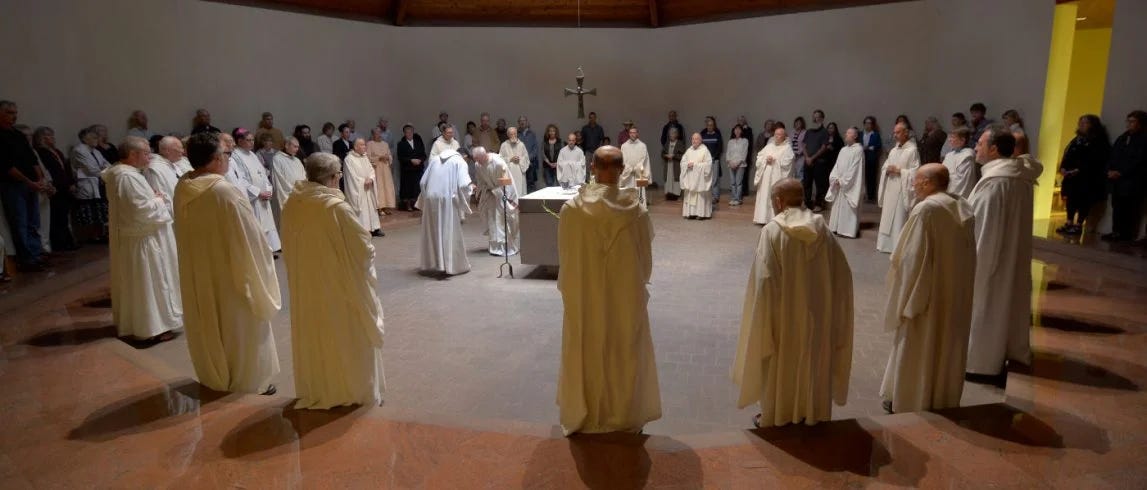
Nuns live a contemplative ministry, whereas sisters typically live an active ministry. I’ll cover the difference between active and contemplative ministry in a future post!
Religious priests often celebrate mass at the local parish, but may not necessarily have a ministry at that parish. They may be a supply priest on Sundays, going where needed, and their work during the week will be the work of their community—working in hospitals or prisons as a chaplain, teacher, nurse, doctor, or other health professional. And if their order has a worldwide presence, they may even be sent to another country during their lifetime.
Parish Ministry
A ministry alternative to becoming a religious priest is to become a parish priest, which is the same as a diocesan or secular priest. Their primary ministry is to people in parishes—essentially family ministry.
Parish priests are largely guaranteed to not only celebrate mass on Sundays at the local parish, but will also take care of all the needs of the people there—offering counseling to people experiencing hardships, hearing confessions, performing weddings, baptisms, and funerals, and working with students in the parish school. Their work is usually limited to a specific locale.
Whereas religious priests live in their religious community, parish priests usually live in a rectory next to their church or an apartment nearby. The daily schedule of parish priests may intrinsically allow for more flexibility and setting their own schedule, insofar as they are not reporting to an organization—rather they are attending to the needs of individual members, or groups within their parish.
Vows for Religious
Religious, which includes monks, nuns, sisters, brothers, and religious priests, take solemn vows of poverty, chastity, and obedience.
The vow of Poverty is the embracing of a simple lifestyle that rejects ownership of property—the religious community itself may own property, but individuals within that religious community may not. Poverty does not mean that the religious are necessarily “poor,” although with some more austere communities, it could mean that. Rather, they have what they need, and they don’t request excess. A friar may use the community car to get his work done, or several may share a car, but no individual friar owns the car. Poverty means a state of detachment to material goods and anything that can take attention away from being focused on the simplicity of Jesus.
Chastity means exercising self-control in all things, both sexual and non-sexual. For example, one piece of chocolate cake is fine, but having three pieces is not being chaste.
The Fruit of the Spirit, the apostle Paul writes, has nine aspects: love, joy, peace, patience, kindness, generosity, faithfulness, mildness, and self-control.2 Some translations (Wycliffe, Douay Rheims) render the last attribute as chastity rather than self-control; in this case the meaning is identical. Additionally, the vow of chastity requires abstinence from marriage.
Obedience is given to their superior who may be called a mother superior, prior/prioress, abbot/abbess, provincial, or other title. These leaders all are obedient to their leader, the local bishop.
Promises for Parish Priests
Parish priests make three promises. These are similar to vows, but vows are considered solemn and public, whereas promises are not pledged formally. The promises are: pray the Liturgy of the Hours, celibacy, and obedience.
The Liturgy of the Hours is also called the Divine Office or simply the Office. This includes the five hours of morning (lauds), evening (vespers), and daytime prayer which can be midmorning, midday, or midafternoon, and night prayer (compline). Each locale or diocese may have different requirements. Religious often pray the office, too.
The office includes the Office of Readings which consists of a selection from the scriptures (in addition to the daily mass readings), and a reading from a renowned spiritual author.
The promise of celibacy goes far beyond abstaining from marriage and sex. Rather, celibacy is a call to love everyone. In marriage, your love for your spouse and children is your top priority; after them, you are called to love all others. Celibate love is a call to love all people—with equal priority.
Obedience means that a priest will follow the direction of his bishop in relocating to a different parish. If the bishop receives complaints about sermons, he may ask that priest to restrict what he preaches, and he is obligated to obey.
Noteworthy—parish priests do not take a vow or promise of poverty. They can own a car or whatever possessions they need to fulfil their ministries. Most parish priests will not own a car; they will simply use the car the parish gives them to use.
Sacramental Ministry
Both religious and parish priests (but not non-ordained religious such as nuns, sisters, and the like) have a sacramental ministry, meaning celebrating the mass and the sacraments of baptism, eucharist, reconciliation (confession), anointing of the sick, and marriage. In some situations a priest can perform the sacrament of confirmation, although typically the bishop does that. Only a bishop can ordain a priest.
NOTE—you may have gleaned from this post that “religious” can be a noun, and sentences like these are typical and grammatically correct:
My aunt is a religious. (Implying she’s a religious sister or nun.)
He’s a priest, but he’s not a religious. (Implying he is a parish priest.)
I wonder… did you already know that nuns, sisters, and brothers are always religious, and that priests can be religious or non-religious?
I wonder… did you know that chastity goes well beyond self-control of sexual pleasure?
I wonder… did you know only some priests take a vow of poverty?
Would love to see any comments!
— Paul
1 The Priestly Sins: A Novel, by Andrew M. Greeley (1928-2013). First published 2004.
2 Galatians 5:22-23.
Comments
Nothing yet. Say the first thing.
Sign in to join the conversation.