
This is the third in a series of posts on the Scriptural, theological, philosophical, and historical foundations of Beloved Community focusing particularly on the work of Martin Luther King, Jr. Previous posts in the series can be found here and here.
In the second post in my series on the Scriptural, theological, philosophical, and historical foundations of Beloved Community focusing particularly on the work of Martin Luther King, Jr. (you can read it here), I discussed the resonance among Beloved Community, the Kingdom of God, and what we know as the “American Dream.”
Dr. King never minced words that his vision of the Beloved Community was “deeply rooted in the American Dream.”1
There are two elements of this Dream I want to explore in more depth in this post because they’re particularly important to Dr. King’s vision of the Beloved Community: universalism and personhood. Together, they lead us to the importance of the imago Dei.
The American Dream (in theory if not always in practice) was universal insofar as it included all people—all races, all religions, all socio-economic classes.
Dr. King’s embrace of such universalism shouldn’t surprise us. He found “the heart of the Gospel message” in Galatians 3:28: “There is no longer slave or free, there is no longer male and female; for all of you are one in Christ Jesus.”
These words of Paul were likewise the basis of Dr. King’s conviction that “segregation is morally indefensible and integration ethically unavoidable. Since all persons have one Creator, all human beings are brothers and sisters. The dignity and worth of every person are rooted in one’s relationship as offspring of God. This relationship, held in common by all, is the source of unity and community.”2
Dr. King, as just noted, understood all human beings to be children of God. As such, they possess certain rights which are themselves God-given. Rights, not privileges, and certainly not privileges extended to citizens by the state. Thus, in Dr. King’s eyes, the right to “life, liberty, and the pursuit of happiness” meant that everyone everywhere should have “three meals a day for their bodies, education and culture for their minds, and dignity, equality and freedom for their spirits.”3
It’s important to note that Dr. King’s conception of all human beings as “children of God” was more than a liberal turn-of-phrase. The conviction that persons are sacred was not only instilled in him by his family and the values of the African American church in which he was raised but sprang from his fundamental understanding and embrace of the Judeo-Christian doctrine of the imago Dei.
The imago Dei—along with the Kingdom of God, which I discussed in my last post—are probably the two most important Scriptural foundations of Dr. King’s conception of Beloved Community.
As Sonnette Bascoe and Benjamin Espinoza write, “We can trace King’s advocacy for the beloved community to his theology, particularly his firm commitment to the doctrine of the imago Dei… For King, the implications of imago Dei spanned from our respectful treatment of our neighbors to peaceful opposition to unjust wars. This principle served as a cornerstone for King’s entire project.”4
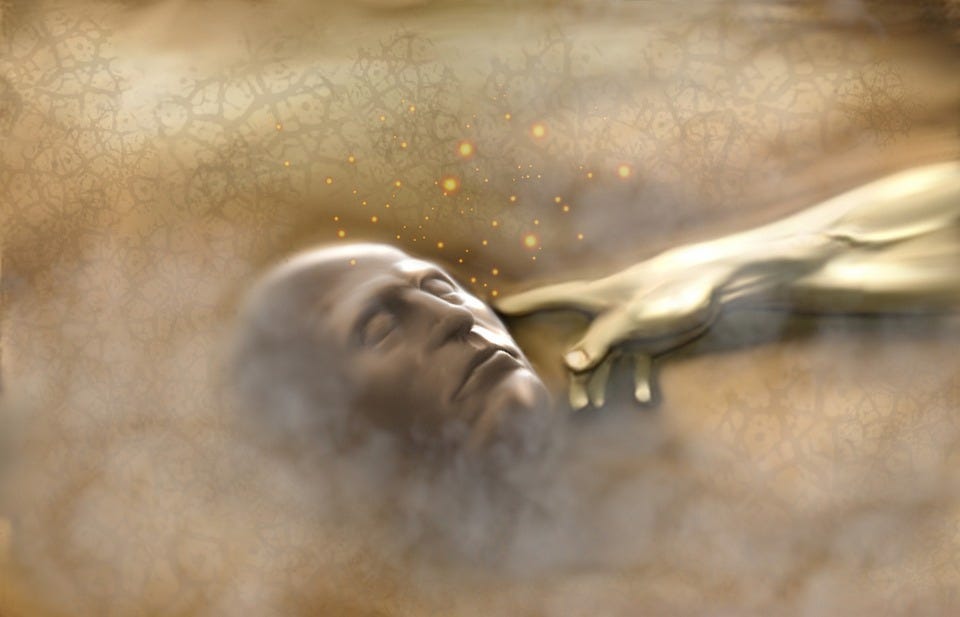
The imago Dei, or image of God, tells us that all people are created in God’s image (Genesis 1:25-27; 5:1-3; 9:6). But this is a deceptively simple statement. Saying that all people are created in God’s image does not mean we can each step in front of a mirror to see what God looks like. It does mean that there is something of the Divine in each of us such that every human life possesses an intrinsic value, dignity, and worth that has nothing to do with race, class, or socio-economic status.
Dr. King explained imago Dei this way:
“The whole concept of the imago Dei, as it is expressed in Latin, the ‘image of God,’ is the idea that all men have something within them that God injected. Not that they have substantial unity with God, but that every man [sic] has a capacity to have fellowship with God. And this gives him a uniqueness, it gives him worth, it gives him dignity. And we must never forget this as a nation: there are not gradations in the image of God… We will know one day that God made us to live together as brothers [sic] and to respect the dignity and worth of every man.”5
What this means, as Richard Wills points out, is that Dr. King’s understanding of personhood was, ultimately, “a theology of community, a community in which all persons were made in the image of God and, more important, all persons were created to be in relationship. In this regard, beloved community represented the logical progression of King’s [thinking]… King held to a belief in a single human family made in the image of God.”6
A theology of the person that is also a theology of community means that imago Dei is more than an epistemological framework for how we are to think about one another. Imago Dei is also an ethic and therein lies its fundamental importance to the creation of beloved community.
If all human life is sacred because all human beings are created both in the image of God and to be in relationship with God and one another, then all human beings are siblings in God’s family. And with that siblinghood comes the responsibility to ensure the welfare and flourishing of one and all.
This, in many ways, is the starting point of creating beloved community. If we see one another first and foremost as a beloved child of God, that dictates how we should (and should not) treat and talk to one another. It dictates that we no longer think in terms of me but of us. It dictates that we recognize an injustice done to one is an injustice done to all. It dictates that compassion, forgiveness, reconciliation, peace, and agape are a non-negotiable responsibility we all share.
And imago Dei also dictates that racism, sexism, misogyny, poverty, and abuse in all its forms are not only contrary to what God intends life to be (and, therefore, contrary to beloved community) but a failure to recognize the sanctity of every human life and a forfeit of our responsibility to ensure the welfare and flourishing of all people.
For all the strength of his conviction that human beings are created in the image of God, Dr. King’s view of human nature was not naive. There’s bad in the best of us and good in the worst of us. Each of us, neither wholly depraved nor wholly innocent, bears within ourselves a capacity for both. But Dr. King’s faith in the reality of the imago Dei led him to an equal faith in the human ability to choose good over evil and reconciliation over division. He was convinced it was possible for even broken human beings to have the courage to embrace the moral imperatives inherent in being created in the image of God.
As Wayne Wills writes of Dr. King’s faith in the imago Dei, “If, in fact, all men were created equal and were endowed with certain inalienable rights by their Creator, the realization of these rights, despite humanity’s propensity toward evil, remained a high probability.”7
The first two of the following books explore Dr. King’s intellectual and theological development. Ansbro is more comprehensive than Burrow but not as in-depth. Burrow, as the title of his book indicates, focuses more on Dr. King’s grounding in the philosophy of personalism, his theology, and the influence of both on his ethics. Burrow also includes a detailed discussion of Dr. King’s ethical lapses, in particular his sexism and, to a lesser degree, his extramarital affairs (a reminder that Dr. King, for all his extraordinary accomplishments, was still a broken human being). The Wills book focuses exclusively on how Dr. King’s thinking and actions were shaped by his understanding of the idea of the image of God. I particularly encourage you to read Burrow and, if you have a special interest in the imago Dei, Wills.
John J. Ansbro, Martin Luther King, Jr.: The Making of a Mind, Maryknoll, NY: Orbis Books, 1982
Rufus Burrow, God and Human Dignity: The Personalism, Theology, and Ethics of Martin Luther King, Jr., Notre Dame, IN: University of Notre Dame Press, 2006
Richard Wayne Wills Sr., Martin Luther King Jr. and the Image of God, New York: Oxford University Press, 2009
1Kenneth Smith and Ira Zepp, Search for the Beloved Community: The Thinking of Martin Luther King, Jr., King of Prussia, PA: Judson Press, 3rd ed., 1998, p.139
2Smith and Zepp, p.143
3Nobel Prize Acceptance Speech, A Testament of Hope: The Essential Writings and Speeches of Martin Luther King Jr., New York: HarperOne, 1986, p.226
4https://blog.nes.edu/mlk-reflection-the-beloved-community
5https://pollycastor.com/2018/01/15/excerpts-from-martin-luther-kings-american-dream-speech/
6Richard Wayne Wills Sr., Martin Luther King Jr. and the Image of God, New York: Oxford University Press, 2009, p.155
7Ibid., p.147
No posts
Comments
Nothing yet. Say the first thing.
Sign in to join the conversation.