
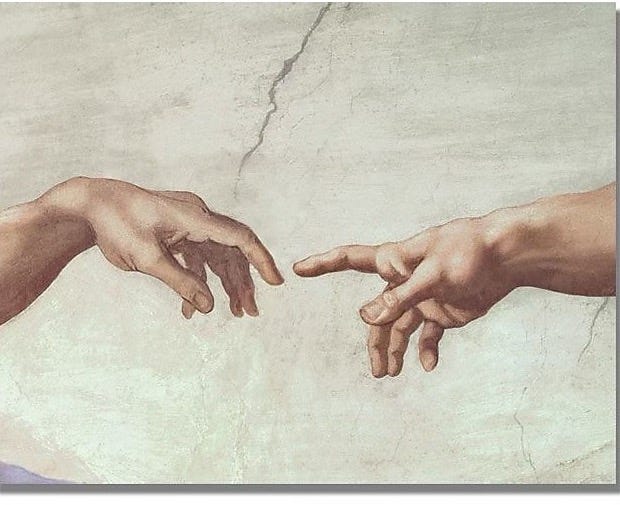
2 Peter 1:3-4 is one of the strangest passages in all of Scripture:
His [that is, God’s] divine power has given us everything needed for life and godliness, through the knowledge of him who called us by his own glory and goodness. Thus he has given us, through these things, his precious and very great promises, so that through them you may escape from the corruption that is in the world because of lust and may become participants in the divine nature.
Look again at those last seven words: may become participants in the divine nature.
What does Peter (or whomever authored the letter) mean?
What is meant is precisely what is said: God has given us everything we need to become participants in the divine nature.
The goal of human life is to become like God.
You read that right. It’s a process called deification (or theosis), and if it sounds to you like nonsense or an overly creative exegesis of a verse of Scripture or just outright blasphemy, take a deep breath and consider the following.
Jesus himself, in the Sermon on the Mount, tells us, “Be perfect, therefore, as your heavenly Father is perfect” (5:48). Or, in John 10:34, where Jesus quotes Psalm 82, “Is it not written in your Law, ‘I have said you are gods’?” Or the Incarnation: the Christ, fully human and fully divine, inviting us to dwell within him as he dwells within us (John 15:1 ff).
Evidence of deification is not limited to Jesus and the Gospels. Philippians 2:12-13, 1 John 3:2, Acts 17:28-29, Colossians 3:10, Ephesians 4:23-24, 5:1, and Romans 8:14-17, 29-32, to name but a few pertinent passages, all resonate with the idea that the goal of human life is to become participants in the divine nature.
John Wesley, founder of Methodism, embraced a kind of deification which he called “Christian perfection.” And John Calvin, theological godfather of the Reformed Tradition, said the end of the Gospel was to “deify us.”
C.S. Lewis, in Mere Christianity, puts it this way:
The command “Be ye perfect” is not idealistic gas. Nor is it a command to do the impossible. He [sic] is going to make us into creatures that can obey that command. He said (in the Bible) that we were “gods” [Psalm 82:6] and He is going to make good His words… He will make the feeblest and filthiest of us into a god or goddess, dazzling, radiant, immortal creatures, pulsating all through with such energy and joy and wisdom and love as we cannot now imagine, a bright stainless mirror which reflects back to Him perfectly (though, of course, on a smaller scale) His own boundless power and delight and goodness.
To really appreciate the profundity of deification, however, we need to turn to our fellow sojourners in the Eastern Orthodox tradition, where deification is understood overtly as the spiritual goal of the faith. There we find multiple voices from across thousands of years speaking of what deification is and is not.
Let’s begin with what deification is not.
Deification does not claim that we become God or are in any way divine—that would be blasphemy. There is no merging or co-mingling of our essence with God’s essence. We remain the created and God the Creator. Further, in saying we become like God, deification is not suggesting you or I can ever reach a point in our spiritual growth where we can create life (only God can do that) or save ourselves (only Jesus can do that) or bring life to what is otherwise lifeless (that work belongs to the Holy Spirit).
What, then—precisely—is deification?
Let the Orthodox Study Bible explain:
Deification means we are to become more like God through God’s grace… In creation, humans were made in the image and likeness of God (Genesis 1:26) according to human nature. In other words, humanity by nature is an icon or image of deity. The divine image is in all humanity. Through sin, however, this image and likeness of God was marred, and we fell.
When the son of God assumed our humanity [through the Incarnation] the process of our being renewed in God’s image and likeness was begun. Those who are joined to Christ through faith in Holy Baptism begin a process of re-creation, being renewed in God’s image and likeness. We become, as Peter writes, “partakers of the divine nature” (2 Peter 1:4).
Because of the Incarnation…being joined to Christ means that it is again possible to experience deification, the fulfillment of our human destiny. That is, through union with Christ…we become “children of God” (John 1:12).
Seventh century Orthodox monk and theologian St. Maximos the Confessor put it succinctly: deification is total participation in Jesus Christ. “All that God is,” Maximos wrote, “except for an identity in being, one becomes when one is deified by grace.”
Depending upon how conversant you are in church-speak or how much you’ve retained from Confirmation Class, some of what’s being expressed here may sound vaguely familiar. Isn’t deification, you may ask, rather like sanctification, the process of living into and from your redemption? In short, discipleship?
Yes and no.
To the extent that we understand our responsibility as Jesus-followers in terms of growing in our Christlike-ness then, yes, deification is similar to sanctification and discipleship. But deification, in effect, begins with much bigger expectations both of us and for us. Discipleship, as most of us have learned and practiced it, asks us to live and love like Jesus. Deification asks the same but also tells us that we can actually indwell Jesus as he indwells us such that we can become by grace what God is by nature (the classic way Orthodox Christianity defines the goal of deification).
In other words, deification understands discipleship in terms of the very essence of who and what we are as children of God.
And there’s something more.
Orthodox Christianity’s understanding of deification wants us to rethink the purpose of the Incarnation. Because everything comes from God, everything should be drawn back to God. God’s original intent for the Incarnation, the argument goes, was not redemption from our fall into sin. The original intent of the Incarnation was that we be adopted as children of God.
As third century Orthodox Patriarch St. Athanasius wrote, “God became man that man might become God.”
I urge you to resist the temptation to reject St. Athanasius’ words as outrageous. I urge you, instead, to live with them awhile. He’s not saying we’ll literally become divine. He’s saying something about what we each are actually created to be and our capacity, through Jesus and the Holy Spirit, to achieve it. And how different life would be, for each of us and for the world, if we did.
I want to acknowledge my indebtedness to the following sources in writing this post:
Robert Lewis Wilken, The Spirit of Early Christian Thought, Yale University Press, 2003
Mark Shuttlesworth, Theosis: Partaking of the Divine Nature, https://www.ssppdetroit.org/theosis
The Orthodox Study Bible, Thomas Nelson Publisher, 2008
No posts
Comments
Nothing yet. Say the first thing.
Sign in to join the conversation.