
I’ve been noticing lately, that there is a temptation whenever tragedy strikes to believe that the story begins with the headline. Have you noticed it?
A shooting at a public festival; a frantic 911 call, Another grieving family, another press conference.
With it comes another round of arguments that feel so painfully familiar we could almost recite them before they begin.
Within hours, sometimes within minutes, we settle into our predictable camps. Some want to debate gun laws. Others want to defend or condemn the police. Some insist that the real issue is mental health. Others point toward race, poverty, broken families, social media, gangs, failed schools, permissive parenting, political leadership, or the steady erosion of community.
Everyone has an explanation waiting. Everyone seems to know which part of the story deserves the greatest attention. Before we have taken time to absorb the facts, let alone the human suffering beneath them, the internet is flooded with commentary, video clips, memes, accusations, counteraccusations, and carefully selected fragments of evidence intended to advance one narrative or another.
I have participated in this ritual. I imagine many of us have. Spaces like this are built on it, social media thrives on it.
Before stimulus and response there is a space where we have the power to choose, grow and find freedom.
It has become one of the habitual ways we process (or perhaps avoid processing) the waves of grief that now pass through our collective consciousness with frightening regularity. When we are overwhelmed by something senseless, the mind searches for relief. We move the event into tidy categories. We are quick to identify the villain, defend the victim, select the political explanation, and tell ourselves that we now understand what happened.
These categories may contain important truths. They may even point toward real accountability, but they can also protect us from the more unsettling work of grief, reflection, and self-examination.
It get it. Yet, I find myself increasingly convinced that many of the questions we ask after public tragedy begin too late. They search for blame or accountability only at the final end of a much longer process. They concentrate on the last few seconds captured by a camera without asking what was unfolding during the months and years that preceded them.
Who pulled the trigger?
We ask whether the officer followed procedure.
Where did the gun come from?
We ask whether the victim complied.
All valid questions. Some of them will determine whether justice is done. But justice worthy of the name must ask more than what happened at the end.
What if our desire for justice, accountability, and meaningful change requires us to slow down long enough to question our assumptions rather than merely litigate the outcome?
There is a space between the tragedy that confronts us and the conclusion we rush to make about it.
Perhaps justice requires us to enter that space.
Perhaps moral courage begins by refusing to allow our first reaction to become our final understanding.
On Sunday, July 26, gunfire erupted during the Bite of Seattle festival at Seattle Center, a crowded public celebration near the Space Needle. Three people were killed and others were wounded, including a two-year-old child.
Police subsequently said that at least three shooters may have been involved. One alleged shooter, a 19-year-old, died at the scene. A 15-year-old was detained, and police said he possessed a privately manufactured ghost gun equipped with an extended magazine. At least one additional suspect remained unidentified as investigators attempted to reconstruct what happened in the chaos of a crowded summer evening.
Early reporting understandably described the event as a mass shooting. As police released more information, the public narrative began shifting toward the possibility that it was gang-related.
But we should pause over what happens inside us when that label appears.
The phrase “gang-related” may provide important investigative context, but it can also become a moral escape hatch. Once a tragedy can be placed inside a category associated with criminality, or young people we have already learned to distrust, public sympathy can begin to narrow. The event is no longer treated solely as a horrifying eruption of gun violence in a public gathering. It becomes something “those kinds of people do to one another.”
The designation may explain something about the shooting. It does not explain it away.
It does not make the bullets less real. It does not make the bystanders less innocent. It does not make a toddler’s injuries less horrifying. It does not make a 15-year-old carrying a ghost gun with an extended magazine any less of a profound social and moral emergency.
If anything, the age of the alleged shooter should force us to look more deeply.
A 15-year-old is old enough to cause enormous harm. A 15-year-old is also still a child being formed.
Both things can be true.
Accountability and social examination are not enemies. We can insist that young people be held responsible for acts of violence without pretending that they created themselves, armed themselves, formed their own moral imaginations, or constructed the conditions into which they were born. They did not. You and I did that.
Just days before the Seattle shooting, another tragedy involving a teenager unfolded in Austin, Texas.
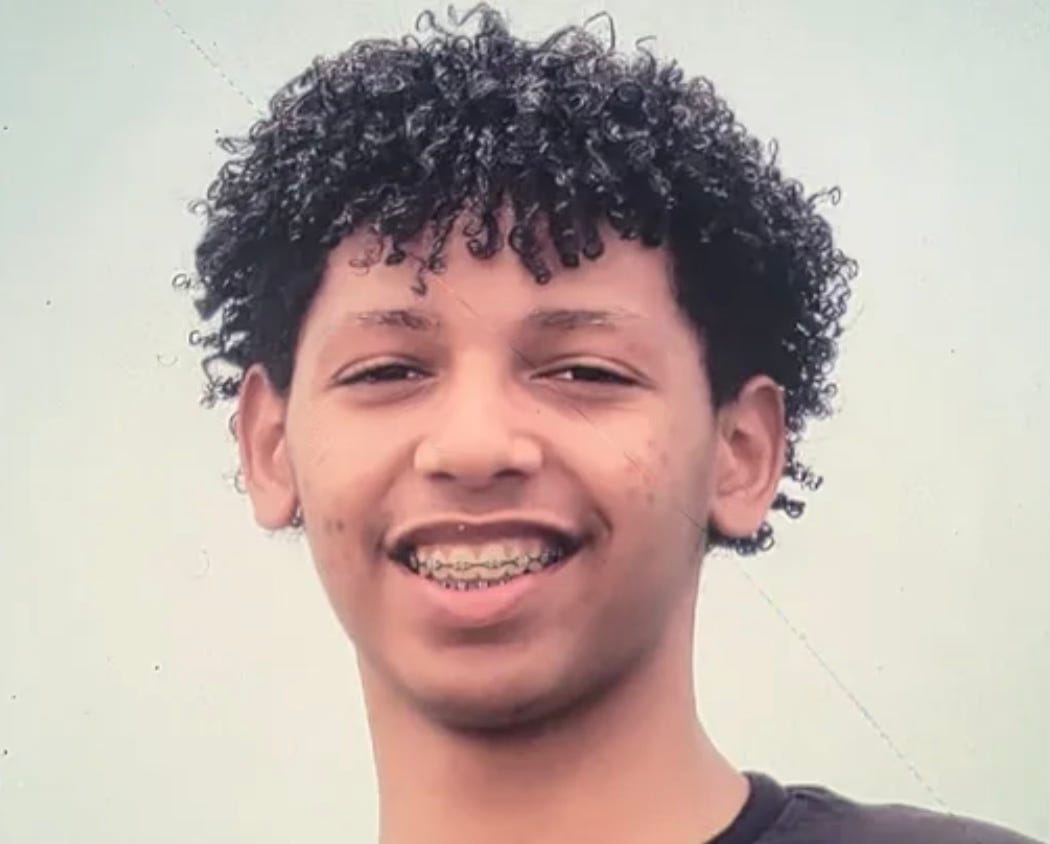
Seventeen-year-old Anthoneil Williams II called 911 from his own phone and reported an armed person near a park. When Austin police officers arrived, they believed they were confronting someone with a firearm. Three officers opened fire, after Anthoneil swiftly reached for an object in his waistband, when instructed to show his hands. The object in Anthoneil’s waistband was later identified as a water bottle.
Police have said they believe Anthoneil may have been attempting what is commonly called “suicide by police.” His family has been left to bury him while investigators, city leaders, police officials, and members of the public debate whether officers perceived the situation accurately, whether de-escalation was possible, whether every reasonable step was taken to preserve life, and whether the public-safety system responded to a child in crisis with the tools the moment required.
We should resist turning speculation about Anthoneil’s intentions into a verdict about the officers’ actions. Even if he wanted to die, that does not remove the responsibility to investigate how and why he died. A person’s suicidal crisis does not diminish the value of that person’s life. It increases our obligation to ask whether our systems are capable of recognizing desperation before responding with deadly force.
Likewise, demanding transparency does not require us to pretend that police officers never confront dangerous, confusing, and rapidly developing situations. Officers may genuinely fear for their lives and still be part of a system that needs deeper transformation. The individual intentions of the officers and the structural adequacy of the response are related questions, but they are not identical ones.
Anthoneil’s death should not be reduced either to a simple declaration that the officers “had no choice” or to a conclusion that every disputed fact has already been settled. The investigation, the body cam-footage, the officers’ sequence of actions, and the availability, or absence of de-escalation strategies and mental-health intervention all matter. But there is another question that matters as well.
What degree of despair must take root inside a 17-year-old before death begins to appear as the only remaining conversation he knows how to initiate? And what kind of society produces children who can initiate their own tragic end by calling police to the scene?
The Seattle and Austin cases are not the same. Their facts are very different. Their legal questions are different. Their circumstances are different. Yet beneath both stories lies a question that refuses to leave me:
What is happening to our children?
Not simply what happened on that day. What happened long before that day? Because yes, every tragedy has a final moment, but every tragedy also has a long beginning.
Long before the first shot is fired, something else has already been happening. Long before someone reaches into a waistband. Long before someone exchanges gunfire in a crowded public square. Long before a seventeen-year-old decides that calling 911 might somehow become the last conversation of his life.
These moments and headlines reveal real failures in our system and society - failures that have been building up for years.
Years of loneliness. Years of learning what it means to be a man.
Years of absorbing messages about strength, worth, success, fear, belonging, violence, and hope.
Years during which a human soul is quietly being shaped.
Our public conversations almost never linger there. We prefer the final chapter because it gives us someone to blame. “Cops should have done better.” “Victim should have kept his hands visible.” “The parents should have known.”
Some of these statements may be true. But quick answers often function as emotional anesthesia. They help us resolve our pain, reinforce our assumptions, and place the moral burden somewhere safely outside ourselves.
The long beginning is more demanding because it requires us to examine not only the people who were present at the final scene, but the society that formed everyone who entered it.
One of the great misunderstandings of our culture is the belief that violence begins when someone pulls a trigger.
Legally, the trigger may mark the beginning of a criminal act. Spiritually and socially, however, violence often begins much earlier.
Violence begins wherever human beings slowly lose the capacity to imagine another way of living.
It begins wherever despair becomes ordinary and belonging disappears. It begins wherever children learn that asking for help is an admission of weakness rather than an act of courage. It begins wherever masculinity becomes associated with domination, emotional concealment, retaliation, and the refusal to be vulnerable.
Violence begins wherever pain is real but there is no trusted language through which to express it, no safe relationship in which to reveal it, and no community prepared to carry it.
It begins wherever isolation becomes normal and algorithms become substitute parents. It begins wherever children are fed an endless stream of images teaching them that visibility is the same thing as worth, that attention is the same thing as significance, and that power is measured by one’s capacity to intimidate, humiliate, dominate, or destroy.
It begins wherever adults become so consumed by our own exhaustion, outrage, financial anxiety, political tribalism, and digital distraction that we fail to recognize what is quietly unfolding inside the young people we love.
It begins whenever our schools are asked to solve every social problem while being stripped of the relationships and resources required to do so. It begins whenever mental-health care exists in theory but remains inaccessible in practice. It begins whenever congregations preach salvation while failing to become places where a frightened teenager can tell the truth without shame. It begins whenever neighborhoods lose the web of adults, institutions, coaches, teachers, mentors, relatives, and elders who once helped notice when a child was beginning to disappear.
It begins whenever guns become easier for some young people to obtain than counseling, mentorship, meaningful work, credible hope, or a community in which they are known by name.
By the time a teenager carries a gun into a festival, or calls emergency services because death itself may have become part of the plan, the deepest tragedy may already have been unfolding for years.
The final act is sadly the moment the rest of us finally take notice. It’s like a wake up call to our collective humanity. Yet wake up calls don’t ask us to address the ending - they ask us to address the beginning. They ask us to get to the heart of the matter, deep, deep down at the very beginning.
It is there, deep within the long beginning, that we must ask what kind of world we are co-creating and passing on to our children.
As a parent of Black children, I wrestle with these questions every day because I do not encounter these stories only as public events. I encounter them as possibilities that live uncomfortably close to home.
I see young men whose lives ended before they had the opportunity to become the fullness of who they might have been. I see frightened parents trying to teach their children how to survive encounters that should never become life-or-death tests. I see young Black boys being required to understand the fears that adults may project onto their bodies before they are old enough to understand their own emerging identities.
I see stories that could, under different circumstances, have easily been about my boys.
That awareness carries its own kind of weight. It requires me to ask not only how I can protect my children from the dangers of the world (I cannot), but how I can help form them to live within that world without surrendering their tenderness, their dignity, their hope, or their capacity to love.
Yet these questions do not belong only to parents of Black children. They belong to all of us because no child is formed alone. Every child is growing inside a moral, social, economic, political, and spiritual environment that adults have helped create. All of us.
Every society teaches its children what kind of world they inhabit. Every culture answers fundamental questions for them before they are old enough to formulate those questions themselves.
Who belongs?
Who matters?
What makes a person valuable?
What makes a person disposable?
What does strength look like?
How does a “real man” respond to fear, rejection, grief, or humiliation?
Can weakness be admitted?
Is vulnerability safe?
Can the adults around me be trusted?
Is there a place for me in the future?
Children rarely learn the answers from sermons alone, whether those sermons come from a pulpit, a politician, a parent, or a motivational speaker.
They learn by watching us. All of us.
They learn from our schools and our social-media feeds, from our politics and our entertainment, from our neighborhoods, churches, locker rooms, police encounters, dinner tables, and family arguments.
They learn from what adults celebrate. They learn from what adults excuse. They learn from what adults fear. They learn from whom adults punish and whom adults protect. They learn from what we refuse to discuss.
They learn from the pain we hide, the prejudices we normalize, the weapons we glorify, the people we abandon, and the suffering we have trained ourselves not to see.
We often imagine consciousness as something private and invisible, hidden inside the individual. But consciousness is also the atmosphere a society breathes together.
Our children breathe whatever atmosphere we create.
When enough of our young people are inhaling loneliness, despair, contempt, anxiety, emotional repression, and the constant threat of violence, we should not be surprised when some of them begin struggling to breathe themselves.
The Hebrew prophets understood something that America has worked very hard to forget.
When ancient Israel experienced moral collapse, the prophets did not limit themselves to condemning the obvious wrongdoer standing at the final scene. They examined the nation itself.
They examined its economy, its leadership, its worship, its courts, its treatment of the poor, and its public imagination. They confronted its willingness to confuse power with righteousness. They exposed its habit of sacrificing vulnerable people while congratulating itself on its religious devotion.
The prophets understood that injustice is never merely personal. It becomes embedded within cultures and institutions, within habits and assumptions, within laws and economies, within the stories a nation tells about itself.
The prophetic question was not simply, “Who committed this particular offense?”
It was also, “What kind of people have we become?”
What have we normalized?
Whose suffering have we learned to tolerate?
Whose children are we willing to lose?
What does our treatment of the vulnerable reveal about the gods we actually worship?
That is why Jesus placed children at the center of the Kingdom of God. He was not engaging in sentimental nostalgia about childhood innocence. He was revealing the moral architecture of the divine commonwealth.
The reign of God is measured from the margins inward. Its truth is revealed in what becomes possible for those with the least social power. Its integrity is demonstrated by whether children are welcomed, protected, nourished, taught, healed, and given a future.
In other words, the measure of a civilization is not merely the wealth it accumulates, the weapons it possesses, the elections it conducts, or the religious language it invokes. Its deepest character is revealed in what becomes possible for its children.
A society that cannot imagine a future for its young has already begun losing its own soul.
James Baldwin once observed that “children have never been very good at listening to their elders, but they have never failed to imitate them.”
Those words should haunt us. Our children are not simply inheriting our economy. They are inheriting our emotional life. They are inheriting our unresolved trauma; our fears, our divisions, our addictions, our loneliness.
Our children have are inheriting our inability to disagree without hatred; our constant digital stimulation, our exhaustion, our despair.
Then we act surprised when some of them begin believing that violence, whether directed toward others or toward themselves, is somehow the only remaining language capable of expressing what words no longer can.
Perhaps they are speaking a language they first heard from us.
The deepest crisis facing America is not simply that teenagers have access to guns, although the ease with which young people can obtain lethal weapons is unquestionably a moral and public-policy emergency.
Nor is the crisis simply that police officers continue to confront volatile situations in which fear, incomplete information, mental illness, racial perception, tactical training, and deadly force converge within seconds.
Those are real and urgent concerns. We should not minimize them in the name of some vague appeal to unity or spiritual transcendence.
But none of these issues exists in isolation, and none can be addressed adequately if we refuse to ask the deeper question beneath them:
What kind of society keeps producing children who struggle to imagine growing old?
What kind of nation has become so accustomed to young people killing and being killed that we experience these stories less as moral emergencies and more as recurring episodes in an endless national routine?
We grieve.
We argue.
We post.
We litigate.
We investigate.
We issue statements.
We defend our side.
We condemn the other side.
Then we wait for the next headline.
Meanwhile, somewhere beyond the reach of our attention, another child may already be living through the long beginning of another tragedy.
I no longer believe our greatest challenge is simply deciding who deserves blame after another young life has been lost. That debate will rage on without any shortage of participants, and valid points will undoubtedly be made on all sides.
But I fear that very little moral ground will be gained if the debate becomes only another arena in which adults perform their certainty while children continue to die.
That, too, is an injustice.
Accountability remains necessary, but accountability must become larger than blame.
Accountability asks what an officer did during the final seconds, but it also asks what training, policies, information, and alternatives shaped that officer’s response.
Accountability asks why a teenager carried a gun, but it also asks how that gun reached his hand, what world formed his imagination, and which institutions failed to interrupt his path toward violence.
Accountability asks what parents knew, but it also asks what burdens families have been expected to carry without adequate resources, support, safety, health care, or community.
Accountability asks who broke the law, but prophetic accountability also asks what kind of culture keeps reproducing the conditions under which these tragedies become predictable.
Our greatest challenge is recovering the courage to ask what kind of people we are becoming while these stories continue unfolding around us.
That question cannot be answered merely by electing different leaders, passing different laws, reforming police departments, expanding mental-health care, restricting firearms, strengthening schools, or funding community programs, although every one of those efforts may be necessary.
The deeper question demands a transformation of our understanding of responsibility.
It demands that we recover our responsibility to and for one another.
It demands that we reject the fiction that any child belongs only to one household, one neighborhood, one race, one school district, or one social category. It demands that we understand every young life as part of the moral community we share.
It demands that we become communities in which children experience genuine belonging before despair becomes their closest companion.
It demands that we form boys who understand that tenderness is not weakness, vulnerability is not failure, asking for help is not humiliation, and violence is not the only path toward power.
It demands that we build schools, neighborhoods, congregations, families, and civic institutions capable of teaching young people that their lives possess infinite worth before they are forced to search for that truth in the shadow of unimaginable loss.
It demands that we build systems capable of responding to a child’s crisis as a plea for preservation rather than merely a threat requiring elimination.
The prophets understood that judgment is not God’s desire for humanity. Judgment is what unfolds when a people refuse to examine the path they are walking and continue calling destruction normal.
Biblical judgment is not merely divine punishment descending from somewhere beyond history. It is also the consequence of breaking covenant with one another. It is what happens when a society repeatedly abandons the vulnerable, worships power, mistakes wealth for blessing, and refuses to hear the cries coming from the edges of its own community.
Perhaps that is where we find ourselves today. Not standing at the end of the story, but somewhere within its long beginning.
We still have choices to make. There are children alive tonight who need adults to notice them. There are boys carrying grief they have never been taught to name.
There are families trying to hold together what economic insecurity, violence, addiction, racism, and isolation keep pulling apart.
There are teachers, counselors, coaches, mentors, youth workers, ministers, therapists, organizers, police officers, and neighbors trying to interrupt despair before it becomes tragedy.
There are congregations with empty pews that could become sanctuaries of belonging.
There are communities that could decide that the life of every child is a shared sacred responsibility.
There is still time to intervene in stories whose endings have not yet been written.
But doing so will require more than outrage after the next tragedy. It will require sustained attention before the tragedy comes. It will require resources, relationships, accountability, and imagination.
The question before us is whether we possess the wisdom and courage to write a different ending for the children who are still watching us.
“For nothing is fixed, forever and forever, it is not fixed; the earth is always shifting, the light is always changing, the sea does not cease to grind down rock. Generations do not cease to be born, and we are responsible to them because we are the only witnesses they have. The sea rises, the light fails, lovers cling to each other and children cling to us. The moment we cease to hold each other, the moment we break faith with one another, the sea engulfs us and the light goes out.”
- James Baldwin, The Fire Next Time.
When tragedy strikes, where do I instinctively place blame, and what might that reaction keep me from seeing?
What are the “long beginnings” behind violence in my own community—loneliness, despair, untreated trauma, easy access to weapons, racial fear, fractured families, or the absence of belonging?
What policies and systems deserve reform, and what deeper cultural habits must change alongside them?
What is one concrete act of presence, advocacy, mentoring, generosity, or community-building I can undertake now?
Text within this block will maintain its original spacing when published
There is One Life.
One Infinite Presence expressing itself through every child, every family, every community, and every soul that walks this earth.
That Life is whole.
That Life is sacred.
That Life has never created anyone disposable.
I rest for a moment in that awareness, allowing it to quiet my outrage without diminishing my resolve, to soften my grief without asking me to turn away from it, and to remind me that beneath every headline is a life that has always belonged to God.
Today I hold in prayer every child whose name the world knows, and the countless others whose stories will never appear in the news.
I embrace the children who are frightened, angry, isolated, misunderstood, overwhelmed, and carrying burdens no child was ever meant to carry.
I affirm that no wound, no despair, no act of violence, and no system of injustice has the authority to erase their inherent dignity or their infinite worth.
I know that Divine Love is not an abstraction floating above history.
It is a living Presence seeking expression through human hearts, courageous communities, just institutions, compassionate policies, wise leadership, and ordinary people who refuse to look away.
May that Love find willing expression through me.
Where our culture has normalized isolation, may I become an instrument of belonging.
Where fear has distorted our vision, may I become a presence of clarity.
Where anger has replaced understanding, may I practice courageous compassion.
Where children have learned that violence is the language of power, may my life proclaim that love is stronger than fear, that dignity is stronger than domination, and that community is stronger than despair.
I affirm that we are not powerless before the future.
The consciousness we cultivate today becomes the world our children inherit tomorrow.
Therefore, I choose to participate in the creation of a society where every child knows they belong, where asking for help is honored as courage, where tenderness is recognized as strength, where justice protects the vulnerable, and where every human being is treated as an irreplaceable expression of the One Life.
May our grief awaken us rather than harden us.
May our prayers become practices.
May our compassion become public.
May our spirituality become justice made visible.
May we remember that every child is our child.
Every neighborhood is our neighborhood.
Every act of healing strengthens the whole.
And every act of love participates in the ongoing creation of a world that truly works for all.
Knowing that the Divine Life within us is greater than the fear around us, I release this prayer into the Creative Law that forever responds to the consciousness we embody.
And so may we become the answer to the very prayer we are praying.
And so it is. Amen.
Rev. Dr. David Alexander D.D., is a public theologian and spiritual writer exploring the intersection of spirituality, justice, and moral imagination in public life. Bringing 20 plus years of pulpit ministry with Centers for Spiritual Living, into everyday life and the call for a better world. He is the author of Freedom from Discord: The Promise of New Thought Liberation Theology and the visionary behind Recovery from the Lie of Whiteness. David also writes the monthly column Philosophy in Action for Science of Mind magazine. Visit www.revdavidalexander.com to learn more.
Thanks for reading The Liberation Lens! This post is public so feel free to share it.
This is my full time work and primary source of income. Thank you for sharing your good with me. Together, we can demonstrate that abundance is the nature of reality.
Comments
Nothing yet. Say the first thing.
Sign in to join the conversation.