

A Tuesday sales team huddle.
Our partner success manager mentions, halfway through, how her 8am works now. Claude builds the priority list before she sits down. The outreach emails sit underneath it, drafted, waiting on her to look at them. She isn’t presenting this to me. She’s referencing it, the way you reference something that’s been true long enough to be boring.
I didn’t build that. I didn’t ask for it. I didn’t have to roll it out.
Same week, our ops lead finished an onboarding program she’d assembled out of years of Google Drive documents nobody had opened since we wrote them. It’s better than anything we’d have paid a consultant to build. Also not assigned. Also not mentioned to me until it was done.
For about a year I’d been the visible one. The power user. Demoing in one-on-ones, running show-and-tell, being deliberately, performatively useful with these tools because that’s what a founder (or executive) is supposed to do.
And the two best pieces of AI work at my company that week had nothing to do with me or any other leader in the business. It was grass roots.
Let me defend the thing I’m about to complicate, because I still believe it.
Mandates don’t work. They never did.
It’s clear as day and anyone can now cite at leas two dozens surveys that depict the cruel reality of where AI and business intersect today. Money is pouring into AI. Tech, consultants, pilots, strategies. The results have been mediocre, at best.
I’ve written about the second sale, the one you make to the operator rather than the executive, and nothing since has changed my mind.
Nobody at Deeded (my company) was ever told to use AI. It spread because people saw results in a context they recognized and wanted in before anyone asked them to.
Ethan Mollick makes the leadership case better than I can.
Workers need “clear and vivid images of what the future actually looks like,” he writes, and “urgency alone isn’t enough.”
He puts modeling AI use in meetings on the short list of things leaders actually have to do. He’s right about that.
There’s a reason the leader has to be the one who goes first, and it isn’t inspiration. Using AI in front of your colleagues is a status risk before it’s a productivity gain. You might look lazy. You might look replaceable. You might look like you needed help with something you’re supposed to be the expert on. The founder is the only person in the building who can absorb that risk for free.
So I went first. For a year. It worked.
That isn’t the problem.
Damon Centola spent his career on a distinction most of us never learn, and it’s the one that explains what happened to me.
Information is a simple contagion. One exposure is enough. You heard about ChatGPT from a single person and that was sufficient, because knowing a thing costs you nothing.
Behavior is different. Behavior is a complex contagion, which means it needs multiple independent sources reinforcing each other before anyone moves. It’s a flywheel, not a singular action.
“Contact with a single adopter is usually not enough to convince us of any of these behaviors,” Centola writes. Not insufficient because the adopter wasn’t persuasive. Insufficient because one is the wrong number.
Run that against a leader who’s doing everything right.
You are one source. That’s the whole arithmetic.
Seniority doesn’t change the count.
Frequency doesn’t change the count.
You can be the most compelling single adopter your company will ever have, demoing three times a week with genuine enthusiasm and real results, and you are still, structurally, one.
Which means leader-modeling does exactly one thing reliably: it creates awareness. That’s what a spark is.
A spark is awareness. Awareness is not adoption.
The plateau that follows isn’t a motivation failure. It isn’t a training failure. It isn’t a sign you need better prompts, a better vendor, or a louder internal campaign.
Here’s the cruel part. From inside the plateau, everything looks fine.
You see your own usage, which is heavy. You see the demos people bring you, which are real. You see enthusiasm in the room, which is genuine. Every instrument available to a leader is pointed at the one node. For a minute, it looks like that’s definitely working.
The data on what’s happening on the other side of that is not subtle.
WalkMe surveyed 3,750 executives and employees across 14 countries this April and found that roughly 8 in 10 enterprise workers are avoiding or actively rejecting the AI tools their employer gave them. More than half did the work manually in the past 30 days instead. A third haven’t touched it at all.
But as they say… “wait, there’s more”, and this one really struck me.
61% of executives say they trust AI for complex decisions. 9% of workers say the same. That’s a 52-point spread between the people buying the tools and the people expected to use them. WalkMe’s CEO put the outcome plainly: fewer than 10% of employees are using AI for meaningful work, against digital transformation budgets averaging $54.2 million a year.
And then there’s Mollick’s number, which I find the most unsettling. More than 40% of workers admit to using AI at work. Official adoption inside companies tends to cap out around 20%. He calls them Secret Cyborgs. The usage exists. It just isn’t pointed at you.
Read those two facts together and the founder’s problem gets worse, not better. A dashboard cannot distinguish between a team that hasn’t adopted and a team that has adopted privately. Both look like silence. One of them is a rollout that failed and one of them is a rollout that succeeded somewhere you can’t see, and you are making decisions as though you can tell which is which.
Every executive inside that 52-point gap had someone modeling enthusiastically at the front of the room.
I recorded, The Signal, my new podcast, with my friend, Chris, he’s a founder about seven months into rebuilding his company around this stuff.
He didn’t hand licenses to everyone on day one.
Management first, nobody else. Then he ran show-and-tells on the weekly management call, rotating, so each leader demonstrated something they’d built themselves rather than watching him demonstrate something he’d built.
Look at what that manufactures. Four or five people, adopting independently, visible to each other. That’s Centola’s condition, built by hand in a recurring meeting. Not one source. Several, reinforcing.
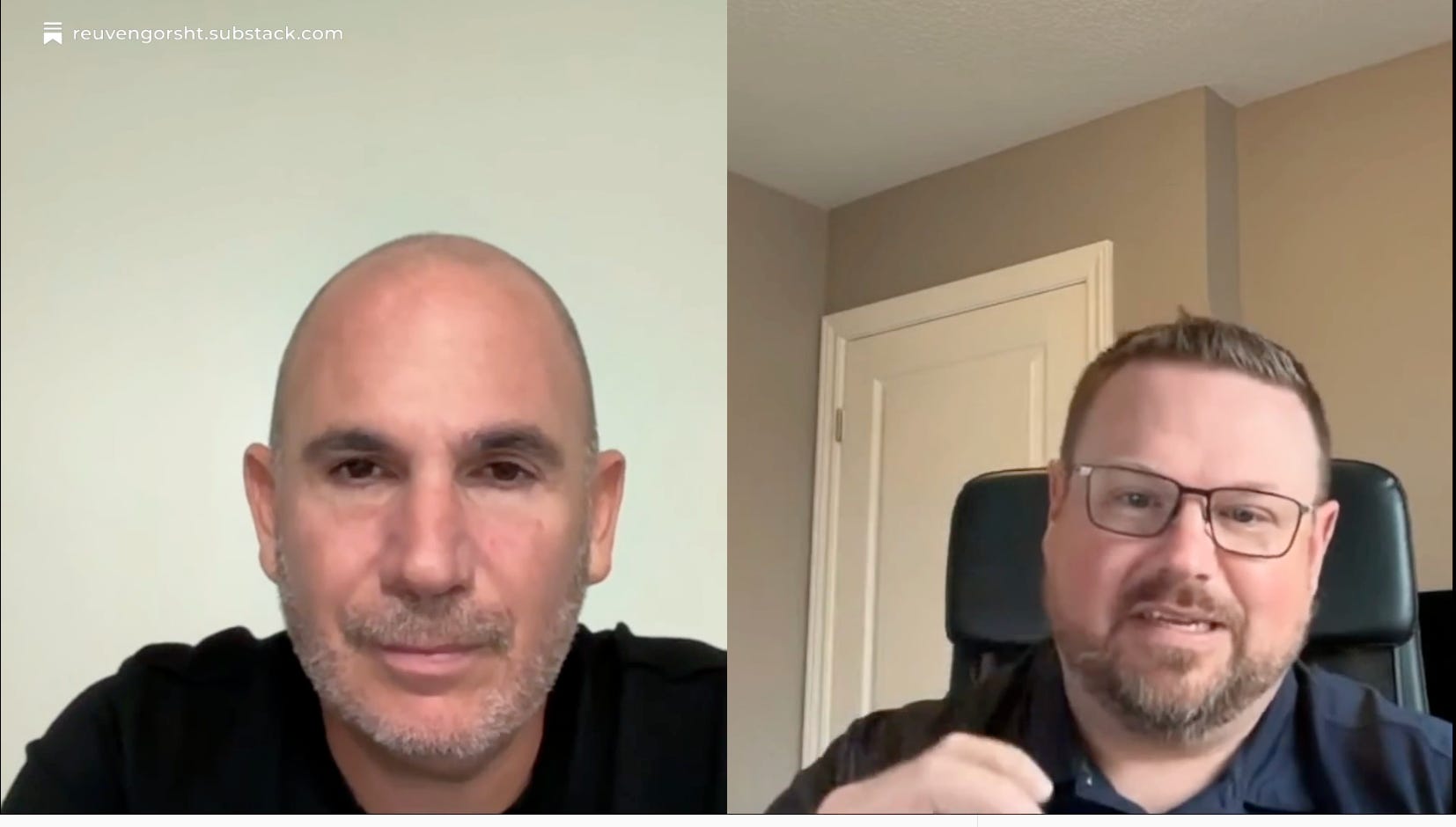
After two cycles, he stopped facilitating. Didn’t announce it, didn’t formally hand it off, didn’t build a program around it.
He just stopped showing up as the person running the thing. It kept going anyway, powered by nothing more sophisticated than leaders not wanting to be the one with nothing to show.
His calendar was wall-to-wall in January. By this summer he was down to about five meetings a week, all under an hour. He describes the compounding as visible around month three and transformative by month six.
The stopping is the part that matters, and it took me a while to see why. While he ran the demos, the demos were pointed at him. Every leader in that room was performing for the founder. That’s a single-source structure wearing a multi-source costume, and it would have stayed that way indefinitely if he’d kept hosting.
His withdrawal is what turned the room sideways.
I can hear the objection, this makes no sense. I remember my old boss’s saying “inspect what you expect”. How the heck does this make sense?
Everything we know about organizational change says the opposite of this. Transformations die when leadership attention wanders. Every company I’ve worked in is littered with half-finished initiatives that had a champion until the champion got interested in something else.
Telling founders to back off sounds like handing out permission slips to lose interest.
The distinction the whole argument rests on is this:
Withdrawing from facilitation is not withdrawing sponsorship.
Stop running the demos. Keep the budget. Keep the air cover. Keep using the tools yourself, in full view, at the same intensity. What you’re removing is your role as the audience. You are not removing your role as the sponsor, and if you remove that one instead you’ve just proven the objection right.
You don’t.
There’s no dashboard for this. Every number a founder can see, seats and logins and demos brought to you and the energy in the room, measures the structure you’re trying to replace. The instruments all point back at you. That’s exactly what makes them useless for the only decision that matters.
The single real signal is negative, and it arrives late. Work you didn’t know about. A queue that was already running. A project that shows up finished. You never get to watch the handoff happen. You find evidence, afterward, that it already did.
Chris found his line by accident, two cycles into a meeting he’d stopped needing to run. I found mine in a one-on-one about something else entirely, when somebody mentioned a Tuesday morning routine in passing.
Neither of us engineered it. Anyone selling you a framework for this is selling you a framework for something they stumbled into too.
So: start a spark. Start a little fire. Then leave them alone.
That last instruction is the hardest one a leader ever gets, and not because it’s complicated. Because from the inside it feels exactly like not caring. Everything about this job trains you to read your own absence as neglect, and there’s a stretch of weeks where you honestly cannot tell which one you’re doing.
You have to be visible enough to start it and absent enough to let it compound. Nobody tells you when you’ve crossed from one to the other.
You find out the way I did. In a Tuesday meeting, about something else (which is awesome!)
Comments
Nothing yet. Say the first thing.
Sign in to join the conversation.