
Today’s article is by the amazing Jill and was first published in her Substack publication, The Liberal Jew.
Wednesday stories (8 pm UK time) are by Sally Prag. Sunday stories (at the same time) feature the work of a range of writers. With the gradual evolution of the JPF, I am keeping all regular posts free but will be introducing a new column for paying subscribers called Book Talk — all about books relevant to Jewish life and literature. Watch this space! For now, if you would like to support me with a one-time donation, click here.
SUBSCRIBE TODAY! The JPF isn’t here for polite debates or academic footnotes — we’re dismantling antisemitism one idiot, one coward, one apologist at a time.
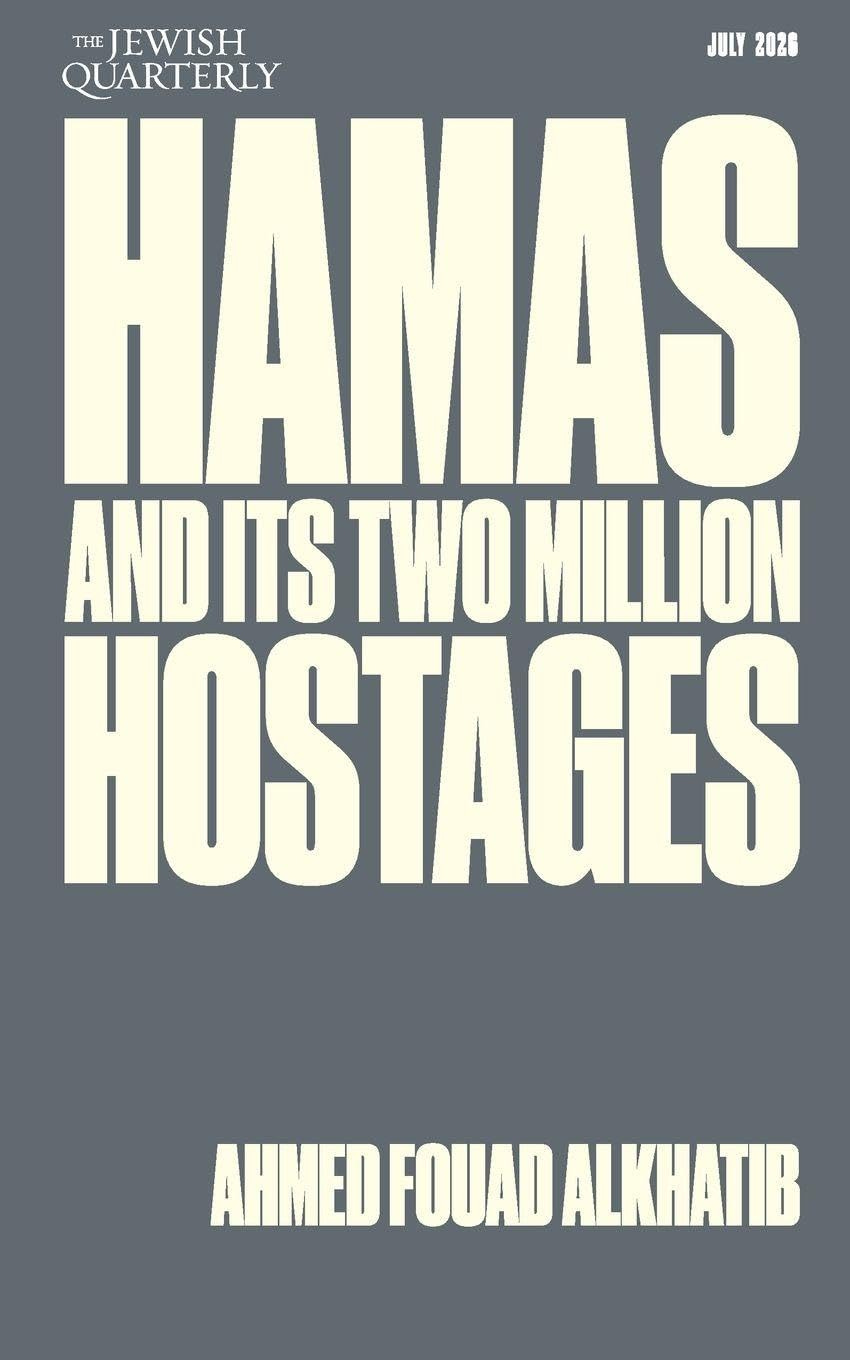
For years, Gaza and its Jewish neighbor have served as possibly the most talked-about territory in the world. We consume most of the content about it from our screens in the safety and comfort of the West, from English-language channels. Much of the time, those who speak of it here do so not out of profound understanding or a desire to seek truth, but rather to moralize. These so-called activists and political commentators talk over Gazan voices, not for them. A real understanding of Gaza among a western audience requires the perspectives of knowledgeable observers, preferably those who are actually Gazan.
Ahmed Fouad Alkhatib is one such voice. After growing up in Gaza, he came to the U.S. as a teenager in 2005 to attend high school through a cross-cultural exchange program. Shortly after he arrived to the U.S., Hamas got elected to run Gaza after Israel’s full withdrawal of its settlements. Ahmed was granted asylum in 2007—the first Palestinian to be granted such relief a result of Hamas’s takeover of the territory—and became a naturalized U.S. citizen in 2017. He has not touched ground in his homeland since Hamas took over.
Despite thinking about this conflict pretty much constantly for years, a deep understanding of Gaza and its people always eluded me. The place to me seemed almost mythical. Each time I would visit the beaches of Tel Aviv to take in the warm Mediterranean breeze, I would think to myself, “Gaza is right down the road.” It’s literally on the same coastline, but separated in a way that felt impossible and out of reach. While I have a reasonable grasp of Israeli history, I never really understood Gaza outside of the context of conflict with Israel.
Even just the term “hostage” became a lightening rod during the war. On October 7th, Hamas massacred Israel within its internationally recognized borders and took 251 hostages. In doing so, they exposed their civilian population to the aggression of the worst Israeli government ever. The title of this work challenges the “us vs. them” narrative with the term itself, suggesting that the terror group’s most numerous hostages are actually their own people—two million of whom who were denied an exit during the worst catastrophe in Palestinian history.
Throughout the last few years especially, Ahmed has served as a steady voice above the activist noise that mistakes itself as “pro-Palestinian” but is actually just anti-Israel and anti-western. He has stern words for those who belong to this movement, describing their actions post-October 7th as “a form of mass psychosis”:
I was furious that a once-in-a-generation opportunity to drum up support for the Palestinian people was squandered on sloganeering and hollow activism. I heard nothing constructive, no desire or attempt to produce pragmatic policies and results for the Palestinian people. Instead of doubling down on the two-state solution and acknowledging that the Palestinian people do not want the annihilation of Israel, but rather seek dignity, freedom and independence, activists in the Western world became drunk on the worst possible combination of extremism, oversimplification and maximalism. This toxic mix has been harmful to the lives and liberty of Palestinians and to the cause of the Palestinian people.
When I spoke out against these trends, I was attacked viciously. I realized that many in the so-called pro-Palestine movement are deeply anti-Palestinian, for they are only interested in platforming and embracing views and experiences that conform to their beliefs. That a Gazan like myself – who lost family members in the war, who is largely deaf in his left ear following an Israeli bombing in 2001 and who has been on the front lines of providing humanitarian support for Palestinians in Gaza – could be dismissed for sharing the “wrong views” was an alarming sign of the degradation of this Western-based activism.
I want to acknowledge a similarity between Ahmed and me: we are both millennials who regard the 90s as our most prosperous and hopeful decade. From the safety of my American upbringing, those positive feelings largely refer to Nintendo 64, Nickelodeon, and shopping malls. For Ahmed, it refers to the Oslo Accords era that I was too young to understand at the time it occurred. That time represented the closest possibility of a functional Palestinian state, complete with a Gaza international airport serviced by Palestinian Airlines, passports that allowed easy passage to and from the Strip, and better job opportunities for the general Gazan population.
The book details the circumstances that led to Hamas’s rise to power, which in effect destroyed any hope of the blossoming, functional society that many envisioned during those hopeful Oslo years. One of the common refrains that we often hear is that Hamas represents the will of their people because they were elected to power in 2005 (it was Gaza’s most recent election). The truth, however, is a bit more complicated. Hamas’s takeover, after what was most certainly a questionable electoral process, represented a power struggle between them and other Palestinian groups (Fatah, the PLO, and the PA). What happened next was hardly a peaceful transfer of power.
Analysis of international NGOs skews more towards valid criticism. After crediting these organizations for providing crucial resources to the Gazan population, he points out that their presence actually had the effect of empowering Hamas. No matter how many acts of terror Hamas committed, NGO money flowed in constantly to provide basic services that Hamas wouldn’t. To be fair, this is a more general problem with international humanitarian organizations working in countries with oppressive governments — Gaza is simply one major illustration of it.
But Gaza is unique in the extent to which its leaders use international organizations like the UN to play into a frankly brilliant PR campaign (fueled largely by Al Jazeera) to reach audiences all over the world. How do you think the ‘Gaza Health Ministry’ suddenly became a trusted authority to our nation’s elite journalists? As long as Hamas could keep that machine going—the NGOs, the donors, the PR—they could claim “resistance” while simultaneously failing to govern. It didn’t matter how many electricity outages, fuel shortages, or general misery they caused for their own.
Keeping the focus on outrage towards Israel enables Hamas to continue their thuggery unabated. The sad reality today is that the more brutality and chaos Hamas brings, the more outside money flows in to fund it. Terrorism has become far more lucrative than peace.
To address a very obvious elephant in the room: I asked Ahmed directly why he chose to publish his book with a Jewish publisher and not a Muslim or otherwise non-Jewish one. I’m just going to allow his own words on that to speak for themselves:
The Jewish Quarterly offered, and their model for publication is ideal, whereby they do short books or long form essays. That was quite a perfect fit for what I was looking for. There is a serious problem within the Muslim community when it comes to Hamas and the “pro-Palestine” sentiments and there aren’t a whole host of available options either. Still, I also do deliberately want to reach Jewish audiences that are otherwise unreachable by the pro-Palestine advocacy movements, even though large elements of my message are directed at pro-Palestine folks.
It’s safe to assume that the majority of the readers of this text will be the pro-Israel types who already regard Ahmed as a sort of unicorn. I don’t know to what extent Ahmed’s views are shared by ordinary Gazans who currently live in the Strip. What I do know, however, is that this compelling text is an earnest attempt by a native Palestinian to educate as a representative of a community that has been talked about endlessly yet understood poorly. He is what “pro-Palestinian” should mean, in a way that our current discourse does not allow.
Thanks for reading!
And thank you to Jill for sharing her work so generously. If you don’t already, please go and subscribe to The Liberal Jew where you’ll find some great analysis of many of the issues facing Jews predominantly in the diaspora.
Comments
Nothing yet. Say the first thing.
Sign in to join the conversation.