
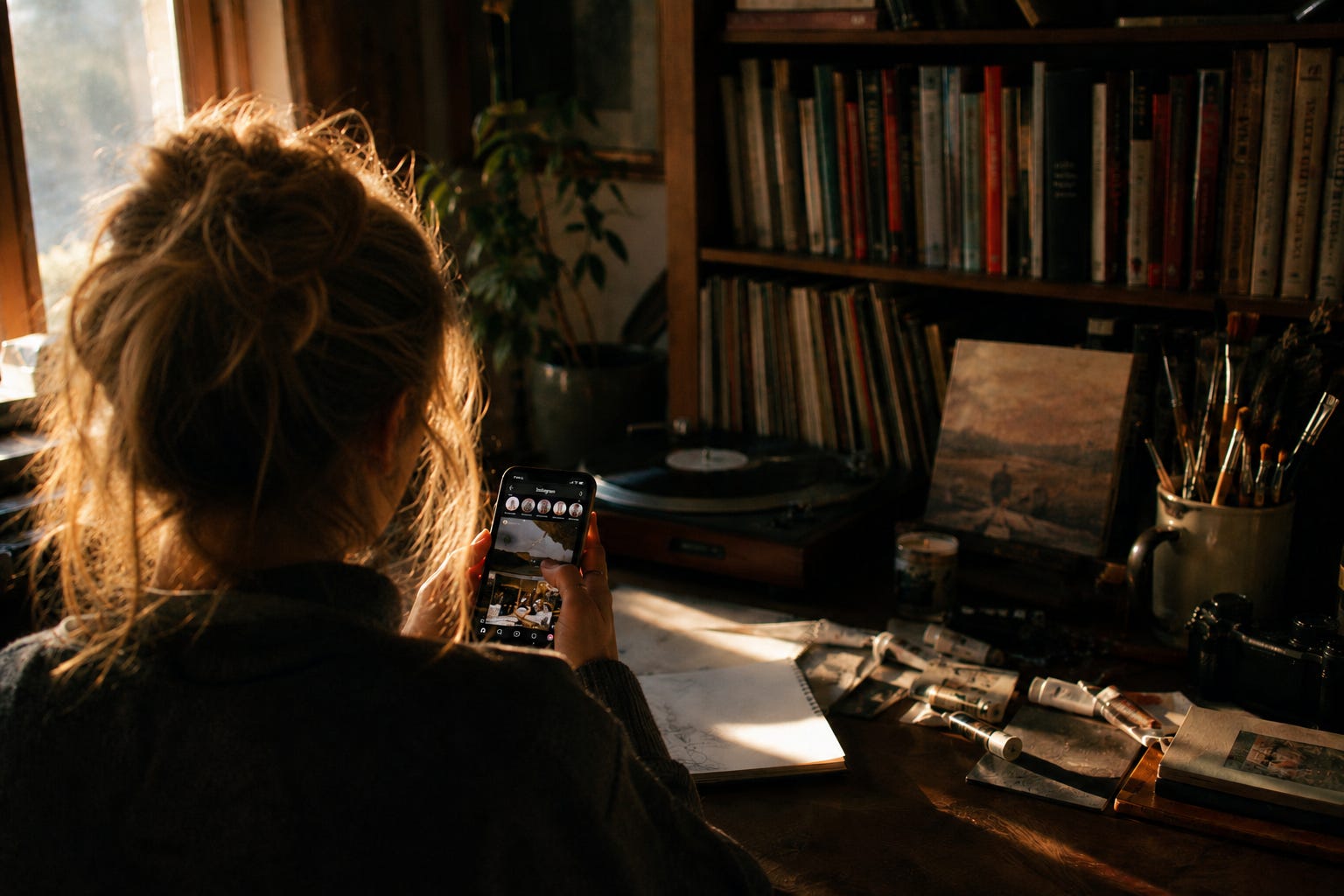
I deleted social media for good almost a year ago. And the thing that shocked me wasn't how much better I felt — it was realizing that what I'd been doing to myself was worse than gambling.
With gambling, you put money on the table. You win or you lose. And as addictive as gambling is, money is still something you can replace (or get more of).
But time is not.
I got on Facebook when it first came out over 20 years ago, back when only college students were allowed to use it. At the time, it was genuinely so fun. You’d write on your friends’ “walls” which was basically just a public discussion forum where you could also post pictures and videos.
It felt innocent. Little did I know (did any of us really know?) that it would seed something sinister into the cultural fabric of our society.
Looking back, that was when the temperature of our cultural pot was pretty tepid. It felt like refreshment at first, jumping into a shaded river on a hot Tennessee summer’s day. Only to realize that the temperature had been slowly creeping up the whole time, cooking us to death like the boiling frog.
After Facebook, I eventually got on to Instagram, and for me that platform became the biggest time suck.
I’d reach for my phone to open Instagram, you know, just to see what people were up to, just for a few minutes. And thirty minutes would disappear. Sometimes an hour. Sometimes more.
And then came the shame spiral: the frustration at myself for not doing the things I said I wanted to do and the awareness of all the time I’d just handed over to a feed that gave me nothing back.
I’d save all these Reels and posts, telling myself I’d come back to them for inspiration. That I was researching. That this was useful.
The truth is that I never actually created anything from it. At least nothing that made a difference for me or anyone else. I was just another passive consumer numbing herself into oblivion and calling it inspiration for whenever I do feel like posting something. Yeah right. That part, the passive consumption disguised as research, was incredibly addictive.
So I would delete the app. Off I’d be for four to six months and feel genuinely free.
And then one day I’d think: It’s been a while. I think I’m good. I’ll just hop back on real quick and see if I have any messages.
And every single time, I got sucked right back into that dopamine loop — that same slot machine mechanism, that curiosity gap of what’s going to show up next. I was gambling my attention away, convinced I was going to get some kind of return, but instead I was losing the one thing I’ll never get back: time.
The University of Michigan’s Institute for Healthcare Policy and Innovation has documented exactly what I was experiencing. What we all experience. Social media platforms are deliberately engineered to copy gambling mechanisms to create psychological cravings.
This isn’t a personality flaw. It’s not a willpower problem. It’s by design.
After years of this cycle of deleting the app, redownloading it, deactivating my accounts, reactivating them, I finally understood (more like admitted) what was keeping me stuck.
I was avoiding fully deleting my accounts because I was holding onto the idea that something important would be waiting for me there someday. Which is kind of insane when I think about it. But somehow, letting go of a social media account felt like letting go of an identity.
Who would I be without access to all the things everyone is doing all over the world at every moment? I need to be in-the-know. What will I actually do with myself?
Even though over the last few years I basically didn’t post at all, it still felt like I was saying goodbye to a digital persona, to my digital avatar, if you will.
I knew they had to go. It was hard. Painful, even.
And that resistance has a name. Dr. Anna Lembke, psychiatrist at Stanford and author of Dopamine Nation, calls it the pleasure-pain balance. Your brain is constantly trying to maintain equilibrium. Every time you get a hit of dopamine — a like, a notification, a new post loading in your feed — your brain registers that pleasure and immediately tips itself to compensate, pushing toward pain to restore balance. The result is that you need more of the stimulus just to feel neutral. And when you remove the stimulus entirely, you go through a period of genuine withdrawal with intense symptoms of anxiety, restlessness, and that compulsive reaching for the thing that isn’t there anymore.
That’s why “just delete it” sounds so simple but isn’t. Your nervous system has been recalibrated around that dopamine hit. The discomfort of not having it is very real, even when the thing itself was making you miserable. It’s a virtual toxic relationship.
Cal Newport (author of Deep Work — awesome book that I need to read again) has written extensively on digital minimalism and frames this concept of digital addiction a little differently but arrives at the same place: these platforms are fragmenting our capacity for sustained attention. The ability to focus deeply — to read a long book, to think through a hard problem, to sit with silence — atrophies more each time we open the app .
You don’t just lose hours to The Scroll. You forfeit the mental fortitude to make those hours meaningful and create something of real value.
For me, the turning point wasn’t dramatic. It was just the accumulation of enough cycles of deactivate-reactivate-repeat to finally stop lying to myself about my ability to moderate something that had no interest in being moderated. The uncomfortable truth is that we can’t moderate something that was never designed to be moderated in the first place.
So I went all the way and did the thing. I deleted them. Not deactivated. Not “taking another break.” Deleted.
And yes, I had withdrawals. I felt that instinctive reach-for-my-phone-without-thinking-about-it impulse during any moment of silence, any pause, any small gap between things. Anytime I’d roll up to a stop light or be standing in line somewhere, out comes the phone and into Instagram I’d go.
It revealed something uncomfortable: I had been using The Scroll to avoid being alone with my own mind, which also meant I was avoiding listening to the voice of the Holy Spirit. The silence I thought was unbearable was actually just unfamiliar. It’s like recognizing someone’s face but not being able to remember their name.
The muscle memory of silence was still there. I was just severely out of practice.
There is a reason God tells us to “be still and know that I am God.” (Psalm 46:10). When we’re more connected to our phones than we are to the voice of God, we are in the most dangerous and vulnerable state we could possibly be in. If we’re not being trained to listen and obey the voice of God then we’re being trained to listen and obey to the voice of either The World or satan. And if it’s the latter, then it’s no wonder our anxiety and depression rates are higher than they’ve ever been.
It’s ok to be still. We must be still.
It took me a while to realize that deleting social media is not enough on its own.
An alcoholic can’t just stop drinking while also keeping alcohol in the pantry. You have to remove it. But you also have to replace it — intentionally, specifically — with something that will actually feed you. Because if you don’t, the void will fill itself with the next reflexive hit.
A different app. A different loop. Same vicious cycle.
This is the part that requires more than just a deletion. It requires deciding, in advance, what you actually want your attention to go toward and building small, specific practices around those things before you get sucked into another algorithmic black hole.
When I wrote about what that replacement looks like for me (I Opted Out of Modern Life) I had no idea it would pop off the way it did. It turns out I’m not the only one craving a less hurried, less fractured life filled with more intentionality, being in the moment, and engaging with life in real life, off of a screen.
One thing I just started doing which is quickly becoming my favorite go-to analog activity is coloring in this beautiful botanical coloring book for adults that I picked up at Barnes and Noble a couple weeks ago. It makes me feel like a kid again and I think that’s exactly what I’m needing more of in this season. Childlike play. Awe and wonder. FUN for fun’s sake! There’s no outcome or deadline. But man, it really does bring me back into the present moment.
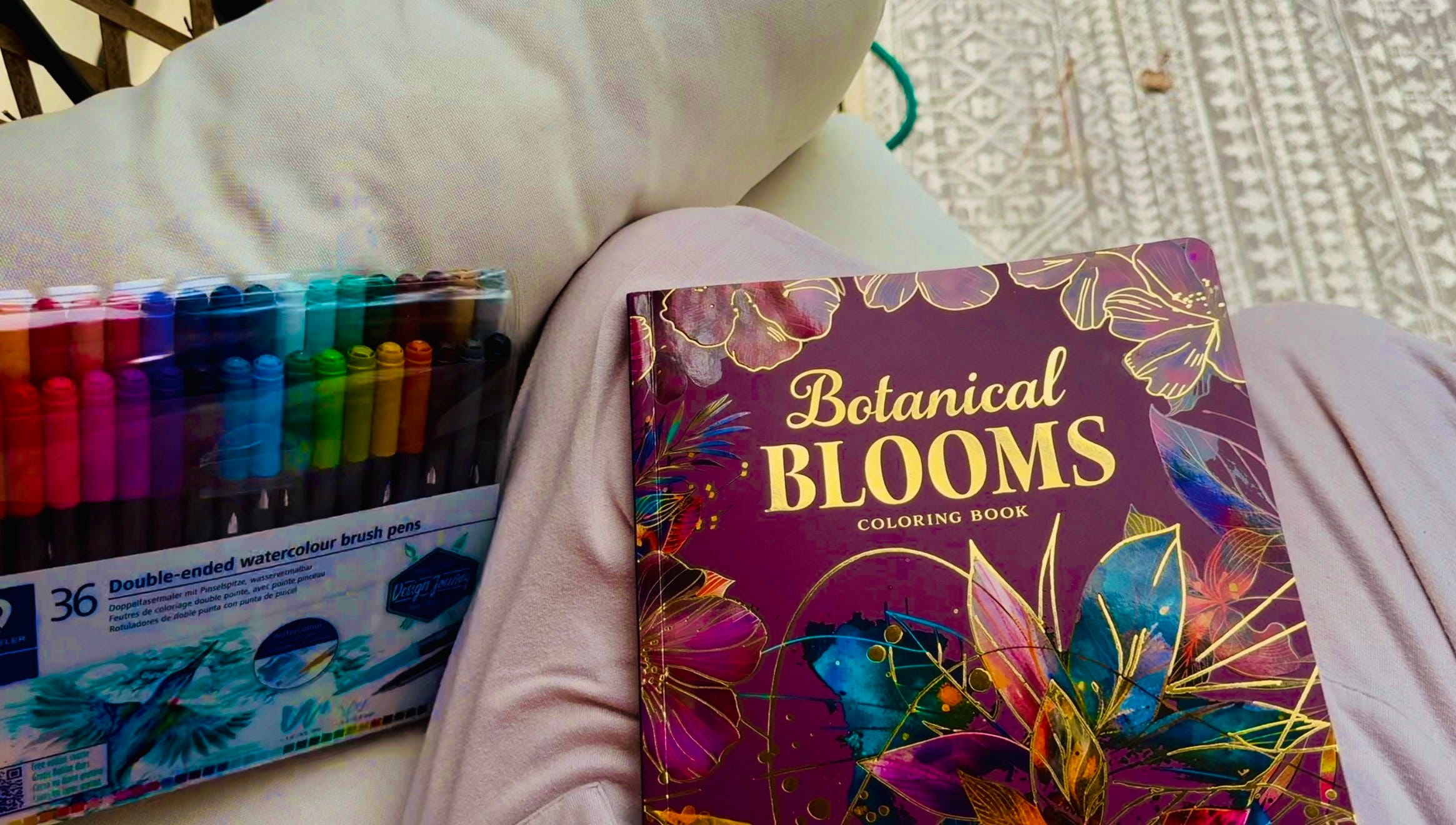
The only decision I have to make is which shade of pink I want to make this flower.
I’ve had some people point out that I’m still online, that I’m on Substack and have a YouTube channel, so who am I to talk about deleting social media?
Friends, we need to be able to allow for nuance.
YouTube is primarily a search engine. I get on it to learn something, watch something, understand something, and yes be entertained. Of course there’s YouTube Shorts (which I still don’t scroll for the very reason I deleted Instagram and TikTok), and yes, YouTube can absolutely become its own addiction. I’m not under any illusions. But the way I interact with it is fundamentally different from the way I interacted with Instagram. I’m creating there, not lurking or doomscrolling to fill a moment.
And then there’s Substack, which does have social elements — notifications, restacks, comments — and I can see how those could become their own dopamine loop if I let them. I’m watching that. But it also has something the other platforms never had for me: actual conversation and the ability to build community. Something we all could genuinely use more of. That feels worth building, not abandoning because it happens to have a notifications function (which I’ve also disabled so my phone isn’t pinging all the time).
What I’m describing isn’t getting rid of all technology. It’s becoming the person who is operating the technology with intention, not the other way around. We wouldn’t hand car keys to a six-year-old and ask them to go pick up a gallon of milk at the grocery store down the road. Operating heavy machinery requires maturity, training, an understanding of consequences, and constant vigilance of your surroundings. It requires mastery. But now everyone has a machine in their back pocket specifically engineered to keep us engaged past the point of our own wellbeing.
The results of that are showing and I refuse to be mastered like that.
I want to be honest with you about what this actually looks like on the other side of deleting it.
It’s not a finish line. There’s no moment where you think: I no longer have Instagram, so I’m good. The digital world is full of new traps, and some of them are perniciously subtle. The vigilance doesn’t end — it just gets quieter, more practiced, a little less exhausting because they now have become habits.
Will I mess up and find myself in another digital dopamine cycle? Maybe. I’m human. The point isn’t perfection. The point is taking radical responsibility for what goes into my own mind and what I do with the time I’ve been gifted by God — and choosing, again and again, to be someone who is present for her own life rather than a passive consumer of everyone else’s.
I do believe it’s possible to master our own domains because it’s what Jesus instructs us to do. So if He’s given us a command to steward our lives and our domains, then that means He’s also provided a way for us to actually do it. The capacity is already there. It just needs to be exercised with intention.
This world is going to keep pulling at us, dragging us down to the lowest common denominator. And as I’ve mentioned before, The Algorithm is always going to be optimizing for our worst impulses. That’s not changing.
But we don’t have to keep letting it win.
We can relearn to be still and know there’s a better way. I promise you, it’s worth it.
That’s what I’m going to dig into in upcoming issues: how we actually reclaim our attention, slow down, and build an unhurried life in the midst of a chaotic world hellbent on destroying the human soul.
If you’ve read this far, thank you. I’m so grateful for you. My prayer is that you come away encouraged, inspired, and a little more resolute in becoming more present and intentional with your own life. One day at a time.
Blessings on you,
Magin
No posts
Comments
Nothing yet. Say the first thing.
Sign in to join the conversation.