

My daughters and I decided to take a break from our quest to play through every mainline Pokemon RPG. We have now taken a detour to play every mainline Mario game instead, starting with the OG Super Mario Brothers. I did show them the 1985 original on the NES (well, the NSO NES app), but we opted to play the Super Mario All-Stars remakes on the SNES. That’s the version I grew up playing.

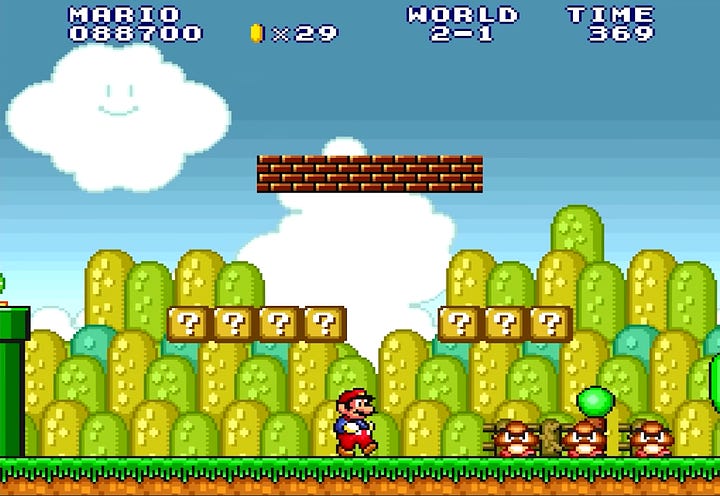
I’ll never forget the day my mom came home with a SNES and three games that were on clearance at KB Toys – Kirby Super Star, Donkey Kong Country 2, and Super Mario All-Stars. We didn’t have much money growing up, and as much as I loved video games, they were just too darn expensive in the 90s. This was such a very special moment that has been burned into my memory. To this day, these three titles remain some of my favorite games of all time.
At first, my daughters giggled at the primitive pixel graphics (they even said the SNES remake “looks funny”), but the gameplay hooked them in immediately. We opted for the time-tested “pass the controller” rule. If you lose a life, you pass the controller. They managed pretty well in the early levels, but the difficulty of the game eventually caught up to us. I am not too proud to brute force my way through tough levels using save states.
The genius of Super Mario Brothers has been acclaimed for decades. While it’s not the first seamless side-scrolling platformer (which is widely considered to be Jump Bug), SMB remains the undisputed grandfather of the genre. The game’s sheer level of excellence places it a notch above other platformers from the time. It’s easy to see right from the start why the Mario franchise reigns as the best selling video game franchise of all time. It’s incredible what Miyamoto and company were able to achieve in the early 80s with such limited tech.
Controlling Mario feels remarkably smooth, a showcase of masterful game design and programming. You can change Mario’s trajectory while in the air (aka “air control” or “aerial drift”), a feature seen only in a few early platformers before SMB which brought this level of control into the mainstream. The sidescrolling is also very smooth, a welcome change from the jarring screen transitions common in the early 80s (cough, cough, Pitfall!). Mario’s movement feels dynamic, an improvement on the NES’s Excitebike (released just one year prior, in 1984). Instead of the static motion and stiff modes of speed you’d expect to find, Mario has gradual acceleration, deceleration, and fairly convincing momentum-based sliding. Imagine the hype of running, ducking, and sliding under that waist high block in World 1-2 for the first time in 1985.
The early level design teaches you important lessons about the game without any hand-holding or invasive text. An observant gamer will see how World 1-1’s intentional design walks you through the basic mechanics of jumping, running, and conquering various enemies, one step at a time. Many classic Mario elements are first seen here in SMB – power-ups, coin collecting, rescuing Princess Peach, and discovering secret areas, warp zones, and secret blocks . We are also introduced to iconic Mushroom Kingdom enemies like Goombas, Bullet Bills, Bloopers, Cheep Cheeps, Hammer Bros, Paratroopas, Piranha Plants, Spinies, and Lakitu.
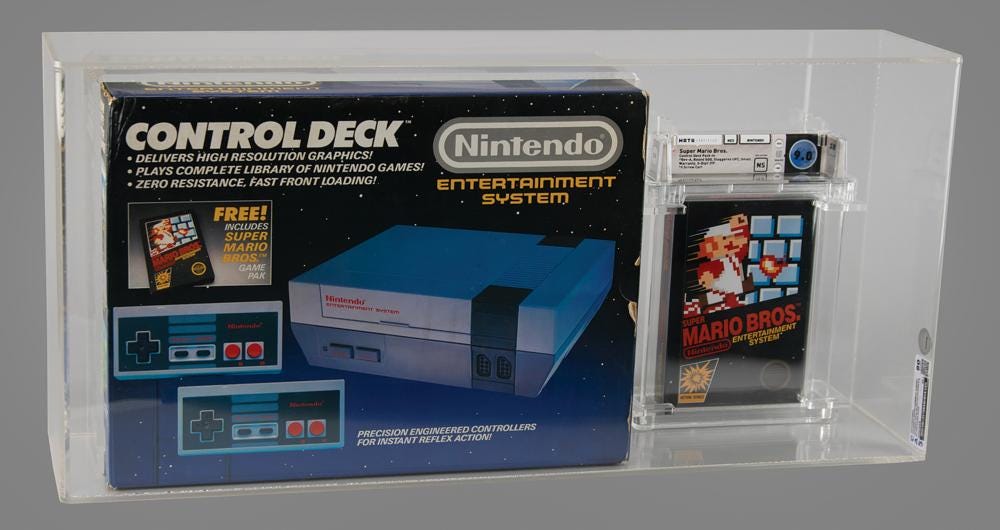
Super Mario Brothers was a breath of fresh air for the industry after the disastrous video game crash of 1983. SMB and the NES are often credited as a primary factor in restoring consumer trust. Nintendo’s reputation as a champion of quality continues to this day (in spite of a few slips here and there).
Of course, we can’t forget to mention the contributions of legendary composer, Koji Kondo. So many memorable themes from SMB have persisted as staple motifs in decades of Mario games, including “Overworld Theme,” “Underworld,” “Underwater,” “Castle,” and “Starman.” If I could only present one composer as a representative of the best of video game music from the 80s and 90s, I would pick Koji Kondo.
Some old games haven’t aged well. I was a bit worried about how my daughters would perceive SMB after playing newer games like Super Mario Odyssey. After the initial giggles wore off about how old the game looked, we started having fun right away. They loved the challenge, even though it quickly became too much for them. Each new milestone was celebrated. “I made it so much farther this time,” or “I beat a whole level by myself!” As a gaming dad, I was absolutely thrilled to see my girls genuinely enjoying this relic from 1985. Super Mario Brothers has aged like fine wine.
No posts
Comments
Nothing yet. Say the first thing.
Sign in to join the conversation.