
1
Steven Bellovin’s work in progress (full TOC below) is past the half way point and an interesting read. From the (presently) most recent post, about B-News:
People would have preferred a real ARPANET connection but that was rarely feasible and never something that a student could set up: ARPANET connections were restricted to places that had research contracts with DARPA. The gateway at Berkeley was, eventually, bidirectional for both Usenet and email; this enabled Usenet-style communication between the networks.
…
It is, in fact, unclear if the gateway was technically permissible.
With the growth in the number of sites came more newsgroups and more articles. This made the limitations of the A-news user interface painfully apparent. Mary designed a new scheme; a high school student, Matt Glickman, implemented what became B-news. There were many improvements.
The most important change was the ability to read articles by newsgroup, and to read them out of order. By contrast, A-news presented articles in order of arrival, and only stored the high-water mark of continuous articles read.
B-news also introduced control messages. As noted, these were unauthenticated; mischief could and did result.
There was also control message support for mapping the network, which did not work as well as we expected.
Here’s the projected TOC:
Here is the table of contents, actual and projected, for this series.
- The Early History of Usenet: Prologue
- The Technological Setting
- Hardware and Economics
- File Format
- Implementation and User Experience
- Authentication and Norms
- The Public Announcement
- Usenet Growth and B-news
- The Great Renaming
- Retrospective Thoughts
- Errata…
(You might remember him as the writer of Firewalls and Internet Security: Repelling the Wily Hacker)
2 Likes
EdS 2
Oh look some maps of the uucp/usenet connectivity:
Here is the backbone as of 1 April 1986:
                                                                      olduse.net
                                                                          |
                                                                  (wormhole to 2016)
                                                                          |
  cbosgd-----------------------------------clyde---------watmath--------utzoo
    |                                        |                            |
  ihnp4-------alberta------ubc-vision       burl                        linus
    | \                        |             |                            |
    | mgnetp                uw-beaver      ulysses--------------bellcore  |
    |                          |                                        \ |
    |                      tektronix-----------------------------------decvax
    |                          |                                        / |
  qantel---------------------\ | /---------oliveb-----glacier-----decwrl  |
    |                         \|/                                         |
    |  kddlab----------------hplabs-------sdcrdcf                         |
    |    |                     |             |                            |
    |    |                     |          sdcsvax                         |
    |    |  (see below)       hao            |                            |
    |    | /                   |          drillsys                        |
    |    |/                    |             |                            |
    |  mcvax-----------------seismo--------gatech----------akgua---------mcnc
    |                         /|\                                         |
 lll-lcc-----lll-crg---------/ | \---------cmcl2-----------------------philabs
                               |
                             munnari
This is the European backbone (mcvax feeds all of them):
       penet  enea   diku   unido           penet -> Finland
         |      \     |     /               enea -> Sweden
         |       \    |    /                diku -> Denmark
         |        \   |   /                 unido -> W. Germany
         |         \  |  /                  vmucnam -> France
vmucnam--+----------mcvax------cernvax      mcvax -> Netherlands
         |         /  |  \                  cernvax -> Switzerland
         |        /   |   \                 ukc -> Great Britain
         |       /    |    \                prlb2 -> Belgium
         |      /     |     \               i2unix -> Italy
       vmars  ukc    prlb2   i2unix         vmars -> Austria
1 Like
gp2000 3
Ah, ubc-vision. A VAX 11/780 running BSD if I remember correctly. Might have been a 750. As a system administrator in the University of British Columbia’s Computer Science department I had an account on it in its later days. Belonged to our AI research group.
1 Like
4
Here’s an article by Peter Salus (“Distributing the News UUCP to UUNET”):
If you were lucky enough to be on the ARPANET in the 1970s, you could get mail and news (in the form of a topical mailing list). But in January 1976 there were still only 63 hosts, and you had to be one of the elite to gain access. But soon there were methods to reach other sites. Like UNIX, the software began in New Jersey. Let’s look at the next dozen years.
And here’s a collection of maps of Usenet.
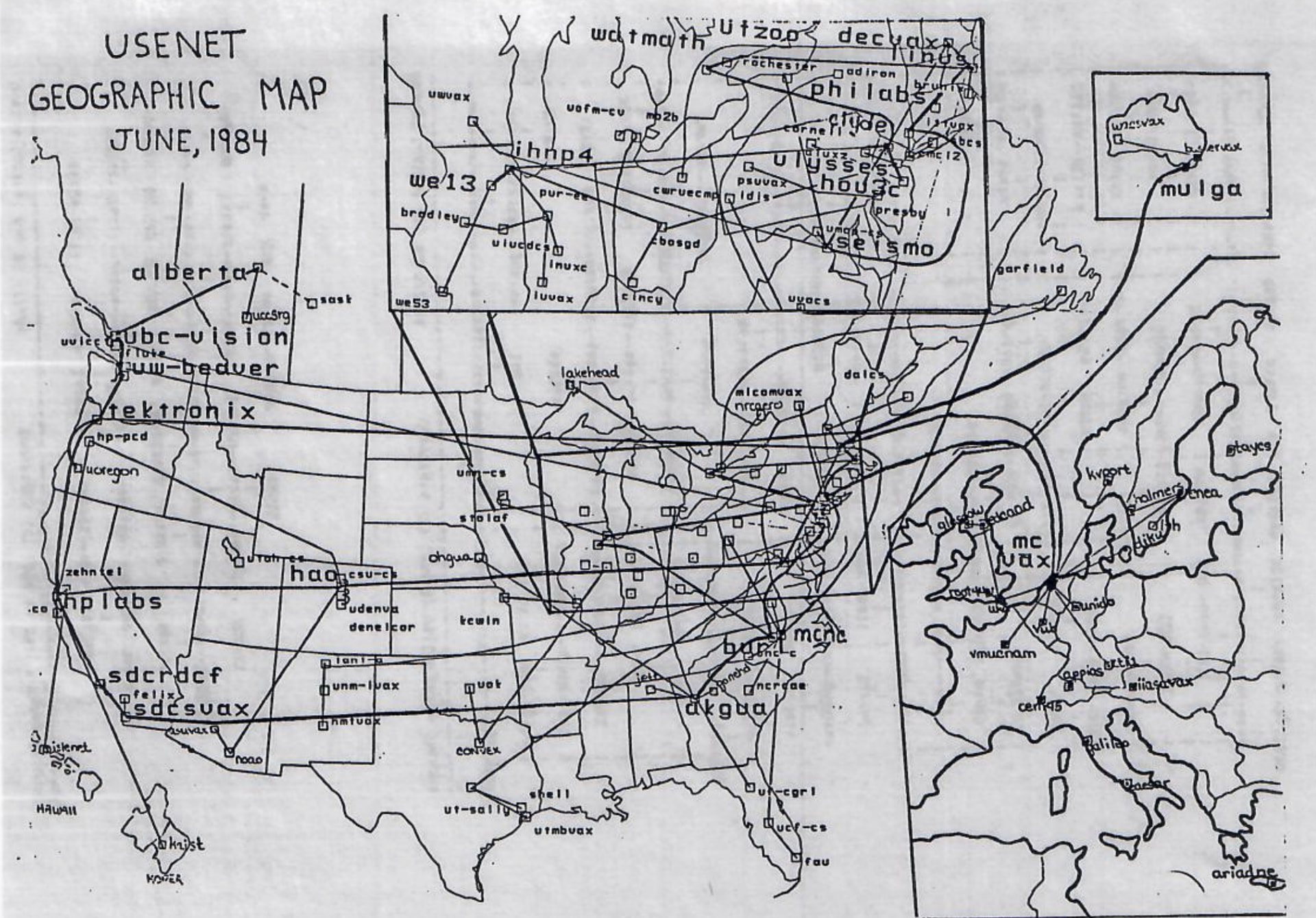
2 Likes
Comments
Nothing yet. Say the first thing.
Sign in to join the conversation.