
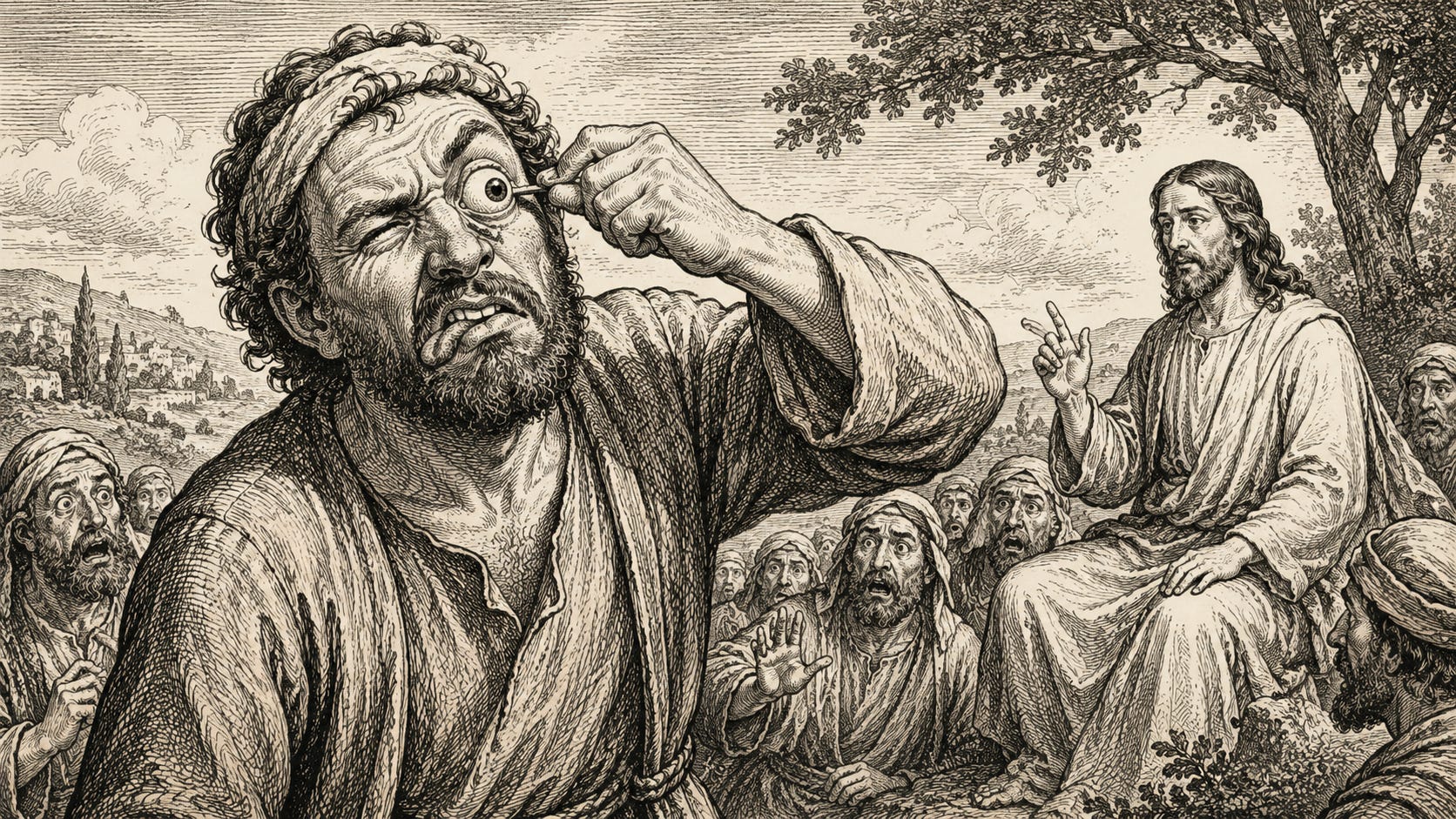
One of the hardest, most jarring things Jesus ever said comes right in the middle of his most famous sermon. Not buried in some obscure corner of the Old Testament… Right here, in the Sermon on the Mount, a few breaths after he calls his followers the light of the world, he says this:
“If your right eye causes you to stumble, gouge it out and throw it away. It is better for you to lose one part of your body than for your whole body to be thrown into hell” Matthew 5:29
And then, in case that wasn’t enough, he does it again with your hand. Cut it off. Throw it away.
Here’s something strange about that verse, and I want you to sit in it before you rush past it. There are people who have built their entire faith on taking the Bible as literally as a human being possibly can, every word, exactly as written, and even they have never done this.
Nobody’s walking around with a patch over one eye for the sake of holiness. From the most conservative literalist to the most casual skeptic, we’ve all landed in the same place: we don’t do that one literally.
And they’re right. But watch what happens next, because it happens to almost everyone. The second we agree it’s not literal, we relax. We file it under figure of speech and move on. And a verse Jesus clearly meant to hit us like a truck ends up feeling like a suggestion.
We didn’t take it too literally. We took it too lightly.
Preorder my new book, When Jesus Tells the Story. An invitation to stop settling for a smaller story and step into the story Jesus is telling. It may not be easy, but it will be worth living.
The mistake isn’t that people read this and go gouge out an eye. Almost nobody does. The mistake is the opposite, we hear how extreme it is, decide it can’t mean what it sounds like, and use that as permission to feel nothing.
And that’s the real problem, and it goes way past this one verse. We treat sin casually.
Think about how you’d respond to a cancer diagnosis. If a doctor sat you down and told you there was something growing inside you that would spread and kill you if it wasn’t dealt with, you would not just shrug it off. You wouldn’t say, “I’ll get to it.” You’d cancel your week. You’d do whatever the surgeon said, however drastic, because you understand exactly what’s at stake.
You do not negotiate with something that’s trying to kill you.
But that’s precisely how we treat sin. We manage it. We hide it. We make our peace with it and promise ourselves we’ll deal with it eventually. We treat the thing that is actually robbing us of the life God made us for like it’s a bad habit we’ll get around to someday.
The Bible does not talk about sin that way. James says desire “gives birth to sin; and sin, when it is full-grown, gives birth to death” (James 1:15). Paul says to “put to death whatever belongs to your earthly nature” (Colossians 3:5). That’s not the language of a bad habit. That’s the language of a tumor. It grows. It spreads. And left alone, it kills.
So when Jesus talks like a man telling you to lose a body part to save your life, he isn’t being dramatic. He’s being accurate. He would rather horrify you than watch you stay comfortable next to something that’s already eating you alive.
That’s what we miss. Not the meaning of the words, but the weight of them.
Now, once you feel the weight, the obvious move is to grab a knife and start cutting. And here’s where you have to slow down, because Jesus already told you where the real problem is, and it’s not your eye.
One verse earlier he said,
“anyone who looks at a woman lustfully has already committed adultery with her in his heart” Matthew 5:28
The heart. Not the eye. He’s talking about the look you choose, the one that lingers, that turns a person into something to have. An object for our own pleasure. Temptation showing up at your door is not the same as inviting it in and offering it a chair.
So Jesus locates the sin in the heart. And then he talks about the eye. And the hand.
Not because the eye doesn’t matter. It absolutely does, your eyes are the door your desires walk through, and what you do with your body shapes what your heart learns to love. But the eye is the access point, not the source.
Which means two things are true at the same time, and you have to hold both or you’ll fall into a ditch on one side or the other. Cut off the access; Jesus commands it, and he means it. And understand that cutting off the access will not, by itself, make you a new person. The knife can cut skin. It can’t cut wanting. A blind man still lusts. Memory doesn’t need an eyeball.
The phrase we read as “causes you to stumble” is skandalizei… It’s where we get our word scandal. But underneath, it’s trap language. It’s the bait on a snare, the stick that springs the whole thing shut the second the animal touches it. Your eye isn’t evil. But it can become the exact spot where temptation gets its grip on you. And the bait is personal, the thing that snares you isn’t the thing that snares the person sitting next to you in church.
Then notice which eye. Not your bad one. Your right one and in that world, the right side stood for strength, value, honor. Jesus doesn’t tell you to throw away something you won’t miss. He puts his finger on the thing you’d least want to lose. Because whatever’s trapping you usually isn’t obviously ugly. It’s something good. Something valuable. Something you’d be a little embarrassed to admit you’re not sure you could live without.
Which raises the question the whole passage has been driving toward. If the problem is that deep, deeper than any knife can reach, then who does the cutting?
The reality is, you are not the surgeon. You can’t be because you cannot reach the thing that’s actually killing you. You can try really hard, you will fully succeed. Only God can cut out the stuff that’s stuck down deep.
He doesn’t tell sinners to clean themselves up and come back presentable. He gives himself for them, and then he gives his Spirit to them, so the heart that produced the wanting can finally be remade. “Create in me a pure heart, O God” (Psalm 51:10)… That’s a prayer, not a project. You can’t manufacture it. You can only ask for it and receive it.
But don’t miss this part, because it’s the whole thing. The person who actually believes the diagnosis doesn’t sit in the waiting room doing nothing. He shows up to every appointment. He quits the thing the doctor told him to quit. He does everything within his reach, not because his effort cures the cancer, it can’t… But because a man who takes a deadly diagnosis seriously acts like it.
Paul puts both halves in a single breath:
“continue to work out your salvation with fear and trembling, for it is God who works in you” Philippians 2:12–13
So the amputation Jesus commands was never you performing surgery on your own soul. It’s you getting on the table. It’s you finally stopping the thing you keep doing and letting God do the rest.
There’s a story in Augustine’s Confessions about his friend Alypius, dragged by his buddies to the gladiator games; something he’d sworn he wanted no part of. So he went, and he sat there with his eyes squeezed shut, proud of himself, determined not to look. Then the crowd roared at a killing blow, and his eyes flew open on their own. One look, and the bloodlust had him.
Alypius didn’t lose because his willpower was too weak. He lost because he thought he could keep the arena as long as he refused the show. He negotiated about how close he was allowed to stand.
That’s the fight most of us are actually losing. Not the fight to resist in the moment, the fight to stop bargaining about proximity. So here’s what taking this seriously actually looks like on a normal week.
Start by naming your right eye. The real one, out loud, in specific words. Not “I struggle with lust” or “I have a phone thing.” The app. The account. The hour of the night. The friendship that isn’t a friendship. The show you only watch alone. Vague answers exist to protect you from the verse. If you can’t say it plainly to God, that silence is telling you something.
Then do one real amputation this week. Not an intention, an action. Delete it. Block it. End the thread. Hand someone else the password and don’t ask for it back. Get the phone out of the bedroom. Jesus meant the drastic part, and you don’t get to skip it just because you’ve learned the verse isn’t literal.
And to be clear, you’re not doing it to earn anything, you’re not paying God back, and cutting it off does not make him love you more. You’re doing it because being close to him is worth more than whatever keeps dragging you away.
Then stop negotiating about the arena. Ask yourself where you keep getting as close as you possibly can without technically crossing the line. That’s Alypius in the stands with his eyes shut. Leave the building.
Then bring somebody in. Say the true thing out loud to a real person who won’t be shocked by it. “Confess your sins to each other and pray for each other so that you may be healed” (James 5:16). Nothing on this list is harder, and nothing on it does more. Sin that stays in the dark keeps every ounce of its power.
And when you’ve done all of it and the wanting is still there, and it will be, don’t read that as failure. That’s the verse doing exactly what it told you it would do. That’s the moment you stop trying to be your own surgeon and finally ask God to reach what your hands never could. Ask him what the thing was promising you. Comfort. Escape. To be wanted. To matter. And then bring that to him, because that’s what he was after the whole time.
You already know what needs to go. That was never really the question. The question is whether you’ll keep trying to fix with a knife what only grace was ever going to reach.
Paid subscribers get every post I publish—no waiting, no missed weeks, and full access to everything I’m writing. If you find this work helpful and want to keep going deeper, it’s $8/month, or sign up annually and get 3 months free.
If this was helpful, pass it along to someone who might need it.
Preorder my new book, When Jesus Tells the Story. An invitation to stop settling for a smaller story and step into the story Jesus is telling. It may not be easy, but it will be worth living.
No posts
Comments
Nothing yet. Say the first thing.
Sign in to join the conversation.